Double Decker Living Root Bridge Trek: Nongriat & Rainbow Falls
Complete guide to the Nongriat Double Decker Living Root Bridge trek: 3,500 stairs from Tyrna, Rainbow Falls extension, village homestays, and tips.
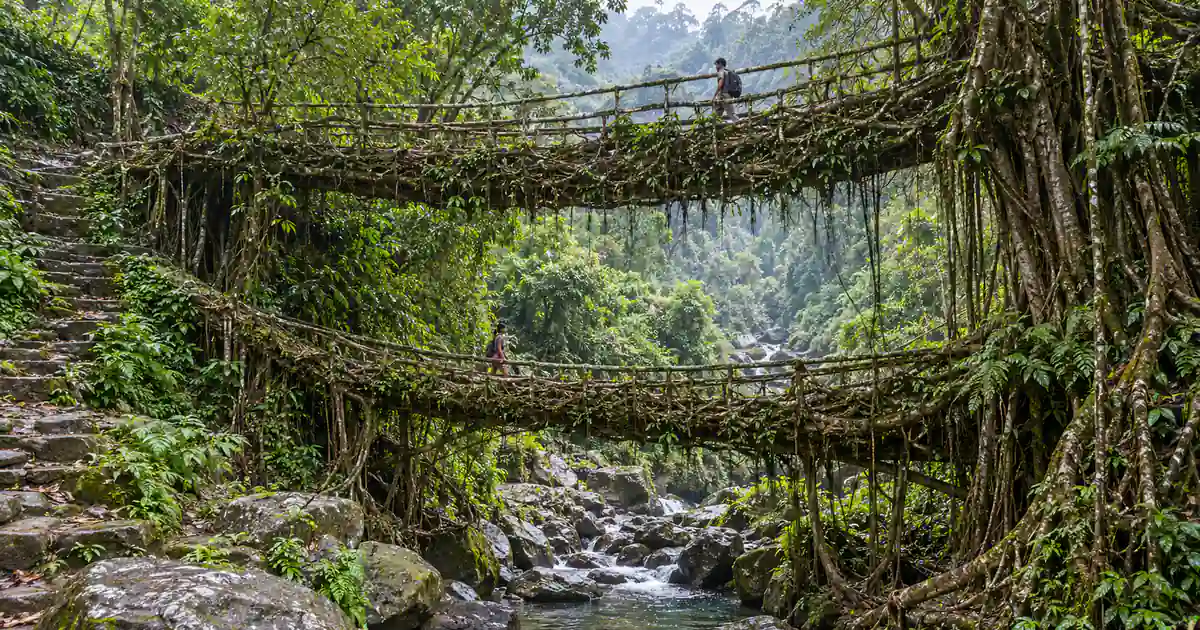
The Umshiang Double Decker Living Root Bridge spans a crystal-clear mountain river in the secluded village of Nongriat, tucked deep within a subtropical gorge 20 kilometers south of Cherrapunji in Meghalaya. This comprehensive trekker guide provides verified trail statistics, stairway elevation profiles, Rainbow Falls route extensions, village homestay guidance, and physical preparation advice for undertaking one of the world’s most unique foot journeys.
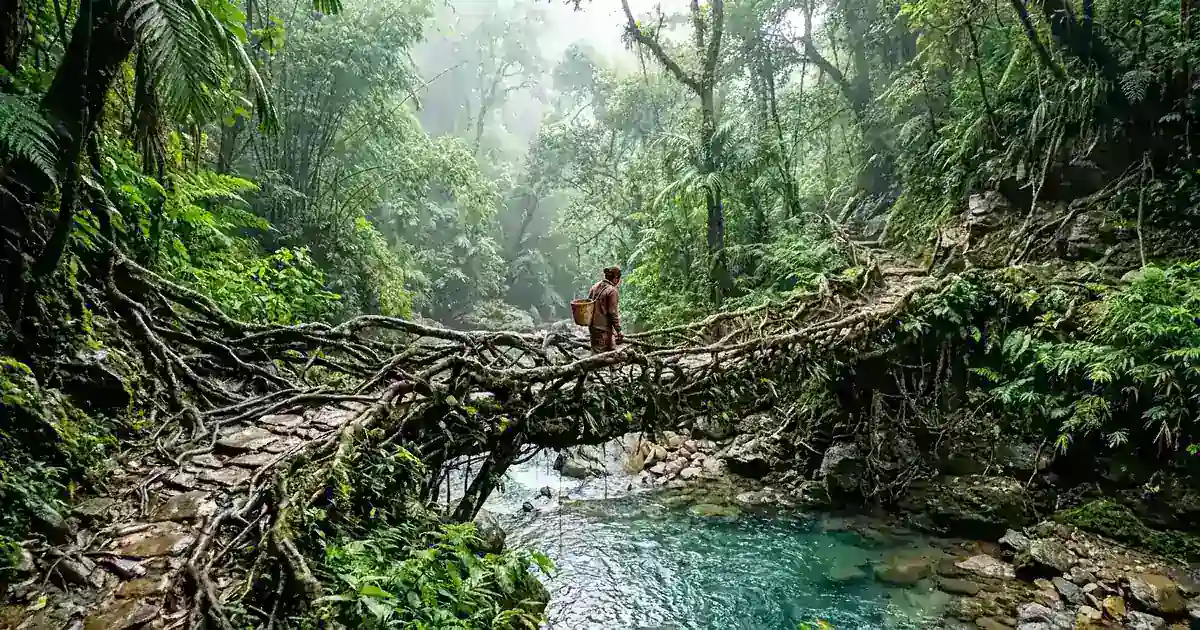
Unlike conventional suspension crossings constructed from steel cables or timber trusses, the bridges of Nongriat are living botanical organisms crafted through centuries of Khasi indigenous engineering. Guided across raging monsoon streams by ancestral clan elders, the aerial roots of living rubber fig trees have grown into a multi-tiered walkway that thrives in the wettest rainforest climate on earth.
Trek Logistics & Route Essentials
- The trail starts at Tyrna village roadhead, descending approximately 3,500 concrete and stone stairs into a 750-meter-deep subtropical river canyon.
- The round-trip trek to the Double Decker Root Bridge spans 7 kilometers, requiring 2 to 2.5 hours of downhill hiking and 3 to 4 hours of steep uphill return.
- A community conservation entry fee of ₹50 per visitor is collected at the entrance to Nongriat village to support trail and suspension bridge maintenance.
- Hikers continuing 90 minutes past the root bridge can reach the turquoise plunge pool of Rainbow Falls, named for persistent water droplets refracting sunlight.
Travelers organizing regional hiking circuits regularly pair this wilderness trek with broader itineraries featured in our complete Meghalaya visitor overview.
Trail Architecture: The 3,500-Step Descent from Tyrna
The trek begins at the village of Tyrna, situated at an altitude of approximately 1,000 meters above sea level and reached via a 45-minute taxi ride from central Cherrapunji. From the parking lot, the trail drops precipitously down the southern face of the Khasi plateau into the Umshiang river basin.
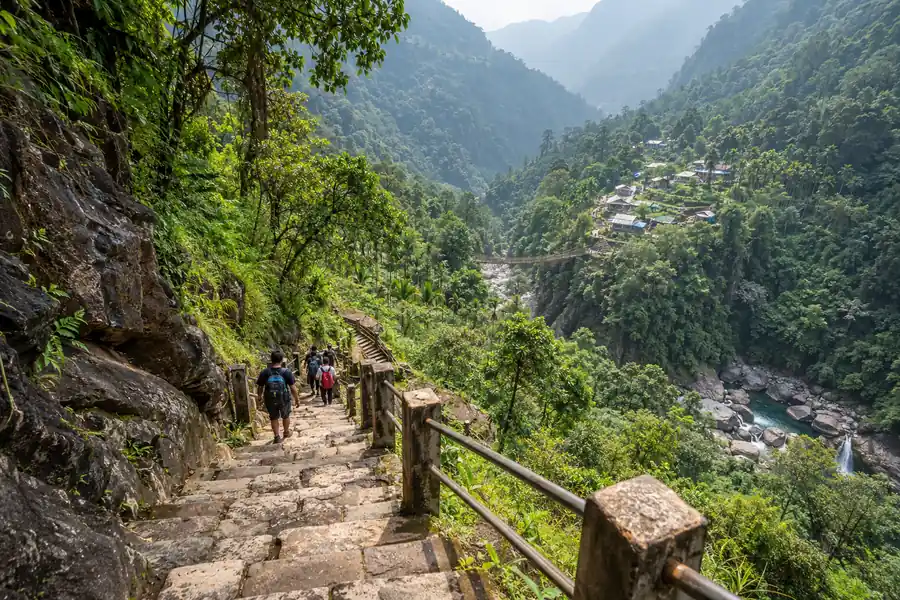
The trail consists of steep concrete and stone steps maintained by local community councils. Hikers pass through terraced groves of betel nut palms, wild pineapple bushes, and bay leaf trees before reaching the lower village of Nonghim.
Along the descent, hikers cross two narrow suspension bridges constructed from steel wire cables that swing high above roaring mountain boulder beds. Crossing these bridges one at a time is mandatory to limit lateral sway across deep river chasms.
The table below breaks down the primary trail stages and milestones between Tyrna and the double-decker crossing:
| Trail Section | Distance & Elevation | Typical Duration | Key Landmarks & Physical Demand |
|---|---|---|---|
| Tyrna to Nonghim Village | 1.2 km / 350 m descent | 45 to 60 Minutes | Steep downhill concrete stairs; bamboo walking stick rentals available |
| Nonghim to Steel Wire Bridges | 1.0 km / 250 m descent | 30 to 45 Minutes | First single-tier living root bridge; two high-clearance cable bridges |
| River Bridges to Nongriat Village | 1.3 km / 150 m descent | 30 to 45 Minutes | Community entry kiosk, betel nut plantations, village church |
| Nongriat to Double Decker Bridge | 200 meters / Flat | 5 Minutes | Umshiang riverbed, two-tier living root structure, natural fish pools |
| Optional Rainbow Falls Extension | 2.0 km / 250 m ascent | 60 to 90 Minutes | Unpaved dirt path, river boulder crossings, turquoise waterfall lagoon |
Renting an inexpensive bamboo trekking pole (₹20) at the Tyrna trailhead is strongly recommended to reduce knee strain during the relentless 3,500-step downward plunge.
Living Bio-Engineering: How the Root Bridges Are Grown
The living root bridges of the Khasi Hills (Jingkieng Jri) represent centuries of collaborative ingenuity between indigenous communities and their rainforest ecosystem. The primary tree species utilized is the Ficus elastica (Indian rubber fig), known locally as Tiew Jri, which naturally anchors onto steep sandstone crags along riverbanks.
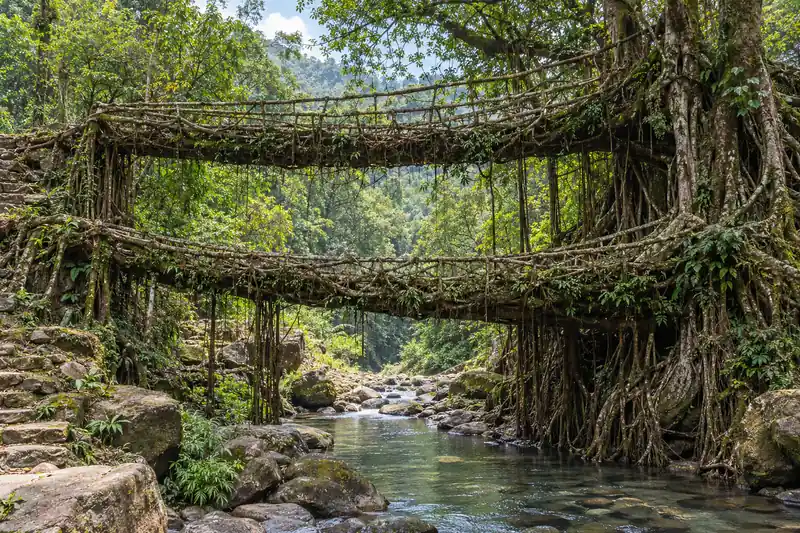
To bridge a river, ancestral villagers plant young ficus saplings along opposite banks. As the tree matures, aerial feeder roots emerging from the upper trunk are threaded through hollowed betel nut (Areca catechu) trunks that span the stream. The betel nut casings provide directional scaffolding, preventing roots from wandering while protecting them from insect attack and flash floods.
Over 15 to 25 years, the roots reach the opposite shore, penetrating deep into the rocky bank soil. As villagers weave lateral secondary roots into the primary strands, the structure undergoes natural inosculation, fusing individual roots into a singular living beam.
The Umshiang bridge is particularly rare because it features two stacked tiers. When severe monsoon floods submerged the original lower bridge, villagers guided a second series of roots along higher branches to create an upper deck that remains safe during high water. Official cultural nomination dossiers are cataloged under the UNESCO World Heritage Tentative List Jingkieng Jri.
Extending the Hike: Rainbow Falls Wilderness Trail
Many travelers who reach Nongriat choose to push deeper into the forest to visit Rainbow Falls, located approximately two kilometers upstream along the Umshiang River. Unlike the paved stairs between Tyrna and Nongriat, this extension follows a rugged dirt footpath across boulder fields, small root bridges, and natural riverbed streams.
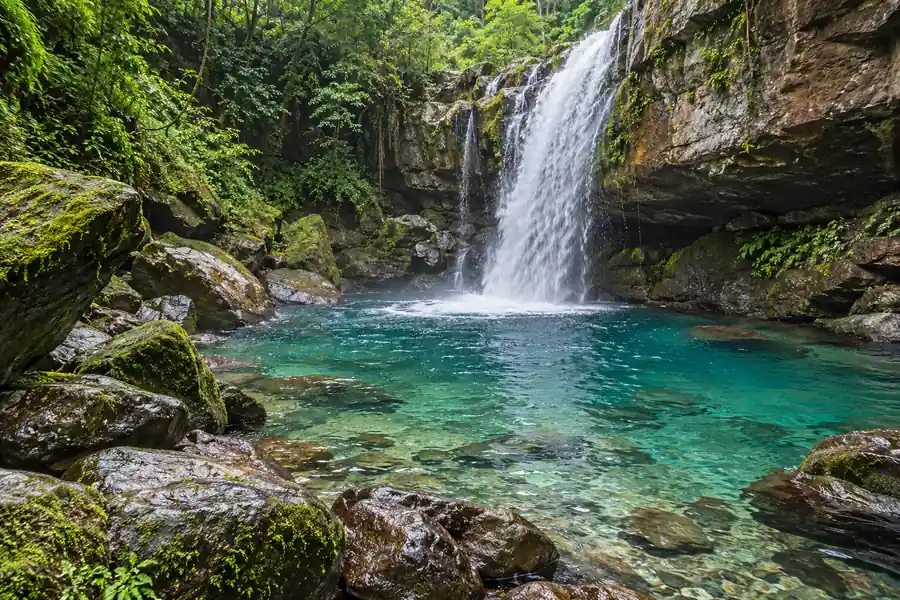
The trail ascends through dense tropical jungle for 60 to 90 minutes. Upon rounding the final canyon bend, hikers are greeted by a massive wall of white water thundering over dark basalt cliffs into an extraordinarily clear turquoise lagoon.
Between 1:00 PM and 3:30 PM on sunny afternoons, the mist spray creates continuous, brilliant rainbows across the gorge, giving the waterfall its name. Swimming in the outer shallows is refreshing after the humid forest hike, though swimming near the central churning plunge pool is dangerous due to powerful underwater undertows.
Additional regional nature excursions are detailed in our visitor guide to the Cherrapunji sightseeing guide.
Homestays, Village Amenities, and Overnight Stays
While strong hikers occasionally complete the round-trip trek to Nongriat and Rainbow Falls in a single exhausting 7-to-8-hour day, staying overnight in Nongriat village is recommended. An overnight stay allows travelers to experience the root bridges in peaceful early morning light before day-trippers arrive from Cherrapunji.
Nongriat contains several simple family-run homestays, including Byrnihat Homestay, Little Chef Homestay, and community guest cottages:
- Accommodation Standards: Rooms are basic and clean, providing wooden beds with mosquito nets, clean cotton blankets, and shared bucket-bath facilities with cold mountain water (hot water buckets available on request for ₹50).
- Pricing: Nightly room rates range between ₹600 and ₹1,200 for double rooms, or ₹300 per bed in dormitory quarters.
- Dining: Homestay hosts prepare fresh communal dinners consisting of rice, dal, scrambled eggs, local organic vegetables, and chicken or pork curry (₹150 to ₹250 per plate).
Local environmental committees require visitors to pack out all plastic waste. Purified natural spring drinking water is available across the village to minimize single-use plastic bottles. Official community eco-tourism guidelines are published on the Meghalaya Tourism Living Root Bridges Guide.
Recovery and Conquering the 3,500-Step Climb Back
The return journey from Nongriat back up to Tyrna represents the most physically demanding segment of the excursion, requiring a continuous 750-meter vertical ascent across 3,500 steep stairs.
Hikers should begin their ascent early in the morning by 6:30 AM or 7:00 AM before the sun heats the exposed canyon walls. Pacing oneself with rhythmic breathing, taking short 30-second breathers every 200 steps, and sipping electrolyte water prevents leg cramping.
Travelers wishing to relax sore muscles after completing the climb frequently travel south to enjoy quiet boat rides along the crystalline waters described in our guide to Dawki river boating and Mawlynnong village. Further district travel support is provided by the East Khasi Hills District Tourism Portal.
Frequently Asked Questions About the Nongriat Root Bridge Trek
How difficult is the trek to the Double Decker Living Root Bridge?
The trek is moderately strenuous, requiring good cardiovascular fitness and strong knees. Descending and ascending approximately 3,500 steep concrete stairs places significant strain on joints, making trekking poles and proper hydration essential.
Can travelers hire porters or local guides at Tyrna?
Yes, local Khasi guides and porters are available for hire at the Tyrna parking lot for ₹700 to ₹1,000 per day. While the trail to Nongriat is clearly paved and easy to navigate independently, hiring a local guide supports the village economy and is helpful for navigating the rugged trail to Rainbow Falls.
Are there mobile network signals in Nongriat village?
Mobile network coverage inside the deep Nongriat river gorge is very weak and intermittent. BSNL and Jio provide occasional voice connectivity near open clearings, while Airtel rarely catches signal; travelers should complete urgent communications before descending from Tyrna.
What should hikers pack for an overnight stay in Nongriat?
Hikers should carry a lightweight backpack containing a change of quick-dry clothing, cotton socks, swimwear, a microfibre towel, basic first-aid supplies with muscle rub, a headlamp, cash for homestays, and a reusable water bottle. Heavy luggage should be left at hotels in Cherrapunji or in vehicle trunks at Tyrna.