Rani ki Vav Patan: Timings, Ticket Price & Stepwell Guide
Plan your visit to Rani ki Vav in Patan with timings, ticket prices, 7-level architecture, 500+ sculptures, 100 rupee note history, and a 1-day itinerary.
Rani ki Vav Quick Visitor Essentials
- Global Distinction: Inscribed as a UNESCO World Heritage Site in 2014; recognized as the finest example of subterranean water architecture in India.
- Currency Feature: Depicted on the reverse of the lavender Reserve Bank of India ₹100 banknote (Mahatma Gandhi New Series).
- Visiting Hours: 8:00 AM to 6:00 PM daily. The evening 3D projection mapping and heritage lighting show begins after sunset around 7:30 PM.
- Entry Tariffs: ₹40 for Indian citizens and SAARC/BIMSTEC visitors; ₹600 for foreign passport holders; free entry for children under 15 years.
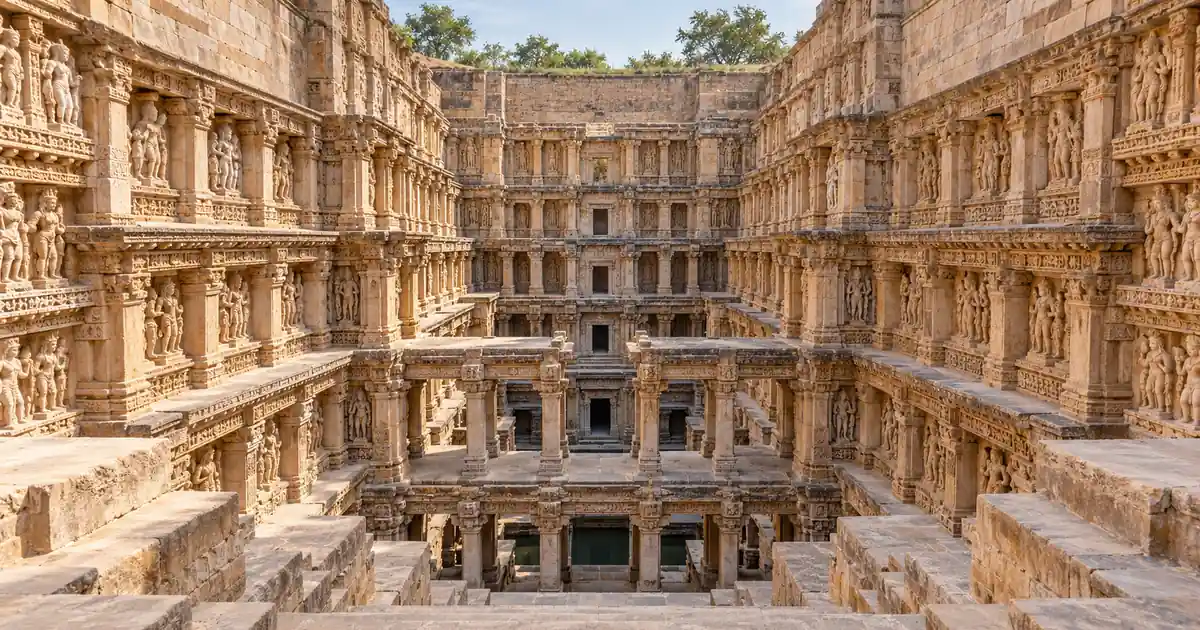
- Architecture & Scale: Stepped east-to-west corridor measuring 65 meters long, 20 meters wide, and 28 meters deep across seven subterranean storeys.
- Sculpture Wealth: Houses over 500 principal carved sandstone sculptures and more than 1,000 secondary relief panels honoring Lord Vishnu and avatars.
- Location & Connectivity: Located in Patan in northern Gujarat, approximately 125 kilometers north of Ahmedabad (3 to 3.5 hours by road via State Highway 41).
Rani ki Vav, known in English as the Queen’s Stepwell, stands as one of the most astonishing architectural achievements of medieval India. Situated on the outskirts of historic Patan along the banks of the ancient Saraswati River, this subterranean monument descends seven storeys into the earth.
Unlike traditional Hindu temples that rise toward the open sky, Rani ki Vav inverts sacred geometry. Builders excavated deep underground to construct a sanctuary where water is venerated as life itself.
The monument features over five hundred principal classical sculptures and more than one thousand secondary figurative reliefs. Exquisite carvings of Lord Vishnu in his Dashavatara incarnations, celestial apsaras adorning themselves, and guardian deities cover every available inch of the stone corridors.
Preserved for over seven hundred years beneath protective layers of river silt, the stepwell emerged into modern view in remarkable condition following careful excavations by the Archaeological Survey of India. Today, travelers from across the globe visit Patan to marvel at this underground masterwork.
The following sections provide practical details on visiting hours, ticket prices, architectural design, sculptural iconography, and an optimized one-day excursion from Ahmedabad paired with the Sun Temple at Modhera.
Historical Origins: Queen Udayamati and the Chaulukya Dynasty
Rani ki Vav was commissioned in 1063 CE by Queen Udayamati as an enduring memorial to her deceased husband, King Bhimdev I of the Chaulukya (Solanki) Dynasty.
The Chaulukya kings ruled western India from their grand capital of Anhilwad Patan between the tenth and late thirteenth centuries. This era is widely recognized by architectural historians as the golden age of Gujarati art and culture, marked by immense prosperity from maritime trade routes across the Arabian Sea.
King Bhimdev I is remembered in regional chronicles as a courageous sovereign who rebuilt the sacred temple at Somnath after foreign military raids. Following his death in 1063 CE, Queen Udayamati chose to honor his memory not with a vanity mausoleum, but with a public civic sanctuary that served the physical and spiritual needs of travelers and locals.
In the arid plains of northern Gujarat, where erratic monsoons frequently produced severe seasonal drought, stepwells (vavs) served as critical communal infrastructures. They provided reliable drinking water, cool resting chambers for trading caravans, and consecrated spaces for social and religious gatherings.
Official administrative profiles published by the District Administration Patan Official Portal document that Queen Udayamati’s devotion turned a functional hydraulic well into a majestic underground cathedral, celebrated across classical Sanskrit literature such as Merutunga’s Prabandha Chintamani.
Subterranean Architecture: The Seven Pillared Levels and Inverted Temple Design
The structural design of Rani ki Vav exemplifies the pinnacle of the Maru-Gurjara style, a distinctive North Indian architectural tradition developed under the Chaulukya kings.
The entire complex measures approximately 65 meters in length, 20 meters in width, and plunges 28 meters straight down into the sandy soil. The stepwell is oriented along an east-to-west axis, aligning visitors with the path of the sun.
Architectural highlights of the seven subterranean storeys include:
- The Stepped Approach Corridor: Visitors enter from ground level at the eastern end, walking downward along open stone terraces flanked by ornamental side walls. Broad flights of stone steps alternate with level pillared platforms (kutas).
- The Multi-Storeyed Pavilion Stages: As you descend, the monument opens into four major pavilion towers. Each pavilion features multiple levels of carved columns, bracket capitals, and cross-beams that brace the massive lateral pressure of the surrounding earth.
- The Deep Stepped Well Shaft: At the far western end sits the circular well shaft, measuring ten meters in diameter. Elaborate projecting galleries surround the shaft, allowing visitors on lower levels to look directly down at the groundwater pool.
- Inverted Sacred Geometry: Stepwells are designed as inverted temples. Instead of ascending steps toward a towering shikhara (spire), pilgrims descend downward through progressively cooler, dimmer subterranean halls toward the sacred water reservoir at the bottom.
Architects incorporated sophisticated cantilever engineering. Heavy sandstone lintels distribute earth pressure outward, allowing the monument to withstand high seismic activity across the Gujarat alluvial basin for nearly a millennium.
Travelers studying western Indian temple craftsmanship can compare this underground stone engineering with coastal monument layouts detailed in our guide to Somnath Temple history and darshan timings. The Solanki monarchs applied identical structural principles to both coastal spires and subterranean stepwells.
| Architectural Feature | Measurement / Detail | Primary Engineering Function |
|---|---|---|
| Overall Length | 65 meters (213 feet) | East-to-west linear procession toward the water shaft |
| Maximum Width | 20 meters (66 feet) | Allows natural daylight to illuminate lower pillared storeys |
| Total Depth | 28 meters (92 feet) | Reaches deep perennial groundwater tables beneath Patan |
| Subterranean Storeys | 7 distinct levels | Stepped tiers that support soil walls and provide resting bays |
| Well Shaft Diameter | 10 meters (33 feet) | Circular reservoir for municipal drinking and ritual snan |
| Stone Material | Hard buff sandstone | Fine-grained regional stone capable of microscopic relief carving |
Sculptural Masterpieces: The Dashavataras, Sheshashayi Vishnu, and Celestial Apsaras
What distinguishes Rani ki Vav among stepwells in the Indian subcontinent is the extraordinary density and artistic perfection of its sculptural ornamentation.
More than five hundred major stone sculptures occupy ornamental niches along the subterranean gallery walls. Over one thousand secondary figures, including floral friezes, geometric borders, and mythical aquatic beasts (makaras), fill every structural joint.
The predominant religious theme honors Lord Vishnu, the preserver of the universe, whose association with primordial cosmic waters (Kshira Sagara) makes him the natural deity of a stepwell sanctuary.
Key sculptural cycles include:
1. The Dashavatara Gallery (Ten Avatars of Vishnu)
Carved panels on the third, fourth, and fifth levels depict the avatars of Vishnu with remarkable iconographic detail:
- Varaha: The boar incarnation, shown with muscular shoulders lifting the diminutive Earth goddess Bhudevi safely from the cosmic ocean atop his curved tusk.
- Narasimha: The half-man, half-lion incarnation, dramatically depicted disemboweling the demon king Hiranyakashipu across his knee at twilight on a palace threshold.
- Vamana: The dwarf Brahmin avatar holding a small wooden parasol and water pot, depicted stepping across the cosmos to humble King Bali.
- Rama and Krishna: Panels capturing epic heroism, with Rama holding his legendary Kodanda bow and Krishna vanquishing demonic serpents.
- Kalki: The prophesied future warrior avatar riding a winged white stallion, brandishing a drawn sword to cleanse cosmic corruption.
2. Sheshashayi Vishnu (Reclining on the Cosmic Serpent)
Directly inside the deep well shaft, sculptors carved colossal high-relief panels of Sheshashayi Vishnu.
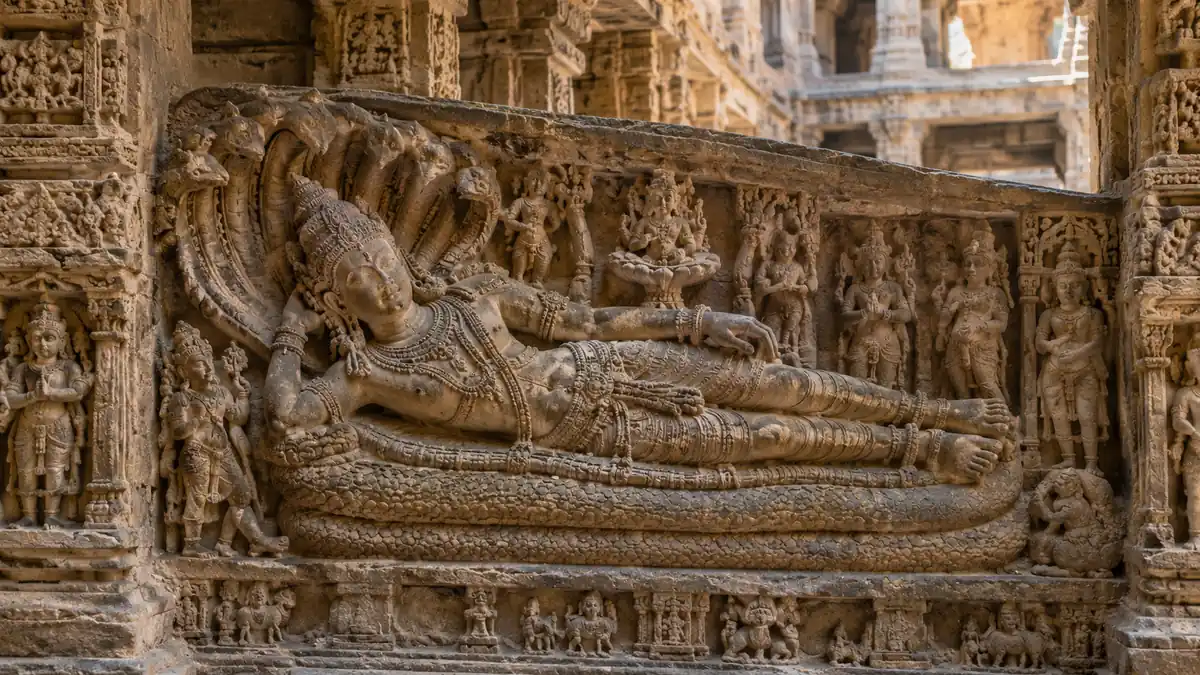
The Lord rests in deep cosmic sleep upon the coiled body of the multi-hooded serpent Sheshanaga, floating on the milk ocean between cycles of creation. Viewing this tranquil deity descending into the dim coolness of the well shaft provides an unforgettable spiritual impression.
3. Apsaras and the Solah Shringar (Sixteen Adornments)
Flanking the divine avatars are dozens of slender, life-sized celestial dancers (apsaras) and maiden spirits (nagkanyas).
Each apsara is captured in naturalistic poses demonstrating the traditional Solah Shringar (sixteen classic beauty rituals): combing wet hair after a bath, applying vermilion powder to hair partings, putting on ankle bells, gazing into polished hand mirrors, and gently plucking thorns from their heels. The sensuous draping of transparent stone garments and delicate jewelry reflects the absolute pinnacle of medieval Indian sculpture.
Official cultural inventories compiled by the District Administration Patan Culture & Heritage Department highlight these stone figures as essential primary records of eleventh-century Solanki dress, court jewelry, and cosmetic traditions.
The 100 Rupee Note Feature and Saraswati River Silt Preservation
In July 2018, the Reserve Bank of India introduced a brand-new banknote design that thrust Rani ki Vav into the hands of hundreds of millions of people daily.
As part of the Mahatma Gandhi New Series of currency notes, the RBI selected Rani ki Vav as the definitive national motif printed across the reverse side of the lavender ₹100 banknote. The currency illustration displays the dramatic perspective view looking downward through the multi-tiered carved pavilions toward the subterranean well.
The remarkable physical condition of Rani ki Vav is due to a dramatic historical accident:
- The Saraswati River Inundation: In the thirteenth century, shifting river courses and major monsoon flooding caused the nearby Saraswati River to overflow its banks. Massive currents carried millions of tons of fine silt, completely submerging the stepwell.
- Natural Soil Encapsulation: Unlike surface temples that suffered weathering, earthquakes, and military iconoclasm during medieval political upheavals, Rani ki Vav remained buried underground under twenty meters of wet sand for over seven centuries.
- Systematic Excavation by the ASI: In the late 1980s, the Archaeological Survey of India launched an extensive archaeological excavation project. Teams carefully hauled away hundreds of thousands of cubic meters of silt, revealing undamaged stone pillars, sharp tool marks, and intact statue galleries.
- UNESCO Inscription: In June 2014, UNESCO designated Rani ki Vav as a World Heritage Site, praising it as an exceptional example of subterranean human craftsmanship and innovative water management.
Today, visitors can stand on the upper grass lawn and compare an actual ₹100 note with the real-life stone terraces descending below.
Travelers exploring heritage landmarks across western India can review similar architectural treasures in our curated directory of best places to visit in India for culture and heritage.
Visiting Logistics: Timings, Ticket Prices, and 3D Projection Mapping
Planning a visit to Rani ki Vav requires understanding gate timings, ticketing protocols, and evening lighting options.
The monument is managed directly by the Archaeological Survey of India (ASI) and remains open every day of the week, including national holidays.
Comprehensive visitor rules outlined by Gujarat Tourism specify operating details:
- Daytime Visiting Hours: 8:00 AM to 6:00 PM daily. The ticket counter closes thirty minutes prior to dusk.
- Entry Tariffs:
- Indian Citizens & SAARC / BIMSTEC Visitors: ₹40 per person.
- Foreign Passport Holders: ₹600 per person.
- Children (Under 15 Years): Free admission upon showing proof of age.
- Online Ticketing: Tickets can be booked in advance via the ASI official ticketing portal using digital UPI or credit cards. QR code scanning counters at the main entrance gate allow quick entry without waiting in long ticket queues.
- Evening 3D Projection Mapping Show: Gujarat Tourism has installed a high-definition 3D projection mapping installation across the stepwell walls. Held every evening starting around 7:30 PM, this twenty-minute multimedia show illuminates the stone carvings with colorful projections, narrating the history of Queen Udayamati and the Solanki Dynasty. Admission to the evening light show is free for all visitors.
Pilgrims combining northern Gujarat heritage stepwells with coastal Saurashtra temple stops often review Nageshwar Jyotirlinga timings and Dwarka road distance before heading west.
Photography Advice for Visitors:
- The best daylight hours for photography inside the stepwell are between 9:00 AM and 11:30 AM, when angled morning sunlight penetrates deeply into the northern and eastern wall niches.
- By mid-afternoon, shadows cast by upper pavilion beams obscure lower relief panels.
- Tripods, monopods, and commercial videography equipment require prior written permission from the ASI office; handheld DSLR cameras and smartphones are freely permitted for personal travel photography.
| Visitor Category | Entry Fee (INR) | Payment Options | Verification Required |
|---|---|---|---|
| Indian Nationals | ₹40 per adult | Cash counter or online ASI portal / UPI | Government photo ID (Aadhaar / Voter ID) |
| SAARC / BIMSTEC Visitors | ₹40 per adult | Cash counter or online ASI portal | Valid national passport |
| International Tourists | ₹600 per adult | International credit card or counter cash | Valid passport with Indian tourist visa |
| Children under 15 | Free admission | Entry via accompanying adult | School ID or birth certificate copy |
| Evening 3D Light Show | Free admission | Open public lawn seating | No ticket needed for evening show |
Curated 1-Day Heritage Circuit: Rani ki Vav, Modhera Sun Temple, and Patola Weaving
A trip to Rani ki Vav connects naturally into an unforgettable full-day northern Gujarat road trip starting and ending in Ahmedabad.
By combining the underground stepwell with the 11th-century Sun Temple at Modhera and traditional Patola double-ikat silk workshops in Patan, travelers experience the three greatest cultural landmarks of the Solanki heritage corridor in twelve hours.
Curated Step-by-Step 1-Day Itinerary:
Morning: Ahmedabad Departure to the Sun Temple at Modhera (07:00 - 10:30)
- 7:00 AM: Depart Ahmedabad early via the Ahmedabad-Mehsana highway (State Highway 41). Enjoy a traditional Gujarati breakfast of piping-hot fafda, jalebi, and spiced masala chai at a highway stop.
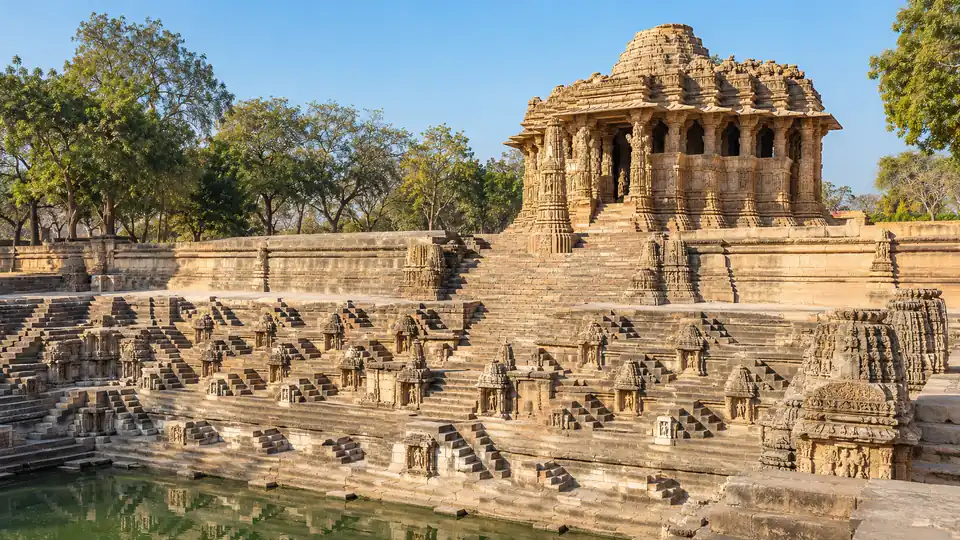
- 9:00 AM to 10:30 AM: Arrive at the Sun Temple at Modhera, situated 100 kilometers northwest of Ahmedabad. Built in 1026 CE by King Bhimdev I (the very husband honored at Rani ki Vav), this temple features the magnificent Surya Kund, an enormous rectangular stepped reservoir adorned with 108 miniature shrines, along with the pillar-carved Sabha Mandap assembly hall.
Midday: Exploring Rani ki Vav in Patan (11:15 - 13:45)
- 10:45 AM: Drive thirty-five kilometers north from Modhera to Patan along smooth state highways.
- 11:15 AM to 1:45 PM: Arrive at Rani ki Vav. Spend two and a half unhurried hours descending the seven subterranean levels. Study the Dashavatara carvings, marvel at Sheshashayi Vishnu, photograph the Apsaras, and stroll the landscaped surrounding gardens.
Afternoon: Authentic Gujarati Thali and Patan Patola Weaving (14:00 - 16:30)
- 2:00 PM to 2:45 PM: Enjoy an authentic Kathiyawadi or Gujarati thali lunch at a local restaurant in Patan town, featuring freshly made rotlas, ringna no olo (roasted eggplant), dal, and sweet shrikhand.
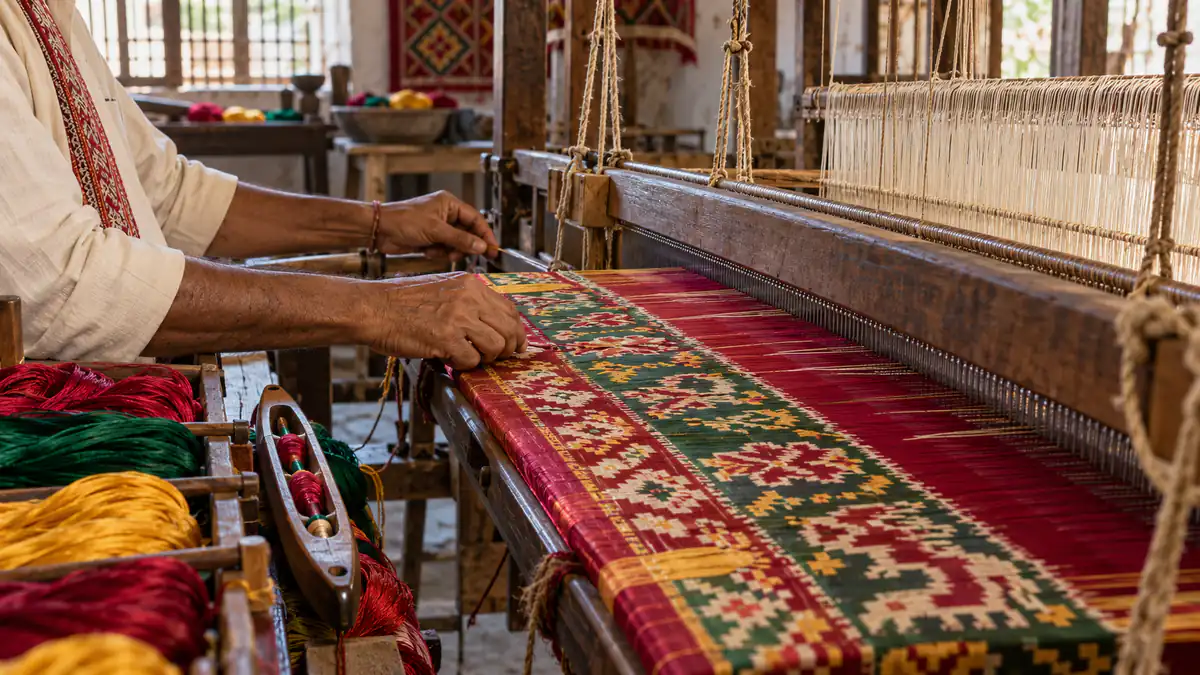
- 3:00 PM to 4:30 PM: Visit the Patan Patola Heritage Museum located near the stepwell. Meet the Salvi family master artisans, who have preserved the ancient art of Double Ikat Patola silk weaving for eight centuries. Each authentic Patola saree takes six months to a year to weave on hand looms, using naturally dyed silk threads where warp and weft are individually dyed before weaving to create identical motifs on both sides of the fabric.
Late Afternoon & Evening: Return Drive to Ahmedabad (16:45 - 20:00)
- 4:45 PM: Begin the return drive southward toward Ahmedabad.
- 7:30 PM to 8:00 PM: Arrive back in central Ahmedabad or transfer to Sardar Vallabhbhai Patel International Airport for onward travel.
Travelers planning extensive circuits across Gujarat can extend their tour south toward central Gujarat to combine ancient subterranean architecture with modern engineering via our Statue of Unity ticket booking and Ekta Nagar guide. The highway networks linking Mehsana, Rajkot, and Jamnagar also offer convenient connections westward toward coastal pilgrimage hubs.
| Time Window | Location | Activity | Highlights |
|---|---|---|---|
| Morning (07:00 - 09:00) | Ahmedabad to Modhera | Scenic highway drive via SH41 | Highway Gujarati breakfast & chai |
| Mid-Morning (09:00 - 10:30) | Sun Temple Modhera | Temple tour & Surya Kund | 108 miniature shrines & Sabha Mandap |
| Midday (11:15 - 13:45) | Rani ki Vav Patan | Subterranean stepwell exploration | 7 storeys, Dashavataras & ₹100 note view |
| Afternoon (14:00 - 14:45) | Patan town center | Traditional Gujarati thali lunch | Authentic vegetarian regional dishes |
| Late Afternoon (15:00 - 16:30) | Patola Heritage Museum | Master artisan weaving demonstration | 800-year double-ikat silk craft secrets |
| Evening (16:45 - 20:00) | Patan to Ahmedabad | Return highway drive | Evening arrival in Ahmedabad city |
How to Reach Patan by Road, Train, and Air from Ahmedabad
Patan is situated in the northern plains of Gujarat and offers dependable highway connections, making travel straightforward for independent tourists and family groups alike.
Official regional transit updates published by Gujarat Tourism highlight primary access routes:
- By Road (Private Cab or Self-Drive): Driving by car is the most convenient way to reach Patan. The distance from Ahmedabad to Patan is approximately 125 kilometers via State Highway 41 (passing through Kalol and Mehsana). The journey requires three to three and a half hours on well-maintained multi-lane toll highways. Cabs hired from Ahmedabad for a full-day return trip covering Modhera and Patan typically cost ₹3,000 to ₹4,500 for a compact sedan.
- By State Bus Transit: Gujarat State Road Transport Corporation (GSRTC) operates frequent direct express buses from Ahmedabad’s Central Bus Terminus (Geeta Mandir) directly to the Patan Bus Depot. Ordinary and Gurjarnagari express coaches depart every thirty to forty-five minutes throughout the morning. One-way bus fares range from ₹110 to ₹160 per passenger.
- By Train: Patan railway station (station code PTN) sits roughly four kilometers south of the stepwell, handling local passenger trains. The primary broad-gauge rail junction is Mehsana Junction (station code MSH), located fifty kilometers southeast of Patan. Mehsana connects directly to New Delhi, Jaipur, Mumbai, and Ahmedabad via daily superfast express trains. Travelers arriving at Mehsana can hire private cabs or board direct passenger shuttle buses to Patan in under an hour.
- By Air: The nearest commercial airport is Sardar Vallabhbhai Patel International Airport in Ahmedabad (airport code AMD), situated 125 kilometers south of Patan. The airport operates dozens of daily domestic flights connecting New Delhi, Mumbai, Bengaluru, Hyderabad, and Chennai, as well as direct international flights to Dubai, London, and Singapore.
- Local Transit in Patan: Reaching Rani ki Vav from the Patan bus stand or railway station is simple. Shared and private auto-rickshaws operate constantly outside arrival gates. A private auto ride to the stepwell monument gate costs ₹80 to ₹120. Travelers driving west toward the Great Rann can combine northern Gujarat’s stepwells with the desert winter festivities covered in our comprehensive Rann Utsav Kutch visitor overview via Radhanpur and Bhuj.
| Origin City | Distance | Recommended Transit Mode | Average Travel Duration |
|---|---|---|---|
| Modhera Sun Temple | 35 kilometers | State Highway taxi or local bus | 40 to 45 minutes |
| Mehsana Junction | 52 kilometers | Express train or highway cab | 1 hour |
| Ahmedabad City Center | 125 kilometers | Private taxi via SH41 | 3 to 3.5 hours |
| Ahmedabad Airport (AMD) | 122 kilometers | Direct airport taxi | 3 hours |
| Vadodara | 235 kilometers | Express train to Mehsana or highway cab | 4.5 to 5 hours |
| Somnath Temple | 450 kilometers | Overland highway drive via Rajkot | 8 to 9 hours |
Frequently Asked Questions About Rani ki Vav
What are the visiting hours and entry ticket prices for Rani ki Vav?
Rani ki Vav is open daily from 8:00 AM to 6:00 PM. Admission costs ₹40 for Indian citizens and SAARC/BIMSTEC visitors, while foreign passport holders pay ₹600 per adult. Children under fifteen years enter free of charge. Tickets can be purchased at the entrance counter or booked online through the Archaeological Survey of India portal.
Why is Rani ki Vav featured on the Indian 100 rupee note?
In 2018, the Reserve Bank of India chose Rani ki Vav for the reverse side of the lavender ₹100 banknote to honor India’s unique subterranean architectural heritage. The stepwell represents a crowning achievement of medieval water management, engineering, and stone sculpture, recognized globally as a UNESCO World Heritage Site.
Who built Rani ki Vav and in which century?
Rani ki Vav was commissioned in 1063 CE during the eleventh century by Queen Udayamati of the Chaulukya (Solanki) Dynasty. She constructed the seven-storey stepwell as a grand memorial for her late husband, King Bhimdev I, turning a functional water reservoir into an underground sacred sanctuary.
Can you visit Rani ki Vav and Modhera Sun Temple in a single day?
Yes. Visiting both monuments in a single day from Ahmedabad is one of the most popular cultural excursions in Gujarat. Modhera Sun Temple sits approximately 100 kilometers northwest of Ahmedabad, and Patan is located just 35 kilometers further north. A full-day road trip starting at 7:00 AM comfortably includes both monuments, lunch, and a stop at the Patan Patola silk museum before returning to Ahmedabad by 8:00 PM.
What is the best season to visit Rani ki Vav in Patan?
The ideal season to explore Rani ki Vav is between October and March. Winter days in northern Gujarat offer pleasant daytime temperatures ranging from 18°C to 28°C with clear skies and mild sunshine. Summer months from April through June bring extreme desert heat exceeding 42°C, making midday walking inside stone monuments uncomfortable.
Can a trip to Rani ki Vav be combined with festivals in Ahmedabad?
Yes, travelers visiting northern Gujarat in mid-January often combine an architectural day excursion to Rani ki Vav and Modhera with the high-energy spectacle of the International Kite Festival Gujarat dates and rituals, when thousands of kites fill the skies over Ahmedabad for Uttarayan.