Rock Garden & Capitol Complex Chandigarh: Timings & Guide
Explore Nek Chand's Rock Garden and Le Corbusier's UNESCO Capitol Complex in Chandigarh with our guide covering entry passes, tour timings, and art history.
Sector 1 in Chandigarh embodies one of the twentieth century’s most striking artistic and architectural contrasts: the disciplined, monumentally planned concrete structures of Le Corbusier’s UNESCO-inscribed Capitol Complex, standing directly alongside the whimsical, labyrinthine fantasy world of Nek Chand’s Rock Garden. Spanning the northern edge of the planned metropolis against the Shivalik hills, this heritage enclave draws architects, art historians, and curious travelers from across the globe.
Travelers checking the rock garden chandigarh timings will discover that these two adjacent landmarks create a complete full-day journey through modernist design and visionary outsider art. From the towering rotated silhouette of the Open Hand Monument and the ceremonial chambers of the Legislative Assembly to the stone-walled gorges and ceramic mosaic figures of the Rock Garden, this guide details visitor schedules, registration formalities, and architectural highlights.
Capitol Complex & Rock Garden Essentials
- UNESCO Inscription: The Capitol Complex was designated a UNESCO World Heritage Site in 2016 as part of the transnational architectural work of Le Corbusier.
- Rock Garden Origins: Secretly created by road inspector Nek Chand starting in 1957, utilizing industrial debris and domestic refuse salvaged from fifty cleared villages.
- Key Corbusian Monuments: Comprises the Secretariat building, the Palace of the Assembly with its hyperbolic cooling tower, the High Court, and the Open Hand sculpture.
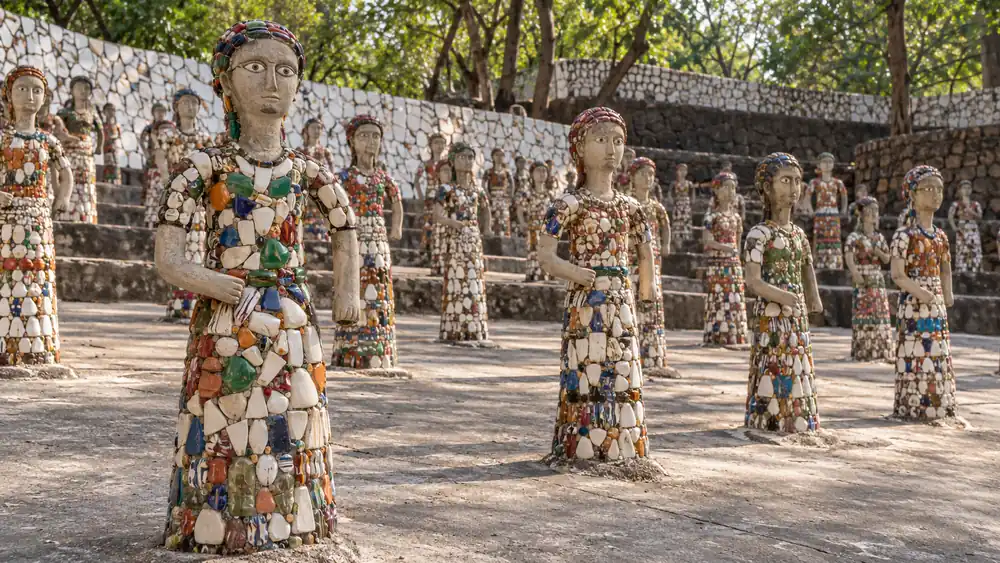
- Material Innovation: Rock Garden sculptures are crafted from broken glass bangles, discarded porcelain bathroom fittings, ceramic cups, iron slag, and river pebbles.
- Tour Protocol: The Capitol Complex requires advance in-person or online registration with photo identity cards for free guided batches, while the Rock Garden operates standard walk-in ticketing.
Nek Chand’s Rock Garden: The Visionary 40-Acre Masterpiece
Spreading across forty acres of wooded terrain between the Capitol Complex and Sukhna Lake, the Rock Garden is globally celebrated as a crowning triumph of intuitive outsider art and urban recycling.
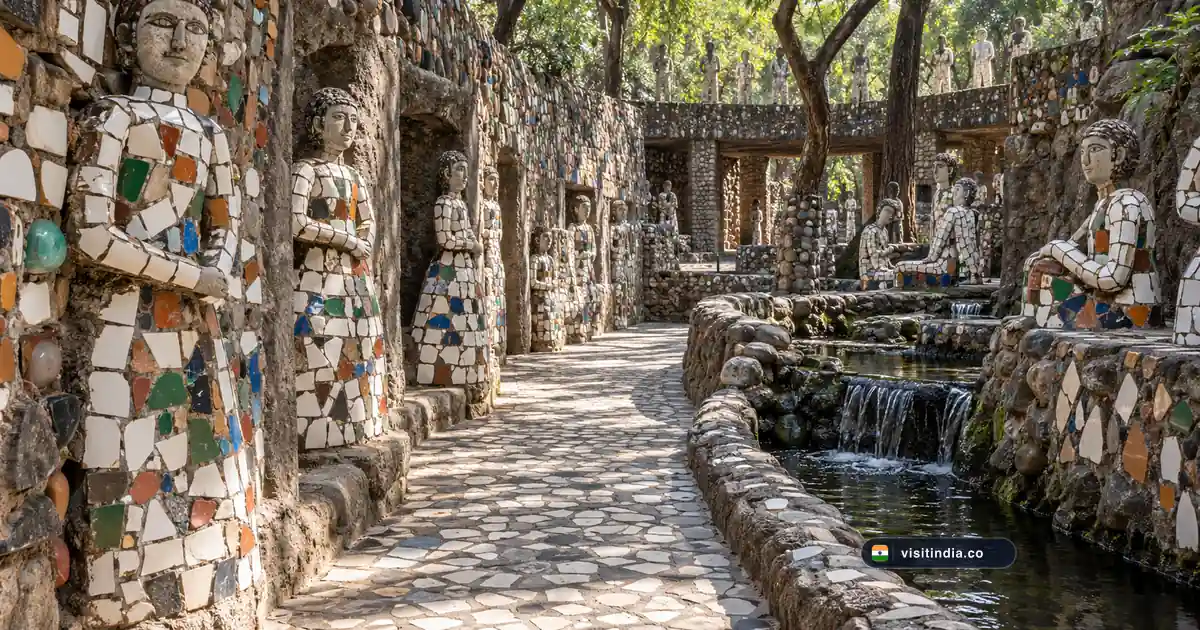
Nek Chand Saini, a humble road inspector with the Public Works Department, began collecting discarded stones, river boulders, and urban waste materials after scores of ancient villages were cleared to construct Chandigarh. Working alone by night in a deserted forest clearing within the government reserve, he cleared dense jungle, built terraced mud walls, and began fashioning figures of village folk, royal courtiers, and animals using broken porcelain and terracotta tiles.
When government officials discovered the unauthorized sanctuary in 1975, public admiration convinced the municipal administration to spare the complex from demolition, granting Nek Chand a salary and a workforce to complete his vision. Today, the garden receives thousands of daily visitors who wander through interconnected open-air galleries that evoke a mystical lost kingdom carved from urban refuse.
The Three Phases of the Rock Garden
Visitors navigate the Rock Garden along a continuous, winding one-way pedestrian circuit divided into three distinct phases:
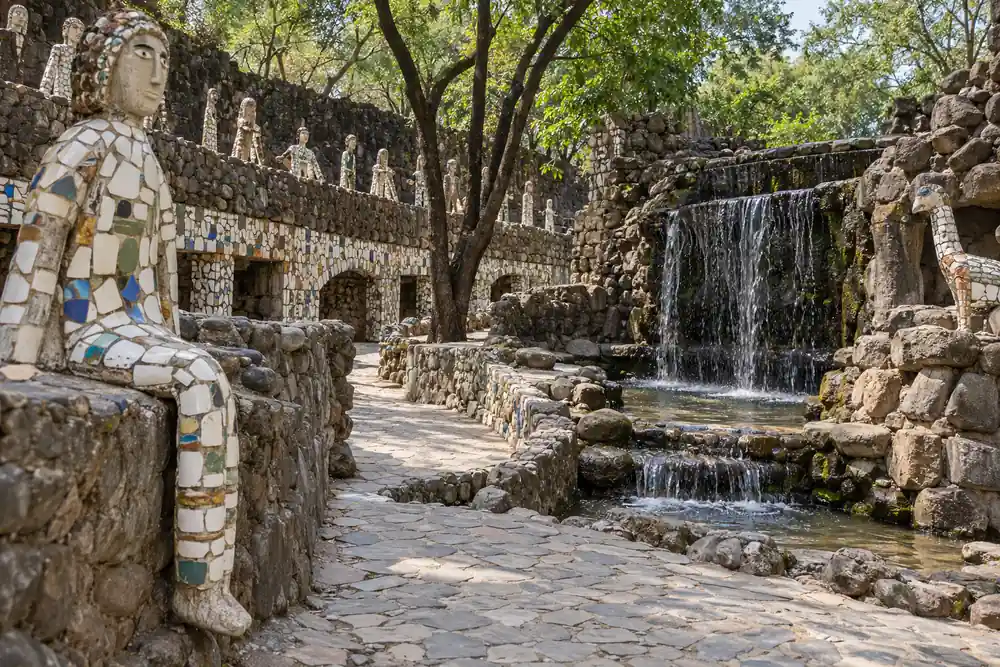
- Phase One (The Rock Gorges and Forest Trails): Begins with low stone doorways that compel visitors to stoop respectfully. The pathway winds through deep sandstone canyons flanked by river boulders, displaying early sculptures of birds, monkeys, and village elders embedded into vertical rock walls.
- Phase Two (Terraced Waterfalls and Village Courtyards): Features dramatic cascading waterfalls that tumble over stone tiers into clear pools. Elevated stone bridges lead past open courtyards lined with hundreds of dancing women sculpted from thousands of colorful broken glass bangles.
- Phase Three (The Grand Archways and Cultural Amphitheater): The most monumental section, featuring towering Romanesque stone archways with suspended swings, expansive courtyards designed for music concerts, and life-size camel and horse caravans.
Visiting Schedules and Ticket Fees
The Rock Garden is open seven days a week, including Sundays and national holidays, operating on seasonal hours:
- Summer Schedule (April to September): 9:00 AM to 7:00 PM daily.
- Winter Schedule (October to March): 9:00 AM to 6:00 PM daily.
- Ticketing Rates: Entry tickets cost ₹30 for adults and ₹10 for children under twelve years of age, purchased directly at the entrance ticket booths.
- Recommended Time: Budget two to two-and-a-half hours to explore all three phases comfortably. Wear comfortable walking shoes, as the trail features uneven stone paving and low doorways.
Official event updates and visitor guidance can be reviewed through the Chandigarh Tourism Rock Garden Portal.
The UNESCO Capitol Complex: Le Corbusier’s Civic Masterpiece
Located just north of the Rock Garden, the Capitol Complex represents the administrative heart of the joint capital of Punjab and Haryana, occupying an expansive geometric plaza designed by Swiss-French master Le Corbusier.
Inscribed on the UNESCO World Heritage List in 2016, the Capitol Complex embodies Le Corbusier’s principles of modern monumentalism. Built primarily of raw, unadorned concrete (béton brut) bearing the wood-grain texture of timber formwork, the complex harmonizes with the natural contours of the Shivalik mountain foothills. Detailed city-wide urban layouts can be studied in our Chandigarh travel guide.
The Major Monuments of Sector 1
The complex comprises three principal civic institutions and several symbolic artistic monuments:
- The Secretariat: A massive 254-meter-long, eight-story administrative slab housing executive ministries, featuring intricate sun-shading concrete screens (brise-soleil) that regulate natural light and ventilation.
- The Palace of Assembly: The legislative hall where both Punjab and Haryana state assemblies convene. The facade features a dramatic swooping portico, while the central chamber is crowned by a colossal hyperbolic concrete cooling tower inspired by thermal power plants in Europe.
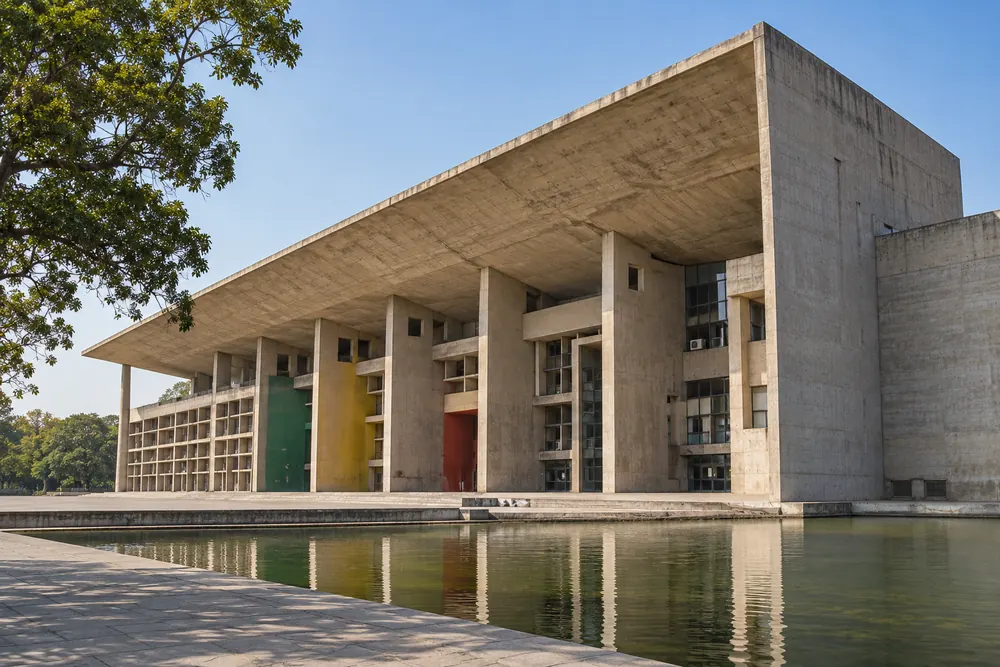
- The High Court (Palais de Justice): An imposing judicial palace featuring a monumental double roof and a brightly painted entrance screen with three colossal piers finished in primary red, green, and yellow hues.
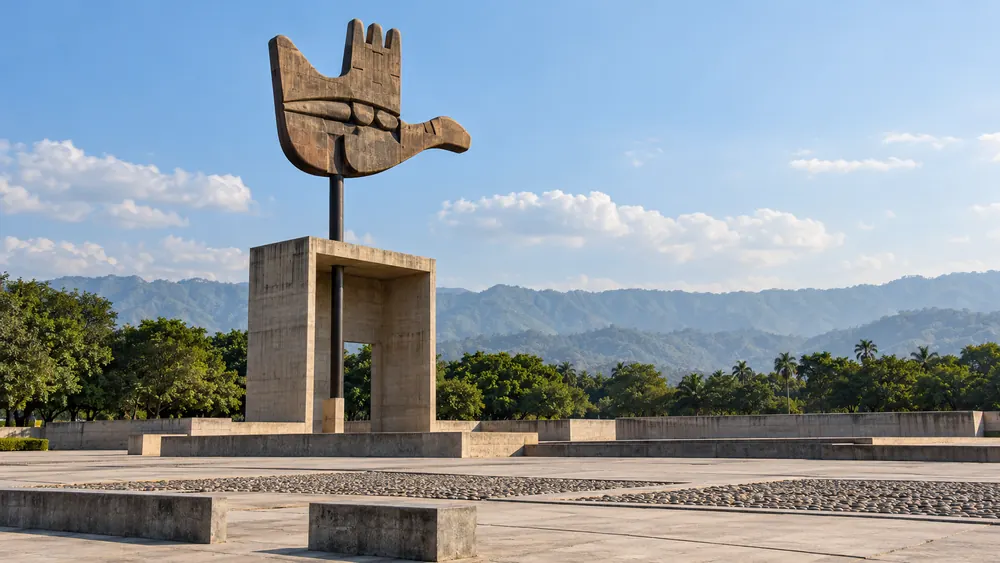
- The Open Hand Monument: A 26-meter-tall rotating metal sculpture rising above a sunken amphitheater known as the Trench of Consideration. Symbolizing world peace, friendship, and non-violence, it stands as the official emblem of the city.
- The Tower of Shadows and Geometric Hill: Experimental solar observation structures designed to study sunlight angles, ensuring that no direct solar rays enter the interior spaces during the summer solstice.
Booking Your Tour: Guided Batches and Entry Rules
Because the Capitol Complex houses active high-security government bodies, independent roaming is not permitted. Visitors must join official guided tours:
- Tour Batches: Guided tours operate daily at 10:00 AM, 12:00 PM, and 3:00 PM, conducted by certified tourism department guides.
- Registration Process: Visitors must register in person at the Tourist Information Centre located at the entrance to the Capitol Complex in Sector 1, or book online via the administration portal at least twenty-four hours in advance.
- Mandatory Requirements: Domestic Indian visitors must carry original government photo identification (Aadhaar or voter card), while foreign nationals must present their passports. Entry and guided tours are completely free of charge.
Official tour schedules and security regulations are cataloged on the Chandigarh Tourism Capitol Complex Registry.
| Attraction | Primary Architect | Construction Period | Key Architectural Feature |
|---|---|---|---|
| Palace of Assembly | Le Corbusier | 1951 to 1962 | Hyperbolic assembly roof and enamel ceremonial door |
| Secretariat Building | Le Corbusier | 1953 to 1959 | 254-meter concrete facade with rhythmic brise-soleil |
| High Court of Justice | Le Corbusier | 1951 to 1957 | Double canopy roof and primary-color monumental pillars |
| Open Hand Monument | Le Corbusier | Conceived 1954 (Built 1985) | Rotating metallic wind vane sculpture on sunken plaza |
| Rock Garden Phase 1 | Nek Chand Saini | 1957 to 1975 | Narrow rock canyons and stone village elder figures |
| Rock Garden Phase 2 | Nek Chand Saini | 1975 to 1983 | Cascading waterfalls and glass-bangle dancing troupes |
| Rock Garden Phase 3 | Nek Chand Saini | 1983 to 1996 | High arched courtyards and terracotta animal camel statues |
Connecting Sights in Sector 1: Sukhna Lake and Leisure Trails
A visit to the Rock Garden and Capitol Complex pairs naturally with the surrounding outdoor attractions of Sector 1.
Located within walking distance or a short five-minute drive, these waterfront and botanical destinations complete an enriching day of sightseeing.
Sukhna Lake: Evening Promenade and Boating
Just eight hundred meters east of the Rock Garden lies Sukhna Lake, Chandigarh’s beloved artificial reservoir.
After a morning of architectural touring, the lake’s paved two-kilometer promenade provides the perfect place to unwind. Visitors can enjoy shaded lakeside seating, watch migratory birds along the wetland shallows, and rent pedal boats or solar cruise craft. Sunset over the lake, with the sky turning orange behind the Shivalik hills, is an essential Chandigarh experience. Complete waterfront activities are covered in our Sukhna Lake and Rose Garden guide.
The Garden of Silence and Shivalik Foothill Trails
At the northern extremity of the Sukhna reservoir lies the Garden of Silence, an open-air stone sanctuary featuring a central seated Buddha sculpture.
Enclosed by concentric stone concentric paths and verdant trees, the garden is designed as a tranquil meditation retreat where visitors can escape urban traffic. Walking trails also connect northward toward the Kansal forest reserve, offering quiet nature walks for birdwatching enthusiasts. Travelers planning regional mountain journeys can explore hill station trails detailed in our Morni Hills and Pinjore Gardens regional guide.
Practical Tips for Visiting Sector 1 Heritage Sites
Making the most of your day in Sector 1 requires thoughtful preparation regarding timings, security checkpoints, and footwear:
- Coordinate Your Tour Timing: Book the 10:00 AM Capitol Complex guided tour first. Upon finishing around 11:30 AM, walk directly to the adjacent Rock Garden, explore its three phases, and pause for lunch.
- Footwear and Hydration: You will walk three to four kilometers across stone plazas and winding gravel pathways; sturdy walking shoes and a refillable water bottle are essential.
- Photography Equipment: Handheld cameras are permitted throughout the Rock Garden and the exterior Capitol Complex plaza, but tripods and drone cameras require formal administrative clearance.
- Refreshments: The Rock Garden exit features government-approved snack counters serving fresh coconut water, bottled juices, and local street snacks like samosas and kulchas.
Travelers touring the broader spiritual and architectural landmarks of northern India can also link their itinerary with the historic golden shrines detailed in our Golden Temple Amritsar darshan and timings. Comprehensive destination highlights and visitor maps are accessible on the Incredible India Chandigarh Guide.
Frequently Asked Questions About Rock Garden and Capitol Complex
What are the opening hours and ticket prices for the Rock Garden?
Nek Chand’s Rock Garden is open daily from 9:00 AM to 7:00 PM during summer (April to September) and from 9:00 AM to 6:00 PM during winter (October to March). Admission tickets cost ₹30 for adults and ₹10 for children under twelve years.
How do I register for a tour of the UNESCO Capitol Complex?
Visitors must register for an official guided tour conducted by Chandigarh Tourism at the Tourist Information Centre in Sector 1. Tours run daily at 10:00 AM, 12:00 PM, and 3:00 PM, and admission is free with a valid government photo identity card.
Can I visit the Rock Garden and Capitol Complex on the same day?
Yes, both attractions are located adjacent to each other in Sector 1, making it very easy to explore the Capitol Complex in the morning and spend the afternoon at the Rock Garden.
What materials did Nek Chand use to create the Rock Garden?
Nek Chand sculpted the garden using urban and industrial waste salvaged from demolition sites, including broken glass bangles, ceramic tiles, porcelain electrical switches, bicycle parts, broken terracotta pots, and natural river boulders.
What is the meaning of the Open Hand Monument in Chandigarh?
Designed by Le Corbusier, the Open Hand Monument represents an open palm rotating with the wind, symbolizing world peace, reconciliation, and the exchange of goodwill (“open to receive, open to give”). It stands as the official symbol of Chandigarh.
Is photography allowed inside the Capitol Complex and Rock Garden?
Photography is permitted for personal handheld cameras across the open courtyards of the Rock Garden and the public plazas of the Capitol Complex. Photography inside active courtrooms and government assembly chambers is strictly prohibited.
How far is the Rock Garden from Chandigarh Railway Station?
The Rock Garden is located approximately eight kilometers west of Chandigarh Junction Railway Station. A taxi or auto-rickshaw takes fifteen to twenty minutes to reach Sector 1 under normal traffic conditions.