Vaishno Devi Katra Yatra: Helicopter Booking & RFID Guide
Vaishno Devi Katra yatra guide covering mandatory RFID cards, online helicopter booking, battery car rates, Tarakote vs Banganga tracks, and Bhawan rules.
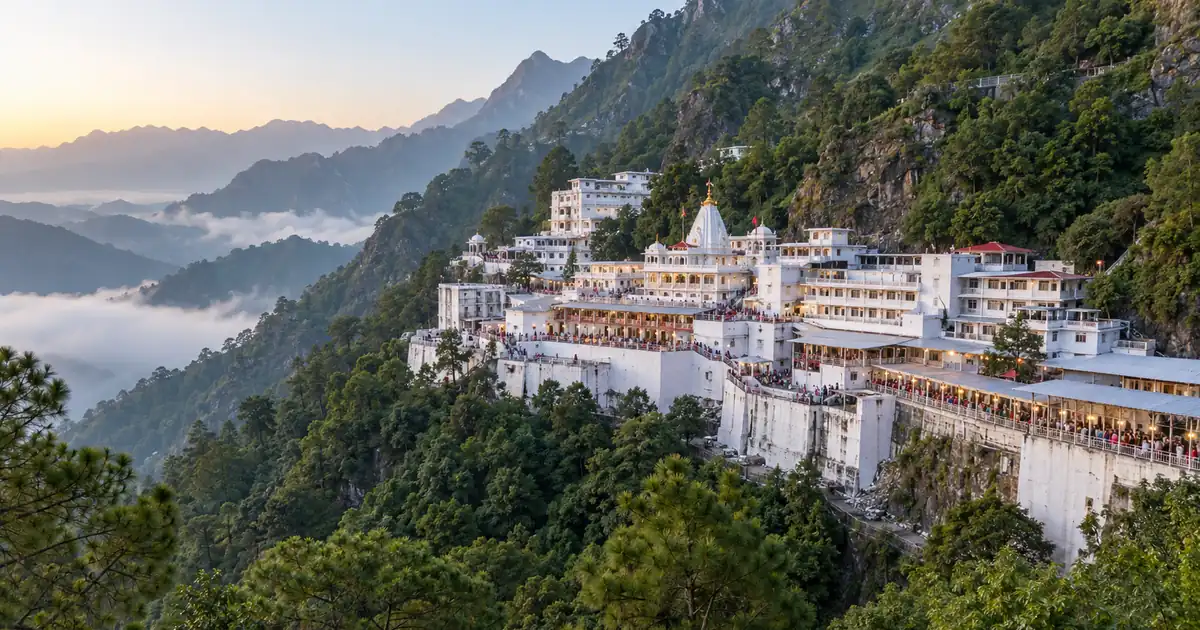
Darshan Essentials
- Mandatory RFID Access Card: Every pilgrim must obtain an RFID card in Katra before crossing the security check at Banganga or Tarakote Marg. The card is issued free of cost at Katra Railway Station, the central bus stand, and the Niharika Complex.
- Trek Distance and Elevation: The walking ascent covers 12 km from Banganga or 13 km from Tarakote Marg, rising from 750 meters in Katra to 1,585 meters at the Holy Bhawan.
- Helicopter Booking Rules: Daily helicopter flights operate between Katra Helipad and Sanjichhat with an 8-minute flight duration. Advance reservations open 60 days prior at 10:00 AM exclusively through the official Shri Mata Vaishno Devi Shrine Board portal.
- Battery Cars and Ropeway: Electric battery cars run between Ardhkuwari and Manokamana Bhawan for ₹354 uphill and ₹236 downhill. A passenger cable car connects Bhawan to Bhairon Temple in 3 minutes for ₹100 per person.
- Sanctum Prohibited Items: Mobile phones, cameras, leather belts, wallets, smartwatches, and footwear are barred inside the Holy Cave. Free digital locker facilities are provided at Bhawan.
The holy pilgrimage to Shri Mata Vaishno Devi in the Trikuta hills of Jammu and Kashmir represents one of India’s most visited sacred journeys. Over 8 million to 10 million pilgrims undertake this mountain trek annually, traveling through steep gorges and pine forests to pay homage at the sanctum.
Modern infrastructure managed by the Shri Mata Vaishno Devi Shrine Board has transformed this challenging trek into a well-regulated mountain trail. Pilgrims now benefit from illuminated covered walkways, clean drinking water dispensaries every 500 meters, regular medical aid centers, and electronic crowd monitoring systems.
Careful advance preparation remains essential for a safe journey. Understanding the mandatory RFID registration procedures, track gradients, helicopter release schedules, and locker mechanics ensures a smooth darshan. Devotees extending their pilgrimage into the Kashmir Valley can plan onward routes with our complete key details for Jammu and Kashmir.
Understanding the Vaishno Devi Yatra: Sanctum Pindis and Spiritual Geography
The spiritual core of Vaishno Devi is located within a natural limestone cave perched at an elevation of 1,585 meters (5,200 feet). Unlike temples with carved stone idols, the inner sanctum houses three self-manifested rock forms known as the Holy Pindis.
These three natural stone protuberances emerge directly from the cave rock and remain submerged in a stream of cold mountain spring water known as the Charan Ganga. Each Pindi represents a distinct divine cosmic energy:
- Maha Kali (Right): Represents Tamoguna, signifying power, the destruction of ego, and dissolution of evil.
- Maha Lakshmi (Center): Represents Rajoguna, signifying wealth, nourishment, preservation, and spiritual prosperity.
- Maha Saraswati (Left): Represents Sattvaguna, embodying wisdom, creative consciousness, purity, and supreme knowledge.
The geographical backdrop of the Trikuta mountain range derives its name from its three prominent peaks. These peaks symbolize the threefold nature of the divine feminine energy recorded in Vedic and Puranic literature. Pilgrims exploring India’s ancient sacred geometry often compare this pilgrimage with the pan-Indian circuits described in our Char Dham Yatra guide.
During ancient times, pilgrims crawled through a 98-foot narrow natural cave tunnel on their hands and knees to reach the sanctum. To accommodate the massive influx of modern pilgrims safely, the Shrine Board engineered two modern entry and exit tunnels in 1977 and 2004.
The original natural cave opens exclusively during off-peak winter months (typically late January and early February) when daily pilgrim footfall drops below 10,000 visitors. At all other times, pilgrims access the holy sanctum through the engineered tunnels, ensuring continuous air circulation and rapid movement.
Mandatory RFID Yatra Access Card: Counters, Verification and Exit Rules
The Shrine Board mandates an Electronic Radio Frequency Identification (RFID) Yatra Access Card for every single devotee. This electronic card replaces older paper permits and serves as an individual tracker to prevent overcrowding on narrow cliff segments.
Security personnel at Banganga and Tarakote Marg will turn back any traveler who arrives without a physical RFID card. Pilgrims cannot enter either trail without passing through automated RFID turnstiles.
The RFID card is completely free of charge. You can register online prior to arrival on the Shrine Board portal, but you must still collect the physical RFID card upon reaching Katra by presenting your digital registration slip and valid government photo identification.
Official RFID Collection Centers
- Katra Railway Station (SVDK): Ground floor concourse counters operating 24 hours daily.
- Central Bus Stand Katra: Yatra Registration Counter No. 2, open from 5:00 AM to 10:00 PM.
- Niharika Complex: Located opposite the Central Bus Stand, offering 24-hour verification booths.
- Tarakote Marg Entry Point: Dedicated entrance gate registration booths open 24 hours.
- Serli Helipad Katra: Specialized counter for confirmed helicopter ticket holders.
- Jammu Airport (IXJ): Arrival lounge registration desk promoted in collaboration with Incredible India.
- Jammu City Hubs: Vaishnavi Dham and Saraswati Dham complexes located adjacent to Jammu Tawi Railway Station.
You must pass the first verification turnstile at Banganga or Tarakote within six hours of the card being issued in Katra. If this six-hour window expires, the system deactivates the card, requiring you to visit an adjustment counter for revalidation.
Keep the RFID card suspended around your neck at all times. Automated electronic overhead scanners track pilgrim density at Charan Paduka, Ardhkuwari, Himkoti, Bhawan, and the Bhairon Ropeway.
Do not lose this card during your trek. You must surrender the physical RFID card at the designated exit turnstiles upon concluding your yatra in Katra. Losing the card incurs an administrative verification delay and possible fine.
Trek Route Comparison: Traditional Banganga Track vs New Tarakote Marg
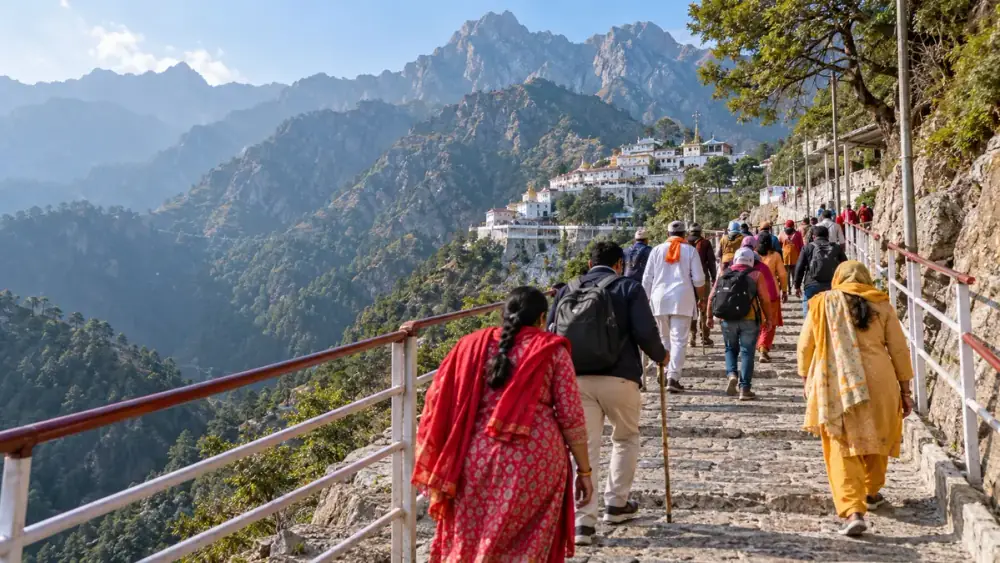
Pilgrims ascending to the Holy Bhawan can choose between two main routes starting from Katra. The older Banganga track runs along the southern slope of the mountain, while the modern Tarakote Marg curves along the northern flank.
Route Comparison Matrix
| Factor | Traditional Banganga Track | Modern Tarakote Marg |
|---|---|---|
| Starting Point | Banganga Checkpost (2 km from Katra center) | Tarakote Gate (2.5 km from Katra center) |
| Total Distance to Bhawan | 12 Kilometers (7.45 miles) | 13 Kilometers (8.07 miles) |
| Average Incline Gradient | Steep steps and variable ramps (Up to 14% grade) | Uniform, gentle engineered slope (7% to 9% grade) |
| Ponies and Mules | Allowed (Frequent horse traffic and odors) | Strictly Prohibited (Zero animal traffic permitted) |
| Pedestrian Comfort | Traditional commercial bazar line with heavy crowds | Wide paved track with clean, unobstructed walkways |
| Battery Cart Availability | Only between Ardhkuwari and Bhawan | Battery carts run full stretch from Tarakote |
| Shelter and Shed Coverage | Partial metal roof sheds | 100% covered modern anti-slip tiled corridor |
| Food and Refreshments | Private dhabas, local sweet shops, tea stalls | Shrine Board vegetarian food courts and cafes |
The traditional Banganga track suits pilgrims seeking historical halts such as the sacred Banganga river crossing and Charan Paduka temple. However, pedestrians must share this path with ponies, palanquins, and porters, which creates congestion during festival seasons.
Tarakote Marg, inaugurated in 2018, is designed specifically for walking comfort. The path features a gradual, consistent incline with rubberized anti-skid floor tiles and full overhead sheds protecting travelers from summer heat and rain. Devotees interested in sacred trail architecture across North India can also read our guide to key landmarks and neighborhoods in Kurukshetra for historic pilgrim paths.
Tarakote Marg completely bans horses and mules, creating a clean, odor-free environment for walking. It rejoins the main track near Ardhkuwari, allowing pilgrims to continue onward toward Bhawan via the modern Himkoti route.
Key Milestones Along the Pilgrimage Trail: Banganga to Bhawan
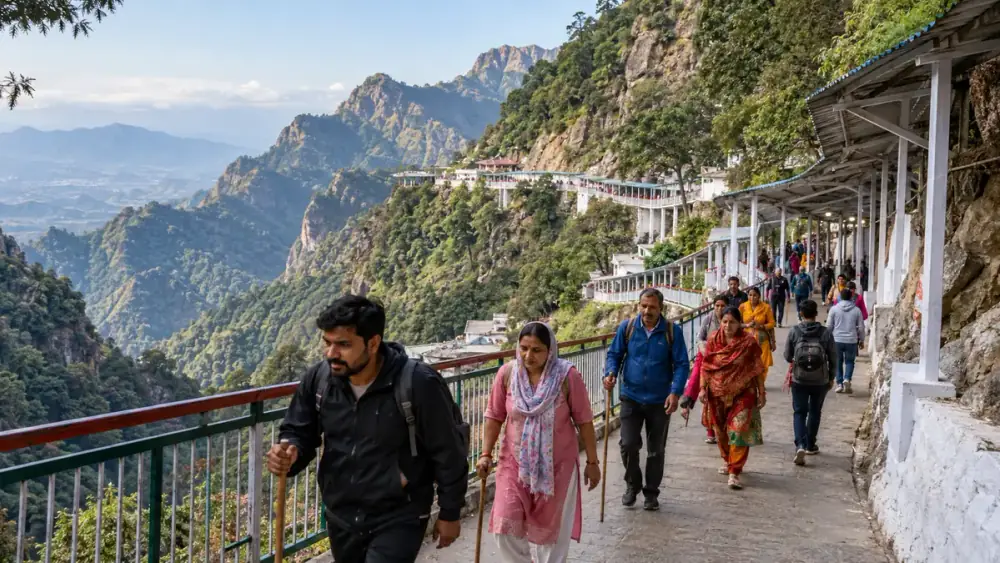
The 12 to 13 kilometer ascent features several spiritual halts and scenic resting stations that divide the strenuous mountain climb into manageable segments.
| Milestone Station | Distance from Katra | Altitude | Key Features & Pilgrim Services |
|---|---|---|---|
| Banganga Gate | 1.5 km | 850 m | Sacred river bathing ghats, security x-ray baggage screening, RFID gates |
| Charan Paduka | 3.0 km | 1,050 m | Rock slab with divine footmarks, primary medical dispensary, water points |
| Ardhkuwari | 6.0 km | 1,370 m | Garbhjun Cave, mid-point token counter, battery cart terminal station |
| Himkoti Viewpoint | 8.5 km | 1,520 m | Panoramic valley view decks, vegetarian food courts, zero animal traffic |
| Sanjichhat Plateau | 9.5 km | 1,765 m | Commercial helipad terminal, emergency 24-hour cardiac care hospital |
| Holy Bhawan | 12.0 km | 1,585 m | Main cave sanctum, free digital lockers, bathing complexes, dining halls |
1. Banganga Checkpost (1.5 km from Katra)
Banganga marks the formal starting gate of the traditional route. According to legend, the Goddess Vaishnavi created a tributary of water here by shooting an arrow into the dry soil to quench the thirst of her steed, Lallu.
Pilgrims traditionally wash their hands and feet or take a holy bath at the Banganga bathing ghats before beginning the climb. Secure baggage x-ray scanning and RFID turnstiles operate at this checkpoint around the clock.
2. Charan Paduka (3 km from Katra, 1,050 meters)
Located 1.5 km above Banganga, Charan Paduka houses a sacred rock slab bearing the imprinted footmarks of Goddess Vaishnavi. Legend recounts that the Goddess paused here to look back at the demon Bhairon Nath during his pursuit.
The temple complex includes medical emergency booths, free filtered cold drinking water dispensaries, and public restroom clusters maintained by Shrine Board sanitation staff.
3. Ardhkuwari and the Garbhjun Cave (6 km from Katra, 1,370 meters)
Ardhkuwari marks the exact halfway point of the mountain pilgrimage. The central shrine houses the Garbhjun Cave, a narrow 50-foot natural tunnel where the Goddess meditated for nine months in penance before confronting Bhairon Nath.
Passing through the tight opening of the Garbhjun Cave is believed to free the soul from the cycle of rebirth. Waiting times for entering the Garbhjun Cave often exceed 12 to 24 hours during peak season.
Devotees take an electronic group token at the Ardhkuwari counter upon arrival. If the token number indicates an extensive wait, you can proceed onward to Bhawan for your main darshan and enter the Garbhjun cave during your return descent.
4. Sanjichhat (9.5 km from Katra, 1,765 meters)
Sanjichhat represents the highest geographic altitude along the walking trail. The plateau offers panoramic vistas over the Chenab river basin and surrounding Pir Panjal mountain ridges. Pilgrims heading onward to alpine trails in Kashmir can contrast these heights with our travel notes on essential stops across Pahalgam.
Sanjichhat serves as the mountain terminal for helicopter flights arriving from Katra. The complex features a 24-hour primary health center, emergency cardiac care units, clean rest rooms, and a spacious Shrine Board dining complex. From Sanjichhat, the trail descends gently for 2.5 kilometers down to the Holy Bhawan.
5. Himkoti Alternative Route
Near Ardhkuwari, the trail splits into two branches. The upper track climbs steeply past Sanjichhat, while the newer, scenic Himkoti track bypasses Sanjichhat altogether.
The Himkoti bypass track is flatter, broader, and strictly bans animal traffic. It offers direct access to the battery cart service and passes through covered view decks, herbal garden viewpoints, and vegetarian quick-service food courts.
Helicopter Booking, Battery Cars and Passenger Ropeway Logistics
Pilgrims traveling with young children, senior citizens, or those with physical limitations can use mechanized transit options across the mountain trail.
| Transport Mode | Sector Route | Transit Time | Standard Tariff | Primary Booking Method |
|---|---|---|---|---|
| Commercial Helicopter | Katra Helipad to Sanjichhat | 8 Minutes | ₹2,100 one-way / ₹4,200 return | Advance online via Shrine Board website |
| Electric Battery Cart | Ardhkuwari to Manokamana Bhawan | 20 Minutes | ₹354 uphill / ₹236 downhill | Online portal and Ardhkuwari counter |
| Passenger Ropeway | Bhawan to Bhairon Nath Temple | 3 Minutes | ₹100 per person (round-trip) | On-spot ticket counter at Bhawan |
| Pony (Horse) | Banganga to Bhawan | 3 to 4 Hours | ₹1,200 to ₹1,500 fixed tariff | Municipal prepaid counter at Banganga |
| Palki (Sedan Chair) | Banganga to Bhawan | 4 to 5 Hours | ₹4,000 to ₹5,500 fixed tariff | Municipal prepaid counter at Banganga |
1. Helicopter Service from Katra to Sanjichhat
Helicopter operations depart from the Serli Helipad in Katra, located 2.5 km from the town center, and land at the Sanjichhat Helipad. The flight takes approximately 8 minutes, replacing four to six hours of strenuous uphill hiking.
Key operational guidelines for helicopter passengers include:
- Authorized Flight Operators: Global Vectra Helicorp and Himalayan Heli Services conduct scheduled shuttle sorties.
- Luggage Limitations: Passengers are permitted exactly one hand-carried bag weighing no more than 5 kilograms.
- Body Weight Regulations: Pilgrims weighing over 80 kilograms are subject to excess weight surcharges per kilogram.
- Advance Window: Reservation slots open 60 days in advance at 10:00 AM on the official Shri Mata Vaishno Devi Shrine Board website.
Warning
Beware of fake travel booking websites and social media scams offering confirmed Vaishno Devi helicopter passes. The Shrine Board never authorizes any private agency, hotel, or individual agent to sell tickets. All genuine bookings require your personal Aadhaar number or passport directly on the official portal.
From Sanjichhat Helipad, passengers must still complete a 2.5 km downhill walk to reach the Bhawan entrance. Battery wheelchairs and porters are available at the helipad for elderly travelers.
Helicopter flights operate strictly under Visual Flight Rules. Operations suspend immediately during heavy cloud cover, monsoon rain, dense winter fog, or strong mountain winds. If your flight cancels due to weather, obtain a physical cancellation stamp on your slip at the helipad counter to receive a full refund through the original payment mode.
2. Electric Battery Carts (Ardhkuwari to Bhawan)
Environmentally friendly electric carts run continuously along the 5.5 km paved Himkoti track connecting Ardhkuwari with Manokamana Bhawan.
- Uphill Tariff (Ardhkuwari to Bhawan): ₹354 per passenger.
- Downhill Tariff (Bhawan to Ardhkuwari): ₹236 per passenger.
- Booking Window: Advance slots can be reserved online via the Shrine Board website. Spot booking counters operate at Ardhkuwari, but long queues form early in the morning.
- Eligibility: Priority is given to senior citizens (60 years and above), pregnant women, and physically disabled pilgrims. Young travelers are permitted only if seats remain unoccupied at departure time.
3. Bhawan to Bhairon Ghati Passenger Ropeway
The climb from Bhawan (1,585 m) to the Bhairon Nath Temple (2,010 m) covers 1.5 kilometers of severe, steep 25-degree gradient. In 2018, the Shrine Board commissioned a state-of-the-art Swiss cable car system that transformed this exhausting 60-minute ascent into a comfortable 3-minute ride.
- Operating Hours: 8:00 AM to 5:00 PM (Operations halt during heavy rain, high winds, or after dusk).
- Ticket Price: ₹100 per person for a two-way round-trip ticket.
- Capacity: Carries 800 passengers per hour in dual enclosed passenger cabins.
- Booking: Purchase physical tokens directly at the ropeway ticket counter near Bhawan.
4. Regulated Rates for Ponies, Palkis, and Porters
The Reasi District Administration Tourism Portal strictly regulates tariffs for animal and manual porters to protect pilgrims from price gouging.
- Pithoo (Porter for luggage or small child): Fixed rate boards are installed at Banganga and Tarakote gates. Typical rates range from ₹400 to ₹700 depending on weight.
- Pony (Horse ride): Government prepaid counters at Banganga charge standardized rates between ₹1,200 and ₹1,500 one-way to Bhawan.
- Palki (Sedan chair carried by 4 porters): Primarily utilized by non-ambulatory pilgrims. Regulated rates range from ₹4,000 to ₹5,500 one-way.
Always hire porters and ponies through the official police-verified prepaid booths. Ensure the porter wears an official laminated municipal ID badge displaying a registered serial number.
Bhawan Darshan Protocol: Locker Counters, Aarti Timings and Prohibited Items
Upon arriving at the Holy Bhawan complex, pilgrims must follow structured operational protocols before joining the sanctum queue.
Snan (Bathing) Facilities
Devotees traditionally take a purifying bath prior to entering the sanctum. The Shrine Board maintains separate, modern, covered bathing ghats with continuous warm water supply for men and women:
- Bathing Complex No. 1 and No. 2: Located directly below the main Bhawan terrace.
- Geyser Availability: Heated water is provided free of cost during autumn, winter, and spring months.
Cloakrooms and Digital Lockers
Security personnel maintain strict screening checkpoints at the entrance of the cave corridors. You cannot carry personal belongings past the security gate.
Prohibited items inside the Vaishno Devi sanctum include:
- Leather goods such as belts, wallets, and wristbands
- Electronic devices including mobile phones, smartwatches, cameras, and power banks
- All outdoor footwear, shoes, and sandals
- Personal luggage, backpacks, and umbrella sticks
- Excessive unpackaged food or outside sweets
The Shrine Board provides free digital lockers across three main buildings: Manokamana Bhawan, Kalika Bhawan, and Gate No. 3. Devotees deposit a refundable security token or scan their RFID card to lock their belongings.
Keep your locker key wristband securely tied to your wrist. Carry only pure cash notes, small offering items purchased from official Shrine Board kiosks, and your mandatory RFID card inside the sanctum line.
Attka Aarti Timings and Special Darshan
The sanctum priests conduct the sacred Attka Aarti twice daily during transitional astronomical hours:
- Morning Aarti: Commences before dawn from 6:00 AM to 8:00 AM.
- Evening Aarti: Commences at twilight from 7:00 PM to 8:30 PM.
During the 90-minute aarti window, regular pilgrim darshan pauses entirely. Priests chant Vedic hymns, bathe the holy Pindis in milk, honey, and sacred waters, and present traditional shringar offerings.
Devotees can book dedicated Attka Aarti seating passes in advance through the Shrine Board website. Attendees sit inside the covered sanctum courtyard directly facing the Pindis while the priests perform the ritual worship.
The Legend of Bhairon Nath: Why the Temple Visit Completes Your Yatra
A visit to the temple of Bhairon Nath, perched at an altitude of 2,010 meters on the neighboring peak of Bhairon Ghati, is considered spiritually mandatory. Traditional belief holds that an individual’s yatra remains incomplete without visiting this hilltop shrine.
According to ancient lore, the demon-tantrik Bhairon Nath pursued the young Goddess Vaishnavi through the wilderness to force her into marriage. After retreating to the Garbhjun Cave at Ardhkuwari for nine months, the Goddess assumed her fierce form of Maha Kali and severed Bhairon Nath’s head at the mountain ridge above the cave.
Bhairon Nath’s severed head flew up the mountain slope and landed 1.5 km away at Bhairon Ghati. In his dying moments, the demon realized the supreme divine nature of the Goddess and pleaded for spiritual redemption.
Moved by his dying repentance, Goddess Vaishnavi granted him a boon: she declared that no pilgrim’s prayer would be fully accepted at her shrine unless the devotee subsequently climbed up to Bhairon Ghati to pay respects at his temple.
The climb from Bhawan to Bhairon Nath temple covers 1.5 km of steep, stepped pathways. The passenger ropeway makes this journey effortless in 3 minutes, depositing passengers directly outside the temple courtyard.
From the observation parapet surrounding Bhairon Temple, you can view the distant snow-crested Himalayan ranges, the rooftops of the Bhawan complex below, and the plains of Jammu stretching toward Punjab. Travelers looking to explore more spiritual landmarks across the country can browse our compendium of the best places to visit in India.
Best Season to Visit: Weather Conditions, Snowfall and Festive Rush
The Vaishno Devi shrine remains accessible 365 days a year. However, seasonal weather variations across the Trikuta range require distinct travel preparations.
| Season Window | Average Temperatures | Weather Profile | Crowd Conditions & Planning Advice |
|---|---|---|---|
| Autumn (Oct to Nov) | 12°C to 22°C | Crisp, clear skies, pleasant days | Festive peak during Sharad Navratri; book stays 2 months early |
| Winter (Dec to Feb) | -2°C to 10°C | Sub-zero nights, snowfall at Bhawan | Carry heavy woolens; natural cave frequently opens in late January |
| Spring (Mar to Apr) | 15°C to 26°C | Blooming hillside flora, mild sunshine | Excellent walking weather; moderate crowds outside Chaitra Navratri |
| Summer (May to Jun) | 22°C to 38°C | Hot in Katra, pleasant at Bhawan | Peak family vacation rush; night trekking strongly recommended |
| Monsoon (Jul to Sep) | 20°C to 30°C | Heavy rain, lush hills, fog | Helicopter flights frequently disrupted; check landslide advisories |
Autumn (October to November)
Autumn offers pleasant mountain weather with crisp blue skies and comfortable daytime temperatures between 15°C and 22°C. Nighttime temperatures drop to 8°C.
The nine days of Sharad Navratri (October) bring massive festive illumination across the mountains. The entire trail is decorated with flowers, but daily pilgrim counts frequently exceed 40,000 visitors, causing 6 to 10 hour waiting lines at the sanctum.
Winter (December to February)
Winter brings freezing cold conditions to the upper mountain ridges. Temperatures at Bhawan fluctuate between -2°C and 10°C.
Snowfall typically occurs in late December, January, and early February, turning the pine trees and red-roofed shrines white. Winter visitors must carry heavy thermal innerwear, down jackets, woolen caps, and windproof gloves. Travelers who appreciate snowy winter landscapes can also plan excursions to Gulmarg visitor itinerary for winter sports.
During late January and early February, low visitor numbers prompt the Shrine Board to open the original natural cave tunnel for darshan.
Spring (March to April)
Spring brings excellent walking weather. Mountain wild flowers bloom along Tarakote Marg, and temperatures hover around a comfortable 18°C to 25°C.
Chaitra Navratri in late March or April introduces temporary festive crowds. Outside of the festival week, spring offers swift darshan queues and reliable helicopter flight operations.
Summer (May to June)
Summer coincides with North Indian school vacations. Daytime temperatures in Katra reach 35°C to 38°C, though temperatures at Bhawan remain cooler at 22°C to 26°C.
Summer represents the highest annual crowd density. Expect long waiting times for battery carts, ropeways, and hotel rooms. Night trekking is particularly popular during summer to avoid daytime heat.
Monsoon (July to September)
The southwest monsoon delivers heavy downpours to the outer Himalayan foothills. The mountain slopes turn lush green with roaring waterfalls, but the trail carries risks of mud slides and falling stones.
The Shrine Board deploys specialized disaster management teams along vulnerable track segments. Helicopters rarely fly during monsoon due to low cloud bases and poor visibility.
How to Reach Katra: Train Connectivity, Jammu Airport and Road Highways
The town of Katra serves as the sole gateway and base camp for the Vaishno Devi pilgrimage. It features modern transit connectivity linked directly with India’s metropolitan centers.
Reaching Katra by Train
The most convenient and comfortable mode of travel is by direct railway connection to Shri Mata Vaishno Devi Katra Railway Station (Station Code: SVDK).
Located just 1.5 km from the town center, SVDK is a modern railway terminal equipped with multi-cuisine food courts, VIP lounges, escalators, and on-platform RFID registration counters.
Notable direct express trains connecting to Katra include:
- New Delhi to Katra Vande Bharat Express (Train No. 22439 / 22440): Covers the 655 km route from New Delhi in 8 hours, departing Delhi at 6:00 AM and arriving at Katra by 2:00 PM. A second afternoon Vande Bharat also operates on this route.
- Shri Shakti Express (Train No. 22461 / 22462): Overnight AC sleeper service from New Delhi, arriving in Katra early morning.
- Jammu Mail and Uttar Sampark Kranti: Daily overnight express trains linking Delhi, Haryana, and Punjab directly to Katra.
- Direct trains from other metros: Long-distance express services connect Katra with Mumbai, Ahmedabad, and Pune.
You can book train tickets through the official IRCTC portal.
Reaching Katra by Flight
The nearest commercial airport is Jammu Airport (IATA Code: IXJ), located approximately 50 kilometers south of Katra.
Jammu Airport operates regular direct flights from New Delhi, Mumbai, Bengaluru, and Chandigarh via major domestic airlines. From Jammu Airport, travelers can hire government-authorized prepaid taxis to Katra (approximate fare ₹1,800 to ₹2,200 for a sedan; 1 hour 15 minutes drive via NH 44). J&K State Road Transport Corporation also operates direct AC coach shuttles between Jammu Airport and Katra bus stand.
Travelers who wish to combine their pilgrimage with sightseeing across the valley can consult our guide on Srinagar visitor itinerary. Many pilgrims also pair their Jammu visit with Punjab’s premier spiritual site using our comprehensive Golden Temple Amritsar shrine guide.
Reaching Katra by Road
Katra connects smoothly with National Highway 44 (the North-South corridor). The four-lane expressway branch leaves the main highway at Domel, offering a smooth 20-minute drive into the valley of Katra.
Regular interstate deluxe, Volvo AC sleeper, and state transport buses run to Katra from Delhi (Kashmere Gate ISBT), Chandigarh, Amritsar, Ludhiana, and Haridwar.
Essential Pilgrim FAQs
Is it safe to undertake the Vaishno Devi trek at night?
The walking trail between Katra and Bhawan is safe for night trekking. The entire 12 km route is illuminated with bright high-pressure sodium and LED lights, monitored by central CCTV surveillance cameras, and patrolled around the clock by the Central Reserve Police Force and Jammu & Kashmir Police. Many pilgrims prefer walking at night to avoid daytime heat and catch the sunrise from the mountain ridge.
What should pregnant women and cardiac patients know before traveling?
The Shrine Board advises women past six months of pregnancy and individuals with severe cardiopulmonary issues against attempting the steep physical walking trek. Those with heart conditions, high blood pressure, or breathing difficulties should obtain a medical fitness certificate from their doctor and use helicopter transport or battery carts rather than climbing the steep mountain slopes on foot.
Where can I leave my luggage in Katra before beginning the trek?
Pilgrims who do not retain their hotel rooms can deposit their large suitcases, duffel bags, and travel luggage at the Shrine Board’s free central cloakrooms. These secure cloakroom counters operate around the clock at the Niharika Complex near the Katra bus stand and inside the Shri Mata Vaishno Devi Katra railway station. Only carry a light backpack containing warm layers, essential medications, and your RFID card up the mountain.
What is the cancellation and refund policy for helicopter tickets during bad weather?
If helicopter flights suspend due to rain, high winds, or mountain cloud cover, passengers receive an automatic full refund through the Shrine Board’s online system. You must present your physical helicopter booking printout at the Serli Helipad or Sanjichhat helipad counter to obtain an official cancellation endorsement stamp, after which the refund processes back to your original bank card or account within 7 to 10 working days.
Can I complete the entire Vaishno Devi yatra in a single day?
Completing the yatra within a single calendar day is practical if you secure an early morning helicopter flight to Sanjichhat, take the ropeway to Bhairon Temple, and return via helicopter in the late afternoon. For walking pilgrims, completing the 25 km round-trip climb in one day requires strong cardiovascular endurance and typically takes 12 to 16 hours of continuous mountain walking. Most devotees prefer spending one night resting at Bhawan or Katra.