Badrinath Temple: Opening Dates, Darshan Timings & Mana Guide
Plan your Badrinath Dham pilgrimage with opening dates, darshan timings, pooja booking, Tapt Kund bath, Char Dham registration, and Mana village itinerary.
Badrinath Dham Pilgrim Essentials
- Sacred Elevation: Located at an altitude of 3,133 meters (10,279 feet) in the Chamoli district of Uttarakhand, along the banks of the Alaknanda River.
- Primary Deity: Lord Badri Narayan (Vishnu) carved from black Saligram stone in a meditative cross-legged padmasana posture.
- Pilgrimage Hierarchy: Holds dual significance as one of the four pan-Indian Bada Char Dhams (alongside Puri, Dwarka, and Rameshwaram) and the northern anchor of the Uttarakhand Chota Char Dham.
- Seasonal Window: The temple opens annually in late April or early May (on Akshaya Tritiya) and closes in late October or November (around Bhai Dooj).
- Darshan Hours: Morning session runs from 4:30 AM to 1:00 PM; evening session operates from 4:00 PM to 9:00 PM. The sanctum closes during the midday break.
- Mandatory Registration: All pilgrims must complete biometric registration on the official Uttarakhand government portal before passing highway checkpoints.
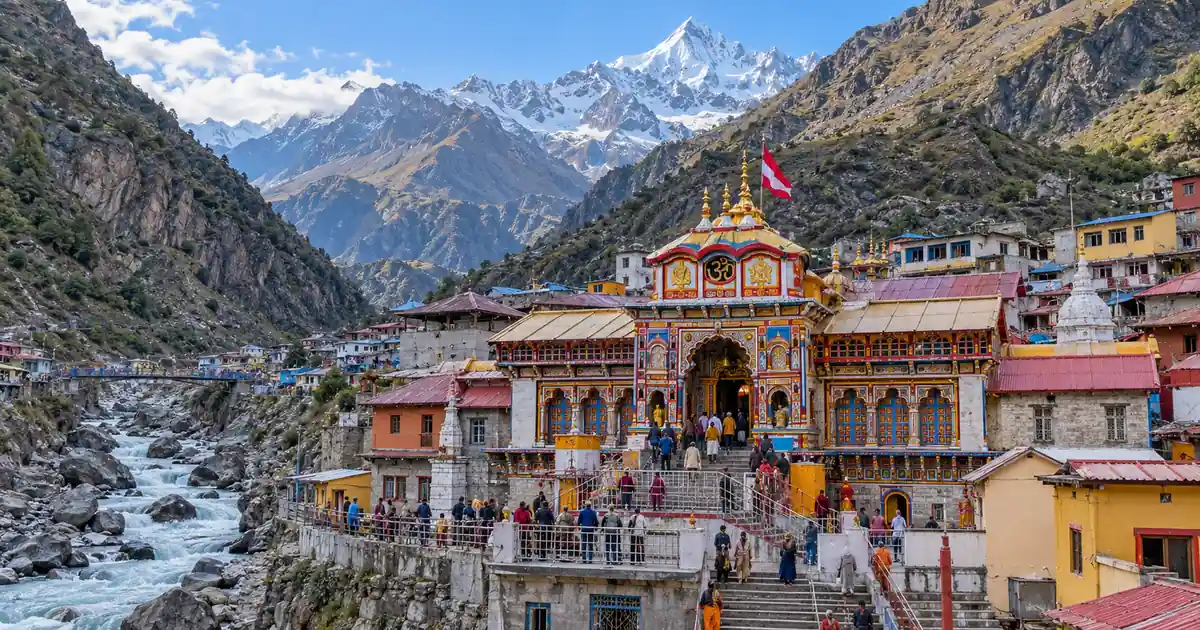
Badrinath Temple stands as the most revered Himalayan sanctuary of Lord Vishnu in India. Rising along the roaring, turquoise waters of the Alaknanda River, this ancient shrine is situated in the Garhwal Himalayas of Uttarakhand, flanked by the twin mountain ranges of Nar and Narayana. Directly behind the temple rises the snow-covered pyramidal peak of Mount Neelkanth, creating a striking natural mountain amphitheater.
Known historically as Badrikashram, the site has attracted sages, ascetics, and spiritual seekers for thousands of years. Consecrated in its present form by the eighth-century philosopher Adi Shankaracharya, the temple features a unique cultural synthesis: a North Indian mountain sanctuary whose hereditary head priest (Rawal) is traditionally chosen from the Nambudiri Brahmin families of Kerala in southern India.
Pilgrims journeying to Badrinath encounter a landscape steeped in sacred geography. Here, thermal sulfur springs bubble beside glacial river torrents, ancient rock caves preserve memories of the composition of the Mahabharata, and winding mountain passes lead toward the high Tibetan plateau.
This complete guide details the seasonal opening and closing cycle, daily darshan schedules, Tapt Kund bathing rituals, mandatory registration rules, and an excursion to Mana Village, the historic border settlement just three kilometers beyond the shrine.
Sacred Himalayan Geography of Badrinath Dham
Badrinath occupies a high mountain valley in the Chamoli district of northern Uttarakhand, approximately 300 kilometers northeast of Rishikesh. As detailed in our comprehensive Uttarakhand travel guide, the shrine forms the northern terminus of the state’s mountain highway corridors. The temple sits at an elevation of 3,133 meters above sea level, where mountain air is crisp and cold throughout the year.
The temple’s physical setting holds profound spiritual significance in classical Hindu cosmology:
- The Alaknanda River: Flowing directly beside the temple compound, the Alaknanda is one of the two primary headstreams of the holy River Ganga. Its glacial waters originate at the confluence of the Satopanth and Bhagirathi Kharak glaciers just seventeen kilometers upstream.
- Mount Nar and Mount Narayana: The temple valley is flanked by two towering granite mountain ridges. Mount Nar, rising to the east, symbolizes human effort and austerity. Mount Narayana, rising to the west, represents divine grace and supreme spiritual consciousness.
- Mount Neelkanth (The Blue Throat): Rising to an elevation of 6,596 meters directly behind the temple, this pyramid-shaped, glaciated peak is affectionately known as the “Garhwal Queen.” At dawn, the first rays of the morning sun strike the snowy summit of Neelkanth, illuminating it in brilliant shades of amber and gold.
- Dual Char Dham Standing: Badrinath is the only sacred site in India that belongs simultaneously to both major Char Dham pilgrimage networks: the ancient pan-Indian Bada Char Dham established by Adi Shankaracharya (with our featured Puri Jagannath Temple guide anchoring the eastern shore, Rameshwaram in the south, and Dwarka in the west), and the high-altitude Uttarakhand Chota Char Dham circuit (comprising Yamunotri, Gangotri, Kedarnath, and Badrinath).
Regional geography archives maintained by the Chamoli District Administration emphasize the sensitive ecological setting of the Alaknanda gorge. Deep mountain ravines, birch forests, and alpine meadows characterize the landscape, which remains buried under heavy snowpack throughout the winter months.
Historical Origins and Adi Shankaracharya’s 8th-Century Consecration
The sacred antiquity of Badrinath spans millennia of Indian spiritual history. The site is praised across classical Sanskrit literature, including the Rigveda, the Bhagavata Purana, the Skanda Purana, and the Mahabharata, with regional temple records preserved in the Chamoli District History Archives.
According to sacred tradition, Lord Vishnu performed intense austerities at this mountain retreat.
To shelter him from harsh Himalayan blizzards and freezing winds, his consort Goddess Lakshmi assumed the form of a wild jujube tree (Badri in Sanskrit), spreading her leafy branches over him. Moved by her devotion, Vishnu named the sanctuary Badrikashram, declaring that Lakshmi would always be honored here alongside him.
During the early medieval period, the original shrine was damaged during regional conflicts, and the sacred black stone deity was cast into the deep currents of the Alaknanda River. In the eighth century CE, the philosopher and reformer Adi Shankaracharya journeyed across the subcontinent to revive Vedic traditions.
Upon arriving in the Garhwal Himalayas, Shankaracharya discovered the sacred self-manifested (Swayambhu) idol of Lord Badri Narayan resting on the riverbed at Narad Kund. He retrieved the holy image and formally re-consecrated it inside a rock cave near the thermal springs.
In the sixteenth century, the King of Garhwal constructed a permanent stone temple at the current site to house the deity. Subsequent structural restorations were carried out by royal patrons from Jaipur and Gwalior following regional earthquake tremors.
To preserve cultural continuity across distant regions of India, Adi Shankaracharya instituted a unique tradition. The head priest of Badrinath, known as the Rawal, must always be a Nambudiri Brahmin hailing from Kerala in southern India.
For more than twelve centuries, this unbroken lineage of South Indian priests has conducted daily rituals inside this high Himalayan sanctuary, creating an enduring bridge between the northern mountains and the southern coast.
Distinctive Mountain Architecture and Temple Shrines
The architectural design of Badrinath Temple presents a striking contrast to classical Dravidian stone cathedrals and traditional Nagara sikhara temples. Positioned in a high alpine valley subject to heavy winter snowfalls and freezing blizzards, the structure combines durable stone construction with colorful Himalayan mountain woodwork.
Architectural Structure of the Temple Complex:
- The Singhdwar (Lion Gate): The outer entrance features a brightly painted, arched gateway topped by small conical pinnacles. Painted in vivid red, green, yellow, and blue colors, this ornate facade creates a cheerful focal point against the barren mountain slopes and grey river stones.
- The Sabha Mandapa: A spacious outer hall constructed of stone where pilgrims assemble before moving into the inner sanctum line.
- The Darshan Mandapa: The intermediate pillar-supported hall where priests sit to accept offerings and distribute sacred tulsi leaves and prasad.
- The Garbhagriha (Sanctum Sanctorum): The innermost sacred chamber, capped by a gold-gilded conical canopy (Chhatra) reaching roughly fifty feet high.
The primary deity inside the sanctum is a one-meter-tall black stone carving of Lord Badri Narayan, sculpted from rare Saligram stone. Unlike typical standing representations of Vishnu holding a conch and discus, the idol at Badrinath depicts the deity seated in a meditative, cross-legged padmasana (lotus posture).
His hands rest peacefully in his lap in deep meditative dhyana mudra, symbolizing supreme inner contemplation. The deity is flanked by fifteen companion stone murtis, including Kubera (the lord of wealth), the divine sage Narada, Uddhava, and a golden image of Garuda, Vishnu’s celestial eagle mount.
Tapt Kund Thermal Springs: Sacred Bathing and Purification Rituals
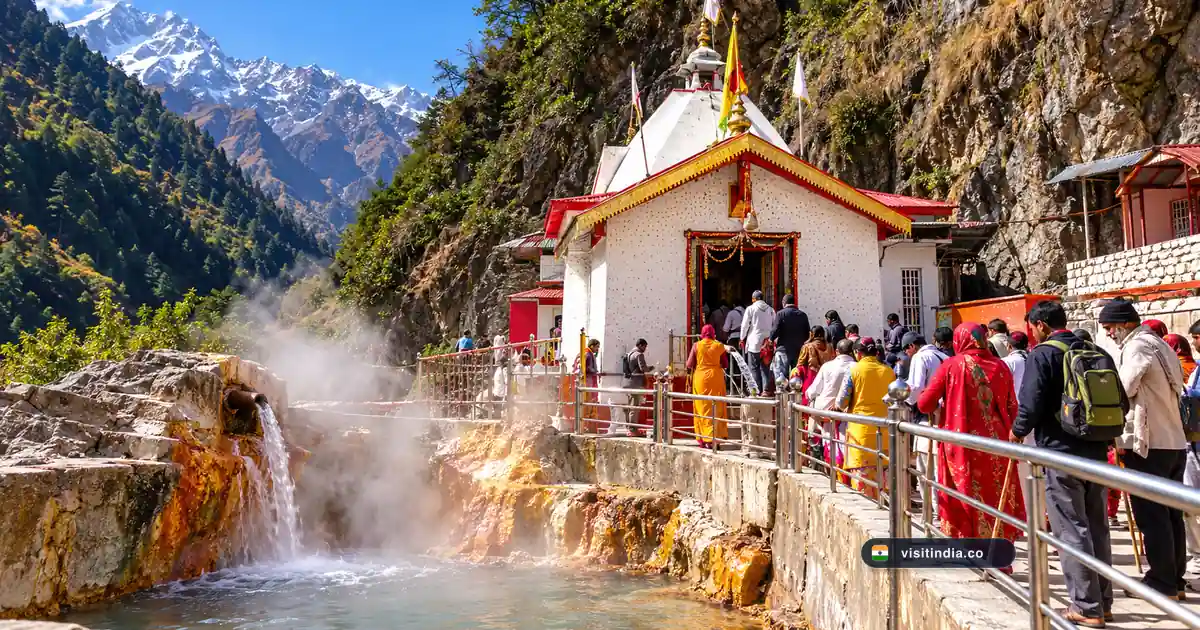
Directly below the temple terrace, along the rocky banks of the Alaknanda River, lies one of the most astonishing natural geothermal wonders of the Himalayas: Tapt Kund.
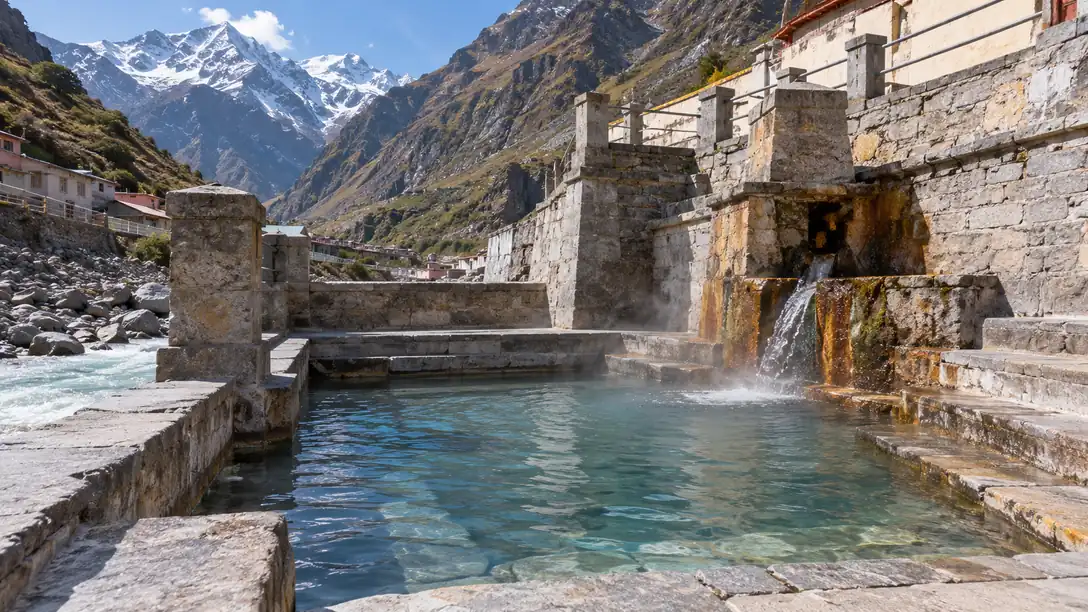
Tapt Kund is a natural thermal sulfur spring where hot mineral water bubbles out from subterranean volcanic fissures at a constant temperature ranging between 45°C and 55°C (113°F to 131°F). The spring provides a remarkable natural contrast: while the Alaknanda River flows just a few feet away with icy glacial runoff near 2°C, the waters of Tapt Kund steam continuously in the mountain air.
Purification Protocols and Sacred Beliefs:
- Ritual Cleansing Before Darshan: Pilgrims traditionally take a holy dip in the steaming waters of Tapt Kund before ascending the stone staircase to the temple. The sulfur-infused water is believed to possess natural therapeutic properties that relieve joint fatigue and refresh travelers after arduous mountain journeys.
- Separate Bathing Enclosures: Temple authorities and the municipal board maintain tiled, railed bathing tanks with separate enclosed sections for male and female pilgrims, fed by continuous running spring outlets.
- Narad Kund and Surya Kund: Adjacent to Tapt Kund are two companion springs. Narad Kund is the cool freshwater cove from which Adi Shankaracharya retrieved the sacred Saligram idol. Surya Kund is another small thermal outlet dedicated to the Sun God.
Pilgrims with sensitive skin or cardiovascular conditions should test the water temperature with their hands before stepping into the main pool, as the fresh sulfur spring discharge can feel intensely hot during early morning hours.
Annual Opening and Closing Dates: The Kapat Cycle and Winter Seat
Because Badrinath is situated at an altitude exceeding 10,000 feet, the entire town is covered in deep snow throughout the winter months, making the highway impassable from December through April. Consequently, the temple observes a strict six-month operational cycle.
The exact dates for the opening and closing of the temple doors (Kapat) are determined each year according to traditional astronomical calculations:
1. Kapat Opening (Kapatodghatan)
The formal date for the opening of the temple doors is calculated every year on the auspicious day of Basant Panchami (usually in late January or early February) by royal astrologers at the palace of the Tehri Garhwal dynasty. The opening ceremony invariably takes place on or around Akshaya Tritiya in late April or early May.
A ceremonial procession brings the Utsav Murti (processional idol) of Lord Badrinath up the mountain highway from its winter seat in Joshimath. On the opening morning, the Rawal and temple trustees perform elaborate Vedic pujas, unlock the massive temple doors amid the blowing of conch shells, and welcome the first wave of Char Dham pilgrims.
2. Kapat Closing (Kapat Samapan)
The date for the winter closing ceremony is calculated on the day of Vijayadashami (Dussehra) in October. The closing ritual takes place in late October or mid-November, typically on the day following Bhai Dooj.
The closing ritual is deeply moving. The Rawal dresses the idol of Badri Narayan in a warm woolen blanket woven by the women of Mana village. The priest fills an ancient earthen oil lamp (Akhand Diya) with pure cow’s ghee and lights it inside the sealed sanctum.
According to ancient belief, the gods and celestial sages continue the worship of Lord Badrinath throughout the snowy winter months. When the temple doors are unlocked six months later in May, priests and pilgrims discover that the ghee lamp inside the sealed chamber is still burning brightly.
3. The Winter Seat at Joshimath
During the six months when Badrinath is buried under snow, worship of the deity moves to the historic town of Joshimath, situated forty-five kilometers down the mountain valley. The sacred processional deity is installed at the ancient Narsingh Temple in Joshimath, where regular daily pujas and darshans continue uninterrupted throughout the winter season.
Travelers who wish to connect the sacred traditions of Badrinath with other revered Himalayan sanctuaries can also study darshan rules for the twelfth Jyotirlinga at Kedarnath Jyotirlinga and Shiva Temple. The Kedarnath shrine shares an identical seasonal opening and closing cycle across the neighboring Mandakini river valley.
Daily Darshan Schedule, Special Poojas, and BKTC Booking Guidelines
Planning your daily schedule carefully is essential for a peaceful darshan experience at Badrinath, particularly during peak pilgrimage weeks in May, June, and October.
Official schedules established by the Uttarakhand Tourism Badrinath administration divide the day into two distinct worshipping windows:
- Morning Darshan Hours: 4:30 AM to 1:00 PM (Daily)
- Midday Break (Sanctum Closed): 1:00 PM to 4:00 PM
- Evening Darshan Hours: 4:00 PM to 9:00 PM (Daily)
- Sanctum Closure and Shayan Aarti: 8:30 PM to 9:00 PM
| Daily Ritual / Pooja | Scheduled Time | Spiritual Nature of the Ritual | Devotee Participation |
|---|---|---|---|
| Maha Abhishek | 04:30 AM - 06:30 AM | Sacred bath with saffron, milk, and sandalwood paste | Advance ticket booking required via BKTC |
| Gita Path | 06:30 AM - 07:30 AM | Recitation of verses from the Bhagavad Gita | Prior online registration required |
| General Morning Darshan | 07:30 AM - 01:00 PM | Free queue darshan for all general pilgrims | Accessible via queue token system |
| Afternoon Bhog & Break | 01:00 PM - 04:00 PM | Deities offered cooked naivedyam; sanctum closed | Outer courtyard accessible |
| Evening Darshan | 04:00 PM - 08:30 PM | General public darshan and evening arati | Accessible via general queue |
| Shayan Aarti | 08:30 PM - 09:00 PM | Final evening flower decorations and lullaby | Open for seated attendees inside mandapa |
Special Pooja Bookings:
Devotees wishing to sit inside the sanctum for the sacred Maha Abhishek or Gita Path must book pooja slots in advance through the official online portal of the Badrinath-Kedarnath Temple Committee (BKTC). Because morning pooja slots are strictly limited to thirty devotees per day to prevent overcrowding, online reservations open two to three months before the pilgrimage season begins and fill rapidly.
General darshan is completely free for all pilgrims. During peak months, local authorities operate an automated electronic token distribution system near the bus terminal, assigning pilgrims specific one-hour time windows to join the main queue, thereby eliminating the fatigue of standing in lines for six hours. For devotees combining nearby shrines on the same trip, Chopta Tungnath Chandrashila Trek darshan and timings outlines practical temple hours and local access.
Mandatory Char Dham Registration, Health Safety, and Acclimatization
To manage pilgrim movement and prevent overcrowding along narrow mountain highway corridors, the Government of Uttarakhand enforces mandatory biometric registration for every traveler visiting Badrinath.
Registration Rules and Procedures:
- Free Online Registration: Pilgrims must register online through the official Uttarakhand Tourism Tourist Care portal (
registrationandtouristcare.uk.gov.in) or via the official “Tourist Care Uttarakhand” mobile app before arriving in the state. - Required Details: Registration requires uploading a valid government photo identity card (Aadhaar card, passport, or voter ID) and specifying planned travel dates and transport vehicle numbers.
- The Yatra QR Code Slip: Upon successful registration, the portal issues a unique QR code slip that must be saved on your smartphone or printed as a paper pass.
- Physical Verification Checkpoints: Police and transport officers scan the QR pass at designated highway verification counters in Haridwar, Rishikesh, Devprayag, and Pandukeshwar. Vehicles without valid registration passes will be turned back.
High-Altitude Health Precautions and Acclimatization:
At an altitude of 3,133 meters, the atmospheric pressure is significantly lower, and oxygen availability decreases by roughly thirty percent compared to coastal plains.
- Acclimatization Strategy: Never attempt to drive directly from sea-level plains to Badrinath in a single day. Break your journey by spending an overnight rest stop at Joshimath (1,890 meters) or Pipalkoti (1,300 meters) to allow your respiratory system to adjust gradually to mountain elevations.
- Symptoms of Acute Mountain Sickness (AMS): Mild headache, nausea, dizziness, and shortness of breath upon exertion are common initial signs. Rest quietly, drink plenty of warm water, and avoid strenuous hill climbs during your first afternoon in Badrinath.
- Hydration and Warmth: Drink three to four liters of warm fluids daily, including ginger tea, warm water, and clear soups. Heavy thermal woolens, thermal innerwear, a windproof outer jacket, woolen caps, and gloves are mandatory, as evening temperatures regularly plunge below 4°C even during mid-summer.
For comprehensive details on planning a complete Himalayan pilgrimage loop across all four mountain sanctuaries, consult our master Char Dham Yatra travel guide.
Mana Village Excursion: India’s First Village, Sacred Caves, and Waterfalls
No pilgrimage to Badrinath is complete without journeying three kilometers further up the valley to Mana Village. Situated at an elevation of 3,200 meters, Mana is historically celebrated as the last inhabited Indian settlement before the Indo-Tibetan border, officially redesignated by the Government of India as “India’s First Village.”
Mana is inhabited by the indigenous Bhotia tribal community, renowned for their generational agro-pastoral livelihoods, carved wooden handicrafts, and hand-knitted sheep wool garments (pashmina shawls, mufflers, and rugs). Devotees drawn to high Himalayan border routes can also read our permit guide to the Adi Kailash and Om Parvat Yatra in eastern Kumaon.
Key Spiritual and Cultural Attractions in Mana:
1. Vyas Gufa (The Cave of Veda Vyasa)
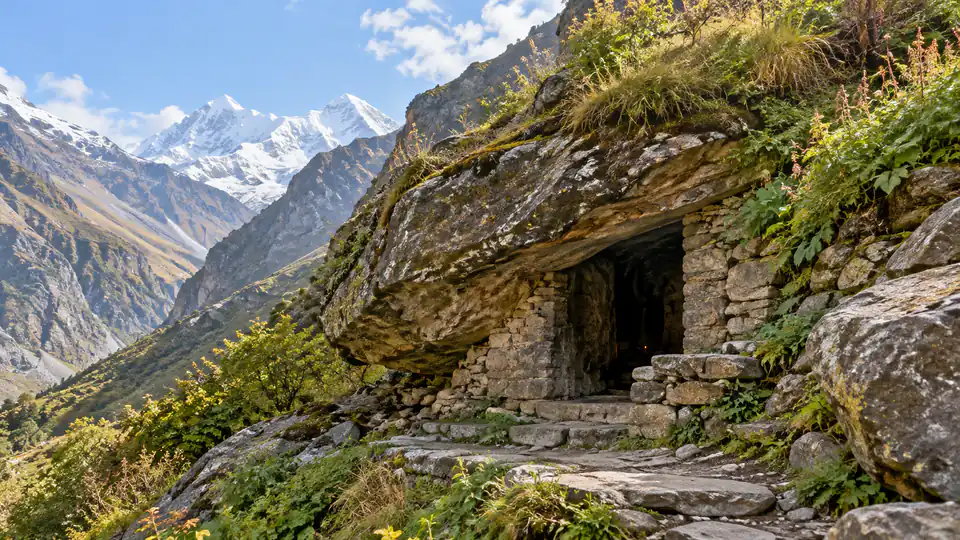
Perched on a rocky hillock in Mana village, Vyas Gufa is a natural rock-hewn cave where Maharishi Veda Vyasa is believed to have resided thousands of years ago. According to sacred tradition, it was inside this tranquil stone cave that Vyasa compiled the four Vedas, composed the eighteen Puranas, and dictated the massive 100,000-verse epic of the Mahabharata.
The cave features a distinctive geological formation: the outer rock layers above the cave entrance resemble the thin, layered pages of an ancient palm-leaf manuscript (Vyas Pothi). Inside the cave rests an ancient murti of Sage Vyasa, attended by resident ascetics.
2. Ganesh Gufa
Located just a few paces below Vyas Gufa, Ganesh Gufa is the small natural rock cave where Lord Ganesha is said to have served as the divine scribe for Maharishi Vyasa. Because Vyasa composed the verses of the Mahabharata at extraordinary speed, Ganesha broke his own divine tusk to use as an unbroken pen, writing down the epic verses without pause.
3. Bhim Pul and the Roaring Saraswati River
Further down the village path, visitors encounter Bhim Pul, an extraordinary geological marvel. The sacred Saraswati River, fed by high glacial snowfields, cascades out of a narrow stone crevice with deafening force before vanishing into the ground to join the Alaknanda at Keshav Prayag.
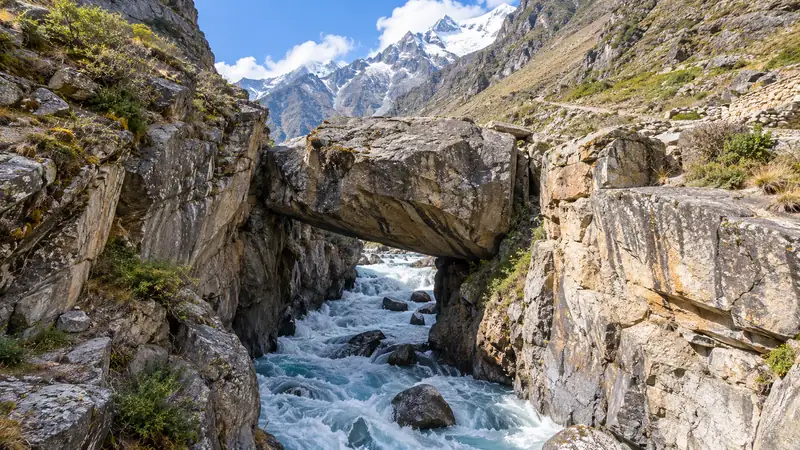
To span the deep, impassable stone gorge, the mighty Pandava brother Bhima is said to have lifted a colossal, flat granite boulder and placed it across the chasm, creating a natural rock bridge so that his wife Draupadi could cross safely during their celestial ascent to Mount Swargarohini. The massive stone slab remains in place today, allowing pilgrims to walk safely across the roaring river torrent.
4. Vasudhara Falls
For adventurous travelers with good stamina, a scenic five-kilometer hiking trail leads beyond Mana village to Vasudhara Falls. Plunging 400 feet down a sheer granite precipice against glaciated peaks, the waterfall spray creates a refreshing mist.
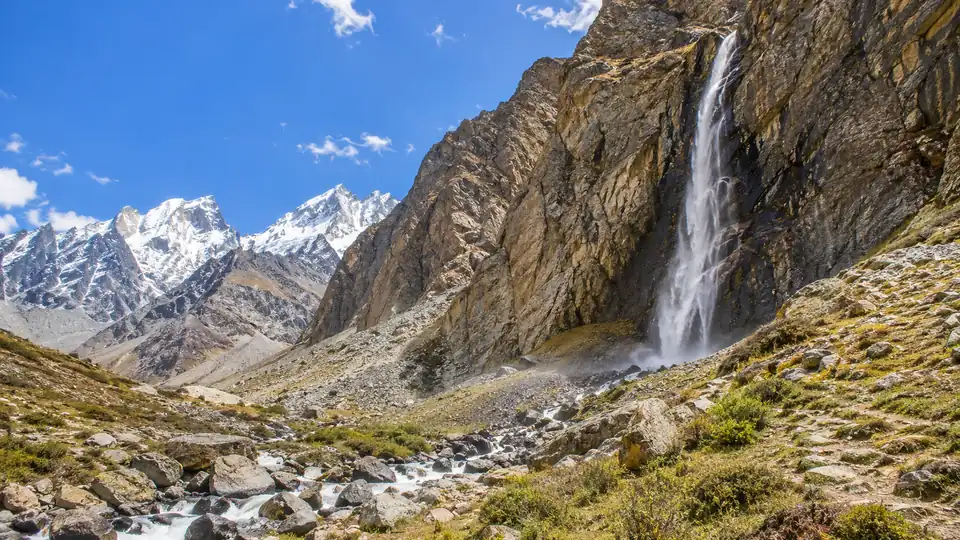
According to local lore, the sacred waters of Vasudhara veer away from individuals who harbor impure thoughts. The round-trip trek requires three to four hours of steady walking along an unpaved mountain footpath.
| Attraction in Mana | Distance from Badrinath | Primary Significance | Recommended Time |
|---|---|---|---|
| Vyas Gufa | 3.2 kilometers | Ancient cave where the Mahabharata was composed | 30 minutes |
| Ganesh Gufa | 3.1 kilometers | Rock sanctuary where Ganesha scribed the epic | 20 minutes |
| Bhim Pul | 3.5 kilometers | Colossal natural rock bridge over Saraswati River | 30 minutes |
| Keshav Prayag | 3.4 kilometers | Sacred confluence of Saraswati and Alaknanda rivers | 30 minutes |
| Vasudhara Falls | 8.0 kilometers | 400-foot glacial waterfall along alpine trail | 3 to 4 hours round trip |
Curated 4-Day Badrinath Pilgrimage Itinerary from Haridwar and Rishikesh
Driving from the plains of Haridwar or Rishikesh to Badrinath covers roughly 295 kilometers of winding mountain roads along National Highway 07. To prevent driver fatigue and avoid the hazards of mountain night driving, this classic four-day circuit offers the ideal balance of safety, spiritual darshan, and sightseeing.
Day 1: Rishikesh to Joshimath via the Sacred Confluences (250 km / 8 to 9 Hours)
- 6:00 AM to 7:00 AM: Depart Rishikesh early along the four-lane NH07 Char Dham highway.
- 8:30 AM to 9:15 AM: Pause at Devprayag to witness the sacred confluence where the muddy waters of the Alaknanda meet the clear currents of the Bhagirathi to form the holy River Ganga.
- 11:00 AM to 1:00 PM: Drive past Srinagar and stop at Rudraprayag (confluence of Alaknanda and Mandakini) for lunch.
- 2:30 PM to 4:00 PM: Cross Karnaprayag (Alaknanda and Pindar confluence) and Nandaprayag (Alaknanda and Nandakini confluence).
- 5:30 PM to 6:30 PM: Arrive in Joshimath (1,890 meters). Check into your hotel. Visit the ancient Narsingh Temple, the winter seat of Lord Badrinath, before enjoying dinner and an early night.
Day 2: Joshimath to Badrinath, Tapt Kund, and Evening Darshan (45 km / 2 Hours)
- 7:30 AM to 8:30 AM: Enjoy breakfast with mountain views. Drive down past Vishnuprayag (confluence of Alaknanda and Dhauliganga) and ascend through the granite gorge toward Badrinath.
- 10:30 AM to 11:30 AM: Arrive in Badrinath town (3,133 meters). Check into your GMVN tourist lodge or ashram.
- 12:00 PM to 1:30 PM: Rest quietly in your room to acclimatize to the high elevation. Enjoy a warm vegetarian lunch.
- 3:30 PM to 4:30 PM: Walk down to the riverbank. Take a holy purification dip in the hot mineral waters of Tapt Kund.
- 5:00 PM to 7:30 PM: Enter Badrinath Temple for evening darshan. Admire the black Saligram idol of Badri Vishal, receive sacred tulsi prasad, and sit inside the mandapa for the Shayan Aarti.
Day 3: Morning Temple Pooja, Mana Village Excursion, and Return to Pipalkoti (80 km)
- 5:30 AM to 7:30 AM: Attend early morning darshan or the sacred Maha Abhishek inside the temple. Watch the first golden rays of sunlight illuminate the snow-clad summit of Mount Neelkanth.
- 8:30 AM to 9:30 AM: Enjoy hot tea and breakfast in town.
- 9:45 AM to 1:00 PM: Drive three kilometers to Mana Village. Explore Vyas Gufa, Ganesh Gufa, and the roaring chasm of Bhim Pul. Sample tea at “India’s First Tea Shop” and purchase handmade woolens from Bhotia artisans.
- 1:30 PM to 2:30 PM: Return to Badrinath for lunch, pack your luggage, and begin the descending drive.
- 4:30 PM to 5:30 PM: Arrive in Pipalkoti or Rudraprayag for an overnight stay at a comfortable lower altitude.
Day 4: Return Drive to Rishikesh and Haridwar (165 km / 6 Hours)
- 7:30 AM to 1:30 PM: Enjoy a scenic drive down the Alaknanda highway, stopping for photography and riverside tea breaks along the way.
- 2:30 PM: Arrive back in Rishikesh or Haridwar in time for your evening express train or flight from Dehradun airport.
Travelers looking to balance high-altitude temple pilgrimages with lower-elevation wildlife wilderness can also plan a combined wildlife safari at Jim Corbett National Park in Uttarakhand. Situated in the Himalayan foothills of the Nainital district, Corbett offers dense sal forests and Royal Bengal tiger habitats.
| Day | Starting Point | Primary Destinations & Activities | Night Halt | Driving Distance |
|---|---|---|---|---|
| Day 1 | Rishikesh | Devprayag, Rudraprayag, Karnaprayag confluences | Joshimath | 250 kilometers |
| Day 2 | Joshimath | Vishnuprayag ascent, Tapt Kund dip, evening darshan | Badrinath | 45 kilometers |
| Day 3 | Badrinath | Morning darshan, Mana village (Vyas Gufa, Bhim Pul) | Pipalkoti | 80 kilometers |
| Day 4 | Pipalkoti | Scenic river valley drive back to the plains | Rishikesh / Haridwar | 215 kilometers |
How to Reach Badrinath by Road, Helicopter, and Railway Transit
Reaching Badrinath requires navigating scenic Himalayan mountain highways that wind through deep river valleys. Recent infrastructure improvements under the Char Dham all-weather highway project have significantly improved road safety, widening corridors and constructing protective avalanche galleries.
Official transport guidance published by Uttarakhand Tourism outlines primary transit options:
- By Road (Self-Drive or Taxi): Badrinath connects directly to Rishikesh via National Highway 07 (NH07), taking nine to ten hours. State buses and private taxis depart daily from Haridwar and Rishikesh stations. Pilgrims starting in the foothills can review sightseeing and ghats in our guide to the top what to see in Rishikesh.
- By Helicopter Services: For elderly pilgrims or travelers with limited time, government-approved aviation operators run helicopter charter packages departing from the Sahastradhara Helipad in Dehradun. Helicopters land at the Badrinath helipad, located just one kilometer south of the temple complex, completing the flight in roughly forty-five minutes.
- By Train: The nearest operational railway stations are Yog Nagari Rishikesh (YNRK), Rishikesh (RKSH), and Haridwar Junction (HW). These stations connect directly to New Delhi, Kolkata, Mumbai, and Lucknow via superfast express trains like the Vande Bharat and Shatabdi Express. Ongoing construction on the Rishikesh-Karnaprayag railway link will soon extend broad-gauge rail connectivity further into the Garhwal mountains.
- By Air: The nearest commercial airport is Jolly Grant Airport (DED) in Dehradun, situated 310 kilometers southwest. The airport handles daily domestic flights from New Delhi, Mumbai, Bengaluru, Hyderabad, and Ahmedabad. Taxis can be hired directly from the arrival terminal to begin the highway drive toward Joshimath.
| Origin City | Distance | Recommended Transit Mode | Typical Driving Time |
|---|---|---|---|
| Joshimath | 45 kilometers | Mountain road drive via NH07 | 2 hours |
| Rudraprayag | 160 kilometers | Highway drive along Alaknanda River | 5 hours 30 minutes |
| Rishikesh | 295 kilometers | All-weather Char Dham Highway (NH07) | 9 to 10 hours |
| Haridwar | 320 kilometers | National Highway via Rishikesh | 10 to 11 hours |
| Dehradun Airport (DED) | 310 kilometers | Airport cab or helicopter charter | 10 hours by road / 45 min by air |
| Kedarnath (Gaurikund) | 215 kilometers | Mountain road drive via Kund and Chopta | 7 to 8 hours |
Frequently Asked Questions About Badrinath Temple
When does Badrinath Temple open and close each year?
The temple opens annually in late April or early May on the auspicious day of Akshaya Tritiya, with the exact date declared on Basant Panchami. The temple closes for the winter season in late October or mid-November around Bhai Dooj. During the snowy winter months, worship continues at Narsingh Temple in Joshimath.
Is biometric registration mandatory for visiting Badrinath?
Yes. The Government of Uttarakhand requires all pilgrims to complete free biometric registration through the official Tourist Care Uttarakhand portal before traveling. A unique QR-code registration pass is issued, which is verified and scanned by authorities at highway checkpoints.
How hot is the water in Tapt Kund, and is bathing safe?
The natural sulfur spring waters of Tapt Kund maintain a constant temperature between 45°C and 55°C (113°F to 131°F). Bathing is safe in the designated tiled enclosures, but visitors should test the water temperature with their hands first and enter gradually to allow their bodies to adjust to the heat.
What is the driving distance between Kedarnath and Badrinath?
The driving distance between Kedarnath (from the roadhead at Gaurikund) and Badrinath is approximately 215 kilometers. The drive takes between seven and eight hours along mountain roads passing through Guptkashi, Kund, Chopta, Mandal, and Chamoli.
What are the best months of the year to visit Badrinath?
The ideal travel windows are May to June (early summer) and September to October (autumn). May and June offer pleasant daytime temperatures between 10°C and 18°C, while September and October feature clear blue skies and crisp mountain air after the monsoon rains recede. The monsoon months of July and August should be approached with caution due to heavy rains and occasional landslides.