Brihadisvara Temple Thanjavur: Timings, 80-Ton Capstone & History
Plan your visit to Thanjavur Big Temple (Brihadisvara) with official timings, pooja schedule, dress code, 80-ton dome engineering, and Chola heritage circuit.
Brihadisvara Temple (Thanjavur Big Temple) Visitor Essentials
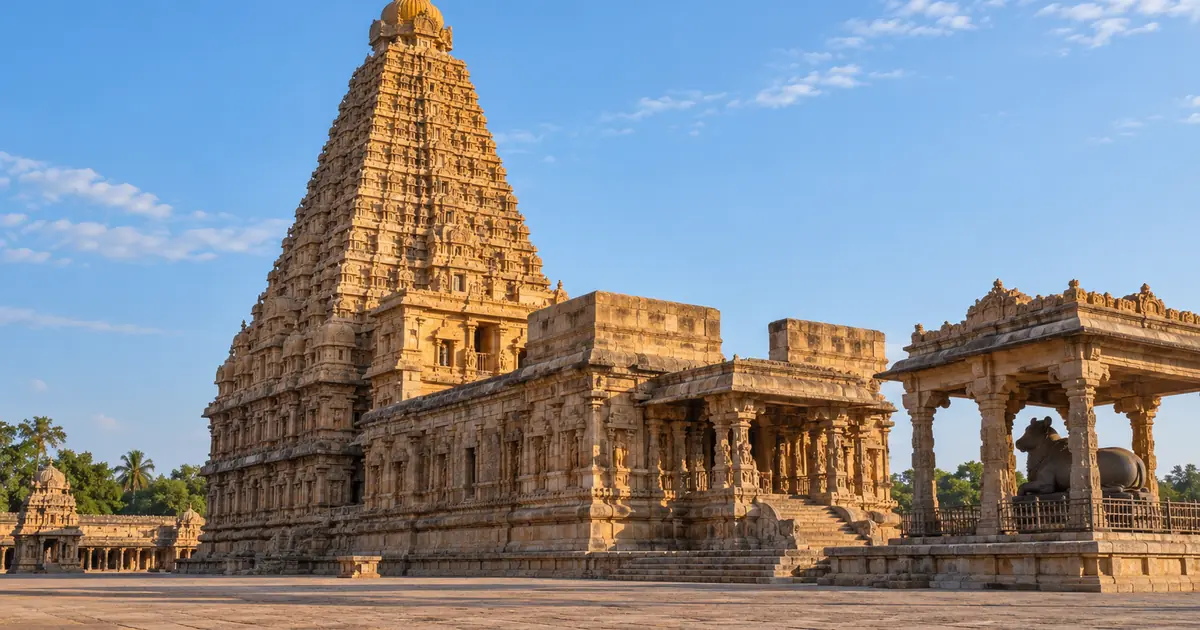
- Monument Status: Dedicated in 1010 CE by Emperor Raja Raja Chola I. Inscribed as a UNESCO World Heritage Site under the Great Living Chola Temples.
- Architectural Scale: The hollow pyramidal Vimana rises 216 feet (66 meters). It is crowned by an octagonal granite capstone (Kumbam) weighing approximately 80 tonnes.
- Temple Timings: Open daily from 6:00 AM to 12:30 PM (morning session) and 4:00 PM to 8:30 PM (evening session). The sanctum remains closed during the afternoon break.
- Entry Tariffs: Admission is completely free for all domestic and international visitors. No advance online reservation or gate fee is required.
- Dress Code: Traditional attire is mandatory. Men must wear dhotis or trousers; women must wear sarees, salwar kameez, or churidars with a dupatta. Shorts and sleeveless clothing are prohibited.
- Location & Transit: Situated in Thanjavur city in the Kaveri Delta region of Tamil Nadu, roughly 55 kilometers east of Tiruchirappalli International Airport.
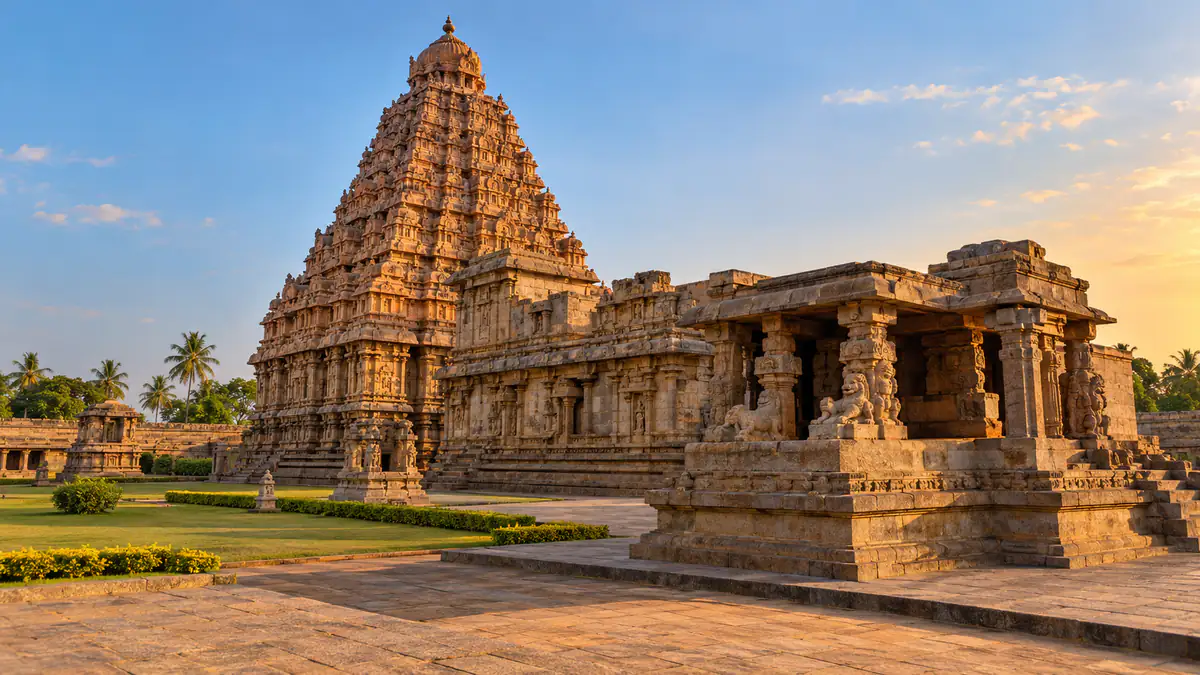
Brihadisvara Temple in Thanjavur stands as the supreme architectural monument of the medieval Chola Empire. Known locally as Peruvudaiyar Kovil or the Big Temple, this monumental sanctuary was conceived by Emperor Raja Raja Chola I and consecrated in 1010 CE. Built entirely of hard granite in an alluvial river basin where no stone quarries exist, the temple represents an extraordinary achievement in engineering, stone carving, and religious geometry.
Rising dramatically over the flat plains of the Kaveri Delta, the central tower reaches 216 feet into the sky. Unlike classical temples where exterior entrance gateways dominate, Brihadisvara places its tallest architectural mass directly above the inner sanctum. Visitors linking the Kaveri Delta with Madurai and Mahabalipuram can map complete regional routes in our Tamil Nadu travel guide.
Travelers visiting the temple experience a rare combination of living Hindu rituals and preserved medieval art. The complex features colossal monolithic sculptures, extensive 11th-century Tamil inscriptions on exterior stone plinths, and classical fresco paintings. This complete guide provides verified daily pooja timings, architectural analysis of the 80-ton dome capstone, dress regulations, and a multi-day itinerary covering the Great Living Chola Temples circuit.
Historical Genesis and Raja Raja Chola I: The 1010 CE Consecration
The construction of Brihadisvara Temple coincided with the military and economic zenith of the Imperial Chola dynasty. Under Raja Raja Chola I, who ruled from 985 to 1014 CE, Chola naval fleets controlled maritime trade across the Bay of Bengal, extending influence toward Sri Lanka, the Maldives, and Southeast Asian trading ports.
In 1004 CE, following decisive military victories across southern India, the emperor ordered the construction of a grand imperial cathedral in his royal capital of Thanjavur. The temple was intended not merely as a regional place of worship, but as a monument celebrating cosmic divine authority and royal sovereignty.
The project required six years of intensive construction, culminating in the formal consecration (Kumbhabhishekam) in 1010 CE, marking the 25th regnal year of Raja Raja Chola I. The emperor named the shrine Rajarajeshwaram (The Lord of Raja Raja). In later centuries, under Maratha and Nayaka rulers, the site became known as Brihadisvara, meaning the Great Lord.
Official heritage archives maintained by the Archaeological Survey of India record that thousands of skilled stonecutters, masons, and sculptors were assembled in Thanjavur.
Because the surrounding Kaveri alluvial delta consists of soft sand and clay, over 130,000 tonnes of granite were quarried from hills near Tiruchirappalli and Pudukkottai, sixty kilometers away. The heavy stones were floated down irrigation canals on wooden rafts and hauled to the site by royal elephant brigades.
Unlike many medieval monuments where royal records focus solely on dynastic conquest, Brihadisvara is unique for its extensive epigraphy. Raja Raja Chola ordered detailed inscriptions to be carved along the polished stone plinths of the temple. These inscriptions document every donation, royal gift, and official appointment made to the temple.
The stone records list the exact names and native villages of 400 temple dancers (talicheripendugal), along with 212 musicians, accountants, cooks, drummers, and garland makers. Each servant was provided with land allotments and daily grain stipends. These inscriptions provide modern historians with an unprecedented record of medieval South Indian administration, economy, and culture.
Dravidian Granite Architecture: The Soaring 216-Foot Sriva Vimana
The architectural design of Brihadisvara Temple marked a radical departure from contemporary Dravidian temple traditions. In classical Pallava and early Chola designs, the tower above the sanctum (Vimana) was kept modest, while entrance gateways (Gopurams) grew progressively taller. Travelers can contrast this monumental scale with earlier seventh-century monolithic rock prototypes and coastal structural shrines in our Mahabalipuram Shore Temple and Pancha Rathas guide.
At Thanjavur, master architect Kunjara Mallan Raja Raja Perunthachan inverted this aesthetic balance. He designed two imposing entrance gateways-the Keralanthakan Gopuram and the Rajarajan Gopuram-but dwarfed them with a colossal central Vimana rising sixteen stepped tiers above the main sanctuary.
Architectural Dimensions and Engineering Data:
- Total Height of Vimana: 216 feet (65.8 meters) from plinth level to the top of the gilded finial.
- Base Footprint: A square stone base measuring 96 feet (29.3 meters) on each side.
- Construction Material: Hard grey and pink granite, assembled entirely through interlocking dry-stone masonry without binding mortar or cementing lime.
- Structural Design: A hollow pyramidal masonry core that reduces downward deadweight while distributing structural loads evenly to the foundation.
- Foundation Depth: Shallow stone foundations anchored into dense subsoil, distributing weight across a wide granite base platform.
- Durability Record: The structure has survived six major documented earthquakes and dozens of regional cyclones over more than 1,015 years without structural displacement.
The Vimana rises with geometric precision. The lower two levels form a massive vertical square block (upapitha and adhisthana) adorned with deep pilasters, niches, and sculpted figures of Shiva in various cosmic manifestations. Above this vertical sanctuary wall rises the thirteen-tier pyramid (tala), narrowing gradually until it reaches the upper square platform.
The balance of horizontal stone courses and vertical recessed bays creates dynamic light and shadow effects across the granite surfaces throughout the day. When the morning sun strikes the eastern face, the golden hue of the aged stone glows warmly against the sky.
A popular folklore myth claims that the Vimana never casts a shadow on the ground at noon. Scientific observation clarifies this phenomenon.
During the midday solar zenith, because the stepped pyramid narrows symmetrically toward the summit, its shadow falls within its own ninety-six-foot base plinth. During morning and late afternoon hours, the tower casts a long shadow across the paved granite courtyard.
The 80-Ton Monolithic Capstone (Kumbam) and the Earthen Ramp Feat
At the pinnacle of the 216-foot Vimana rests the crowning marvel of medieval Indian engineering: the monolithic granite dome capstone, known in temple architecture as the Kumbam or Sikhara. Carved from a single massive block of granite, this octagonal dome weighs an estimated eighty tonnes (approximately 81,000 kilograms).
Resting atop this colossal stone dome is the gilded copper finial (Stupi or Kalasam), which stands over twelve feet high and was originally plated with 3,083 palam of pure gold by Raja Raja Chola I.
How 11th-century builders lifted an eighty-tonne stone block to the height of a modern twenty-story building without cranes or hydraulic machinery remains one of the greatest engineering feats of antiquity. Historians and structural engineers have confirmed the primary construction technique through regional archaeology and oral traditions.
Engineering Mechanisms Used to Lift the Capstone:
- The Inclined Earthen Ramp: Architects constructed a long earthen incline starting at the village of Sarapallam (literally meaning “scaffold depression”), located roughly six kilometers northeast of the temple site.
- Gentle Gradient: By extending the ramp over four to six kilometers, builders maintained a gradual incline gradient of less than four degrees, allowing heavy loads to move without uncontrolled sliding.
- Wooden Rollers and Timber Tracks: The 80-ton block was lashed to timber sledges and maneuvered over grease-lubricated hardwood rollers positioned along the earthen causeway.
- Elephant and Human Teams: Hundreds of trained work elephants, accompanied by thousands of laborers pulling thick hemp ropes, hauled the monolithic stone steadily up the ramp over several months.
- Temporary Structural Scaffolding: As the sixteen tiers of the Vimana grew taller, stone courses were reinforced with packed earth fill that held the stones firmly in place until the capstone was anchored.
- Removal of Earthwork: Once the capstone was aligned and secured with iron dowels, the earthen ramp was dismantled, revealing the completed granite tower.
The precision fit between the sixteen-tier pyramid and the octagonal capstone highlights the extraordinary mathematical skill of Chola guild engineers. The capstone serves not merely as an ornamental crown, but as an essential structural keystone. Its immense downward deadweight locks the upper interlocking granite blocks into perpetual compression, preventing lateral movement during tremors.
The Colossal Monolithic Nandi and the Sacred Maha Lingam Sanctum
Entering the vast paved courtyard through the Rajarajan Gopuram, visitors encounter the iconic Nandi Mandapa. Situated directly on the central east-west axis facing the main sanctum, this sculpted pavilion houses one of the largest monolithic statues of Nandi (the sacred bull) in India.
The colossal bull is carved from a single massive block of dense grey granite. It measures 19.4 feet in length, 12 feet in height, and 8.23 feet in width, weighing roughly twenty-five tonnes. The sculpture portrays Nandi in a seated posture with front hooves folded forward, adorned with carved necklaces, bell-studded chains, and floral garlands.
According to regional administrative records documented by the Thanjavur District Administration, the present sculpted pillared pavilion (mandapam) surrounding the Nandi was constructed in the sixteenth century during the Nayaka dynasty. The Nayaka pavilion features elaborately carved ceiling panels and fluted granite pillars depicting mythological scenes, protecting the monolithic sculpture from direct monsoon exposure.
Behind the Nandi pavilion lies the colossal sanctum sanctorum (Garbhagriha). Passing through the Ardha Mandapa and Maha Mandapa along dimly lit stone corridors, pilgrims enter the two-story sanctum hall.
Sanctum Specifications and Sacred Elements:
- The Maha Lingam: The primary deity, revered as Adavallan or Brihadisvara, is a monolithic granite Shiva Lingam rising thirteen feet (nearly four meters) in height from the sanctum floor.
- The Avudaiyar (Base Pedestal): The circular stone pedestal measures approximately fifty-four feet in circumference.
- Natural Ventilation System: The double-walled ambulatory corridor surrounding the sanctum creates natural chimney airflow, keeping the inner chamber cool even during peak summer temperatures.
- Acoustic Design: The high hollow interior chamber acts as a natural sound resonator, amplifying Sanskrit chants and sacred Vedic mantras during ritual recitations.
Pilgrims exploring historic pilgrimage circuits across Tamil Nadu often connect this Kaveri sanctuary with the sacred coastal shrine at Rameshwaram Jyotirlinga and Ramanathaswamy Temple. Travelers can also trace the five cosmic elements of Shiva across the state using our comprehensive Pancha Bhuta Sthalams circuit guide. Both shrines share profound historical connections with Shaivite traditions and royal architectural patronage.
Chola Murals, Ancient Tamil Inscriptions, and 108 Bharatanatyam Karanas
Beyond its architectural magnitude, Brihadisvara Temple serves as an encyclopedia of classical Indian performing arts and painting. During the construction of the temple, Raja Raja Chola commissioned painters and sculptors to illustrate sacred texts across the walls of the inner sanctum ambulatory corridor.
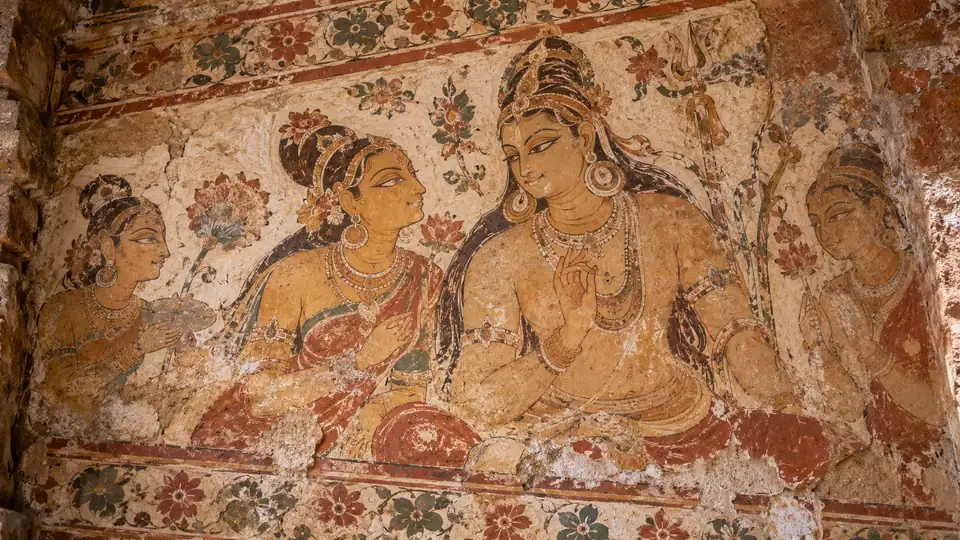
In 1931, Professor S.K. Govindaswami of Annamalai University made a sensational art-historical discovery inside the dark passageways surrounding the Garbhagriha. While examining peeling seventeenth-century Nayaka-era paintings, he discovered that an earlier, magnificent layer of Chola fresco murals lay preserved underneath.
Artistic Treasures Preserved Inside the Temple:
- 11th-Century Chola Frescoes: Masterpieces of early medieval tempera painting executed on wet lime plaster using organic vegetable and mineral pigments. Famous panels depict Lord Shiva as Tripurantaka riding a chariot, Saint Sundarar traveling to Mount Kailash on an elephant, and Emperor Raja Raja Chola standing reverently with his spiritual guru Karuvur Devar.
- 108 Bharatanatyam Karanas: Along the upper gallery corridor above the sanctum wall, sculptors carved 81 bas-relief stone panels depicting the fundamental dance postures (karanas) codified in the ancient Natya Shastra. Students of classical Indian dance comparing these stone karanas often pair their visit with the complete series of 108 sculpted dance postures adorning the gateway gopurams of Chidambaram Nataraja Temple darshan and timings, situated just 100 kilometers northeast.
- Tamil Epigraphical Records: More than one hundred detailed stone inscriptions incised in ancient Tamil and Grantha scripts line the base plinths. These records document land grants, tax revenues, gold jewelry inventories, and administrative decrees.
- Ashta-Dikpalaka Shrines: Eight directional guardian deities carved into specialized perimeter niches around the primary courtyard.
The murals display fluid brushwork, expressive facial gestures, and naturalistic anatomy that rival the famous Buddhist cave paintings of Ajanta. Because light and air exposure can degrade delicate organic pigments, entry to the inner Chola mural corridor is strictly restricted by the Archaeological Survey of India for conservation reasons. However, photographic reproductions and historical documentation are exhibited in the on-site Archaeological Museum located in the southern cloister.
Thanjavur Big Temple Timings, Daily Pooja Schedule, and Entry Regulations
Brihadisvara Temple functions simultaneously as a protected UNESCO World Heritage archaeological monument and an active center of daily Hindu worship. Understanding the daily operational rhythm is essential for planning an efficient visit.
The temple complex opens daily in two distinct sessions: an early morning session and an evening session. The sanctum doors close for three and a half hours during the afternoon for ritual maintenance and deity rest.
Official Operating Hours:
- Morning Darshan Hours: 6:00 AM to 12:30 PM (Daily)
- Afternoon Break (Sanctum Closed): 12:30 PM to 4:00 PM
- Evening Darshan Hours: 4:00 PM to 8:30 PM (Daily)
- Courtyard Access: Visitors can walk around the open stone courtyard between 6:00 AM and 8:30 PM, though the inner sanctum remains shut during the midday break.
| Pooja Kalam | Ritual Name | Scheduled Time | Ritual Description |
|---|---|---|---|
| First Kalam | Palabhishekam / Morning Pooja | 08:30 AM | Sacred milk offering, floral decoration, and morning arati |
| Second Kalam | Uchikaala Pooja / Noon Pooja | 12:00 PM | Midday cooked rice offering (naivedyam) and deeparadhana |
| Third Kalam | Sayarakshai Pooja / Evening Pooja | 06:00 PM | Evening oil lamps lit, instrumental nadaswaram recital |
| Fourth Kalam | Arthajama Pooja / Night Pooja | 08:30 PM | Final sacred offering, deity rest ritual, and sanctum closure |
Entry Tariffs and Booking Rules:
Admission to Brihadisvara Temple is completely free for all domestic Indian pilgrims and foreign visitors. No entry tickets, online darshan passes, or biometric tokens are required. Travelers should ignore unauthorized street touts near the southern car park who claim that fast-track passes must be bought in advance.
Shoe custodial cloakrooms operate near the outer entrance gate, charging a nominal service fee of ₹5 per pair. Free drinking water filtration stations and public restrooms are maintained along the outer perimeter lawn by municipal authorities.
Dress Code Protocol, Footwear Etiquette, and Photography Restrictions
Because Brihadisvara Temple is an active, sacred shrine governed under the Tamil Nadu Hindu Religious and Charitable Endowments (HR&CE) framework, strict behavioral etiquette and dress guidelines are enforced at the entrance.
Dress Code Guidelines for Visitors:
- For Men: Traditional dhotis with an upper cloth (angavastram), or formal trousers/jeans paired with a collared shirt. Traditional veshtis or pajamas are welcomed.
- For Women: Traditional sarees, salwar kameez, or churidars with a dupatta covering the chest. Modern Western clothing that covers both the shoulders and knees is acceptable, but traditional Indian attire is encouraged.
- Prohibited Clothing: Shorts, mini-skirts, sleeveless tank tops, cut-off jeans, beachwear, and tight sportswear are strictly prohibited. Visitors wearing inappropriate clothing will be denied entry at the gateway checkpoint.
Footwear Regulations and Ground Temperature:
Footwear of all kinds-including shoes, sandals, and flip-flops-must be deposited at the shoe storage counter outside the outer moat entrance. No shoes are permitted beyond the outer gateway.
The vast courtyard consists of unpolished granite flagstones. During peak afternoon hours, these stone slabs absorb intense tropical heat and become uncomfortably hot to bare feet.
While temple authorities lay coconut-fiber runner mats along major corridors, visiting during early morning (7:00 AM to 10:00 AM) or late evening (4:30 PM to 7:00 PM) is far more comfortable. Carrying clean cotton socks helps protect sensitive feet on warm stone surfaces.
Photography and Electronics Etiquette:
- Courtyard and Exterior Photography: Handheld still photography and smartphone pictures of the Vimana, Nandi mandapa, and surrounding pillared cloisters are freely permitted.
- Inner Sanctum Ban: Photography and videography are strictly barred inside the inner Maha Mandapa and the primary Garbhagriha. Mobile phones should be silenced or stored in bags when entering the sanctum line.
- Drones and Heavy Equipment: Unmanned aerial vehicles (drones) and commercial tripod equipment are strictly prohibited across the entire monument perimeter without prior written authorization from the Archaeological Survey of India.
Travelers who appreciate grand Dravidian temple architecture and religious traditions can also review darshan rules for the historic twin-sanctuary complex at Meenakshi Amman Temple in Madurai. Madurai sits just 160 kilometers southwest of Thanjavur, forming an ideal combined South Indian heritage loop.
The UNESCO Great Living Chola Temples Circuit: Thanjavur, Gangaikonda Cholapuram, and Darasuram
Brihadisvara Temple is the centerpiece of a magnificent triad of imperial Chola sanctuaries designated collectively as the UNESCO World Heritage Site of the Great Living Chola Temples. Visiting all three temples allows travelers to appreciate the artistic evolution of Chola stone architecture across three generations of royal builders.
The three temples span seventy kilometers across the Kaveri Delta and can be explored together within two relaxed days of travel.
1. Gangaikonda Cholapuram (Brihadisvara Temple II)
Located roughly seventy kilometers northeast of Thanjavur near Jayankondam, this temple was built by Emperor Rajendra Chola I (reigned 1014-1044 CE), the brilliant son and military successor of Raja Raja Chola I. After leading a triumphant military expedition to the banks of the sacred River Ganges in northern India, Rajendra founded a new imperial capital named Gangaikonda Cholapuram (“The City of the Chola who Conquered the Ganges”).
The central Vimana rises 180 feet (55 meters). While shorter than its Thanjavur parent, the tower features a graceful concave curving profile rather than a rigid pyramid.
Art historians describe the Thanjavur temple as bold and masculine, while Gangaikonda Cholapuram displays rhythmic, feminine elegance. The sanctuary features stone sculptures of Saraswati, Nataraja, and a panel showing Shiva garlanding his devotee Chandesha.
2. Airavatesvara Temple at Darasuram
Situated thirty-eight kilometers northeast of Thanjavur near the temple town of Kumbakonam, Airavatesvara Temple was constructed in the twelfth century by Emperor Raja Raja Chola II (reigned 1146-1173 CE). Named after Airavata, the white divine elephant of Indra who worshiped Shiva here to cure a celestial curse, this complex represents the miniature jewel of Chola art.
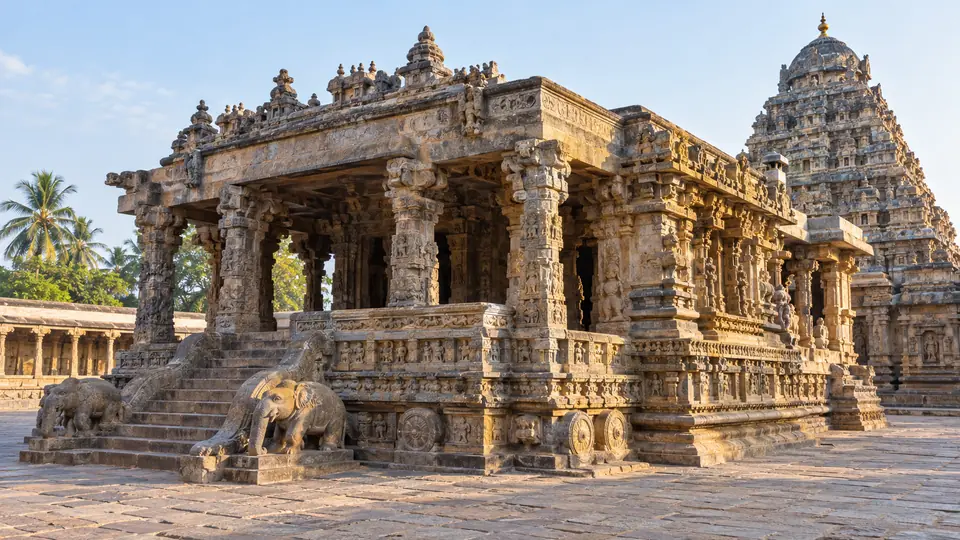
The temple’s front porch (Agra Mandapa) is carved in the shape of a colossal stone chariot drawn by galloping horses and caparisoned elephants, complete with intricate stone wheels and spokes. The stone steps feature musical acoustics that produce distinct musical notes when tapped lightly. The exterior walls are decorated with delicate miniature friezes depicting scenes from the Periya Puranam, narrating the lives of the sixty-three Shaivite Nayanmar saints.
| Monument | Reigning Monarch | Dedication Year | Vimana Height | Architectural Distinctions |
|---|---|---|---|---|
| Brihadisvara (Thanjavur) | Raja Raja Chola I | 1010 CE | 216 feet (66 m) | 80-ton single capstone, monumental 13-ft Lingam, 19-ft monolithic Nandi |
| Gangaikonda Cholapuram | Rajendra Chola I | 1035 CE | 180 feet (55 m) | Graceful concave curving Vimana, lion water well (Simhakinaru) |
| Airavatesvara (Darasuram) | Raja Raja Chola II | 1166 CE | 80 feet (24 m) | Sculpted chariot mandapa with wheels, musical stone steps, miniature friezes |
Curated 1-Day Heritage Itinerary: Big Temple, Maratha Palace, and Saraswathi Mahal Library
For travelers basing themselves in Thanjavur, following an organized daily circuit ensures that you experience the city’s royal architecture, craft workshops, and museum collections without feeling rushed.
Morning Session: The Big Temple at Sunrise
- 6:30 AM to 7:00 AM: Wake early and arrive at the Brihadisvara Temple entrance as morning light begins to illuminate the eastern face of the 216-foot Vimana.
- 7:00 AM to 9:00 AM: Enter the inner sanctum to witness morning darshan and observe the Palabhishekam ritual. Enjoy the peaceful atmosphere in the sanctum corridor before morning tour groups arrive.
- 9:00 AM to 10:15 AM: Walk along the perimeter cloisters to examine the 252 stone Shiva lingams, inspect the Ashta-Dikpalaka shrines, and photograph the monolithic Nandi pavilion.
- 10:30 AM to 11:30 AM: Enjoy a traditional South Indian breakfast at a nearby heritage restaurant, featuring steaming filter coffee, crisp medu vadas, and warm pongal.
Midday Session: Royal Palace Complex and Ancient Manuscripts
- 11:45 AM to 1:15 PM: Drive two kilometers to the Thanjavur Maratha Palace Complex. Explore the Goodagopuram observation tower, the ornate Durbar Hall with its vaulted stucco ceilings, and the Nayak Bell Tower.
- 1:15 PM to 2:15 PM: Tour the famous Saraswathi Mahal Library, one of the oldest medieval libraries in Asia. The museum preserves rare palm-leaf manuscripts, hand-drawn medieval maps, and original musical notations in Tamil, Sanskrit, and Marathi.
- 2:15 PM to 3:15 PM: Enjoy an authentic Thanjavur vegetarian lunch served on a fresh banana leaf, featuring aromatic Kaveri Delta rice, sambar, kootu, rasam, and sweet payasam.
Afternoon Session: Art Bronze Castings and Thanjavur Crafts
- 3:30 PM to 4:45 PM: Visit a traditional lost-wax bronze casting workshop near the old town bazaar. Watch master craftsmen sculpt intricate bronze idols of Nataraja and Parvati using techniques passed down since the Chola era.
- 5:00 PM to 6:00 PM: Browse local artisan emporiums for genuine Thanjavur Art Plates (featuring brass, copper, and silver embossed designs) and bobblehead roly-poly dancing dolls (Thanjavur Thalaiyatti Bommai).
Evening Session: Floodlit Temple Darshan
- 6:30 PM to 8:00 PM: Return to Brihadisvara Temple for evening darshan. As darkness falls, powerful warm floodlights illuminate the 216-foot granite Vimana against the night sky.
- 8:00 PM to 8:30 PM: Sit quietly in the open courtyard to absorb the Sayarakshai pooja bell tolls and the fragrance of temple incense before returning to your hotel for dinner.
Travelers exploring coastal heritage across Tamil Nadu can also combine their Thanjavur journey with a visit to the historic sixteenth-century San Thome Basilica Chennai architecture and heritage. Contrasting classical Dravidian temple craftsmanship with Portuguese Gothic architecture illustrates the remarkable architectural variety of the state.
| Time Window | Activity | Location | Practical Advice |
|---|---|---|---|
| 06:30 AM - 10:15 AM | Sunrise darshan, Vimana exploration | Brihadisvara Temple | Cooler courtyard stones, minimal queues |
| 10:30 AM - 11:30 AM | Traditional South Indian breakfast | Near South Rampart Road | Fresh filter coffee and tiffin |
| 11:45 AM - 02:15 PM | Palace architecture, bronze gallery | Thanjavur Royal Palace & Library | Combined ticket available at gate |
| 02:15 PM - 03:15 PM | Banana leaf thali lunch | City center heritage restaurants | Pure vegetarian Kaveri meals |
| 03:30 PM - 06:00 PM | Bronze workshops, handicraft shopping | Old town artisan quarters | Support certified artisan co-ops |
| 06:30 PM - 08:30 PM | Floodlit darshan, evening Sayarakshai | Brihadisvara Temple courtyard | Extraordinary night illumination |
How to Reach Thanjavur by Air, Train, and Road
Thanjavur is well connected by modern transport networks across the Kaveri Delta region of central Tamil Nadu, making it easily accessible from major domestic and international transit hubs.
Official transit advisories published through Tamil Nadu Tourism highlight multiple travel options:
- By Air: The nearest airport is Tiruchirappalli International Airport (TRZ), situated approximately 55 kilometers west of Thanjavur. Trichy airport operates regular domestic flights connecting Chennai, Bengaluru, and Mumbai, as well as international services to Singapore, Kuala Lumpur, Colombo, and Middle Eastern hubs. Pre-paid taxis and app cabs make the comfortable highway drive to Thanjavur in roughly sixty minutes via National Highway 83. Pilgrims flying into Trichy frequently pair their Thanjavur visit with the colossal island sanctuary at Srirangam Ranganathaswamy Temple darshan and timings, located just ten kilometers from the airport.
- By Train: Thanjavur Junction (railway code TJ) is a major railway hub with direct superfast and express services connecting Chennai Central (Uzhavan Express, Cholan Express), Madurai, Bengaluru (Mysuru Express), Rameswaram, and Tiruchirappalli. The railway station is situated just two kilometers southeast of the Big Temple.
- By Road: National Highway 83 and National Highway 67 link Thanjavur to all major cities in Tamil Nadu. The State Express Transport Corporation (SETC) and Tamil Nadu State Transport Corporation (TNSTC) run frequent air-conditioned and regular express buses connecting Thanjavur with Chennai, Coimbatore, Madurai, Trichy, and Kumbakonam throughout the day.
- Local City Transit: Auto-rickshaws, shared taxis, and local city buses connect the railway station and new bus stand to the temple gate. Ensure auto drivers turn on their digital meters or agree upon standard fares (typically ₹80 to ₹120 for local trips) before departure.
| Origin City | Distance | Recommended Route / Mode | Typical Travel Duration |
|---|---|---|---|
| Tiruchirappalli (Trichy) | 55 kilometers | NH83 four-lane highway (Cab or Bus) | 1 hour |
| Kumbakonam | 38 kilometers | SH64 via Darasuram (Local bus or cab) | 45 minutes |
| Madurai | 160 kilometers | NH383 and NH83 highway road drive | 3 hours 15 minutes |
| Chennai | 345 kilometers | Superfast Express Train or NH32/NH36 | 6 hours to 7 hours |
| Bengaluru (Bangalore) | 390 kilometers | Overnight express train or NH44/NH83 | 7 hours 30 minutes |
Frequently Asked Questions About Brihadisvara Temple
Does the Vimana of Thanjavur Big Temple really never cast a shadow?
The popular claim that the Vimana never casts a shadow is a misunderstanding. During midday when the sun is directly overhead at its solar zenith, the stepped pyramid narrows so symmetrically that its shadow falls within the broad ninety-six-foot base plinth. However, during early morning and late afternoon hours, the 216-foot tower casts a long, distinct shadow across the paved courtyard.
Is there an admission fee or advance online booking required for Big Temple?
Entry to Brihadisvara Temple is completely free for all visitors, including Indian citizens and international tourists. No advance online reservation, entry ticket, or paid token is required. Visitors simply walk through the entrance gate after leaving their footwear at the cloakroom.
What is the best time of day to visit Brihadisvara Temple?
The ideal visiting windows are early morning between 6:30 AM and 9:30 AM, and late afternoon between 4:30 PM and 7:30 PM. Visiting during these hours avoids the intense midday heat when the courtyard stone flagstones become very hot to bare feet, and allows visitors to experience both sunrise illumination and evening floodlit views.
How was the 80-ton granite capstone placed atop the 216-foot tower?
Chola engineers used a massive earthen ramp starting at the village of Sarapallam, approximately six kilometers northeast of the temple. By maintaining a gentle incline gradient, teams of work elephants and laborers using timber rollers and ropes hauled the eighty-tonne monolithic block to the summit before the ramp was dismantled.
How much time is needed to explore the Big Temple complex?
A thorough visit to the temple takes between two and three hours. This provides sufficient time to walk through the outer courtyards, admire the monolithic Nandi, receive darshan in the inner sanctum, inspect the ancient Tamil inscriptions, and view the Ashta-Dikpalaka shrines.
Can Brihadisvara Temple be combined with the Kumbakonam Navagraha circuit?
Yes, Thanjavur sits only 38 kilometers southwest of Kumbakonam, making it a natural gateway. Many pilgrims visit the Big Temple in the early morning before embarking on the 9-shrine Navagraha temples circuit around Kumbakonam across the fertile Kaveri Delta over two days.