Mahabalipuram Shore Temple & Pancha Rathas: Timings, Tickets & ECR Guide
Plan your trip to Mahabalipuram (Mamallapuram) with Shore Temple timings, Pancha Rathas, Descent of the Ganges, ASI ticket fees, and Chennai ECR itinerary.
Mahabalipuram (Mamallapuram) Travel Essentials
- World Heritage Status: Inscribed as a UNESCO World Heritage Site in 1984 under the Group of Monuments at Mahabalipuram.
- Historical Dynasty: Conceived and sculpted during the seventh and eighth centuries under the Pallava monarchs Narasimhavarman I and Rajasimha.
- Ticketed vs Free Zones: A single combined ASI ticket covers both the Shore Temple and Pancha Rathas on the same calendar day. Descent of the Ganges, Krishna’s Butterball, and hillside cave temples are free open-access monuments.
- ASI Entry Fees: ₹40 for Indian citizens and SAARC/BIMSTEC visitors; ₹600 for foreign passport holders. Children below 15 enter free.
- Operating Hours: The Shore Temple and Pancha Rathas are open daily from 6:00 AM to 6:00 PM. Hillside rock monuments remain accessible during daylight hours.
- Scenic Coastal Route: Located 56 kilometers south of Chennai along the East Coast Road (SH49), making it one of southern India’s most popular day trips.
Mahabalipuram, known officially as Mamallapuram, stands on the windswept Coromandel Coast of Tamil Nadu as one of the great open-air architectural museums of Asia. Positioned between saltwater coastal lagoons and the rolling surf of the Bay of Bengal, this ancient port city preserves the earliest stone monuments of southern India.
Here, in the seventh and eighth centuries CE, master sculptors of the Pallava dynasty transformed granite cliffs and whale-back boulders into free-standing temples, rock-cut cave sanctuaries, and colossal narrative bas-reliefs. Travelers combining the Coromandel Coast with interior temple towns and hill stations can explore complete itineraries in our Tamil Nadu travel guide.
The town presents a remarkable progression of Indian sacred architecture. Within a three-kilometer circuit, travelers can trace the historic transition from cave excavation (mandapas) to free-standing monolithic stone carving (rathas), culminating in structural masonry shrines assembled directly beside the sea waves.
Whether you travel from Chennai along the East Coast Road for a day trip or spend a weekend exploring beachside seafood cafes and stone-carving studios, Mamallapuram provides an extraordinary cultural journey. This comprehensive guide details Shore Temple timings, combined ASI ticketing procedures, rock monument symbolism, and a complete 1-day itinerary from Chennai.
Historical Genesis: The Pallava Maritime Seaport of Mamallapuram
Long before stonecutters began carving its coastal granite ridges, Mamallapuram served as the primary deep-water maritime harbor for the Pallava Empire, whose royal capital was based inland at Kanchipuram. Classical Roman coins, Chinese pottery shards, and Greek maritime records confirm that merchant fleets sailed from this coastal port across the Indian Ocean to trade spices, fine cotton, and precious gemstones.
The golden age of monument building began under Emperor Narasimhavarman I, who ruled from 630 to 668 CE. A fearsome military general and athlete, he held the royal title Mamalla, meaning “the great wrestler.” Under his patronage, the city took his name, becoming Mamallapuram.
Following a historic victory over the Western Chalukyas at Badami in 642 CE, Narasimhavarman brought celebrated sculptors and artisans to his coastal seaport. He directed them to transform the exposed coastal granite hills into enduring dynastic monuments; travelers extending their Tamil Nadu road trip from the Coromandel Coast up into the Nilgiris should also check TN e-pass Ooty registration rules before ascending the ghats.
Official monument archives managed by the Archaeological Survey of India highlight that the site served as an experimental architectural laboratory. Pallava guilds used the dense granite formations to practice structural designs, testing dome profiles, column capitals, and figurative reliefs before executing larger permanent projects across Tamil Nadu.
In later European maritime lore, Mamallapuram became famous as the legendary “Seven Pagodas.” British and Portuguese navigators sailing down the Coromandel Coast recorded seeing seven soaring temple spires rising above the palm fringe and ocean breakers.
According to long-standing local folklore, six of these magnificent structural temples were swallowed by the sea during catastrophic ancient storm surges, leaving only the solitary Shore Temple standing on the shoreline today.
The Shore Temple: Twin-Spired Coastal Sanctuary and Tsunami Discoveries
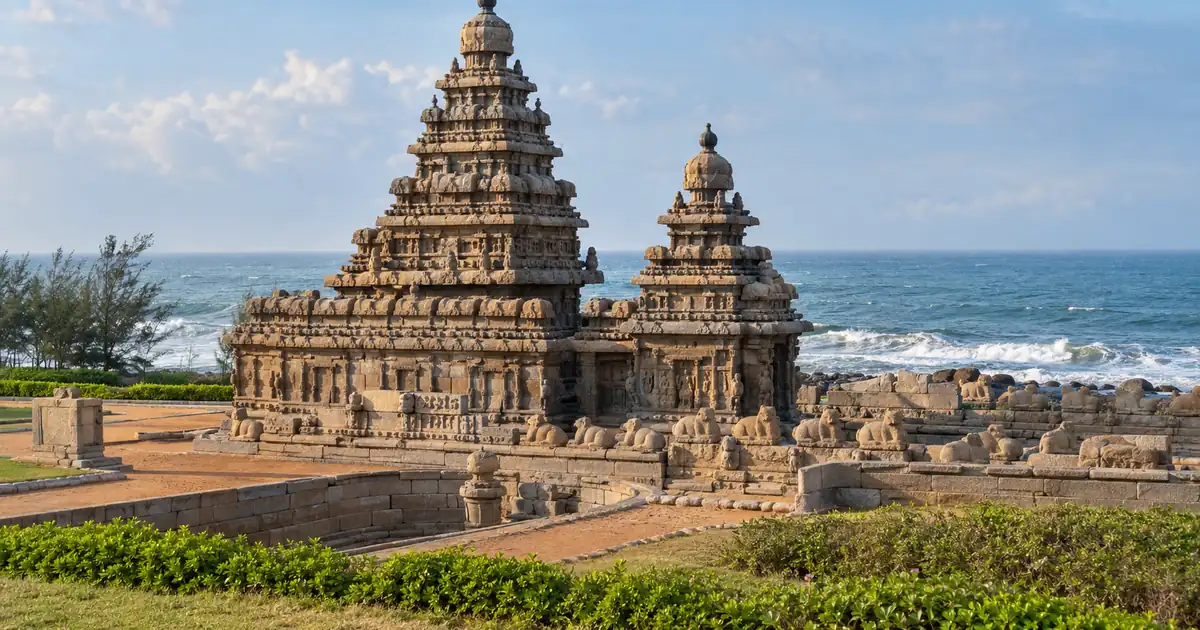
Perched on a rocky promontory overlooking the rolling surf of the Bay of Bengal, the Shore Temple represents the climax of Pallava stone engineering. Unlike the earlier rock-cut caves carved into existing hillsides, the Shore Temple is a free-standing structural masonry shrine built from dressed blocks of local granite and granulite.
Constructed in the early eighth century during the reign of King Narasimhavarman II (also known as Rajasimha, reigned 700 to 728 CE), the complex was designed to function both as an active place of royal devotion and as a visible navigational landmark for inbound merchant galleys.
Architectural Elements of the Shore Temple Complex:
- The Primary Eastern Shrine: Dedicated to Lord Shiva under the name Kshatriyasimhesvara. Its slender pyramidal tower (Vimana) rises five stepped tiers to a height of sixty feet, positioned so that the first morning rays of the sunrise illuminate the inner sanctum across the sea.
- The Western Shiva Shrine: A smaller, companion three-tiered pyramidal tower, also dedicated to Shiva under the royal epithet Rajasimhesvara.
- The Intermediate Vishnu Shrine: Positioned between the two soaring towers is a roofless rectangular sanctum housing a massive rock-hewn carving of Lord Vishnu resting in cosmic sleep (Anantasayana), reclining peacefully upon the serpent Adisesha.
- Perimeter Cloister and Nandi Sculptures: The temple compound is enclosed by a low granite wall topped by dozens of seated monolithic sculptures of Nandi, the sacred bull of Shiva.
- Monolithic Lion Sanctuary: A freestanding granite monolith in the outer courtyard features an open carved chest containing a relief of Goddess Durga, flanked by guardian figures.
The Shore Temple has withstood twelve centuries of relentless ocean winds, salt spray, and abrasive sea sand. Over time, the aggressive maritime climate softened the sharp edges of its exterior carvings, giving the granite surfaces a weathered, timeless appearance.
The catastrophic Indian Ocean tsunami of 26 December 2004 provided astonishing validation for historical legends surrounding the submerged temples. As the ocean water receded hundreds of meters offshore moments before the devastating wave struck, tourists and local fishermen witnessed colossal granite boulders, carved stone walls, and submerged temple structures emerging momentarily from the sea floor.
Subsequent underwater archaeological surveys conducted by the Archaeological Survey of India and the National Institute of Oceanography confirmed extensive submerged ruins. Divers discovered submerged foundation platforms, carved stone lions, and masonry walls stretching several hundred meters into the sea, demonstrating that the Shore Temple was once part of an expansive coastal complex that extended far into the modern harbor.
The Pancha Rathas: Monolithic Chariots Carved from Whale-Back Boulders
Situated one kilometer south of the village center, the Pancha Rathas (literally the “Five Chariots”) constitute one of the most remarkable sculptural achievements in the ancient world. At first glance, the site appears to be a courtyard of five distinct temples.
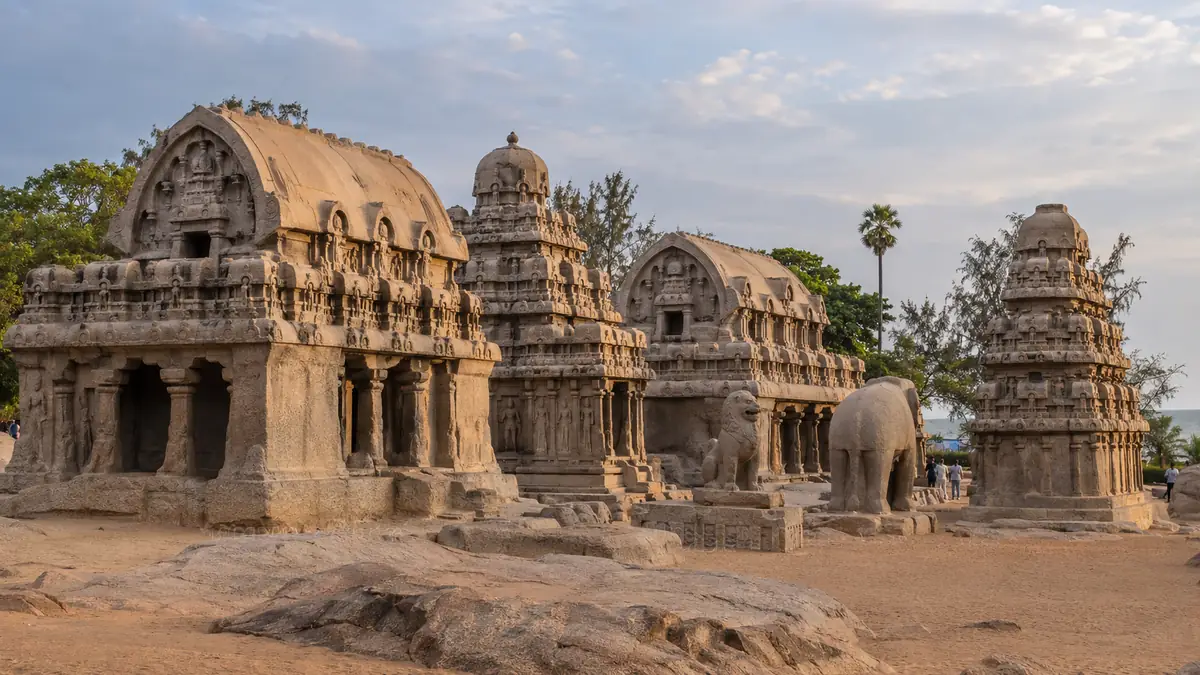
In reality, all five structures, along with three massive animal statues, were carved out of a single continuous outcropping whale-back boulder of grey granite during the reign of Narasimhavarman I in the mid-seventh century.
The temples are commonly named after the heroic Pandava brothers and their shared wife Draupadi from the Hindu epic Mahabharata: Draupadi Ratha, Arjuna Ratha, Bhima Ratha, Dharmaraja Ratha, and Nakula-Sahadeva Ratha. However, these popular titles are later folkloric misnomers.
The shrines bear no direct connection to the epic figures. Instead, they served as full-scale architectural prototypes, each demonstrating a different structural model of contemporary Dravidian temple design.
Architectural Analysis of the Five Chariots:
1. Draupadi Ratha
The smallest and simplest shrine in the group, Draupadi Ratha resembles a traditional thatched mud hut (kutagara) of ancient Bengal and rural Tamil Nadu. Its curved stone roof imitates bamboo thatch, complete with carved imitation cords at the corners. The shrine is dedicated to Goddess Durga, whose four-armed sculpted figure is carved inside the rear wall of the sanctum, surrounded by reverent attendants.
2. Arjuna Ratha
Sharing a raised granite plinth with Draupadi Ratha, the Arjuna Ratha is a classic two-tiered pyramidal Dravidian temple. The exterior walls are decorated with beautifully modeled human figures, including elegant portraits of Pallava royal couples, dvarapalas (door guardians), and representations of Shiva and Vishnu.
3. Bhima Ratha
Positioned directly south, the Bhima Ratha represents a distinctive oblong structure crowned by a barrel-vaulted roof (sala). Measuring forty-two feet in length and twenty-five feet in height, its design resembles an ancient Buddhist chaitya hall, supported by open columned porticos with lion-base pillars.
4. Dharmaraja Ratha
The largest and most architecturally complex monument in the compound, Dharmaraja Ratha rises three tiers above a square ground floor. The tower features miniature roof shrines (kutus) and corner pavilions (karnas). The exterior niches display twenty-eight exquisitely carved sculptures, including Somaskanda, Ardhanarishvara (half-male, half-female Shiva), and an inscribed royal portrait of King Narasimhavarman I.
5. Nakula-Sahadeva Ratha
Situated slightly apart from the main north-south axis, this shrine displays an apsidal, horseshoe-shaped floor plan and roof, known in temple geometry as gajaprishta (resembling the curved back of a seated elephant). Appropriately, an imposing, life-size monolithic elephant is carved from the living rock immediately beside the temple.
| Monument Name | Architectural Form | Number of Tiers | Primary Dedication | Distinctive Feature |
|---|---|---|---|---|
| Draupadi Ratha | Hut-shaped curved roof (kutagara) | Single tier | Goddess Durga | Carved imitation bamboo cords, lion vahana |
| Arjuna Ratha | Stepped square pyramid | Two tiers | Lord Shiva | Elegant royal couple portraits in niches |
| Bhima Ratha | Oblong barrel vault (sala) | Single tier | Reclining Vishnu | Lion-based column portico, open veranda |
| Dharmaraja Ratha | Square stepped pyramid | Three tiers | Shiva / Royal shrine | 28 sculpted panels, early Pallava Grantha inscriptions |
| Nakula-Sahadeva Ratha | Horseshoe apsidal (gajaprishta) | Two tiers | Indra / Kartikeya | Curved elephant-back roof, monolithic stone elephant |
In addition to the five temples, the complex features three life-size monolithic animal statues carved directly from granite outcroppings: a proud standing lion, a powerful war elephant, and a seated Nandi bull positioned behind Arjuna Ratha. Because King Narasimhavarman I died before the project was completed, none of the shrines were consecrated, leaving the interiors empty of installed idols.
Descent of the Ganges (Arjuna’s Penance): The World’s Largest Open-Air Bas-Relief
Situated in the heart of Mamallapuram village beside the main roadside park, the Descent of the Ganges, frequently called Arjuna’s Penance, is recognized as the world’s largest open-air rock-cut bas-relief. Sculpted across two massive natural granite boulders spanning ninety-six feet in length and forty-three feet in height, this colossal relief contains more than one hundred carefully carved figures of gods, humans, celestial beings, and wildlife.
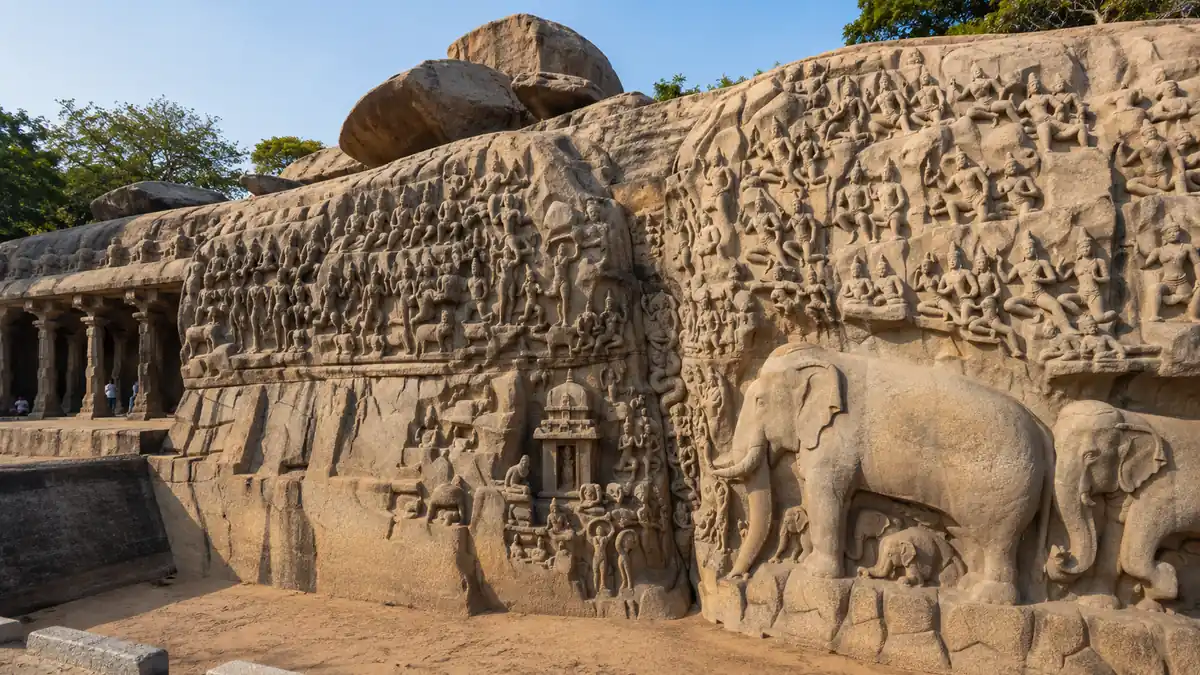
The relief is split down the center by a deep, natural vertical fissure in the rock. During the Pallava era, engineers constructed a masonry water reservoir atop the cliff.
During festival days and ceremonial occasions, water was released down this cleft, cascading into a stone basin below. This flowing water realistically portrayed the descent of the sacred River Ganga from the heavens down to the earth.
Dual Mythological Interpretations:
- The Descent of the Ganges (Bhagiratha’s Penance): According to Hindu cosmology, King Bhagiratha underwent severe penance for a thousand years to bring the purifying waters of the celestial river Ganga to earth to cleanse the ashes of his ancestors. To cushion the immense shock of the falling river, Lord Shiva agreed to catch the torrential flood in his matted locks before letting it trickle gently to the ground.
- Arjuna’s Penance for the Pasupatastra: A parallel interpretation from the Mahabharata suggests the central ascetic figure represents the warrior Arjuna, standing on one leg with arms raised skyward in deep austerities to obtain the celestial weapon Pasupatastra from Shiva. The figure of a four-armed Shiva stands beside the hermit, accompanied by playful ganas (dwarf attendants).
The relief is celebrated for its naturalistic observation of the animal kingdom. On the right boulder, sculptors depicted a life-size family of wild elephants emerging from the forest canopy, with an enormous bull elephant leading a protective mother and baby elephants playing beneath their parents’ legs.
Nearby, monkeys groom each other, mountain deer scratch their noses with their hind hooves, and celestial Gandharvas and Kinnaras float effortlessly toward the central water cleft.
The composition also features delightful wit. Below the hermit, sculptors carved a humorous panel depicting a hypocritical ascetic cat standing on its hind legs in prayer beside the riverbank, pretending to fast, while unsuspecting mice dance merrily at its feet.
Krishna’s Butterball, Hillside Caves, and Rock Sanctuaries
Just two hundred meters northwest of the Descent of the Ganges lies one of the most photographed natural geological novelties in India: Krishna’s Butterball, known locally in Tamil as Vaan Irai Kal (Stone of the Sky God).
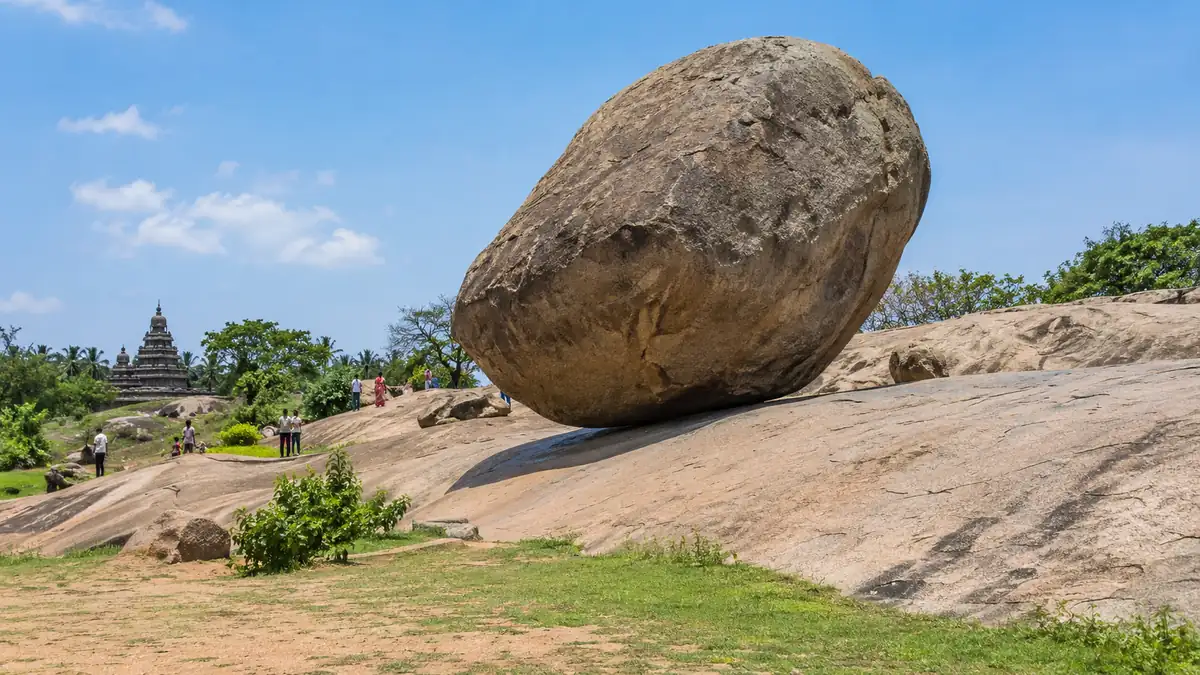
This colossal, spherical granite boulder measures approximately twenty feet in height and sixteen feet in width, weighing an estimated 250 tonnes. The boulder rests on a smooth forty-five-degree natural granite incline, appearing to defy gravity as it balances upon a tiny contact patch of less than four feet.
The boulder has occupied this precarious position for more than twelve hundred years. In 1908, the British Governor of Madras, Arthur Lawley, Lord Ampthill, grew concerned that the massive stone might slide down the slope during a monsoon earthquake and crush residential houses below.
He ordered seven royal work elephants to be harnessed to the boulder with thick chains to pull it down to safe level ground. Despite hours of strenuous pulling, the seven elephants failed to budge the stone by even a millimeter, and the attempt was abandoned. Today, the boulder serves as an iconic backdrop for creative perspective photography.
Beyond the Butterball, the granite hillock is honeycombed with exquisite rock-cut cave temples (mandapas):
- Varaha Cave Temple: A magnificent rock sanctuary featuring four prominent high-relief panels. The most celebrated depicts Lord Varaha (the boar incarnation of Vishnu) raising Goddess Earth (Bhudevi) from the cosmic ocean, surrounded by adoring sages. Another panel shows Vishnu as Trivikrama measuring the three worlds in three cosmic strides.
- Mahishasuramardini Cave Temple: Perched on the southern edge of the hill, this cave contains one of the greatest masterpieces of Indian narrative sculpture. The right wall features a dynamic, full-scale battle scene showing Goddess Durga riding her fierce lion, drawing her bow against the buffalo-headed demon Mahishasura, who recoils in terror. The facing wall portrays Lord Vishnu reclining in yogic sleep (Yoganidra) on the serpent Shesha.
- Krishna Mandapa: A broad, pillared open cave hall that illustrates the pastoral lore of Lord Krishna lifting Mount Govardhana with his left pinky finger to shelter village cowherds, milkmaids, and cattle from an angry torrential storm sent by Indra.
Travelers interested in comparing classical coastal rock architecture with historic Gothic monuments in Tamil Nadu can also tour the nineteenth-century San Thome Basilica Chennai history and mass timings. The basilica sits along the same Coromandel coastal corridor, just fifty kilometers north of Mamallapuram.
Olakkannesvara Temple and the Historic Circular Stone Lighthouse
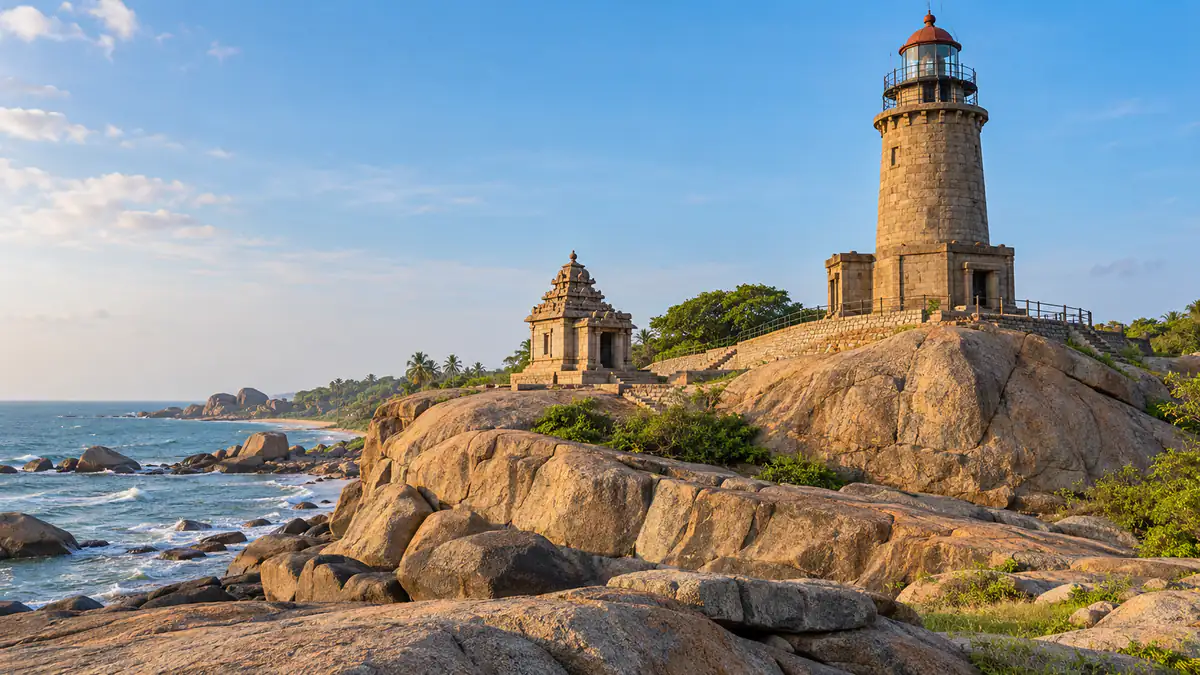
Perched atop the highest granite hillock in Mahabalipuram, directly above the Mahishasuramardini Cave, stands the historic Olakkannesvara Temple. Built in the eighth century under King Rajasimha, this structural granite shrine is dedicated to Lord Shiva. The name translates colloquially to the “Temple of the Flame Eye,” reflecting its historic dual function.
For over a millennium, long before modern navigation equipment existed, Pallava lighthouse keepers maintained a large wood-and-oil bonfire atop the flat masonry roof of Olakkannesvara Temple every night. The fire served as an ancient navigational landmark, guiding merchant ships through dangerous coastal sandbars into the protected Mamallapuram harbor.
Directly adjacent to the ancient stone shrine stands the modern Mamallapuram Lighthouse. Constructed between 1887 and 1904 by British engineers using durable local circular stone masonry, this functioning lighthouse rises ninety-five feet above the hilltop. It emits a powerful flash every ten seconds that can be seen across twenty-four nautical miles.
Visitors can purchase a modest entrance ticket (₹10 for adults) to climb the interior spiral staircase to the open observation gallery at the top. The panoramic vantage point delivers unobstructed views across the entire UNESCO monument landscape: the twin spires of the Shore Temple against the blue ocean, the dense palm canopies of the town, and fishing catamarans bobbing on the waves.
Visiting Hours, Combined ASI Entry Tariffs, and Ticketing Secrets
A common point of confusion for first-time visitors to Mahabalipuram is understanding which monuments require paid admission and which are completely free to enter.
Ticketing Structure Breakdown:
The monuments in Mahabalipuram are divided into two distinct administrative categories:
- Ticketed Enclosures: The Shore Temple and the Pancha Rathas are enclosed archaeological parks maintained by the Archaeological Survey of India (ASI). Entry requires a paid admission pass.
- Free Open-Access Monuments: Descent of the Ganges (Arjuna’s Penance), Krishna’s Butterball, Varaha Cave, Mahishasuramardini Cave, and all hillside rock shrines sit within an open public park and are completely free to enter without tickets.
Official visitor regulations outlined by the Chengalpattu District Administration highlight that a single combined ticket covers both paid monuments on the same date.
The Single Combined Ticket Rule:
When you purchase an ASI entry ticket at the Shore Temple ticket counter (or via the official ASI online QR portal), that exact same ticket grants admission to the Pancha Rathas on the same day. You do not need to buy two separate tickets. Always keep your digital barcode or paper ticket slip safely with you when traveling between the two sites.
| Visitor Category | Tariff (INR) | Scope of Coverage | Booking Method |
|---|---|---|---|
| Indian Citizens | ₹40 per person | Covers both Shore Temple and Pancha Rathas | Online ASI QR scan or counter |
| SAARC and BIMSTEC Citizens | ₹40 per person | Covers both Shore Temple and Pancha Rathas | Valid passport required |
| Foreign Nationals (All Others) | ₹600 per person | Covers both Shore Temple and Pancha Rathas | Online portal or gate counter |
| Children (Below 15 Years) | Free entry | All monument complexes | Age verification at gate |
| Still Camera (Handheld) | Free | Handheld consumer cameras and phones | Included with entry ticket |
| Video Camera Pass | ₹25 | Non-commercial handheld video recording | Ticketed separately at counter |
| Lighthouse Entry Ticket | ₹10 per adult | Access to British lighthouse observation deck | Purchased directly at lighthouse gate |
Visiting Hours and Strategy:
- Operating Hours: The Shore Temple and Pancha Rathas open promptly at 6:00 AM and close at 6:00 PM every day of the week, including Sundays and public holidays.
- Best Hours to Visit: To avoid intense coastal heat and crowded tour buses, visit the Shore Temple at 6:30 AM for magical sunrise lighting over the ocean. Visit the Pancha Rathas around 4:00 PM, followed by an evening sunset stroll around Krishna’s Butterball and the hillside caves.
- Footwear Etiquette: Because these are archaeological monuments rather than active consecrated shrines, visitors are permitted to wear walking shoes throughout the courtyards of the Shore Temple and Pancha Rathas. However, removing shoes when climbing into delicate cave sanctums is requested to protect carved stone floors.
Travelers exploring grand temple architecture across Tamil Nadu can also examine our detailed architectural study of the 216-foot Chola monument at Brihadisvara Temple in Thanjavur. Comparing seventh-century Pallava rock-cut experiments with eleventh-century Chola granite cathedral engineering reveals the extraordinary evolution of Dravidian stonecraft.
Curated 1-Day East Coast Road (ECR) Itinerary from Chennai
The drive from Chennai to Mahabalipuram along the East Coast Road (State Highway 49) ranks among the most enjoyable coastal road trips in India. Following a carefully structured itinerary ensures you experience the best monuments, heritage centers, and coastal cuisine without feeling rushed.
Morning Session: Sunrise at Shore Temple and Monolithic Rathas
- 6:30 AM to 7:45 AM: Depart Chennai early via the East Coast Road. Enjoy sea views and coastal breeze as traffic clears outside the city limits.
- 8:00 AM to 9:15 AM: Arrive at the Shore Temple. Purchase your combined ASI ticket. Walk through the palm gardens to photograph the twin granite towers glowing under the warm morning sunlight with ocean waves in the background.
- 9:30 AM to 10:15 AM: Stop at a local cafe near Othavadai Street for a classic South Indian breakfast of hot idlis, crispy dosas, and fresh filter coffee.
- 10:30 AM to 11:45 AM: Drive one kilometer south to the Pancha Rathas. Use your combined ticket to enter. Examine the five monolithic chariots, admire the monolithic elephant, and study the architectural progression between the shrines.
Midday Session: Rock Relievos, Cave Temples, and Seafood Lunch
- 12:00 PM to 1:15 PM: Walk through the hillside monument complex. Stand before the colossal 96-foot Descent of the Ganges bas-relief to admire the elephant herd and ascetic figures. Walk up the gentle slope to photograph Krishna’s Butterball and explore the Varaha Cave panels.
- 1:30 PM to 2:45 PM: Savor a leisurely coastal lunch at a beachside restaurant along the northern beach strip. Sample freshly caught grilled fish, prawns, and calamari prepared with South Indian coastal spices, or enjoy a traditional vegetarian thali.
Afternoon Session: Lighthouse Panorama and Heritage Craft Studios
- 3:00 PM to 4:00 PM: Climb the hill to the 1904 Mamallapuram Lighthouse. Take the internal spiral staircase to the top for 360-degree views across the Bay of Bengal and town monuments.
- 4:15 PM to 5:15 PM: Stroll down Five Rathas Road to visit traditional stone-carving workshops. Watch generational granite sculptors chisel traditional temple statues using centuries-old techniques. Small soapstone and granite souvenirs make meaningful keepsakes.
- 5:30 PM to 7:00 PM: Begin your relaxed return drive to Chennai along the ECR, optionally stopping at Covelong Beach (Kovalam) or the DakshinaChitra Heritage Museum before entering the city.
Travelers planning an extended circuit through Tamil Nadu can link this East Coast itinerary with the legendary architectural halls of Meenakshi Amman Temple in Madurai. Madurai provides an unforgettable contrast between coastal rock monuments and living medieval temple cities.
| Time Window | Activity | Location | Practical Advice |
|---|---|---|---|
| 06:30 AM - 07:45 AM | Coastal highway drive from Chennai | East Coast Road (SH49) | Leave early to beat suburban morning traffic |
| 08:00 AM - 09:15 AM | Shore Temple sunrise exploration | Shore Temple complex | Buy combined ASI ticket; keep barcode safely |
| 09:30 AM - 10:15 AM | South Indian breakfast break | Othavadai Street cafes | Filter coffee, fresh dosas, relaxed atmosphere |
| 10:30 AM - 11:45 AM | Monolithic Pancha Rathas tour | Five Rathas enclosure | Same ASI ticket valid; inspect elephant statue |
| 12:00 PM - 01:15 PM | Descent of the Ganges & Butterball | Hillside open park | Free admission; wear hat for sun protection |
| 01:30 PM - 02:45 PM | Coastal seafood or vegetarian lunch | Beachfront restaurants | Fresh catch of the day, relaxed ocean breeze |
| 03:00 PM - 04:00 PM | Climb 1904 circular stone lighthouse | Hilltop lighthouse | ₹10 entry pass; panoramic coast views |
| 04:15 PM - 05:15 PM | Stone-carving workshop visits | Five Rathas Road | Support authentic local generational sculptors |
| 05:30 PM - 07:00 PM | Scenic coastal drive back to Chennai | East Coast Road | Optional stop at Covelong or DakshinaChitra |
Before leaving the capital region, visitors can savor traditional South Indian breakfasts, filter coffee, and beach snacks with our Chennai street food and Mylapore tiffin guide.
How to Reach Mahabalipuram by Road, Bus, and Air
Mahabalipuram is exceptionally well connected to Chennai and the broader transport network of northern Tamil Nadu, making access simple and convenient for all travelers.
Transportation Options:
Official transit guidelines documented by Tamil Nadu Tourism highlight several convenient transit modes:
- By Road (Private Car or Taxi): Driving along the East Coast Road (ECR / SH49) is the fastest and most scenic route from Chennai. The 56-kilometer drive takes approximately one hour and fifteen minutes outside morning rush hours, passing beach resorts and backwaters. An alternative route runs via the Old Mahabalipuram Road (OMR / Rajiv Gandhi Salai) through the IT corridor. Pre-booked cabs and app-based taxis (Uber and Ola) operate regular day-return packages from Chennai.
- By State and City Bus: Metropolitan Transport Corporation (MTC) and State Express Transport Corporation (SETC) operate frequent bus services from Chennai directly to the Mahabalipuram bus stand.
- Bus Route 588: Originates from Thiruvanmiyur bus terminus in southern Chennai, running continuously down the ECR every twenty minutes.
- Bus Route 599: Connects T. Nagar bus stand to Mahabalipuram via the OMR expressway.
- Bus Route 102: Connects Broadway Bus Terminus (near Chennai Central) to Mahabalipuram.
- By Air: The nearest airport is Chennai International Airport (MAA), situated roughly 54 kilometers northwest of Mahabalipuram. The airport connects to every major domestic city in India and numerous international hubs across Southeast Asia, Europe, and the Middle East. Pre-paid airport taxis reach Mahabalipuram in roughly seventy-five minutes via the Pallavaram-Thoraipakkam 200 Feet Radial Road and ECR.
- By Train: The nearest railway station is Chengalpattu Junction (station code CGL), located twenty-nine kilometers west. Express trains from southern Tamil Nadu halt at Chengalpattu, from where local state buses and auto-rickshaws reach Mahabalipuram in forty minutes. Major interstate express trains terminate at Chennai Central (MAS) and Chennai Egmore (MS), roughly sixty kilometers north.
Travelers continuing onward into northern Tamil Nadu often connect this coastal corridor with the sacred pilgrimage center at Tiruvannamalai Arunachaleswarar Temple, situated roughly 140 kilometers west via Tindivanam.
| Origin Transit Point | Distance | Recommended Transport Mode | Estimated Travel Time |
|---|---|---|---|
| Chennai City Center (Mylapore) | 52 kilometers | Private car or taxi via East Coast Road | 1 hour 15 minutes |
| Chennai Airport (MAA) | 54 kilometers | Pre-paid airport taxi via ECR | 1 hour 15 minutes to 1.5 hours |
| Chennai Central Railway (MAS) | 60 kilometers | Pre-paid cab or MTC Bus Route 102 | 1 hour 30 minutes |
| Chengalpattu Railway (CGL) | 29 kilometers | Local bus or shared taxi via SH58 | 40 minutes |
| Kanchipuram (Silk Town) | 66 kilometers | State highway bus or private car via SH58 | 1 hour 45 minutes |
| Pondicherry (Puducherry) | 98 kilometers | Scenic coastal highway drive via ECR (NH332A) | 2 hours |
Frequently Asked Questions About Mahabalipuram
Does a single ASI ticket cover both the Shore Temple and Pancha Rathas?
Yes. The Archaeological Survey of India issues a single combined entry ticket that covers both the Shore Temple and the Pancha Rathas on the same calendar day. You do not need to buy two separate tickets. Visitors must retain their ticket slip or digital QR code to scan at the second gate.
Are all the monuments in Mahabalipuram ticketed?
No. Only the Shore Temple and the Pancha Rathas require a paid ASI entry ticket. All other celebrated monuments-including Descent of the Ganges (Arjuna’s Penance), Krishna’s Butterball, the Varaha Cave Temple, and the Mahishasuramardini Cave-are located in an open public park and are completely free to explore.
How far is Mahabalipuram from Chennai, and is it suitable for a day trip?
Mahabalipuram is located 56 kilometers south of Chennai along the scenic East Coast Road. The driving time is approximately one hour and fifteen minutes each way, making it one of the easiest and most rewarding day trips from the state capital.
What is the best season and time of day to visit Mahabalipuram?
The ideal visiting season runs from November through February when coastal winter daytime temperatures remain pleasant between 22°C and 29°C. During any season, the best times of day are early morning between 6:30 AM and 9:30 AM for the Shore Temple, and late afternoon after 4:00 PM for the Pancha Rathas and hillside caves to avoid midday tropical heat.
Are visitors allowed to wear shoes inside the Mahabalipuram monuments?
Yes. Because the Shore Temple and Pancha Rathas are protected archaeological monuments rather than active places of worship, visitors can keep their walking shoes on throughout the courtyards and grounds. Comfortable walking shoes are strongly recommended when walking across sandy pathways and climbing natural granite hills.