Tiruvannamalai Temple & Girivalam: Complete Visitor Guide
Tiruvannamalai Arunachaleswarar Temple and 14 km Girivalam guide. Covers temple timings, 8 lingams route, Pournami full moon dates, and Karthigai Deepam.
Field Advisory & Quick Summary
- The Fire Element (Agni Sthalam): Arunachaleswarar Temple honors Lord Shiva as the fire element among South India’s five sacred elemental shrines. The holy red granite hill of Arunachala is worshipped as an embodiment of Shiva in the form of a cosmic column of light.
- The 14-Kilometer Girivalam: Pilgrims walk barefoot along the sacred 14 km circumambulation roadway encircling the mountain, visiting the eight directional guardian lingams (Ashta Lingams).
- Pournami (Full Moon) Surge: Every full moon night, over 500,000 pilgrims perform the night circumambulation. Peak winter months draw even larger crowds.
- Karthigai Deepam Festival: The annual 10-day celebration in November/December culminates with the lighting of the massive Maha Deepam flame atop the peak of Arunachala at sunset.
- Mandatory Dress Code: Strict traditional Indian attire is enforced. Men must wear dhotis or pyjamas and must remove shirts when entering the inner sanctum. Women must wear sarees or modest salwar kameez with dupattas.
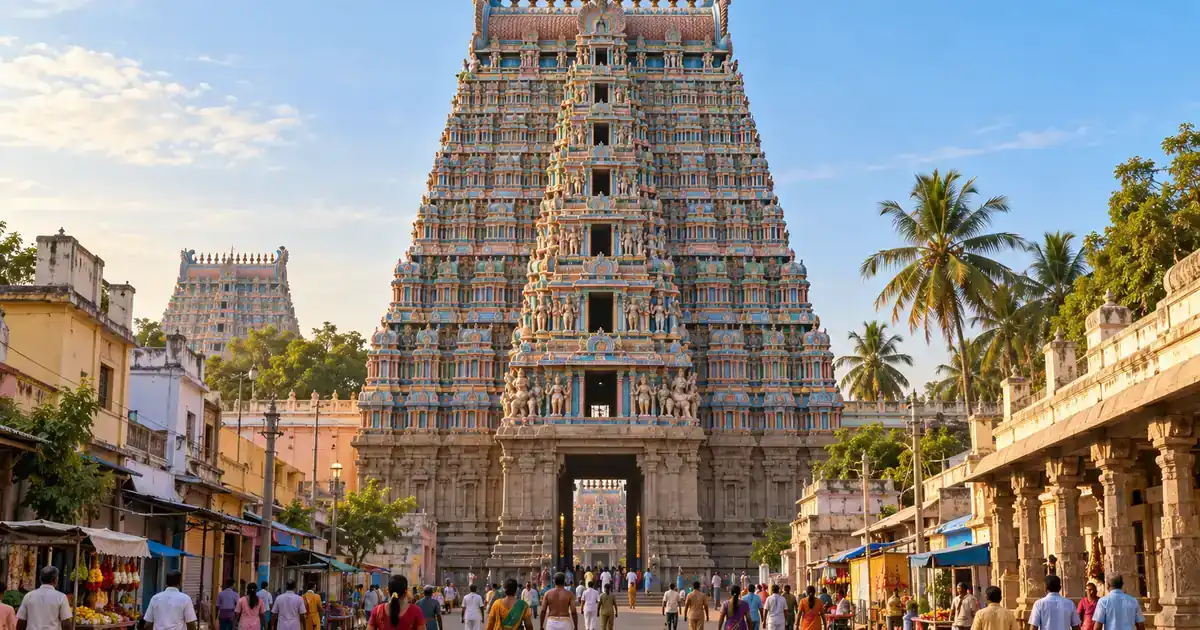
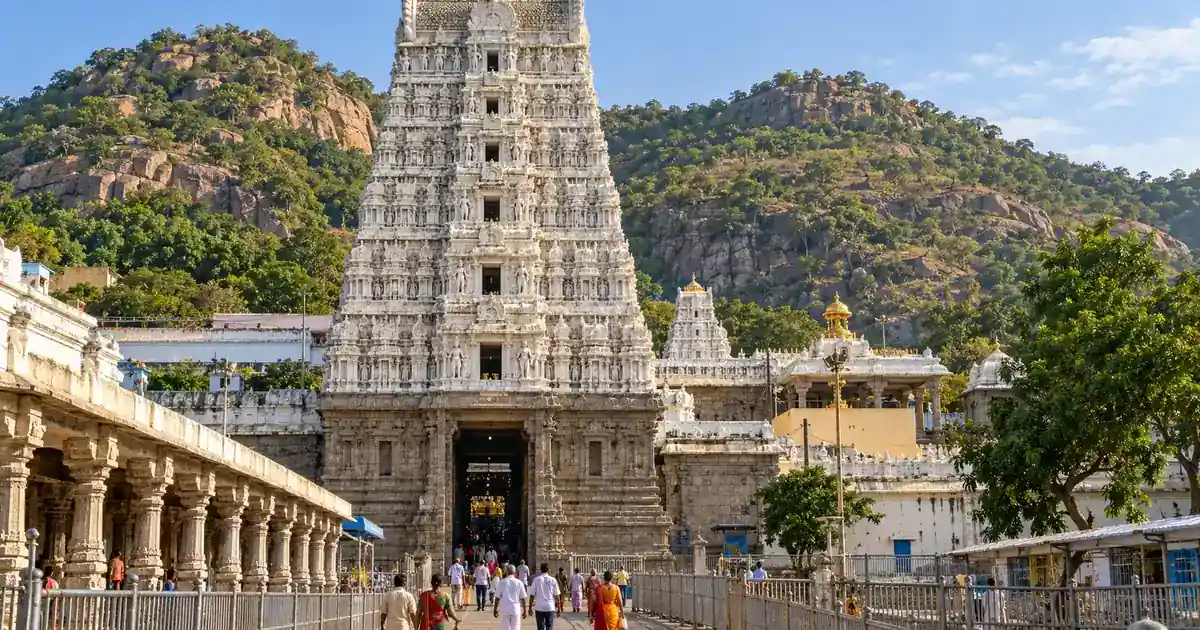
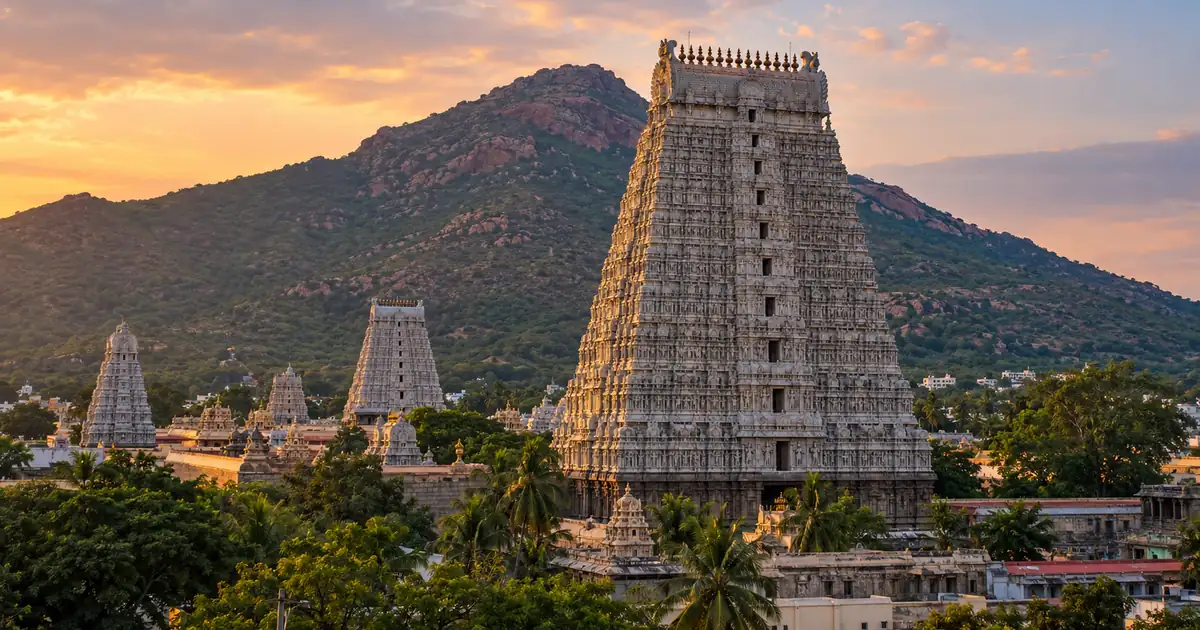
Rising grandly at the base of the sacred volcanic-shaped red granite hill of Arunachala, the Arunachaleswarar Temple (also known as Annamalaiyar Temple) in Tiruvannamalai represents one of the largest and most venerated Shaivite temple complexes in India.
The temple encompasses twenty-four acres of walled stone courtyards, guarded by four soaring outer gateway towers. Its massive eastern Rajagopuram ascends eleven tiers to a height of sixty-six meters (217 feet), dominating the plains of northern Tamil Nadu.
Beyond its monumental Dravidian granite architecture, Tiruvannamalai holds a profound place in Hindu philosophy. While other shrines depict the divine through sculpted bronze or stone murtis, here the mountain of Arunachala itself is revered as the physical manifestation of Lord Shiva.
Devotees seeking to explore the broader regional network of elemental shrines can contrast this sacred fire monument with the elemental sanctuaries mapped in our aarti timings and entry details for Pancha Bhuta Sthalams Circuit.
Cosmic Foundations: Shiva as the Infinite Column of Fire (Agni Sthalam)
In classical Shaivite cosmology, Arunachaleswarar Temple represents the fire element (Agni Lingam) among the five elemental sanctuaries (Pancha Bhuta Sthalams) of South India.
According to ancient Purana scriptures, an argument once arose between Lord Brahma (the Creator) and Lord Vishnu (the Preserver) regarding which deity held supreme cosmic dominion. To dissolve their pride, Lord Shiva manifested between them as a blinding, boundless column of fire (the Jyotirlinga) that stretched through the heavens and the underworld.
| Elemental Aspect | Temple Detail & Theological Principle |
|---|---|
| Cosmic Element | Fire (Agni / Tejas), representing spiritual purification and knowledge |
| Presiding Deity | Lord Arunachaleswarar (Annamalaiyar) and Goddess Unnamalai Amman (Apitakuchambal) |
| Physical Sanction | Swayambhu (self-manifested) Lingam inside the inner granite garbhagriha |
| Mountain Form | Arunachala Hill (814 meters elevation), revered as the solidified column of divine fire |
| Philosophical Focus | Advaita Vedanta (non-dualism), self-inquiry (Atma Vichara), and spiritual liberation |
Brahma assumed the form of a swan and flew skyward to locate the top of the fiery pillar, while Vishnu took the form of a boar (Varaha) and burrowed deep into the earth to find its roots. Neither could discover the limits of the infinite light.
Recognizing their limitations, both gods surrendered to Shiva, who then condensed his blazing radiance into the stationary, sacred mountain of Arunachala. Consequently, pilgrims do not consider Arunachala a mere geological formation of granite, but a living physical form of Shiva.
Ancient Tamil texts, including the Tirumurai composed by Appar, Sambandar, Sundarar, and Manikkavacakar, declare that merely remembering Tiruvannamalai (Smaranath Arunachalam) grants spiritual liberation to the seeker.
Monumental Dravidian Architecture: Gopurams, Mandapams and Sacred Enclosures
The architectural evolution of Arunachaleswarar Temple reflects over a millennium of royal patronage. Early structural stone work began under the Cholas in the 9th century CE, followed by extensive expansions by Hoysala monarchs, Sangama rulers, and Vijayanagara emperors.
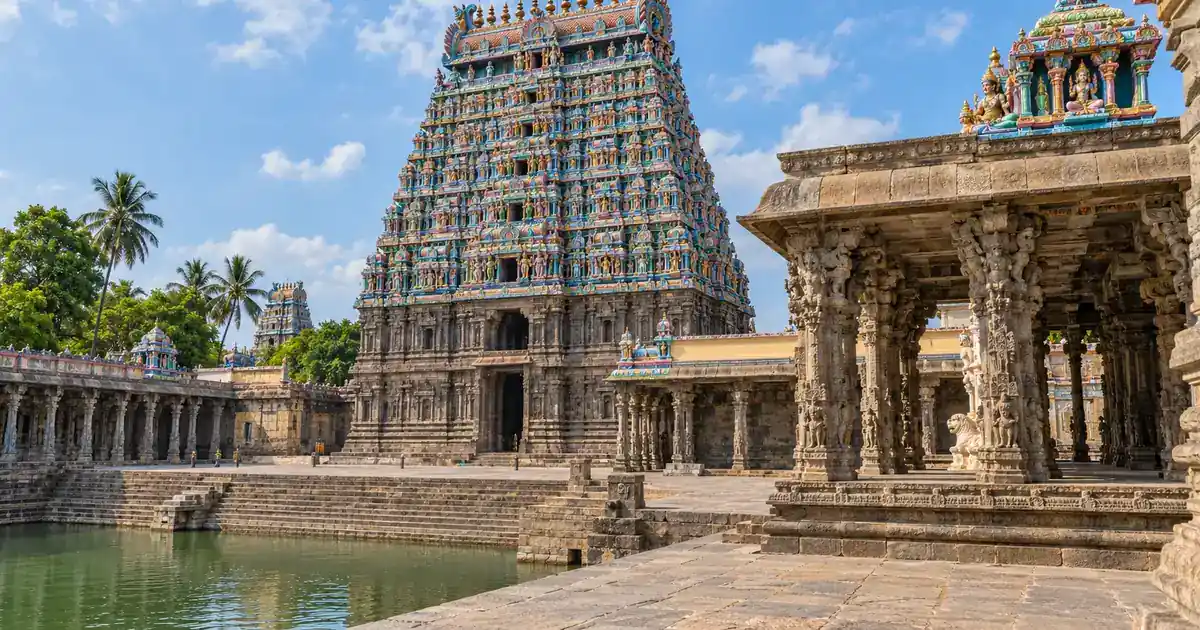
The entire sanctuary covers approximately twenty-four acres and features five concentric courtyards (prakarams), punctuated by nine sculpted stone gateway towers (gopurams).
| Tower / Architectural Structure | Height & Measurements | Historical Dynasty | Architectural Significance |
|---|---|---|---|
| Eastern Rajagopuram | 66 meters (217 feet, 11 tiers) | Vijayanagara (Krishnadevaraya, 1516 CE) | Principal ceremonial gate; second tallest gopuram in Tamil Nadu |
| Western Pey Gopuram | 49 meters (160 feet, 9 tiers) | Vijayanagara Empire | Provides direct axis alignment to the peak of Arunachala Hill |
| Southern Tirumanjana Gopuram | 48 meters (157 feet, 7 tiers) | Chola / Saluva Dynasty | Flanks the holy southern processional gate |
| Northern Ammani Amman Gopuram | 43 meters (141 feet, 7 tiers) | Built by female ascetic Ammani Amman | Distinctive classical proportions on the northern perimeter |
| Thousand Pillar Hall (Aayiram Kaal) | 1,000 carved granite columns | Krishnadevaraya (1516 CE) | Houses the subterranean Patala Lingam meditation chamber |
| Shivaganga Sacred Tank | 100 meters by 60 meters | Nayaka Dynasty | Massive stone stepwell inside the third enclosure |
The eastern Rajagopuram stands as the grand ceremonial entrance. King Krishnadevaraya of Vijayanagara initiated its construction in 1516 CE after his military campaigns, and it was subsequently completed by Sevappa Nayak of Thanjavur.
Inside the vast outer courtyard sits the magnificent Thousand Pillar Hall. Each granite column is carved with detailed reliefs of celestial dancers, rearing yalis, epic scenes, and royal patrons.
Beneath the hall floor lies the dark, subterranean chamber known as the Patala Lingam. It was in this windowless granite vault that the young sage Sri Ramana Maharshi spent months in uninterrupted meditation during the late 1890s, completely absorbed in supreme consciousness.
Travelers admiring the soaring stone craft of Tamil Nadu can study earlier granite engineering milestones in our detailed guide to Brihadisvara Temple in Thanjavur.
The 14-Kilometer Girivalam (Giri Pradakshina): Sacred Circumambulation Route
The defining spiritual ritual of Tiruvannamalai is Girivalam (derived from the Tamil words giri meaning mountain and valam meaning circumambulation). The sacred barefoot walk follows a paved fourteen-kilometer road that encircles the base of Arunachala Hill in a clockwise direction.
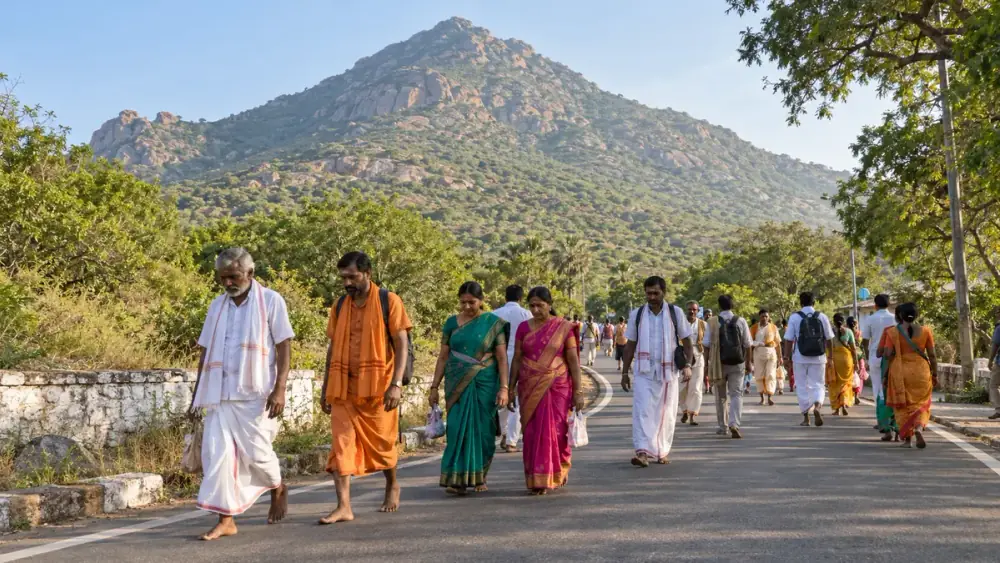
Tradition dictates that pilgrims keep the holy hill to their right side throughout the entire walk. The practice represents the movement of the planets around the sun and centers the pilgrim’s physical and mental awareness upon the divine mountain.
Along the fourteen-kilometer path, pilgrims encounter eight sacred Shiva shrines positioned at precise cardinal and inter-cardinal points. Known as the Ashta Lingams, these shrines were consecrated to represent the eight directional guardians (Dikpalakas).
| Directional Lingam | Compass Direction | Associated Planet | Primary Spiritual Blessing | Location Marker along Route |
|---|---|---|---|---|
| 1. Indra Lingam | East | Sun & Venus | Leadership, social honor, and worldly prosperity | Near the bus terminus, early along the path |
| 2. Agni Lingam | Southeast | Moon | Relief from physical disease and clearing mental obstacles | Beside the Seshadri Swamigal Ashram road |
| 3. Yama Lingam | South | Mars | Longevity, removal of fear of death, and vitality | Past Sri Ramanasramam, quiet tree-lined stretch |
| 4. Niruthi Lingam | Southwest | Rahu | Peace of mind, protection from negative energies | Near the scenic western mountain ridge view |
| 5. Varuna Lingam | West | Saturn | Wisdom, wealth accumulation, and karmic balance | Beside the historic Varuna Theertham tank |
| 6. Vayu Lingam | Northwest | Ketu | Respiratory health, vital energy, and stress relief | Mountain breezes sweep down the granite cliffs |
| 7. Kubera Lingam | North | Jupiter | Material wealth, business success, and abundance | Most crowded shrine; popular among local traders |
| 8. Esanya Lingam | Northeast | Mercury | Spiritual enlightenment, equanimity, and inner peace | Concluding shrine near the cremation grounds |
In addition to the Ashta Lingams, the Girivalam path passes numerous historic shrines and spiritual landmarks. Pilgrims walk past the Surya Lingam, Chandra Lingam, and several sacred water tanks (theerthams).
The road also skirts the peaceful tree-shaded grounds of Sri Ramanasramam, where travelers pause to sit in the silent Samadhi Hall of Bhagavan Ramana Maharshi.
Further along the southern hillside trail, energetic pilgrims can hike up to the historic Virupaksha Cave and Skandashram, natural rock-cut hermitages where Ramana Maharshi lived and meditated between 1899 and 1922.
Pournami (Full Moon) Girivalam: Ritual Mechanics and Pilgrim Tips
While devotees walk the fourteen kilometers on every day of the year, performing Girivalam during Pournami (the night of the full moon) carries extraordinary significance in South Indian spiritual life.
On every full moon night, between 500,000 and 1,000,000 pilgrims converge upon Tiruvannamalai. The entire fourteen-kilometer circular road is closed to vehicular traffic, transforming into a sea of walking pilgrims.
- Walk Direction: Strictly clockwise (hill always on your right side).
- Footwear: Must be performed barefoot on public paved roads.
- Typical Duration: 3.5 to 5 hours at a gentle, mindful walking pace.
- Peak Rush: Midnight to 4:00 AM under the direct light of the full moon.
The spiritual tradition teaches that during the full moon, the rays of the moon interact with the rare herbal flora and mineral-rich granite of Arunachala, generating purifying bio-energetic vibrations that quiet the human mind.
| Practical Aspect | Advisory for Solo & Family Pilgrims | Common Pitfalls to Avoid |
|---|---|---|
| Walking Surface | Smooth asphalt road and concrete tiled pedestrian footpaths | Do not walk on unpaved gravel shoulders; keep to the painted pedestrian lines |
| Hydration & Fluids | Free municipal water kiosks, tender coconut stalls, and herbal tea vendors | Avoid sugary cold drinks; carry an insulated reusable water bottle |
| Foot Preparation | Apply herbal oils or moisturizers before starting; walk on bare feet | Do not wear socks, as thin fabric tears rapidly on rough asphalt sections |
| Crowd Movement | Move with the natural rhythm of the crowd; avoid stopping abruptly | Never try to walk counter-clockwise against the flow of hundreds of thousands |
| Luggage Storage | Leave bags and valuables at your hotel room or registered ashram locker | Do not carry heavy backpacks during the 14 km walk; travel light |
Local district authorities deploy thousands of police personnel, medical rescue posts every two kilometers, mobile ambulances, and temporary sanitization facilities along the entire perimeter.
Official municipal announcements and monthly full moon calendar timings are posted regularly on the Tiruvannamalai District Administration Portal.
The Grand Karthigai Deepam Festival: Lighting the Cosmic Flame
The pinnacle of Tiruvannamalai’s cultural and devotional calendar is the ten-day Karthigai Deepam Brahmotsavam, celebrated during the Tamil month of Karthigai (corresponding to mid-November to mid-December).
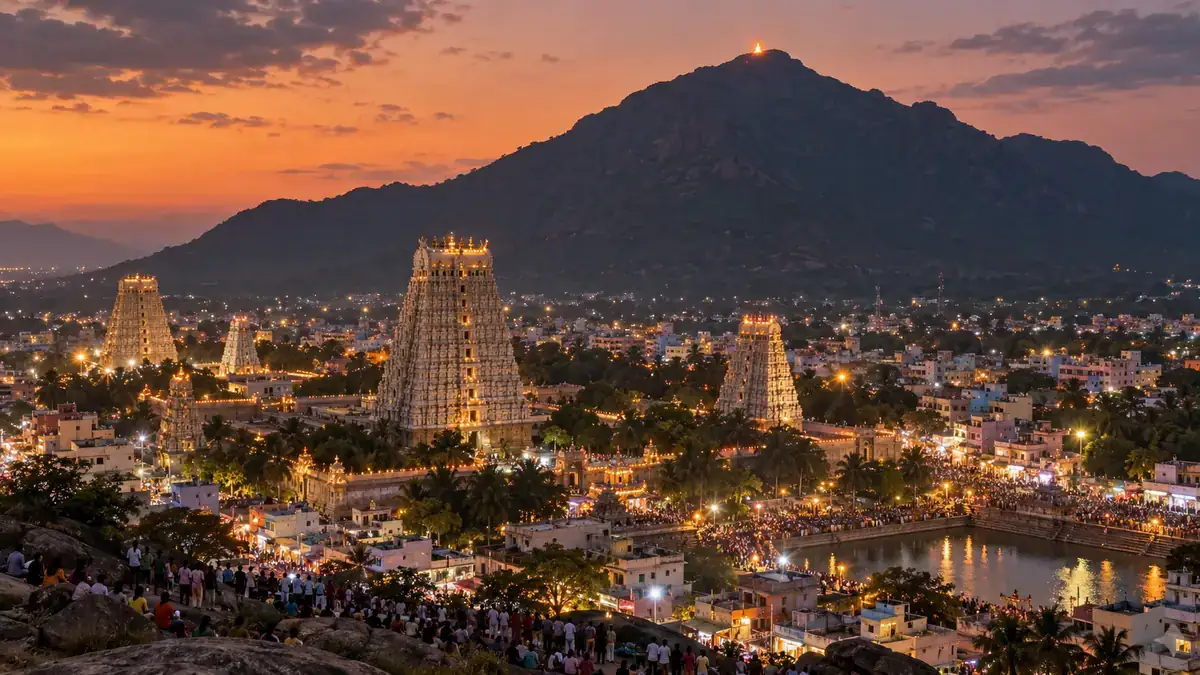
The festival commemorates the mythological occasion when Lord Shiva manifested as the infinite pillar of fire, liberating the cosmos from ignorance.
On the tenth and final day, over three million pilgrims pack the streets and surrounding hillsides of Tiruvannamalai to witness two extraordinary ritual events:
1. Bharani Deepam (Dawn Ritual)
At approximately 4:00 AM on the festival day, a sacred fire is lit inside the inner sanctum sanctorum of Arunachaleswarar Temple before the primary Agni Lingam. Hereditary temple priests offer special prayers and distribute the holy flame to five earthen oil lamps, representing the five cosmic elements.
2. Maha Deepam (Sunset Peak Lighting)
At exactly 6:00 PM, as the sun dips below the horizon and the full moon ascends into the twilight sky, a signal flag is waved from the temple courtyard.
Simultaneously, atop the 814-meter rocky peak of Arunachala Hill, temple fishermen and designated servitors light the Maha Deepam inside a colossal copper cauldron standing five feet tall.
| Festival Metric | Official Specification & Material Requirements |
|---|---|
| Cauldron Vessel | Monolithic pure copper cauldron, 5.5 feet tall and 5 feet wide |
| Ghee Contribution | Over 3,500 to 4,000 kilograms of pure cow ghee donated by devotees |
| Wick Material | Over 2,000 meters of pure woven cotton cloth treated with camphor |
| Visible Range | The blazing flame shines brightly across a radius of 30 to 35 kilometers |
| Burning Duration | The sacred fire continues to burn continuously for 7 to 11 consecutive nights |
When the flame ignites atop the mountain, millions of devotees assembled throughout the town fall to the ground with folded hands, crying out the sacred chant: “Annamalaikku Arogara!” (Praise be to Lord Annamalaiyar).
Following the lighting, thousands of pilgrims begin the 14-kilometer circumambulation under the warm glow of the cosmic mountaintop flame.
Temple Timings, Special Darshan Queues & Ticket Guidelines
Arunachaleswarar Temple functions under the administrative oversight of the Tamil Nadu Hindu Religious and Charitable Endowments (HR&CE) Department. Knowing the daily liturgical schedule prevents unnecessary waiting.
- Morning Session: 5:30 AM to 12:30 PM (Sanctum doors open for Go Pooja and morning darshan).
- Midday Closure: 12:30 PM to 3:30 PM (Sanctum closed; outer courtyards open for transit).
- Evening Session: 3:30 PM to 9:30 PM (Evening sevas concluding with Arthajama Pooja at 9:15 PM).
The temple doors open promptly at 5:30 AM with the ceremonial Go Pooja (worship of the sacred cow). Worshippers can choose between multiple darshan queues depending on available time and physical mobility.
| Darshan Queue Category | Ticket Price per Person | Typical Waiting Time (Weekdays) | Typical Waiting Time (Pournami & Weekends) | Where to Obtain Passes |
|---|---|---|---|---|
| General Dharma Darshan | Free (₹0) | 1.5 to 2.5 hours | 5 to 8 hours | Walk-in through the main eastern Rajagopuram lane |
| Special Entry Darshan | ₹50 per person | 45 minutes to 1 hour | 2 to 3.5 hours | On-site counter near the third enclosure |
| VIP Fast-Track Darshan | ₹200 per person | 20 to 35 minutes | 1 to 2 hours | Dedicated booth at the eastern gopuram concourse |
| Special Abhishekam Ticket | Variable (₹500 to ₹1,500) | Timed seva entry | Advance reservation required | Official HR&CE administrative booking counter |
During peak festival days and monthly full moon windows, general queue waiting times can extend beyond seven hours. Senior citizens and families traveling with infants should utilize the special paid darshan counters to avoid excessive physical fatigue.
Current administrative announcements and online festival schedules can be verified on the Tiruvannamalai District Festival Calendar.
Mandatory Traditional Dress Code and Sanctum Guidelines
In strict accordance with Tamil Nadu temple regulations, all devotees visiting Arunachaleswarar Temple must adhere to modest Indian attire.
Security officers stationed at the outer gopuram gates inspect clothing and will refuse entry to visitors wearing inappropriate garments.
- Male Visitors: Must wear a traditional dhoti (veshti) with an angavastram or a formal cotton kurta and pyjama. While shirts are permitted in the outer courtyards, men are strictly required to remove their shirts and vests before entering the innermost sanctum corridor leading to the Agni Lingam. Jeans, shorts, bermudas, and graphic t-shirts are strictly barred.
- Female Visitors: Must dress in traditional sarees, half-sarees (pavadai), or modest salwar kameez sets with a dupatta draped across both shoulders. Western clothing such as jeans, mini-skirts, sleeveless blouses, and western trousers are strictly prohibited inside the sacred enclosures.
Security and Electronic Device Regulations
- Smartphones and Cameras: Photography and videography are strictly prohibited inside the inner courtyards and sanctum sanctorum. Visitors can deposit mobile phones at secure paid cloakrooms located near the eastern Rajagopuram entrance for a nominal charge of ₹10 to ₹20 per device.
- Footwear Protocol: Shoes and sandals must be left at the municipal footwear storage stalls outside the gopurams before entering the complex.
- Leather Items: Belts and small leather purses are generally allowed through security, but large leather bags and suitcases must be placed in cloakrooms.
Devotees traveling along the coastal highway can compare these traditional Agamic mandates with the heritage preservation regulations outlined in our guide to the monolithic shrines of Mahabalipuram.
Sri Ramanasramam, Virupaksha Cave and Skandashram
Tiruvannamalai holds international reverence not only for its ancient temple, but also as the home of modern India’s most celebrated non-dualist sage, Bhagavan Sri Ramana Maharshi (1879–1950).
Seeking quiet contemplation, seekers from across the globe visit the peaceful spiritual centers situated along the southern foot of Arunachala.
| Hermitage & Ashram Site | Historical Background | Primary Spiritual Focus | Visitor Guidelines & Timings |
|---|---|---|---|
| Sri Ramanasramam | Established in 1922 along the southern Girivalam road | Silent meditation in the Samadhi Hall and old meditation hall | Open daily 5:00 AM to 12:30 PM, 2:00 PM to 8:30 PM; free entry |
| Virupaksha Cave | Small cave on the eastern hill slope, inhabited since the 13th century | Ramana Maharshi meditated here from 1899 to 1916; profound stillness | Open daily 8:00 AM to 4:00 PM; accessible via a 30-minute hillside stone staircase |
| Skandashram | Hillside hermitage surrounded by mango trees and natural springs | Ramana Maharshi lived here with his mother Alagammal from 1916 to 1922 | Open daily 8:00 AM to 4:00 PM; stunning panoramic views of the temple gopurams |
| Seshadri Swamigal Ashram | Located next to Ramanasramam along Chengam Road | Dedicated to Sri Seshadri Swamigal, the mystic contemporary of Ramana | Quiet prayer gardens and daily pujas; open daily 6:00 AM to 8:00 PM |
Unlike the energetic, sensory-rich environment of the great temple, Sri Ramanasramam maintains deep silence. Visitors sit quietly on polished granite floors, practicing self-inquiry through the fundamental question, “Who am I?” (Nan Yar?).
A shaded mountain trail leads from the back of the ashram up the slopes of Arunachala to Skandashram and Virupaksha Cave. The 30 to 45-minute uphill trek offers panoramic vistas of the soaring temple gopurams rising above the green forest canopy.
Devotees wishing to connect their Shaivite pilgrimage with other coastal sacred sites can read our comprehensive overview of the Ramanathaswamy Temple and the holy theerthams in Rameshwaram.
Best Time to Visit: Weather Conditions and Seasonal Guide
Tiruvannamalai experiences a tropical climate typical of interior northern Tamil Nadu, with hot summers, pleasant winters, and moderate monsoon rainfall.
| Season & Months | Average Temperatures | Weather Characteristics | Pilgrim Advisory & Recommendations |
|---|---|---|---|
| Winter (October to March) | 18°C to 30°C | Cool morning breezes, mild sunshine, low humidity | Best season for the 14 km Girivalam; coincides with Karthigai Deepam |
| Summer (April to June) | 28°C to 42°C | Intense dry heat; blistering stone courtyard surfaces | Avoid daytime walking; undertake Girivalam strictly between 1:00 AM and 6:00 AM |
| Monsoon (July to September) | 24°C to 34°C | Intermittent showers, lush green hillsides, fresh air | Carry light rain ponchos; check weather forecasts before mountain walks |
The winter months from November to February represent the optimal window for exploring Tiruvannamalai. The pleasant ambient temperatures allow comfortable barefoot walking along the 14-kilometer circumambulation road, even during midday hours.
In contrast, summer temperatures frequently exceed 40°C. During these months, the granite stone tiles of the temple courtyards become scorching by 10:00 AM, necessitating morning visits before 8:30 AM or evening darshans after 5:00 PM.
Comprehensive state-wide tourism routes and seasonal highlights are detailed on the official Incredible India Tamil Nadu Portal.
How to Reach Tiruvannamalai by Air, Train, and Road
Tiruvannamalai enjoys convenient transit connections with major metropolitan centers across South India, including Chennai, Bengaluru, Puducherry, and Tirupati.
| Origin City | Road Distance | Primary Highway Route | Typical Travel Time | Recommended Transit Mode |
|---|---|---|---|---|
| Chennai | 195 kilometers | NH 48 and NH 77 (via Kanchipuram & Tindivanam) | 4 to 4.5 hours | Direct SETC state buses or private taxi |
| Bengaluru | 210 kilometers | NH 44 and NH 77 (via Hosur, Krishnagiri & Chengam) | 4.5 to 5 hours | Private car, KSRTC interstate buses |
| Puducherry (Pondicherry) | 105 kilometers | NH 332 and SH 9 (via Villupuram & Tindivanam) | 2.5 hours | Regular state transport buses or rental taxi |
| Tirupati | 190 kilometers | NH 716 and NH 40 (via Chittoor & Vellore) | 4 to 4.5 hours | Direct APSRTC and TNSTC buses or cab |
| Tiruchirappalli (Trichy) | 180 kilometers | NH 38 (via Perambalur & Ulundurpet) | 3.5 to 4 hours | Express trains or private road vehicle |
By Air
The closest airport is Chennai International Airport (MAA), situated 185 kilometers northeast of Tiruvannamalai. The airport handles round-the-clock domestic flights connecting every major Indian hub and numerous international airlines.
Alternatively, travelers arriving from Karnataka can land at Bengaluru Kempegowda International Airport (BLR), located approximately 235 kilometers northwest.
Pre-paid airport taxis and private vehicle rentals are readily available at both international airports, with one-way fares to Tiruvannamalai typically costing between ₹4,500 and ₹6,000 for a private air-conditioned sedan.
By Train
Tiruvannamalai has its own railway station (Station Code: TNM), located two kilometers from the temple complex. The station sits on the Villupuram-Katpadi branch railway line and connects to Chennai, Madurai, and Tirupati via selective passenger and express services.
For extensive long-distance rail travel, Villupuram Junction (Station Code: VM), situated 60 kilometers southeast, serves as the major regional rail hub. Villupuram connects directly to superfast express trains traveling between Chennai, Coimbatore, Kerala, and southern Tamil Nadu.
Pilgrims can book confirmed train tickets well in advance via the official IRCTC portal.
By Road and State Buses
The Tamil Nadu State Transport Corporation (TNSTC) and State Express Transport Corporation (SETC) operate direct express bus services to Tiruvannamalai every fifteen minutes from Chennai’s Puratchi Thalaivar Dr. M.G.R. Bus Terminus (CMBT Koyambedu / Kilambakkam).
Continuous interstate bus services also link Tiruvannamalai with the Bengaluru Majestic Bus Stand, Salem, Vellore, and Pondicherry.
Frequently Asked Questions About Tiruvannamalai Arunachaleswarar Temple
What is the significance of the 14-kilometer Girivalam walk?
Girivalam is the sacred practice of circumambulating the holy hill of Arunachala on foot in a clockwise direction. Because the mountain itself is worshipped as the physical embodiment of Lord Shiva, walking the 14-kilometer path purifies negative karma, calms the restless mind, and bestows spiritual and physical well-being.
Why do pilgrims walk Girivalam during Pournami (Full Moon)?
Walking Girivalam during the full moon is believed to magnify spiritual benefits. Ancient tradition teaches that moonlight illuminates rare medicinal herbs growing on the slopes of Arunachala, releasing natural fragrances and subtle energetic vibrations that encourage deep inner peace. Over 500,000 pilgrims perform the walk on every full moon night.
What are the main opening hours of Arunachaleswarar Temple?
The temple sanctum opens daily in two sessions: from 5:30 AM to 12:30 PM for morning rituals and darshan, and from 3:30 PM to 9:30 PM for evening worship. The sanctum doors remain closed during the afternoon between 12:30 PM and 3:30 PM, though pilgrims can explore the outer courtyards.
When is the Karthigai Deepam festival celebrated?
Karthigai Deepam is celebrated annually during the Tamil month of Karthigai (November/December). The 10-day festival culminates on the full moon day when the colossal Maha Deepam flame is lit atop the 814-meter summit of Arunachala Hill at sunset, burning for days and visible for over 30 kilometers.
What is the mandatory dress code for visiting the temple?
Men must wear a traditional dhoti (veshti) or pyjama and are strictly required to remove their shirts and vests before stepping into the inner sanctum corridor. Women must wear traditional sarees, half-sarees, or modest salwar kameez sets with a dupatta. Western casuals such as jeans, shorts, and sleeveless tops are strictly prohibited.