San Thome Basilica Chennai: Timings, Tomb Chapel & Guide
Plan your visit to San Thome Basilica in Chennai with 2026 timings, mass schedules, dress code, subterranean tomb chapel rules, museum facts, and routes.
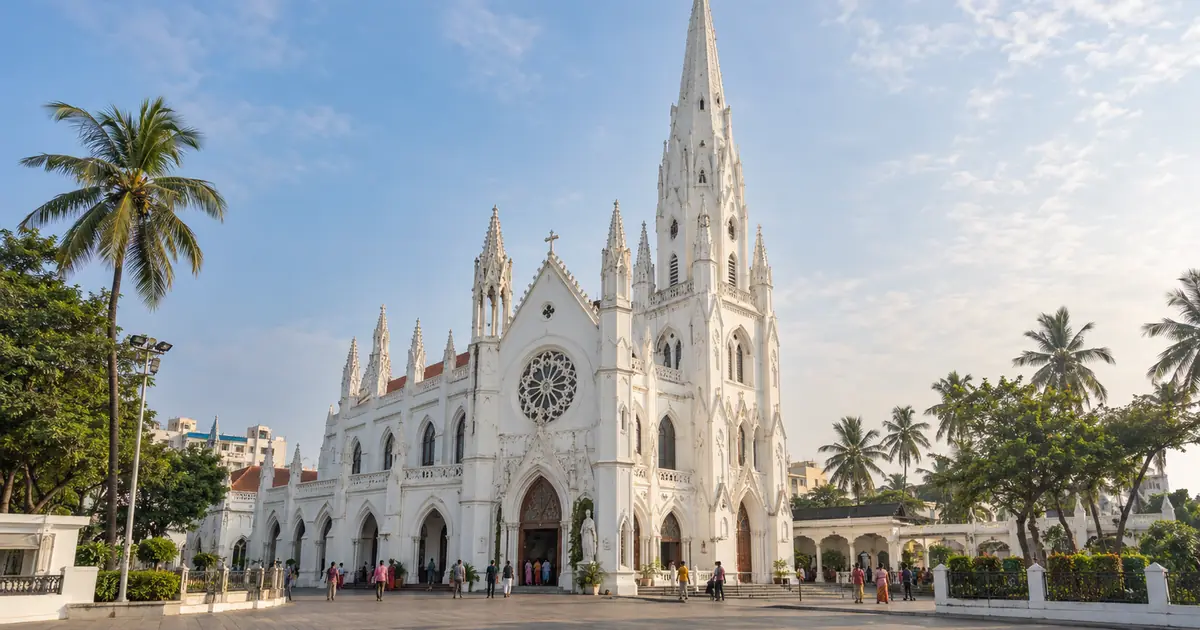
San Thome Cathedral Basilica stands along the southern fringe of Marina Beach in Mylapore, Chennai. Known officially as the National Shrine of Saint Thomas Cathedral Basilica, the gleaming white Neo-Gothic monument occupies an exceptional position in global church geography.
It is one of only three churches across the entire world erected directly above the tomb of an apostle of Jesus Christ. The basilica shares this rare apostolic status with Saint Peter’s Basilica in Vatican City and the Cathedral of Santiago de Compostela in Spain.
San Thome Basilica Essentials
- Operating Hours: The basilica nave and subterranean tomb chapel welcome pilgrims and travelers daily from 6:00 AM to 8:00 PM.
- Admission Charge: Entry is free of charge for the main cathedral nave, the subterranean tomb chapel, and the ground-level historical museum.
- Dress Code Standard: Modest attire covering shoulders and knees is strictly enforced; footwear must be removed before entering the subterranean tomb chapel.
- Apostolic Burial: Houses the mortal sepulchre and lance head relic of Saint Thomas the Apostle, who preached across India between 52 CE and 72 CE.
- Strategic Transit: Positioned along Santhome High Road in Mylapore, 1.5 km from Thirumayilai MRTS station and 8 km from Chennai Central Railway Station.
Rising against the maritime horizon of the Bay of Bengal, the cathedral’s 155-foot central spire commands the coastal avenue of Mylapore. Travelers stepping through its Gothic portals trade the urban hum of modern Chennai for the soaring stillness of ribbed vaults, pointed arches, and colorful stained glass windows imported from nineteenth-century Munich.
Beyond its architectural grace, the basilica functions as a primary pilgrimage destination for Indian and international Christians. The subterranean tomb chapel beneath the main altar provides an intimate subterranean space where pilgrims pray directly beside the ancient sepulchre of the Apostle Thomas.
| Key Feature | Architectural & Practical Detail |
|---|---|
| Geographic Location | 38 Santhome High Road, Mylapore, Chennai, Tamil Nadu 600004 |
| Original Foundation | 1523 CE by Portuguese missionaries; rebuilt 1893 to 1896 by British architects |
| Architectural Style | Neo-Gothic revival with ribbed timber vaulting and pointed arches |
| Central Spire Height | 155 feet (47.2 meters) |
| Nave Dimensions | 210 feet length by 72 feet width; seats approximately 800 worshippers |
| Apostolic Enshrinement | Tomb and relic bone of Saint Thomas the Apostle (martyred 72 CE) |
| Ecclesiastical Status | Minor Basilica (Pope Pius XII, 1956); National Shrine of India (CBCI, 2006) |
| Nearest Railway Hubs | Thirumayilai MRTS (1.5 km); Chennai Egmore (7 km); Chennai Central (8 km) |
Visiting Hours, Mass Schedules, and Service Timings
San Thome Basilica functions as both an active Catholic cathedral and a protected pilgrimage center. Because liturgical services take precedence throughout the morning and evening, visitors should coordinate their arrival to avoid disruptions to parish worship.
Daily visiting hours for general sightseeing and personal prayer run from 6:00 AM until 8:00 PM throughout the week. The cathedral gates open promptly at dawn, providing quiet morning hours when soft sunlight illuminates the stained glass panels along the eastern transept.
Daily Sightseeing Hours and Tomb Chapel Timings
Sightseeing visitors may explore the primary cathedral nave throughout regular opening intervals between morning and evening liturgical services. Casual walking and exploratory viewing are paused during active parish Masses to ensure quiet reverence.
The subterranean tomb chapel, situated beneath the elevated high altar, follows the same general operating schedule from 6:00 AM to 8:00 PM daily. Visitors descend via a dedicated marble flight of stairs positioned along the eastern flank of the sanctuary. Because the crypt serves as a focused zone of perpetual adoration, visitors must maintain absolute silence while admiring the sepulchre niche.
The adjacent San Thome Museum and mini-theatre operate from 10:00 AM to 6:00 PM from Monday through Saturday. On Sundays, museum access opens slightly later at 10:30 AM following morning parish services.
Sunday and Weekday Mass Schedules in English and Tamil
Eucharistic liturgies are conducted daily inside the main sanctuary in both Tamil and English. Attending an English service allows domestic travelers and international guests to participate comfortably in the cathedral’s living worship tradition.
| Day | Service Timing | Liturgical Language | Location & Notes |
|---|---|---|---|
| Monday to Saturday | 6:00 AM | Tamil | Morning parish Eucharistic liturgy |
| Monday to Saturday | 11:00 AM | Tamil | Midday service in the subterranean chapel |
| Monday to Saturday | 6:00 PM | Tamil | Evening parish service |
| Sunday | 6:00 AM | Tamil | Early morning parish community Mass |
| Sunday | 7:15 AM | English | Principal morning English Eucharistic service |
| Sunday | 8:15 AM | Tamil | Mid-morning congregation service |
| Sunday | 9:30 AM | English | Second morning English service for families |
| Sunday | 10:30 AM | Tamil | Youth and children community service |
| Sunday | 12:00 PM | English | Midday English Eucharistic celebration |
| Sunday | 6:00 PM | Tamil | Evening parish community Mass |
Devotees wishing to secure seating for Sunday services should arrive at least fifteen minutes prior to the scheduled start time. During major solemnities such as Christmas, Easter, and Holy Week, additional special services are arranged under open-air canopies within the cathedral compound. Current seasonal announcements are updated on the National Shrine of Saint Thomas Cathedral Basilica Portal.
Pilgrims continuing south down the Coromandel Coast to Nagapattinam district can pair Chennai’s apostolic shrine with our Velankanni Church Shrine Basilica timings and room guide covering six-language daily Masses and offline token accommodation rules.
Entry Fees, Dress Code, and Visitor Regulations
Access to San Thome Cathedral Basilica, the subterranean apostolic tomb chapel, and the historical museum is managed with an open-door policy welcoming visitors of every background.
Admission Guidelines and Museum Permissions
General admission to the cathedral, tomb crypt, and the museum is completely free of charge. The archdiocese collects no ticketing charges or entry fees from domestic travelers or foreign visitors.
Visitors wishing to support the ongoing preservation of the heritage complex may drop voluntary contributions into secured metal offering boxes placed near the entrance and chapel exits.
Photography protocols are clearly delineated across the compound:
- Cathedral Nave: Handheld mobile photography and non-flash camera use are permitted during regular visiting hours when services are not in progress.
- Subterranean Tomb Chapel: Photography inside the crypt is strictly discouraged to protect prayerful focus around the apostolic sepulchre.
- Tripods and Drones: Professional photography setups, commercial gimbal gear, and unmanned aerial drones are strictly forbidden without advance written authorization from the cathedral administration office.
- Mobile Phones: All smartphones must be placed on silent mode prior to crossing the entrance colonnade.
Sacred Attire and Decorum Standards
Because San Thome Basilica is one of the foremost Christian pilgrimage shrines in the subcontinent, visitors are held to traditional standards of modest attire. Security personnel stationed at the entry portal will politely redirect visitors wearing casual beachwear or revealing clothes.
Travelers should observe these specific apparel guidelines:
- Shoulders and Upper Body: Shirts, blouses, and dresses must fully cover both shoulders. Sleeveless tops, tank tops, and low-cut apparel are prohibited.
- Lower Body Coverage: Pants, trousers, long skirts, and traditional Indian garments such as salwar kameez must extend past the knees. Shorts and miniskirts are not permitted inside the sanctuary.
- Footwear Protocols: Visitors may retain clean footwear while walking across the polished marble floor of the main cathedral nave. However, all shoes and sandals must be removed and placed on designated storage racks before descending the steps into the subterranean tomb chapel.
- Sanctuary Decorum: Whispering or complete silence is expected within the tomb area. Eating, drinking, and recreational phone calls are strictly banned across all indoor spaces.
The Tomb and Sacred Relics of Saint Thomas the Apostle
The historical preeminence of San Thome Basilica rests upon its custody of the mortal resting place of Saint Thomas, one of the Twelve Apostles chosen by Jesus Christ. In Catholic and Syrian Christian tradition, Thomas is remembered for his initial skepticism regarding Christ’s resurrection, earning the scriptural moniker “Doubting Thomas,” before professing faith with the declaration: “My Lord and my God.”
Christian tradition across southern India documents that Saint Thomas sailed across the Arabian Sea aboard Roman merchant vessels, landing on the Malabar Coast of modern Kerala in 52 CE. After establishing seven historic Christian communities along the southwestern seaboard, the apostle traveled eastward across the peninsula to the Coromandel Coast, arriving in the maritime port of Mylapore.
Thomas preached across the ancient trading villages surrounding the Bay of Bengal for two decades. In 72 CE, historical accounts record that he suffered martyrdom on Saint Thomas Mount (Parangi Malai), a rocky hill situated roughly eleven kilometers southwest of Mylapore. His disciples recovered his remains and interred them near the coastal shore of Santhome, marking the exact spot where the present basilica rises today.
The global apostolic triad represents one of the most remarkable patterns in Christian history. Only three cities across the planet preserve the sepulchre of an original apostle of Christ:
- Vatican City: Saint Peter’s Basilica, erected above the tomb of Simon Peter on the Vatican Hill in Rome.
- Santiago de Compostela, Spain: The Metropolitan Cathedral, constructed above the resting place of Saint James the Greater.
- Chennai, India: San Thome Cathedral Basilica, built over the tomb of Saint Thomas Didymus along the Coromandel Coast.
| Historic Milestone | Era | Ecclesiastical Significance |
|---|---|---|
| Arrival in Malabar | 52 CE | Saint Thomas lands in Kodungallur (Muziris), commencing Indian ministry |
| Coromandel Ministry | 68 to 72 CE | Preaches and establishes early Christian communities in Mylapore |
| Apostolic Martyrdom | 72 CE | Martired at Saint Thomas Mount; buried in Santhome |
| First European Church | 1523 CE | Portuguese explorers erect a stone chapel over the neglected tomb |
| Neo-Gothic Cathedral | 1893 to 1896 | British administration commissions grand cathedral designed by architect J.A. Power |
| Minor Basilica Elevation | March 16, 1956 | Pope Pius XII raises San Thome to Minor Basilica status |
| National Shrine Declaration | 2006 | Designated National Shrine of India by the Catholic Bishops’ Conference |
The Subterranean Tomb Crypt and Reliquary
In 2004, the archdiocese undertook a major conservation and enhancement program to create direct, dedicated access to the apostolic sepulchre beneath the central sanctuary. The subterranean tomb chapel was carefully excavated and finished in polished white marble, creating a tranquil underground crypt isolated from surface traffic noise.
At the center of this underground crypt rests the venerated tomb niche of Saint Thomas. A life-sized golden sculpture of the sleeping apostle lies behind protective glass, dressed in liturgical vestments and holding an apostolic cross.
Above the sepulchre, a secure reliquary case displays a sacred bone relic of the apostle. While the larger portion of Saint Thomas’s skeletal remains was transported to Edessa (modern-day Urfa, Turkey) in the third century and subsequently to Ortona, Italy, significant bodily fragments and the original burial earth have remained continuously enshrined in Mylapore for nearly two thousand years.
Devotees and visitors may kneel at the prayer rail directly facing the tomb. Small containers of sacred tomb sand, believed by pilgrims to possess spiritual blessing, are maintained beside the prayer station.
The Basilica Museum and Historic Lance Head
Positioned on the ground floor of the adjoining administrative wing, the San Thome Museum preserves valuable archaeological artifacts documenting the antiquity of Christianity on the Coromandel Coast.
The museum’s most prized artifact is the iron lance head, authenticated by church historians as the weapon tip with which Saint Thomas was pierced during his martyrdom on Saint Thomas Mount in 72 CE. The relic is displayed within a secure, climate-controlled glass case alongside ancient Portuguese stone plaques carved with fourteenth-century and sixteenth-century epitaphs.
Additional highlights inside the museum include:
- Persian Cross of Mylapore: A stone carving of the historic Saint Thomas Cross bearing Pahlavi (ancient Persian) inscriptions, dating back to the seventh or eighth century.
- Papal Decrees: The official Latin parchment bulls issued by Pope Pius XII in 1956 elevating the church to basilica standing.
- Antique Numismatics: Roman coins recovered from archaeological soundings around Mylapore, corroborating maritime commerce between first-century Rome and ancient Tamilakam.
- Audio-Visual Mini Theatre: A compact screening hall located on the upper floor of the museum that screens a fifteen-minute documentary detailing the life and archaeological trail of Saint Thomas in Chennai.
Detailed listings of nearby regional circuits can also be examined through the official Tamil Nadu Tourism San Thome Basilica Guide.
Neo-Gothic Architectural Marvels of San Thome
While earlier Portuguese structures in India favoured classical Renaissance and Baroque forms, such as those found at the Basilica of Bom Jesus in Old Goa, San Thome Cathedral Basilica reflects nineteenth-century British Neo-Gothic revivalism. Constructed between 1893 and 1896, the building features dramatic verticality, pointed arches, and delicate exterior buttresses finished in brilliant white plaster. History enthusiasts extending this circuit can explore Dhanushkodi Ghost Town & Pamban Bridge visitor overview for monument timings, tickets, and route context.
The 155-Foot Spire and Nave Design
The most striking exterior element of the cathedral is its towering central bell tower, capped by a slender octagonal spire that climbs 155 feet (47.2 meters) into the sky. Flanked by twin smaller spires at the western entrance facade, the bell tower creates a commanding focal point visible from kilometers away along the Marina coastline.
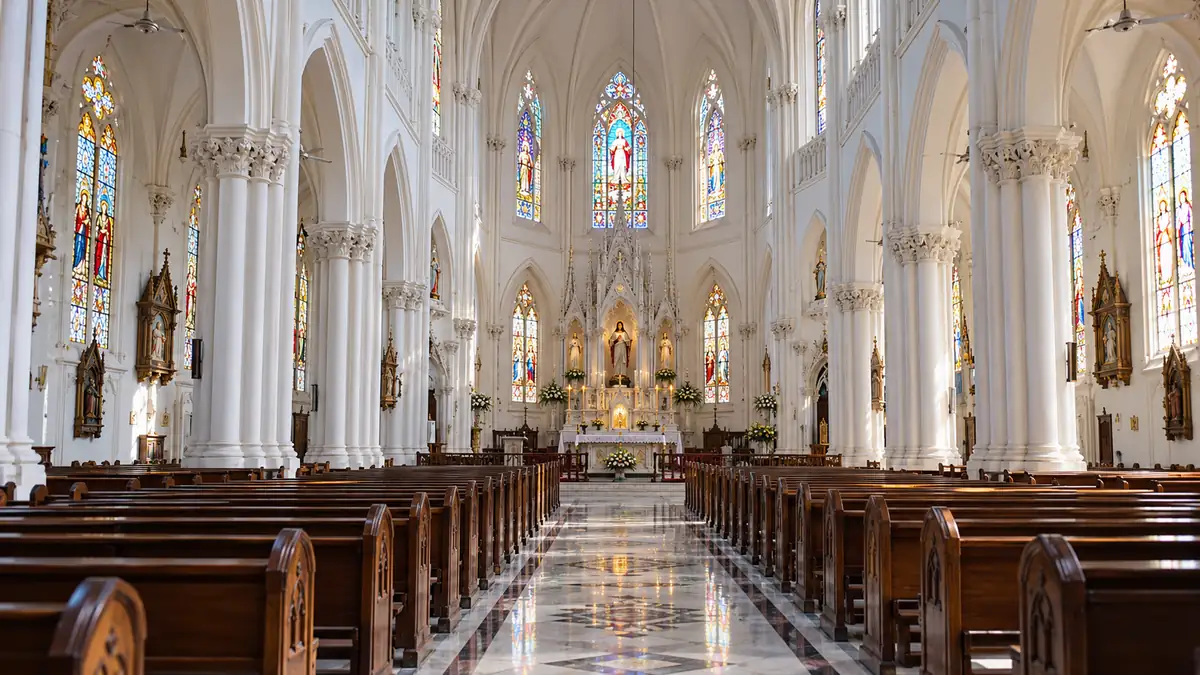
The exterior walls feature slender Gothic buttresses, trefoil arches, and ornate pinnacles that direct the viewer’s gaze skyward. The white facade reflects the tropical coastal sunshine during midday and catches a gentle warm glow during late afternoon golden hour.
Stepping through the carved timber western portal reveals a spacious, pillarless single nave spanning 210 feet in length and 72 feet in width. The cathedral can comfortably seat up to 800 worshippers across rows of polished teakwood pews. The timber-paneled roof rests on high ribbed vault arches that enhance the interior acoustics during choral singing and pipe organ recitals.
Munich Stained Glass and Historic Statuary
The sanctuary features a series of majestic stained glass windows imported directly from the Mayer & Co. studios in Munich, Germany, during the late nineteenth-century reconstruction.
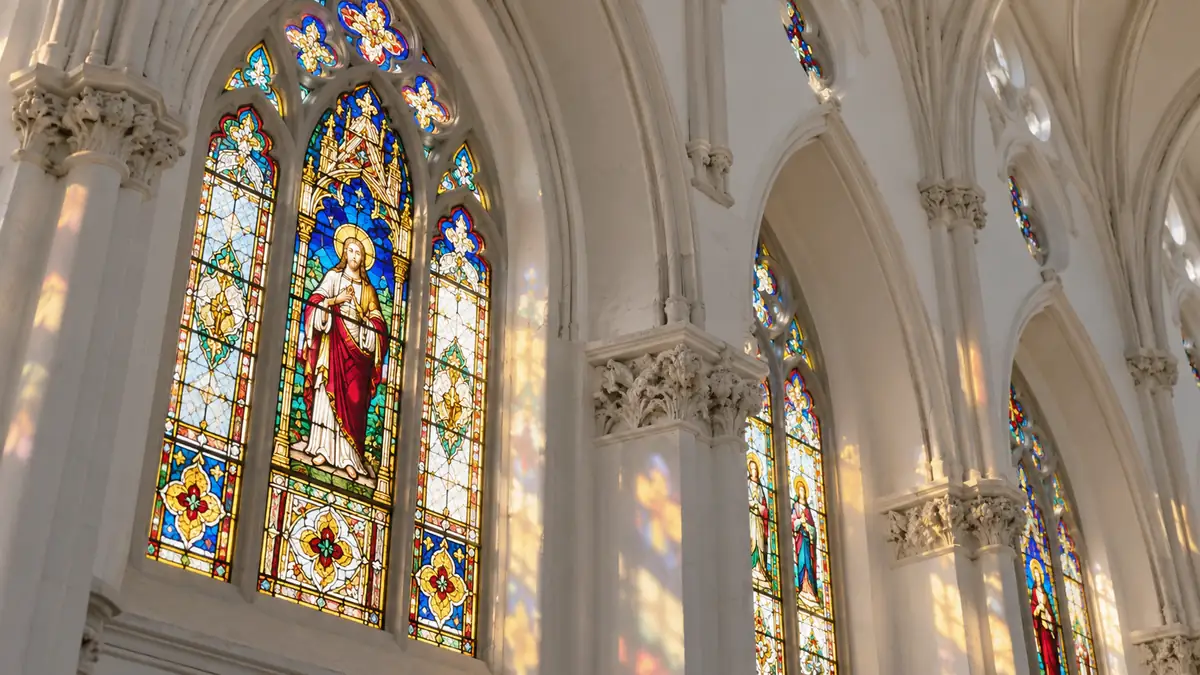
Installed along the tall lancet openings behind the high altar, these vibrantly colored leaded glass compositions portray key moments from biblical history:
- The Encounter of Doubting Thomas: Depicts the resurrected Christ inviting Thomas to inspect his crucifixion wounds, serving as the theological centerpiece of the cathedral.
- The Twelve Apostles: Series of portraits illustrating each of the original apostles with their historic martyrdom symbols.
- The Annunciation and Nativity: Scenes depicting the early life of the Virgin Mary, honoring her patronage under the title of Our Lady of Mylapore.
At the eastern transept stands the historic wooden statue of Our Lady of Mylapore, brought from Portugal in 1543. Traditional chronicles record that Saint Francis Xavier prayed fervently before this identical statue during his four-month residence in Mylapore in 1545 before departing for Malacca.
Best Time to Visit and Annual Feast Celebrations
Chennai features a tropical wet-and-dry climate characterized by warm temperatures throughout the calendar year and intense seasonal northeast monsoon rain. Selecting the appropriate travel window ensures comfortable sightseeing conditions.
- Winter Season (November to February): This is the most pleasant period to visit San Thome Basilica. Daily maximum temperatures range between 27°C and 30°C, accompanied by refreshing sea breezes off the Bay of Bengal. Morning hours offer cool weather ideal for combining the church visit with a leisurely walk along nearby Marina Beach.
- Summer Season (March to May): Temperatures climb steadily toward 38°C with elevated coastal humidity. Visitors planning trips during these months should schedule indoor visits during early mornings (between 6:30 AM and 9:00 AM) or late afternoons after 4:30 PM to avoid the midday sun.
- Southwest & Northeast Monsoon (June to November): While the southwest monsoon brings moderate showers, Chennai receives the bulk of its heavy precipitation between October and late November via the northeast monsoon. Coastal winds can be intense during this time, though the washed white facade of the cathedral appears luminous against overcast skies.
Major Religious Feasts and Celebrations
The cathedral marks major liturgical celebrations during specific calendar occasions:
- Feast of Saint Thomas (July 3): Celebrates the solemn transfer of the relics of the Apostle Thomas. The cathedral hosts a nine-day novena leading up to solemn concelebrated High Masses, cultural programs, and a devotional car procession through the streets of Mylapore.
- Feast of Our Lady of Mylapore (Early December): Dedicated to the ancient patroness of the shrine, featuring special blessings for coastal fishing families and community candlelit processions.
- Christmas and New Year Season (December 24 to January 1): The cathedral compound is adorned with illuminated star lanterns, expansive nativity crib displays, and outdoor midnight services attended by thousands of residents.
Travelers enjoying the pleasant winter weather along the coast can also plan an easy day excursion south down the East Coast Road to explore the 7th-century rock monuments in our places to visit in Mahabalipuram guide.
How to Reach San Thome Basilica in Chennai
Positioned on Santhome High Road along the southeastern coastal corridor of Chennai, the basilica is easily accessible by commuter rail, metro, city bus, taxi, and auto-rickshaw from every major quadrant of the metropolitan area.
Reaching by Suburban Train, Metro, and City Bus
Chennai’s extensive mass transit network provides affordable and efficient routes to Mylapore:
- By Chennai MRTS (Commuter Train): The nearest railway stop is Thirumayilai MRTS Station, located roughly 1.5 kilometers west of the basilica. Regular commuter trains link Thirumayilai directly to Chennai Beach Station (providing access to North Chennai and harbor terminals) and Velachery. A quick five-minute auto-rickshaw or a pleasant fifteen-minute walk connects the station to the church gates. Alternatively, Light House MRTS Station lies 1.2 kilometers north along the beach road.
- By Chennai Metro: The closest operational underground metro stop is Government Estate on the Blue Line, located approximately 5 kilometers north. From Government Estate, travelers can board a direct MTC bus or hire a metered taxi southward down Kamarajar Salai (the Marina beach road).
- By Metropolitan Transport Corporation (MTC) Bus: Numerous public buses stop directly outside the basilica at the “Santhome Church” bus stop. Popular routes include Bus 21G, 102, 1A, and 27D, connecting the basilica with Broadway Bus Stand, Central Railway Station, Adyar, and Tambaram.
| Starting Transit Point | Road Distance | Typical Transit Duration | Recommended Transport Mode |
|---|---|---|---|
| Thirumayilai MRTS Station | 1.5 km | 5 to 10 minutes | Auto-rickshaw or pedestrian walk |
| Chennai Egmore Station (MS) | 7 km | 20 to 25 minutes | Prepaid taxi or MTC Bus Route 27D |
| Chennai Central Station (MAS) | 8 km | 25 to 30 minutes | Prepaid taxi or MTC Bus Route 21G |
| T. Nagar Shopping District | 7.5 km | 25 to 30 minutes | App-based cab via Eldams Road |
| Chennai Airport (MAA) | 17 km | 45 to 60 minutes | Metro to Government Estate + taxi, or direct cab |
| Adyar Junction | 5 km | 15 to 20 minutes | Direct coastal drive down Santhome High Road |
Transit from Interstate Railway Termini and Chennai Airport
For travelers arriving from interstate origins, several major transport hubs connect directly to Mylapore:
- Chennai Central (Puratchi Thalaivar Dr. M.G. Ramachandran Central Railway Station - MAS): Located 8 kilometers north of the basilica, Chennai Central is the city’s primary long-distance rail terminus. Prepaid taxi counters and app-based rides (Uber, Ola) outside the main concourse connect to San Thome in under thirty minutes outside peak traffic hours.
- Chennai Egmore Railway Station (MS): Handling long-distance express services to southern Tamil Nadu and Kerala, Egmore lies 7 kilometers northwest. Auto-rickshaws and cabs operate continuously from the station forecourt.
- Chennai International Airport (MAA): Situated 17 kilometers southwest in Meenambakkam, the airport connects to Mylapore via the Chennai Bypass and Sardar Patel Road through Adyar, or via the suburban train network from Tirusulam station to Chennai Park and onto the MRTS. Taxi transit typically takes forty-five to fifty-five minutes.
Official district infrastructure and civic advisories can be accessed on the Chennai District Tourism Administration. Pilgrims and cultural travelers planning extended heritage journeys into the Kaveri Delta can also explore the eleventh-century Chola granite architecture in our Brihadisvara Temple Thanjavur guide.
Mylapore Heritage Walking Circuit and Nearby Sights
A trip to San Thome Basilica serves as an ideal centerpiece for exploring the ancient cultural neighborhood of Mylapore. Renowned as one of the oldest inhabited maritime centers of south India, Mylapore seamlessly blends centuries of Catholic, Hindu, and colonial maritime traditions within a compact geographic radius.
Visitors can easily plan a cohesive three-hour walking circuit starting from the basilica gates:
- San Thome Cathedral Basilica and Crypt: Begin your morning tour inside the quiet nave and descend into the subterranean apostolic tomb chapel before visiting the relic museum.
- Marina Beach and Light House: Walk three hundred meters east across Santhome High Road to reach the golden sands of Marina Beach. Take the elevator to the top observation deck of the Chennai Light House for panoramic vistas over the Bay of Bengal and the cathedral spire.
- Kapaleeshwarar Temple: Head 1.8 kilometers inland along Kutchery Road to explore this seventh-century Dravidian temple complex dedicated to Lord Shiva. Admire the soaring polychrome gopuram, stone-pillared mandapams, and the sacred temple tank, illustrating the pluralistic spiritual fabric of Mylapore.
- Ramakrishna Math Chennai: Located 2.5 kilometers northwest, this peaceful monastery provides tranquil garden pathways and a grand universal temple ideal for quiet meditation. Travelers can also sample local breakfast items, filter coffee, and beach snacks with our dedicated Chennai street food and Mylapore tiffin guide.
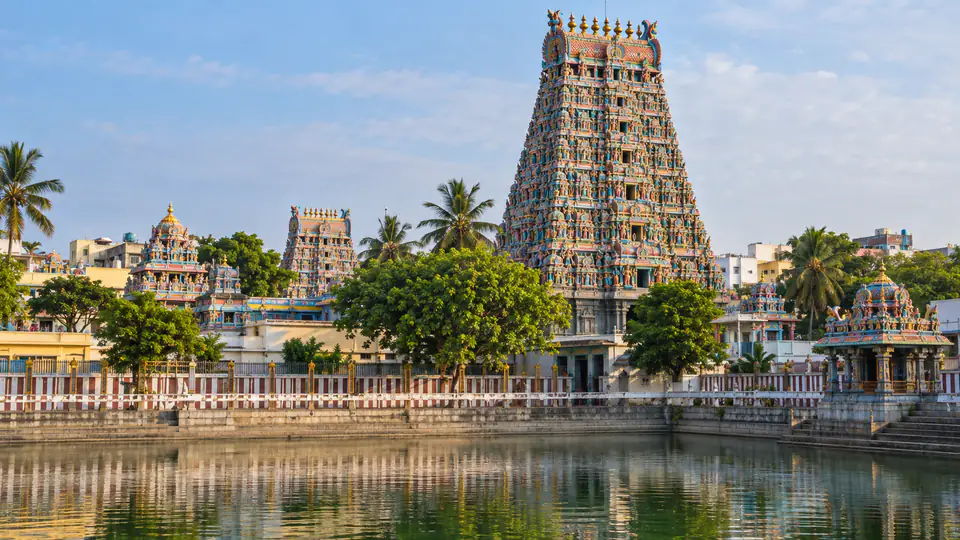
Travelers mapping extended southern pilgrimages across Tamil Nadu can connect their coastal Chennai exploration with our in-depth guide to the ancient Meenakshi Amman Temple in Madurai and the sacred island shrine of Rameshwaram Jyotirlinga. For comprehensive state itineraries and heritage circuits, explore the Tamil Nadu Tourism Chennai Heritage Portal.
Essential Tips for a Respectful Visit
To ensure a smooth, spiritually enriching visit to San Thome Basilica, travelers should remember these practical recommendations:
- Plan for Early Morning Light: Arriving between 6:30 AM and 8:00 AM on weekdays allows you to admire the sunlight illuminating the Munich stained glass windows in near-total tranquility before city traffic picks up.
- Dress Conservatively: Ensure your clothing covers both shoulders and extends well past your knees. Pack a lightweight shawl or cotton scarf if traveling in summer attire to maintain modesty.
- Remember Footwear Rules for the Crypt: While shoes are permitted on the main church nave floor, slip-on footwear makes it convenient to remove and retrieve shoes smoothly before descending into the underground tomb chapel.
- Watch for Sunday Parish Crowds: Sunday mornings feature heavy parishioner attendance across seven consecutive services. If you seek peaceful architectural photography or quiet contemplation, visit on a Tuesday, Wednesday, or Thursday afternoon.
- Combine with Broader Travel Plans: Extend your architectural exploration by discovering other iconic landmarks outlined in our guide to the Best Places to Visit in India.
Frequently Asked Questions About San Thome Basilica
What are the opening timings of San Thome Basilica in Chennai?
San Thome Basilica opens daily from 6:00 AM to 8:00 PM for prayer and tourism. The subterranean tomb chapel follows the same schedule, while the museum is open from 10:00 AM to 6:00 PM.
Is there an entry fee to visit San Thome Basilica and the tomb?
General entry to San Thome Basilica, the underground tomb chapel, and the museum is completely free of charge. Visitors may offer voluntary donations at designated collection boxes inside the complex.
What is the dress code for visitors entering San Thome Church?
Visitors must wear modest clothing that fully covers both shoulders and knees. Footwear must be removed before stepping into the underground tomb chapel of Saint Thomas.
Which three churches in the world are built over an Apostle’s tomb?
The three churches built directly above the tomb of an apostle are Saint Peter’s Basilica in Vatican City, the Cathedral of Santiago de Compostela in Spain, and San Thome Basilica in Chennai, India.
Which railway station is closest to San Thome Basilica?
Thirumayilai Railway Station on the Chennai MRTS network is the nearest station, located approximately 1.5 kilometers away. Chennai Central and Egmore railway stations are roughly 8 kilometers and 7 kilometers away respectively.