Basilica of Bom Jesus: Timings, Dress Code, History & Visiting Guide
Plan your visit to the Basilica of Bom Jesus in Old Goa with verified visiting hours, Sunday mass schedules, dress code rules, entry fees, and travel tips.
Old Goa Heritage Guide
Basilica of Bom Jesus
The Basilica of Bom Jesus stands as one of the most celebrated monuments of Christian heritage in Asia and a cornerstone of the UNESCO World Heritage ensemble in Old Goa. Consecrated in December 1605 by the Jesuit order, this Catholic basilica houses the sacred mortal remains of Saint Francis Xavier within an elevated silver reliquary casket atop a Florentine marble mausoleum.
Located ten kilometers east of Panaji along the Mandovi River basin, the church draws pilgrims, architecture historians, and curious travelers from across the globe.
Visitor & Service Essentials
- The Basilica of Bom Jesus is situated in Old Goa (Velha Goa), ten kilometers east of Panaji along National Highway 748.
- Tourist visiting hours operate from 9:00 AM to 6:30 PM from Monday to Saturday, and from 10:30 AM to 6:30 PM on Sundays.
- General admission to the basilica nave and viewing galleries is completely free of charge for all visitors.
- A strict modest dress code requires all visitors to keep their shoulders and knees covered at all times inside the church.
- The site is protected under the joint jurisdiction of the Archdiocese of Goa and Daman and the Archaeological Survey of India.
What to Expect at the Basilica of Bom Jesus
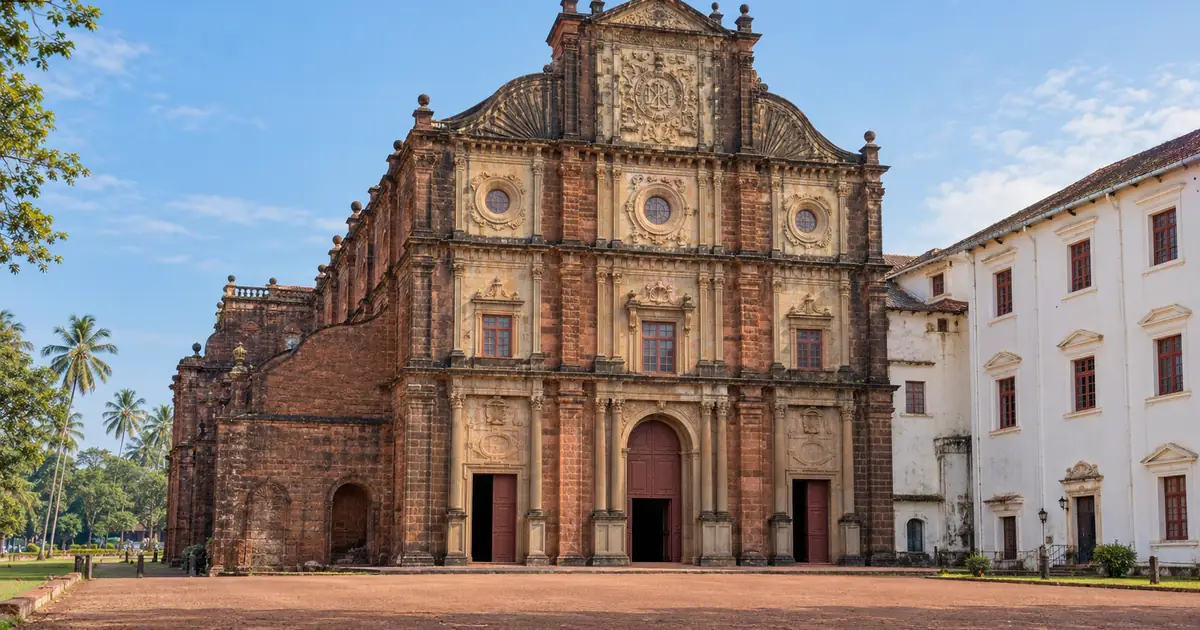
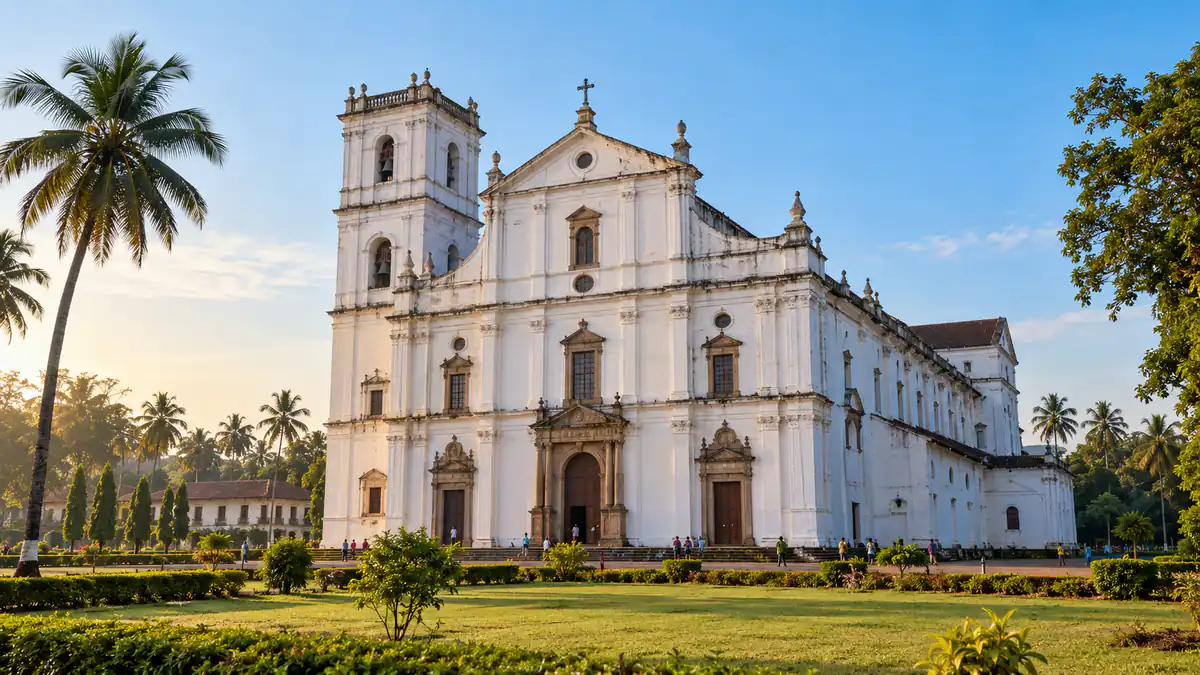
Visitors to the Basilica of Bom Jesus encounter a soaring monument of late Renaissance and Baroque architecture characterized by an unplastered red laterite stone facade. Unlike most Portuguese colonial churches across coastal Goa that display bright whitewashed exteriors, the exposed volcanic basalt and laterite masonry of Bom Jesus lends the structure a weathered, austere presence.
Inside the cavernous single nave, the atmosphere shifts from outdoor heat to cool stone tranquility. The eye is drawn immediately toward the towering gilded reredos at the far end of the sanctuary, rising to the timber ceiling behind the main altar.
To the right of the high altar lies the dedicated chapel of Saint Francis Xavier. His incorrupt relics rest in a seventeenth-century silver casket elevated above an ornate three-tiered marble pedestal. Devotees offer quiet prayers along the chancel rail, while travelers admire the intricate woodwork, sacred paintings, and historic choir loft.
| Feature | Architectural & Practical Detail |
|---|---|
| Geographic Location | Old Goa (Velha Goa), North Goa District, Goa 403402 |
| Foundation Era | Commenced in 1594; Consecrated on December 4, 1605 |
| Patron Dedication | Dedicated to the Infant Jesus (“Bom Jesus”) |
| Key Relic | Mortal remains of Saint Francis Xavier (1506-1552) |
| Architectural Orders | Baroque and Mannerist (Doric, Ionic, and Corinthian tiers) |
| Structural Dimensions | 183 ft (56 m) length; 55 ft (17 m) breadth; 61 ft (18.5 m) height |
| Nearest Railway | Karmali Railway Station (KRMI), 3 km away |
| Nearest Airport | Dabolim Airport (27 km); Manohar Airport Mopa (45 km) |
Visiting Hours, Mass Timings, and Daily Schedule
The Basilica of Bom Jesus remains an active parish church and sacred pilgrimage shrine where liturgical services take precedence over general tourism. Visitors planning a trip to Old Goa should coordinate their arrival around regular prayer hours to ensure uninterrupted access to the sanctuary.
Daily Visiting Hours for Tourists
General sightseeing and tourist entry are permitted throughout the week during scheduled non-service intervals. On weekdays and Saturdays, visitors can enter the basilica from 9:00 AM until 6:30 PM.
On Sundays, general tourist entry opens later at 10:30 AM following the completion of morning parish Eucharistic services, remaining open until 6:30 PM. The final admission through the main portal is typically allowed thirty minutes prior to evening gate closure.
During major religious celebrations, including Holy Week, the Novena of Saint Francis Xavier in late November, and the annual feast day on December 3, tourist flow is redirected to accommodate extensive pilgrim queues.
Parish Mass Timings in English and Konkani
Holy Mass is celebrated daily inside the basilica nave in both Konkani (the regional language of Goa) and English. Attending a morning service allows international and domestic visitors to experience the living devotional tradition of the Goan Catholic community.
| Day of the Week | Mass Schedule (Konkani) | Mass Schedule (English) | Notes for Devotees |
|---|---|---|---|
| Monday to Friday | 7:00 AM | 8:00 AM | Celebrated in the main sanctuary |
| Saturday | 7:00 AM | 8:00 AM | Evening anticipation service at 6:00 PM |
| Sunday | 8:00 AM, 10:15 AM | 9:15 AM | Tourist entry opens at 10:30 AM |
| First Friday of Month | 7:00 AM | 8:00 AM | Dedicated Holy Hour and Adoration follow |
Travelers wishing to attend church services should arrive at least twenty minutes before the scheduled time to secure seating in the nave pews. During Eucharistic celebrations, walking through the transepts and taking casual photographs is strictly prohibited to maintain reverence.
Entry Fees, Ticket Guidelines, and Dress Code Rules
Access to the main sacred spaces of the Basilica of Bom Jesus is treated as a religious right rather than a commercial tourist transaction.
Admission Charges and Photography Permissions
General entry to the Basilica of Bom Jesus is completely free of charge for Indian citizens and international visitors. Visitors do not require advance online booking or paper tickets to enter the main nave, view the altar, or pay respects before the chapel of Saint Francis Xavier.
Ancillary areas on the premises carry specific regulations:
- Basilica Nave and Tomb Viewing: Free admission for all individuals throughout standard operating hours.
- Bom Jesus Art Gallery: A nominal admission fee of ₹5 to ₹10 per person is collected at the entrance of the adjoining second-floor modern art gallery displaying contemporary Christian religious paintings.
- Still Photography: Handheld still photography without flash is permitted inside the main hall for personal, non-commercial purposes.
- Flash Photography: Flash photography is strictly forbidden everywhere inside the church, especially near the antique silver reliquary casket to protect the delicate metallic finish and historic paintings from light degradation.
- Videography and Tripods: Using tripods, gimbal stabilizers, or recording professional commercial video requires formal written clearance from the Archaeological Survey of India Protected Monuments Portal.
Strict Dress Code Expectations for Visitors
Because the basilica is an active house of worship and venerated pilgrimage site, the church administration enforces strict dress code requirements at the main entrance gate. Security staff turn away visitors wearing casual beach attire or revealing clothing.
Visitors must observe these specific attire standards:
- Shoulders Covered: Both men and women must wear tops, shirts, or blouses that fully cover the shoulders. Tank tops, spaghetti straps, halter tops, and sleeveless vests are prohibited.
- Knees Covered: Bottom wear must fall below the knee line. Trousers, jeans, ankle-length dresses, and traditional Indian clothing such as salwar kameez are recommended.
- Beachwear Prohibited: Short athletic shorts, miniskirts, swimwear, crop tops, and see-through fabrics are strictly banned.
- Temporary Wraps: Visitors arriving in shorts or sleeveless attire can borrow or purchase modesty shawls from volunteer stalls situated outside the church compound before entering.
- Footwear: Visitors may keep their shoes on while walking through the church nave, provided the footwear is clean. Hats and caps must be removed upon crossing the entrance threshold.
The Sacred Relics of Saint Francis Xavier
The enduring fame of the Basilica of Bom Jesus across Christendom stems from its preservation of the mortal body of Saint Francis Xavier. Known as the “Apostle of the Indies,” Francis Xavier was a founding member of the Society of Jesus alongside Saint Ignatius of Loyola.
He arrived in Portuguese Goa in May 1542 to carry out extensive evangelical and charitable missions across western India, Malacca, the Moluccas, and southern Japan. Alongside the apostle sepulchre at San Thome Basilica in Chennai, Bom Jesus serves as one of India’s two foremost Christian pilgrimage shrines.
Francis Xavier passed away on December 3, 1552, on the island of Shangchuan off the southern coast of Guangdong, China, while waiting for authorization to enter the Ming Empire. His body was temporarily buried in quicklime on the island before being disinterred months later and found remarkably preserved without signs of decomposition.
After a brief transit through Portuguese Malacca, the sacred remains arrived in Goa in March 1554. They were placed inside the College of Saint Paul before being transferred permanently to the newly constructed Basilica of Bom Jesus in 1624.
| Historic Milestone | Year | Significance |
|---|---|---|
| Birth in Navarre | 1506 | Born in modern Spain; studied at the University of Paris |
| Founding of Jesuits | 1534 | Co-founds Society of Jesus with Saint Ignatius of Loyola |
| Arrival in Goa | 1542 | Lands in Old Goa; establishes schools, hospitals, and churches |
| Passing on Shangchuan | 1552 | Dies off Chinese coast; body discovered uncorrupted |
| Arrival in Goa | 1554 | Sacred relics transported to Goa amidst massive crowds |
| Enshrinement in Bom Jesus | 1624 | Relics transferred permanently to the Jesuit basilica |
| Medici Mausoleum Assembly | 1698 | Italian marble pedestal installed in southern chapel |
The Medici Marble Mausoleum and Silver Casket
Inside the southern transept chapel, the saint’s relics rest on an elevated monument that represents an extraordinary marriage of Italian Baroque stonecraft and seventeenth-century Goan silver metallurgy.
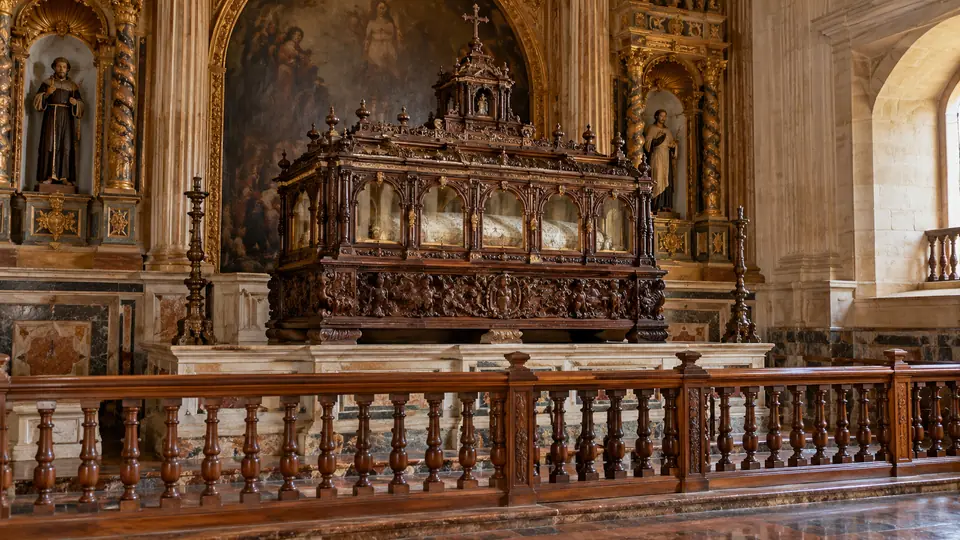
The pedestal was a personal gift from Cosimo III de’ Medici, the Grand Duke of Tuscany, who dispatched the monument from Florence as an offering of devotion. Designed and sculpted between 1696 and 1698 by Florentine court sculptor Giovanni Battista Foggini, the monument is crafted from alternating tiers of red Jasper, Carrara white marble, and verde antico stone.
Four bronze bas-relief plaques embedded along the marble tiers illustrate key episodes from the life of Saint Francis Xavier. These panels depict his preaching to coastal villagers, baptisms in Malacca, survival during dangerous storms at sea, and his peaceful death on the shores of Shangchuan.
Resting atop this three-tiered Italian plinth is the great silver reliquary casket. Fabricated between 1636 and 1637 by local Goan silversmiths using more than three hundred kilograms of silver, the casket is divided into thirty-two intricately chased repoussé panels depicting miracles and missionary journeys. The casket is fitted with glass viewing panes through which the sacred relics can be seen from below during regular visiting sessions.
The Decennial Exposition Tradition
Under long-standing ecclesiastical tradition, the sacred relics of Saint Francis Xavier are brought down from their elevated pedestal once every ten years for public veneration in an event known as the Solemn Exposition of Saint Francis Xavier.
During the exposition, which generally spans six to eight weeks from late November through early January, the silver casket is carried in a solemn liturgical procession across the road to the larger Se Cathedral. Millions of pilgrims from across India, Southeast Asia, Europe, and the Americas travel to Old Goa during this window to view the relics up close and walk past the glass enclosure.
Official schedules and pilgrim guidelines are published by the state administration on the Goa Tourism Development Corporation Events Calendar.
Architectural Marvels of the Jesuit Basilica
The Basilica of Bom Jesus was designed according to the architectural traditions established by the Council of Trent, which emphasized clear lines of sight toward the high altar, acoustics suited for preaching, and dramatic ornamentation to inspire faith. Constructed between 1594 and 1605, the structure reflects late Renaissance Mannerism harmonized with Baroque drama.
The Unplastered Red Laterite Facade
The exterior facade of the basilica presents a distinctive appearance among colonial churches in India. Built primarily from local red laterite stone blocks with decorative pilasters, pediments, and doorframes carved from dense dark basalt, the facade rises across three distinct architectural tiers:
- The Ground Tier: Displays austere Doric columns flanking three arched entry portals. The central portal is crowned with an ornate triangular pediment.
- The Middle Tier: Features refined Ionic columns flanking three rectangular choir windows that illuminate the western entrance loft.
- The Upper Tier: Follows classical Corinthian orders, culminating in a soaring baroque pediment carved with the sacred Jesuit monogram IHS (the first three letters of the name of Jesus in Greek). The emblem is flanked by carved stone angels supporting the letters beneath a radiant cartouche.
In the mid-twentieth century, Portuguese conservators removed the protective white lime plaster from the exterior walls under the assumption that exposing the bare masonry would restore the original antique appearance. While this decision created the iconic weathered red facade recognized around the world today, it also exposed the porous laterite stone to heavy seasonal monsoon rainfall, necessitating ongoing conservation treatments by the Archaeological Survey of India.
Gilded Baroque Altarpiece and Sacred Art
Crossing the threshold into the interior reveals a spacious, pillarless nave covered by a vaulted timber ceiling. The focal point of the church is the monumental wooden reredos, covered in heavy gold leaf that glows under soft sanctuary lighting.
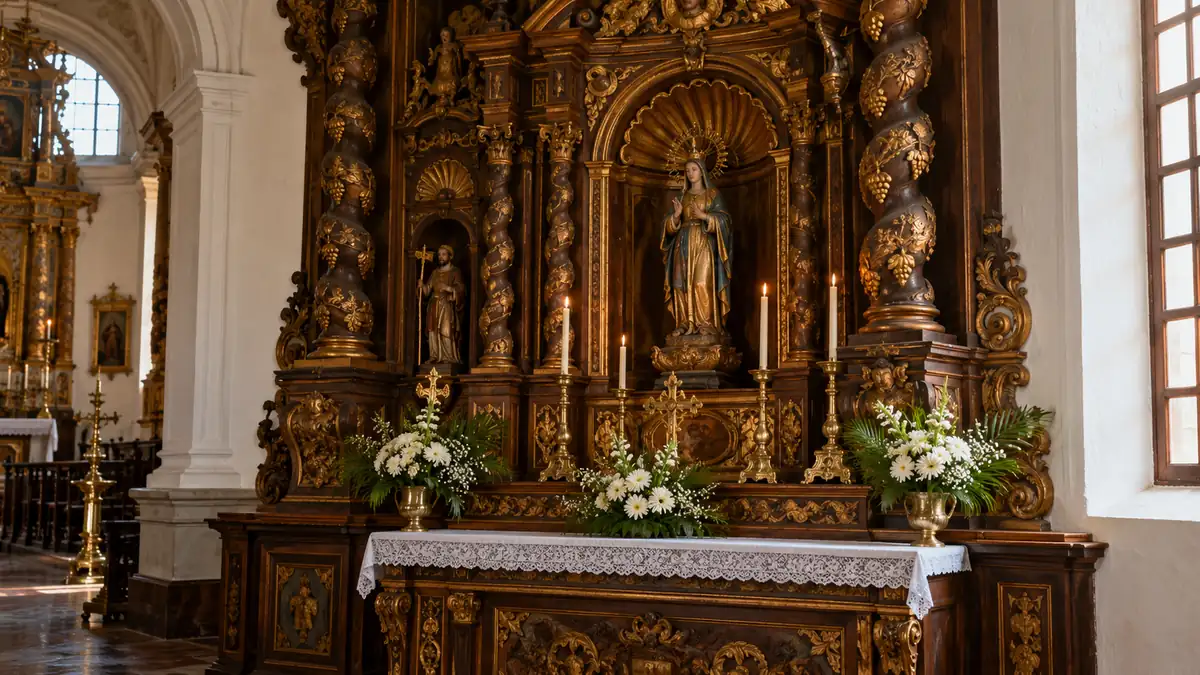
The altarpiece honors the theological identity of the Jesuit order:
- Statue of Saint Ignatius of Loyola: Dominating the upper section of the altar is a massive six-foot painted wooden sculpture of Saint Ignatius of Loyola, the founder of the Jesuits. His eyes are fixed upward toward a radiant gilded sunburst displaying the IHS crest, symbolizing spiritual illumination.
- The Infant Jesus: Below the central statue, directly above the tabernacle, rests the image of the Infant Jesus (“Bom Jesus”, meaning Good Jesus), to whom the basilica is formally dedicated.
- Carved Wooden Pulpit: Positioned along the northern wall of the nave is an exquisite seventeenth-century carved wooden pulpit. Supported by intricate figures of angels and cherubs, the canopy of the pulpit features detailed floral and biblical motifs carved from native Goan teakwood.
Best Time to Visit and Seasonal Weather
Old Goa experiences a tropical coastal climate characterized by distinct dry, wet, and transitional seasons. Choosing the right month to visit ensures comfortable walking conditions between the various heritage monuments.
- Winter Season (November to February): This is the ideal window for sightseeing. Daytime temperatures hover comfortably between 28°C and 32°C with minimal rainfall and lower humidity. The morning hours offer clear skies, making the pedestrian walk across the heritage zone pleasant.
- Feast Season (Late November to Early December): The annual Feast of Saint Francis Xavier takes place on December 3, preceded by nine days of solemn Novena services. While this period features lively community fairs and traditional Goan food stalls around Old Goa, travelers should expect significant traffic and large crowds. Travelers visiting later in winter can also experience regional music and parades at the annual Goa Carnival.
- Summer Season (March to May): Temperatures rise steadily, often reaching 35°C with intense tropical humidity. If visiting during these months, schedule your arrival for early morning (between 9:00 AM and 10:30 AM) to complete outdoor photography before the afternoon heat peaks.
- Monsoon Season (June to September): The southwest monsoon brings torrential downpours to coastal Goa. While the exposed red laterite stone turns deep crimson against lush green palms, outdoor walking between monuments requires rain gear and caution on slippery stone pathways.
How to Reach the Basilica of Bom Jesus in Old Goa
Old Goa is positioned along major state transportation arteries, making it straightforward to reach by private taxi, rental scooter, self-drive car, or regular government bus routes from all major corners of the state.
Reaching Old Goa from Panaji and Coastal Beach Belts
The heritage complex lies approximately ten kilometers east of the capital city of Panaji.
- By Government Bus from Panaji: The most economical option is the frequent shuttle bus operating from the Panaji KTC Bus Stand to the Old Goa Bus Stop. Buses depart every fifteen to twenty minutes throughout the day. The journey takes roughly twenty to twenty-five minutes and costs less than ₹20 per passenger.
- From North Goa Beach Towns: When traveling from coastal resorts highlighted in our guide to the Best Beaches in Goa, drive south toward Panaji, cross the Mandovi Bridge, and continue east along National Highway 748 (the Panaji-Ponda highway). The distance is approximately twenty-four kilometers, requiring forty to fifty minutes of driving time depending on traffic.
- From South Goa Beach Belts (Colva, Benaulim, Margao): Drive north via National Highway 66 toward Cortalim, cross the Zuari Bridge, and follow the bypass road through Agassaim toward Old Goa. The drive from Margao spans approximately thirty kilometers and takes forty-five to fifty-five minutes.
| Starting Location | Road Distance | Typical Drive Time | Recommended Route |
|---|---|---|---|
| Panaji (KTC Bus Stand) | 10 km | 20 - 25 minutes | NH 748 Direct Highway |
| Calangute Beach | 24 km | 45 - 50 minutes | Via Chogm Road and Panaji Bridge |
| Candolim Beach | 22 km | 40 - 45 minutes | Via Nerul, Betim, and NH 748 |
| Baga Beach | 26 km | 50 - 55 minutes | Via Arpora, Porvorim, and Panaji |
| Margao Railway Hub | 30 km | 45 - 50 minutes | Via NH 66 and Agassaim Bypass |
| Vasco da Gama | 28 km | 40 - 45 minutes | Via Zuari Bridge and NH 566 |
Transit from Railway Stations and Airports
For travelers arriving from interstate origins, several major transit hubs provide convenient proximity:
- Karmali Railway Station (KRMI): Karmali is the nearest railway station to the monument, located just three kilometers south of the basilica. High-speed Konkan Railway services, including the Tejas Express and Vande Bharat Express connecting Mumbai and Goa, stop regularly at Karmali. A local auto-rickshaw or taxi reaches the church gates in less than ten minutes.
- Madgaon Junction (MAO): The primary railway hub of South Goa lies thirty-three kilometers away. Taxis take roughly fifty minutes to reach Old Goa.
- Dabolim International Airport (GOI): Located twenty-seven kilometers to the southwest, Dabolim Airport is approximately forty minutes away via the modern cable-stayed Zuari Bridge corridor.
- Manohar International Airport, Mopa (GOX): The northern greenfield airport is situated forty-five kilometers away. Driving time averages fifty-five to sixty-five minutes via the national highway.
Old Goa Heritage Walking Circuit
A trip to the Basilica of Bom Jesus should be combined with the neighboring historical landmarks of Old Goa. All major monuments in the central heritage precinct are situated within comfortable walking distance of each other across shaded pedestrian avenues.
| Monument Name | Distance from Bom Jesus | Key Architectural Highlight |
|---|---|---|
| Se Cathedral | 100 meters directly opposite | Tuscan exterior; Golden Bell; 14 gilded side chapels |
| Church of Saint Francis of Assisi | 150 meters northeast | Manueline portal; Archaeological Museum of Old Goa |
| Church of Saint Cajetan | 350 meters north toward river | Modeled after original drawings of Saint Peter’s Basilica |
| Viceroy’s Arch | 450 meters north | Ceremonial stone gateway erected by Francisco da Gama in 1597 |
A comprehensive tour starts at Bom Jesus in the early morning, crosses the lawn to Se Cathedral, tours the viceroy portraits in the ASI museum, and finishes with a peaceful riverfront stroll near Saint Cajetan.
Essential Visitor Tips for Respectful Exploration
To maximize your visit while respecting the spiritual traditions of the local community, keep these practical advisories in mind:
- Arrive Early in the Morning: Plan your arrival for 9:00 AM on weekdays to explore the interior before tour bus excursions arrive from coastal resort towns. Early morning provides quiet contemplation and optimal diffuse lighting for photography.
- Hire Official Certified Guides: Licensed ASI guides wearing identity badges can be hired outside the ticket office of the museum across the road. They provide valuable architectural context explaining the biblical allegories carved into the altars and pulpit.
- Carry Adequate Water and Sun Protection: While the church interior remains cool, walking between Se Cathedral, Saint Cajetan, and the museum involves open sun exposure. Bring an umbrella, hat, and reusable water bottle.
- Silence Mobile Devices: Switch your smartphone to silent mode upon entering the sanctuary. Speaking loudly or taking phone calls inside the nave is disrespectful to devotees in prayer.
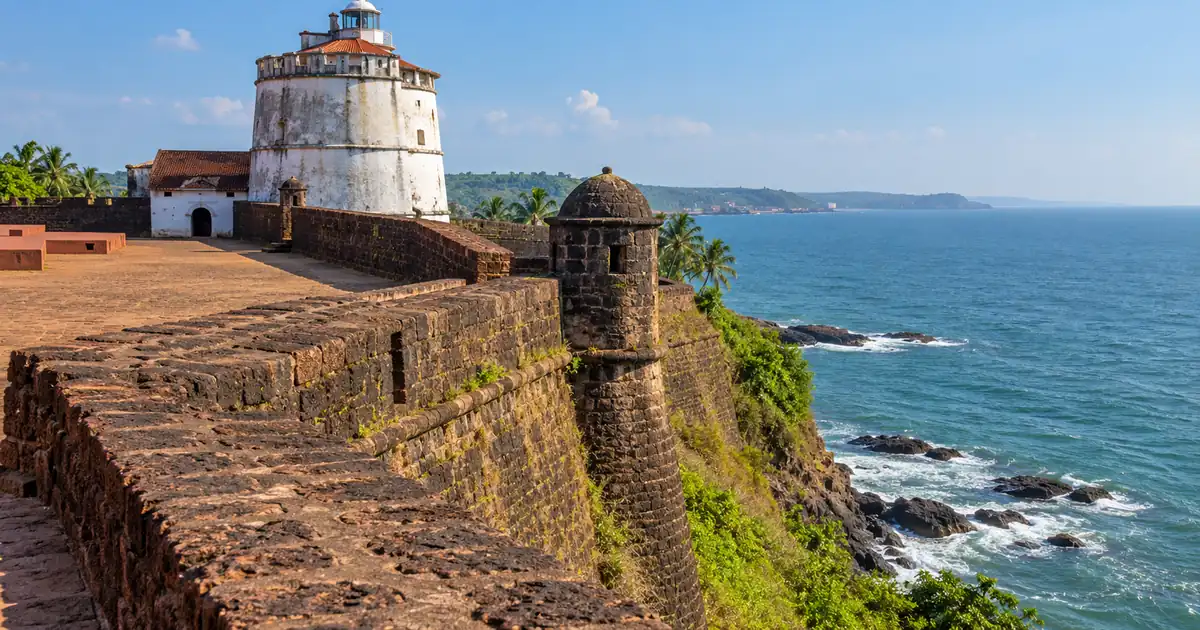
- Explore Broader Regional Travel Circuits: Combine your heritage excursion with scenic coastal fortifications at Aguada Fort or plan an extended state-wide itinerary with our comprehensive Goa Travel Guide. Official national tourism details are accessible through the Incredible India Goa Heritage Portal.
Frequently Asked Questions About the Basilica of Bom Jesus
What are the opening hours of the Basilica of Bom Jesus?
The basilica opens for tourists from 9:00 AM to 6:30 PM from Monday to Saturday, and from 10:30 AM to 6:30 PM on Sundays. Sunday tourist entry begins later to accommodate morning parish Eucharistic services.
Is there an admission fee to enter the Basilica of Bom Jesus?
General entry to the church and the viewing gallery of Saint Francis Xavier is completely free of charge. Visitors only pay a small nominal fee of ₹5 to ₹10 if they choose to visit the separate second-floor modern art gallery.
What is the dress code for entering the Basilica of Bom Jesus?
Visitors must observe a modest dress code covering both their shoulders and knees at all times inside the church. Sleeveless tops, tank tops, short skirts, and beach shorts are strictly prohibited by church security.
Can tourists view the mortal remains of Saint Francis Xavier?
The silver reliquary casket containing the relics of Saint Francis Xavier is elevated in a glass-faced niche in the southern chapel, allowing visitors to see the relics from below during standard visiting hours. The casket is brought down to eye level only once every ten years during the solemn Decennial Exposition.
Which railway station is closest to the Basilica of Bom Jesus?
Karmali Railway Station (KRMI) is the closest transit point, situated just three kilometers south of the monument. Auto-rickshaws and local taxis from Karmali reach the church gates within eight to ten minutes.