Padmanabhaswamy Temple Dress Code, Timings & Entry Guide
Visit Sree Padmanabhaswamy Temple in Trivandrum with exact men and women dress code rules (mundu, saree), split darshan timings, free entry, and vault history.
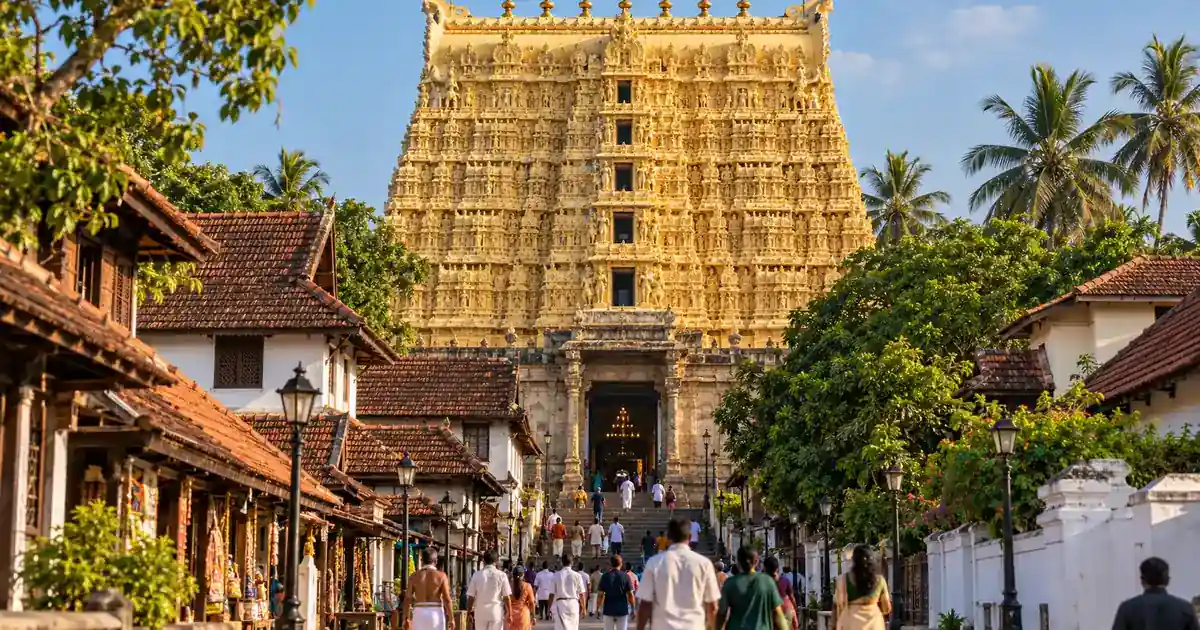
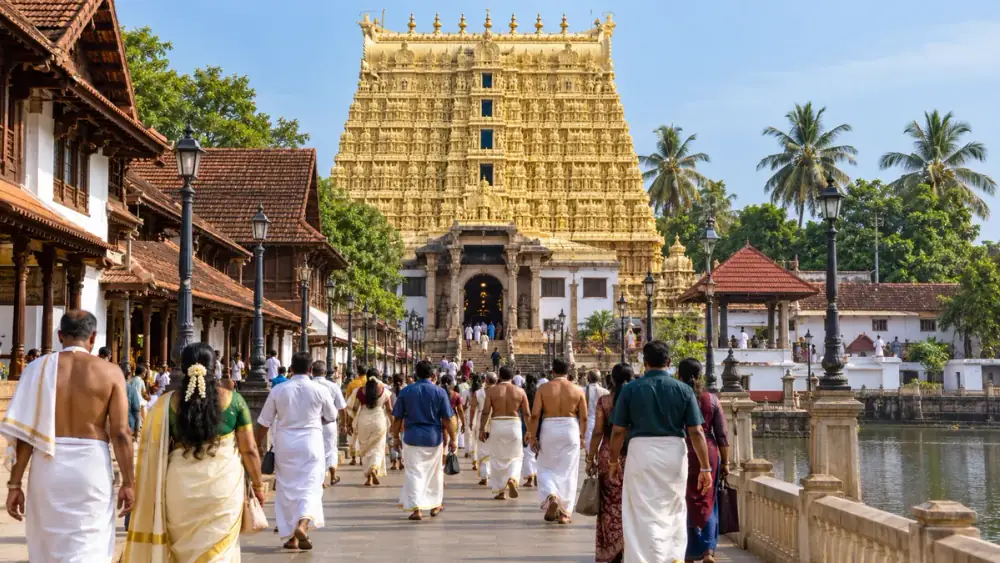
Rising majestically behind the East Fort walls in the heart of Thiruvananthapuram, Sree Padmanabhaswamy Temple is Kerala’s most famous Vaishnavite shrine and one of the 108 sacred Divya Desams. Inside its granite sanctum rests an 18-foot reclining idol of Lord Vishnu in Ananthasayanam posture atop the five-hooded serpent Adisesha, viewed sequentially through three stone doorways.
Known worldwide for its strict traditional dress code, split daily worship slots, and the historic subterranean Kallara treasure vaults beneath its courtyard, visiting smoothly requires careful preparation before reaching East Fort. This guide details exact men’s and women’s dress code rules, verified darshan timings, free entry vs. special seva portals, vault history, and Trivandrum transit distances.
Darshan & Dress Code Essentials
- Mandatory Dress Code: Men must wear an unstitched white/cream mundu (dhoti) bare-chested without shirts; women wear a saree, set-mundu, or wrap a mundu over salwar kameez.
- Split Darshan Hours: Opens in morning windows between 3:30 AM and 12:00 PM, and evening windows from 4:30 PM to 7:20 PM.
- Entry Fee: General queue darshan is completely free (INR 0); optional special sevas and Palpayasam offerings are booked on spst.in.
- Entry Restriction: Only practicing Hindus are permitted inside the inner temple courtyard and sanctum.
- Electronics & Cloakrooms: Mobile phones, cameras, smartwatches, and leather items are strictly prohibited and stored at East Fort cloakrooms.
Padmanabhaswamy Temple Dress Code for Men, Women, and Children
Sree Padmanabhaswamy Temple enforces one of India’s strictest orthodox dress codes, permitting only Hindus dressed in traditional Kerala attire inside the outer walls. Men must wear a crisp white or cream cotton mundu (dhoti) bare-chested without any shirt or vest, while women must wear a saree, set-mundu, or tie a cotton mundu over salwar kameez pants.
Security attendants stationing the four gopuram entrances inspect clothing carefully before allowing visitors into the queue corridors. Pilgrims accustomed to flexible dress guidelines elsewhere, or comparing regional temple practices such as Chidambaram Nataraja Temple sanctum rituals, should prepare traditional attire ahead of arrival to avoid morning queue delays.
| Visitor Category | Prescribed Mandatory Attire | Prohibited Garments (Strictly Banned) |
|---|---|---|
| Adult Men & Boys | Unstitched white/cream cotton mundu (dhoti) reaching the heels; bare chest without shirt/vest (angavastram shoulder shawl permitted) | Shirts, t-shirts, vests, trousers, jeans, shorts, and bermudas |
| Adult Women | Traditional Indian saree, Kerala set-mundu (mundum neriyathum), or long skirt with blouse | Western dresses, shorts, jeans, t-shirts, and sleeveless tops |
| Women Wearing Salwar Kameez | Permitted only if an external cotton mundu is wrapped and tied over the salwar pants like a long skirt | Uncovered salwar, churidar, or leggings without an over-wrap mundu |
| Young Children | Boys wear small mundus or shorts bare-chested; girls wear traditional pavadai long skirts or modest frocks | Denim jeans, western party wear, and sleeveless tops |
Mandatory Mundu Rules for Men and Saree or Over-Wrap for Women
Men cannot keep t-shirts, kurtas, or banians on inside the temple courtyard; even folded shirts must be stored at cloakrooms or carried politely if permitted only outside, though wearing a light angavastram towel across one shoulder is accepted. Trousers or jeans worn underneath a mundu are strictly disallowed, so remove pants at your hotel or changing room beforehand.
Women arriving in churidars or salwar suits do not need to change completely if they wrap a traditional cotton mundu securely around their waist down to the ankles before stepping past the ticketed security archway.
Dhoti Rentals, Cloakrooms, and Non-Hindu Entry Policy
If arriving directly from the railway station without traditional garments, dozens of licensed stalls along East Fort street sell fresh cotton mundus for INR 150 to INR 250 or rent clean washed wraps for nominal fees. Paid digital cloakrooms adjacent to the Eastern Gopuram store footwear, backpacks, trousers, smartwatches, and mobile phones safely.
Remember that non-Hindu visitors may photograph the towering East Fort gopuram and Padmatheertham pond from outside the perimeter wall, as entry inside the inner complex is reserved solely for Hindus.
Important
Zero Electronics Inside Courtyard: Even switched-off mobile phones, smartwatches, and car key fobs with screens are confiscated at metal detectors. Leave all electronics at East Fort cloakrooms or your hotel safe.
Sree Padmanabhaswamy Temple Darshan Timings and Entry Tickets
Padmanabhaswamy Temple operates across split morning and evening darshan windows: morning slots run between 3:30 AM and 12:00 PM, followed by a five-hour afternoon break, and evening slots open from 4:30 PM to 7:20 PM. General queue darshan carries zero entry fee (INR 0), while special sevas and offerings are reserved on Sree Padmanabhaswamy Temple official trust portal.
Plan arrival 20 to 30 minutes before your preferred opening slot because gates close promptly at the end of each short worship block. Devotees organizing multi-temple southern itineraries alongside the South Indian temple darshan timings circuit should note that Padmanabhaswamy closes earlier in the evening (around 7:20 PM to 8:00 PM) than many Tamil Nadu shrines.
| Daily Darshan Window | Exact Operational Hours | Ideal Visitor Strategy |
|---|---|---|
| Early Morning Nirmalyam | 3:30 AM to 4:45 AM | Auspicious dawn viewing; shortest queue wait |
| Morning Darshan | 6:30 AM to 7:00 AM | Crisp dawn light over Padmatheertham tank |
| Mid-Morning Seva | 8:30 AM to 10:00 AM | Active general queue; moderate crowd flow |
| Noon Darshan | 10:30 AM to 11:15 AM & 11:45 AM to 12:00 PM | Final morning slots before afternoon closure |
| Evening Reopening & Deeparadhana | 4:30 PM to 6:15 PM | Traditional oil lamps illuminated across prakara |
| Night Darshan & Athazha Pooja | 6:45 PM to 7:20 PM (up to 8:00 PM special) | Concluding evening worship before night closure |
Split Morning and Evening Darshan Slots Explained
The quietest spiritual viewing takes place during Early Morning Nirmalyam (3:30 AM to 4:45 AM) and the 6:30 AM slot when cool air settles across the granite corridors. Between 12:00 PM and 4:30 PM, the sanctum doors remain locked completely for midday rituals and priest rest.
Evening Deeparadhana between 4:30 PM and 6:15 PM illuminates rows of brass lamps along the stone colonnades, though weekend queues grow brisk after 5:15 PM.
Free General Queue vs Special Seva and Palpayasam Bookings
Standard darshan standing in the general East Fort queue is completely free for all devotees. Pilgrims wishing to reserve special Nirmalyam passes, Pushpanjali, or renowned temple Palpayasam sweet offerings book directly online via spst.in or at official trust counters inside the courtyard, avoiding third-party middlemen outside the gopuram.
Ananthasayanam Reclining Vishnu Idol and Three Sanctum Doorways
Inside the sanctum rests an extraordinary 18-foot idol of Lord Padmanabha reclining on the five-hooded serpent Adisesha in Ananthasayanam posture, crafted from 12,008 sacred Salagrama stones bound with a herbal Katusarkara mixture. Devotees view the colossal deity sequentially through three separate stone doorways framing the head, torso, and lotus feet.
Standing before the towering main doorway evokes centuries of unbroken South Indian Vaishnavite devotion shared with coastal centers like Udupi Sri Krishna Vaishnavite worship. Official architectural and heritage summaries are maintained on the Kerala Tourism Padmanabhaswamy Temple guide.
| Sanctum Doorway Frame | Divine Viewable Anatomy | Accompanying Celestial Deities |
|---|---|---|
| First Door (Southern Opening) | Divine Face, Diadem, and Shiva Lingam beneath right hand | Sage Bhrigu and celestial attendants |
| Second Door (Central Opening) | Chest, Lotus Navel, and Four-Faced Brahma seated on lotus | Processional gold Utsava idols of Vishnu, Sridevi & Bhudevi |
| Third Door (Northern Opening) | Holy Lotus Feet, Five Serpent Hoods, and Anklets | Sage Markandeya and divine celestial weapons |
Viewing Through the Three Doors and Ottakkal Single-Slab Mandapam
Moving slowly left to right from the southern doorway to the northern doorway, devotees gaze across the 18-foot reclining posture without ever seeing the entire length in one frame. Priests guide queues smoothly across the single-piece 20-foot square granite block known as the Ottakkal Mandapam positioned immediately before the sanctum doors.
Chera-Dravidian Gopuram, Kulasekhara Mandapam, and Mural Corridors
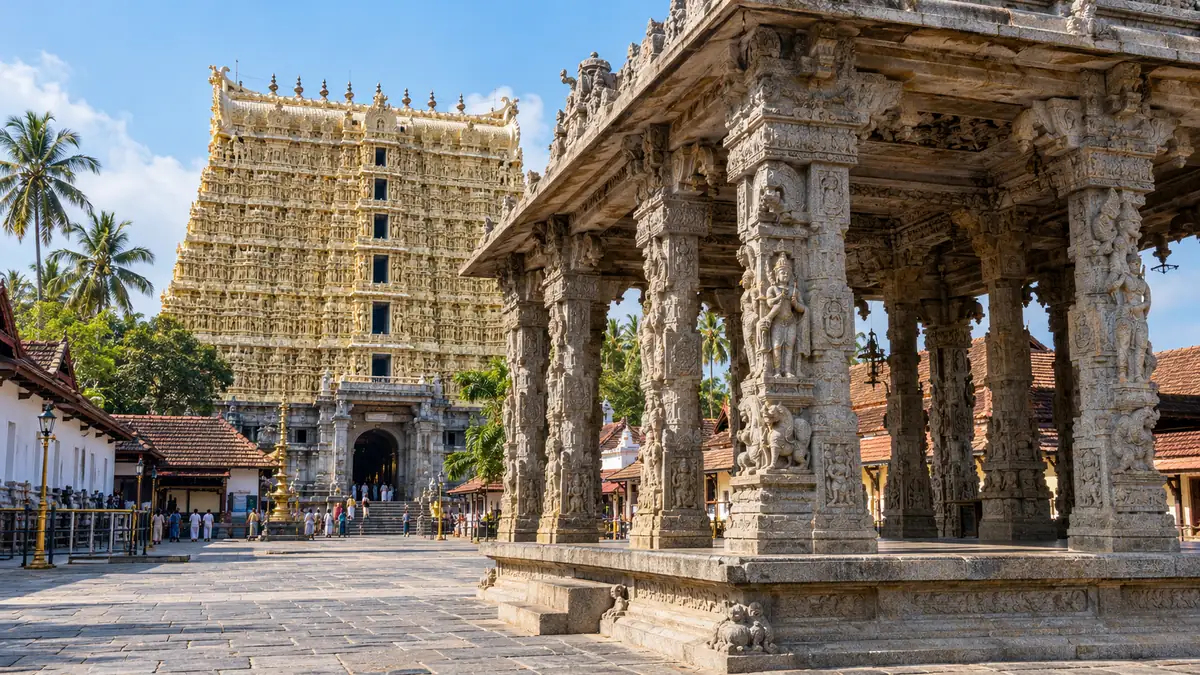
Outside the inner sanctum, a 100-foot seven-storey Dravidian gopuram rises in pale sandstone tones above the sacred Padmatheertham pond. Surrounding the courtyard runs the massive Sheeveli Pura corridor supported by 365 carved granite pillars, leading past the Kulasekhara Mandapam renowned for stone columns that emit distinct musical notes when gently tapped.
Secret Vaults A to F, Vault B Mystery, and Travancore History
Beneath the inner granite courtyard lie six ancient subterranean stone chambers designated Kallaras A through F, holding centuries of royal Travancore donations, ceremonial vessels, and temple offerings. While Vault A underwent historic court-monitored cataloging in 2011 and Vaults C through F hold ritual jewelry, serpent-embossed Vault B remains sealed by judicial oversight and royal tradition.
Like India’s great riverfront shrines featured in historic riverfront shrines in India, Padmanabhaswamy’s living cultural authority flows directly from centuries of continuous patronage intertwined with regional history.
| Temple Vault | Historical Status & Contents Cataloged | Current Custody & Security |
|---|---|---|
| Vault A | Opened in 2011; contained gold coins, chains, solid gold Vishnu idol, and gemstones | Cataloged under digital inventory; strictly sealed |
| Vault B | Unopened in modern era; guarded by twin serpent-carved iron doors | Remains sealed by royal custom & judicial orders |
| Vaults C, D, E & F | Opened periodically for ceremonial festivals | House active ritual vessels, lamps, and festival ornaments |
What Was Found in Vault A vs Why Vault B Remains Sealed
Supreme Court-appointed observers opening Vault A in 2011 documented immense historical wealth accumulated from Pandya, Chera, Vijayanagara, and Travancore eras as well as foreign trade sovereigns. Vault B, guarded by iron doors embossed with twin cobras, remains unopened following royal Travancore family appeals and traditional beliefs tying its seal to sacred trust covenants.
Marthanda Varma’s Trippadidanam and Travancore Stewardship
In January 1750 CE, Maharaja Marthanda Varma performed the historic Trippadidanam ritual, placing his sword upon the Ottakkal Mandapam and surrendering the entire kingdom of Travancore to Lord Padmanabha. From that day forward, Travancore rulers governed strictly as Padmanabhadasas (humble servants acting on behalf of the temple deity).
How to Reach Padmanabhaswamy Temple from Trivandrum Station, Airport, and Beaches
Sree Padmanabhaswamy Temple stands inside East Fort in central Thiruvananthapuram, just 1.5 km from Trivandrum Central Railway Station (TVC) and 6 km from Trivandrum International Airport (TRV). Kovalam Beach lies 14 km south and Varkala cliffs sit 45 km north along NH 66.
Easy airport and rail access makes East Fort an ideal starting hub for southern coastal routes or wellness retreats extending north toward southern spiritual landmarks in Coimbatore. Regional state travel advisories are indexed on the Incredible India Kerala travel guide.
| Origin Hub | Transit Distance | Recommended Route & Transport | Travel Time |
|---|---|---|---|
| Trivandrum Central Station (TVC) | 1.5 km | Auto-rickshaw or walk via Chalai Bazaar | 8 to 10 minutes |
| Trivandrum International Airport (TRV) | 6 km | Prepaid airport taxi via Shankumugham Road | 15 to 20 minutes |
| Kovalam Beach | 14 km | Cab or KSRTC city bus via Bypass Road | 25 to 30 minutes |
| Varkala Beach | 45 km | Intercity express train or coastal taxi | 1 hour 15 minutes |
| Kollam (Quilon) | 66 km | Superfast train or highway cab via NH 66 | 1.5 to 2 hours |
| Kanyakumari | 90 km | Train or morning highway drive via NH 66 | 2.5 hours |
East Fort Buses, Auto-Rickshaws, and Airport Transfers
Auto-rickshaws wait outside Trivandrum Central Station around the clock, reaching East Fort cloakrooms in under ten minutes for roughly INR 40 to INR 60. East Fort also serves as the central terminus for nearly all Thiruvananthapuram KSRTC city buses, connecting seamlessly to Kovalam, Neyyar Dam, and Napier Museum.
Pairing East Fort with Kovalam, Kanyakumari, and Southern Temples
Completing early 6:30 AM darshan lets visitors step next door to the historic wooden Kuthiramalika (Puthenmalika) Palace Museum built by Swathi Thirunal before afternoon warmth rises, leaving the afternoon open for Kovalam lighthouse beaches or an evening drive south toward Kanyakumari.
Pro Tip
Best Season & Festival Windows: Visit between October and March for pleasant 24 C to 31 C mornings. Major ceremonial processions occur twice yearly during Alpashi (October–November) and Panguni (March–April), culminating in the Arattu beach procession to Shankumugham.
Frequently Asked Questions About Padmanabhaswamy Temple
What is the dress code for men and women at Padmanabhaswamy Temple?
Men must wear an unstitched white or cream cotton mundu (dhoti) bare-chested without shirts, vests, or trousers beneath. Women must wear a saree, set-mundu, or long skirt with blouse; women wearing salwar kameez must wrap a cotton mundu externally over their pants.
What are the daily darshan timings at Padmanabhaswamy Temple Trivandrum?
Morning darshan slots open at 3:30 AM to 4:45 AM, 6:30 AM to 7:00 AM, 8:30 AM to 10:00 AM, 10:30 AM to 11:15 AM, and 11:45 AM to 12:00 PM. Evening darshan opens from 4:30 PM to 6:15 PM and 6:45 PM to 7:20 PM.
Is there any entry fee or ticket price for Padmanabhaswamy Temple?
No, general queue darshan at Sree Padmanabhaswamy Temple is completely free (INR 0). Devotees wishing to reserve special archanas, Nirmalyam passes, or Palpayasam offerings can pay nominal seva tariffs via the official trust portal spst.in.
Are non-Hindus allowed inside Padmanabhaswamy Temple?
Only practicing Hindus dressed in traditional attire are permitted inside the inner temple courtyard and sanctum. Non-Hindu visitors may admire the grand East Fort gopuram and Padmatheertham pond from the outer perimeter streets.
How far is Padmanabhaswamy Temple from Trivandrum Railway Station and Airport?
The temple lies 1.5 km from Trivandrum Central Railway Station (8 to 10 minutes by auto-rickshaw) and 6 km from Trivandrum International Airport (15 to 20 minutes by taxi).
Can mobile phones or bags be carried inside Padmanabhaswamy Temple?
No, mobile phones, cameras, smartwatches, bags, and leather items are strictly prohibited inside. Safe digital cloakrooms and footwear counters operate right outside the East Fort entrance gate.