Puducherry Travel Guide: French Quarter, Auroville & ECR
Plan your trip with our Puducherry travel guide covering White Town French villas, Auroville Matrimandir, Paradise Beach ferry, and ECR coastal routes.
Puducherry occupies a singular place along the Coromandel Coast of southern India. This Puducherry travel guide details how the coastal Union Territory preserves the layout of an 18th-century French colonial trading port while serving as an active center for Tamil cultural life and spiritual contemplation.
Planning a journey here involves balancing distinct local experiences. Visitors spend mornings walking among mustard-yellow colonial mansions, afternoons taking backwater ferries toward secluded sandbars, and evenings strolling down pedestrian-only waterfront boulevards.
Puducherry Union Territory Essentials
- Territorial Enclaves: Puducherry spans 492 square kilometers divided into four non-contiguous coastal regions: Puducherry and Karaikal along Tamil Nadu, Mahe along Kerala, and Yanam along Andhra Pradesh.
- Dual Cultural Grid: The central settlement is divided by the old Grand Canal into the French Quarter (White Town) bordering the Bay of Bengal and the Tamil Quarter (Heritage Quarter) inland.
- ECR Highway Transit: The standard arrival corridor runs 150 kilometers south from Chennai Airport (MAA) via the scenic East Coast Road (SH 49), taking roughly 3.5 hours by taxi or express bus.
- Best Visiting Season: Cool dry conditions prevail from October through March, with daytime temperatures hovering between 20°C and 30°C.
Puducherry Travel Guide: Architecture, Heritage Quarters, and Territorial Overview
Puducherry’s historic urban core is organized as an orthogonal grid divided by the Grand Canal into the French Quarter (White Town) and the Tamil Quarter. Over 1,000 preserved heritage structures feature colonial colonnades, arched wooden gateways, and traditional street-facing thinnai verandahs.
What makes Puducherry’s geography unique among Indian union territories? The Union Territory does not form a single continuous landmass. Instead, it consists of four disparate enclaves preserved from French India: the main district of Puducherry, Karaikal on the Kaveri delta, Mahe on the Arabian Sea coast of Malabar, and Yanam on the Godavari delta.
The primary travel district centers on the coastal township of Puducherry, bordered entirely by the surrounding districts of Tamil Nadu. The urban core reflects the orthogonal grid master plan drawn by French colonial planners in the early 1700s. The historic settlement was split into two parallel worlds separated by the Grand Canal drainage canal.
Travelers can consult the Incredible India Puducherry portal and Puducherry Tourism Chunnambar directory for regional maps and updated heritage walking trail brochures. The municipal authorities have preserved over 1,000 heritage structures across both quarters, creating an exceptional urban architectural open-air museum.
Ville Blanche: French Town Planning and Street Architecture
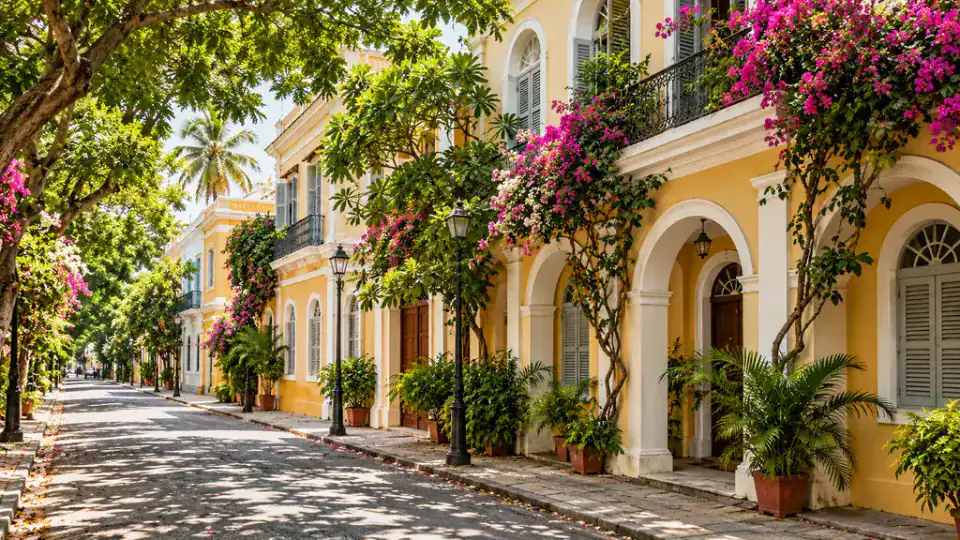
White Town follows an orderly grid laid out parallel to the Bay of Bengal coast. Shaded cobblestone lanes are bordered by high compound walls, arched wooden doorways, and pastel mustard villas.
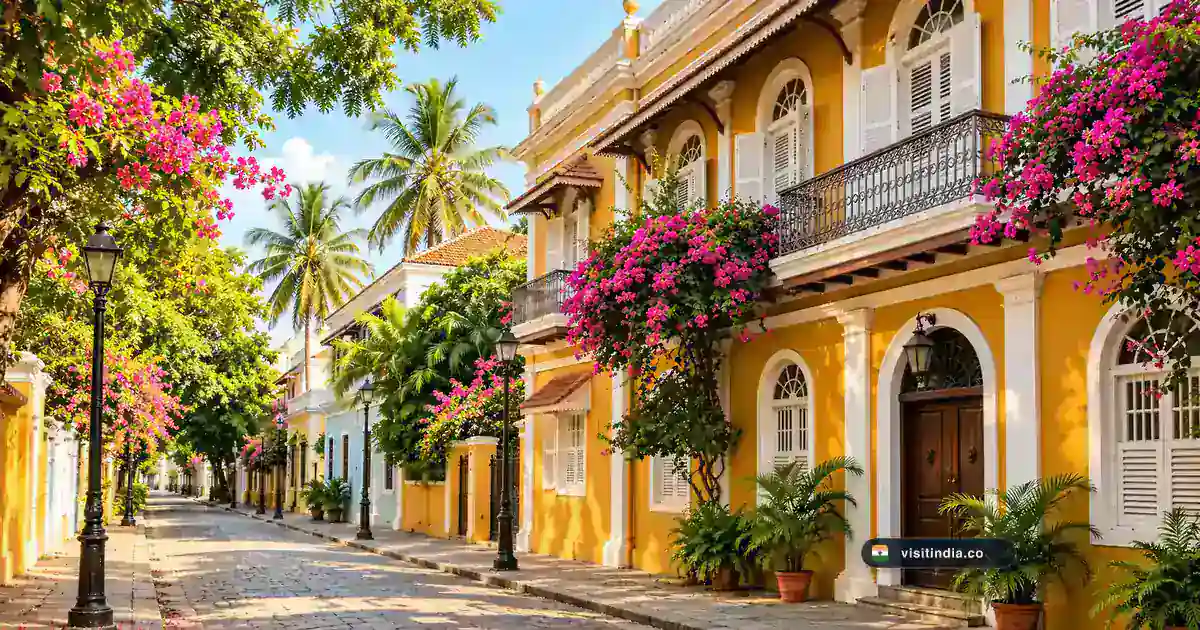
East of the canal lies White Town, officially designated as Ville Blanche. Here, cobblestone streets named Rue Dumas, Rue Romain Rolland, and Rue Suffren feature high compound walls, arched wooden gates, and shaded courtyards. European administrators designed these homes with tall louvered shutters and interior gardens to circulate sea breezes during warm afternoons.
The French Consulate General occupies an imposing seafront villa on Marine Street, standing as a direct diplomatic link to the territory’s colonial history. Walking past these pastel facades reveals cast-iron street lamps, carved limestone cornices, and climbing bougainvillea blooms that create a distinct visual rhythm.
Ville Noire: Vernacular Tamil Architecture and Carved Pillars
The Tamil Quarter preserves vernacular Dravidian streetscapes characterized by street-facing covered verandahs known as thinnai. These homes feature ornate wooden pillars, terracotta tile roofs, and continuous shaded facades.
West of the canal lies the Tamil Quarter, known historically as Ville Noire. This sector features vernacular Tamil architecture developed by local merchants and scholars. Homes here open directly onto the street through covered front porches supported by hand-carved teakwood pillars.
These thinnai spaces functioned as social gathering areas where family elders greeted neighbors and hosted traveling visitors. Behind the carved front doors lie central open courtyards (mutram) that channel natural rainwater and daylight into deep interior family living rooms.
Puducherry Destinations Master Matrix
Puducherry divides into five core sightseeing zones: White Town heritage streets, Promenade waterfront, Auroville universal community, Chunnambar backwaters and beaches, and the southern heritage site of Arikamedu. Most urban sites are open daily with free public access.
Navigating Puducherry requires understanding the distinct clusters that make up the Union Territory. While White Town and the oceanfront Promenade can be explored entirely on foot or by bicycle, reaching Auroville, Chunnambar, and Karaikal requires motorized road transport.
The matrix below outlines the primary travel clusters, standard operating hours, entry requirements, and optimal visiting windows across the territory.
| Destination / Zone | Cluster Category | Standard Timings | Entry Tariff & Transport | Key Highlight |
|---|---|---|---|---|
| White Town French Quarter | Heritage & Urban Walking | Open 24 hours (Best 7:00 AM to 6:00 PM) | Free public access | Mustard villas, French street signs, and courtyard cafes |
| Promenade Beach (Goubert Avenue) | Coastal Waterfront | Vehicle-free 6:00 PM to 7:30 AM | Free public access | 1.5 km seaside walkway, Gandhi statue, and Old Lighthouse |
| Sri Aurobindo Ashram | Spiritual Pilgrimage | 8:00 AM to 12:00 PM, 2:00 PM to 6:00 PM | Free admission | White marble Samadhi courtyard of Sri Aurobindo and The Mother |
| Auroville Township & Matrimandir | Experimental Community | 9:00 AM to 5:30 PM (Visitors Centre) | Free pass (Inner chamber requires advance online slot) | Golden geodesic meditation sphere and tranquil gardens |
| Paradise Beach (Chunnambar) | Coastal Sandspit | 9:00 AM to 5:00 PM (Boats stop 4:00 PM) | ₹354 round-trip ferry per adult + ₹150 beach entry | 25-minute backwater motorboat cruise to clean sandy spit |
| Serenity Beach | Coastal Water Sports | Daylight hours (Dawn to dusk) | Free public access | Surf breaks, private surf schools, and fisherman catamaran boats |
| Arikamedu Archaeological Site | Ancient Maritime History | 9:00 AM to 5:00 PM | Free public access | 1st-century BCE Indo-Roman trade depot on the Ariyankuppam river |
| Karaikal Coastal Enclave | Regional Pilgrimage Hub | Open daily | Free public access (130 km south) | Karaikal Ammaiyar Temple and scenic French-era port riverfront |
Travelers looking for an in-depth breakdown of town attractions should consult our dedicated places to visit in Pondicherry guide for neighborhood-by-neighborhood walking routes.
Exploring White Town: French Heritage Walk and Promenade Beach
White Town walking routes center on Goubert Avenue and adjacent streets like Rue Dumas and Rue Suffren. Key landmarks include the French Consulate, Church of Our Lady of the Angels, French War Memorial, and the 1836 Old Lighthouse.
White Town forms the cultural centerpiece of any visit to Puducherry. The quarter is laid out in a symmetrical grid parallel to Goubert Avenue and the Bay of Bengal coastline. Walking through these streets reveals shuttered windows, wrought-iron balconies, and cascading pink bougainvillea draping over sun-baked ochre compound walls.
Much like the European colonial quarters of Fort Kochi in Kerala, White Town preserves its historical street grid intact, blending European town planning with tropical coastal ecology.
Pro Tip
Rent a classic single-speed road bicycle for roughly ₹100 per day from rental shops along Mission Street. Cycling through White Town before 8:30 AM allows you to photograph the architectural facades without parked motorbikes or delivery vehicles blocking street views.
Historic Churches and Colonial Mansions of Rue Dumas
Rue Dumas anchors prominent colonial structures including the 1855 Church of Our Lady of the Angels. Its Greco-Roman facade and twin bell towers stand surrounded by restored French period villas.
Completed in 1855, the Church of Our Lady of the Angels was designed by French engineer Louis Guerre, modeled after the Basilica of Notre-Dame in Paris. Its interior features polished limestone plasterwork mixed with egg whites to produce a luminous marble-like finish.
Nearby stands the French Institute of Pondicherry on Saint Louis Street. This research institute houses centuries of botanical surveys, rare Sanskrit manuscripts on palm leaves, and microfilms documenting French administrative history across South Asia.
Promenade Beach Waterfront and Evening Pedestrian Curfew
Goubert Avenue stretches 1.5 kilometers along a granite sea wall bordering the Bay of Bengal. Between 6:00 PM and 7:30 AM daily, all motorized traffic is barred, transforming the boulevard into a peaceful walkway.
Along the eastern edge of White Town stretches Goubert Avenue, commonly known as Promenade Beach or Rock Beach. The 1.5-kilometer paved oceanfront promenade is bordered by large black granite sea boulders designed to absorb coastal wave energy. The municipal government enforces a strict motorized vehicle curfew daily between 6:00 PM and 7:30 AM, transforming the entire seaside road into an open pedestrian promenade.
Walking down the Promenade leads past historic civic monuments. The French War Memorial honors soldiers from French India who fell during the First World War. Further south stands a four-meter bronze statue of Mahatma Gandhi, encircled by eight tall, intricately carved granite monolithic pillars transported from the 16th-century Gingee Fort. Across the road stands the 29-meter Old Lighthouse, built by French engineer Louis Guerre in 1836.
Spiritual Landmarks: Auroville Township and Sri Aurobindo Ashram
Spiritual travel in Puducherry centers on Sri Aurobindo Ashram in White Town and the international experimental township of Auroville 12 kilometers north. Both centers emphasize silent contemplation, self-realization, and human unity without sectarian ritual.
Spiritual seekers and architecture enthusiasts travel from across the globe to visit the spiritual institutions established by Indian nationalist philosopher Sri Aurobindo and his spiritual collaborator Mirra Alfassa, revered as The Mother.
Sri Aurobindo Ashram: Samadhi Courtyard and Guidelines
The ashram welcomes visitors daily from 8:00 AM to 12:00 PM and 2:00 PM to 6:00 PM. Guests sit in silent meditation around the white marble Samadhi of Sri Aurobindo and The Mother beneath a historic Service Tree.
Located on Rue de la Marine inside White Town, the Sri Aurobindo Ashram serves as an active center of spiritual practice founded in 1926. Visitors enter a tranquil courtyard shaded by a magnificent Service Tree to sit in silent contemplation around the white marble Samadhi.
The sacred enclosure preserves the mortal remains of Sri Aurobindo and The Mother. Silence is strictly observed throughout the ashram premises, and mobile devices must be switched off completely. Volunteers distribute quiet literature, and an on-site dispensary provides traditional herbal remedies.
Auroville Universal Township and Matrimandir Passes
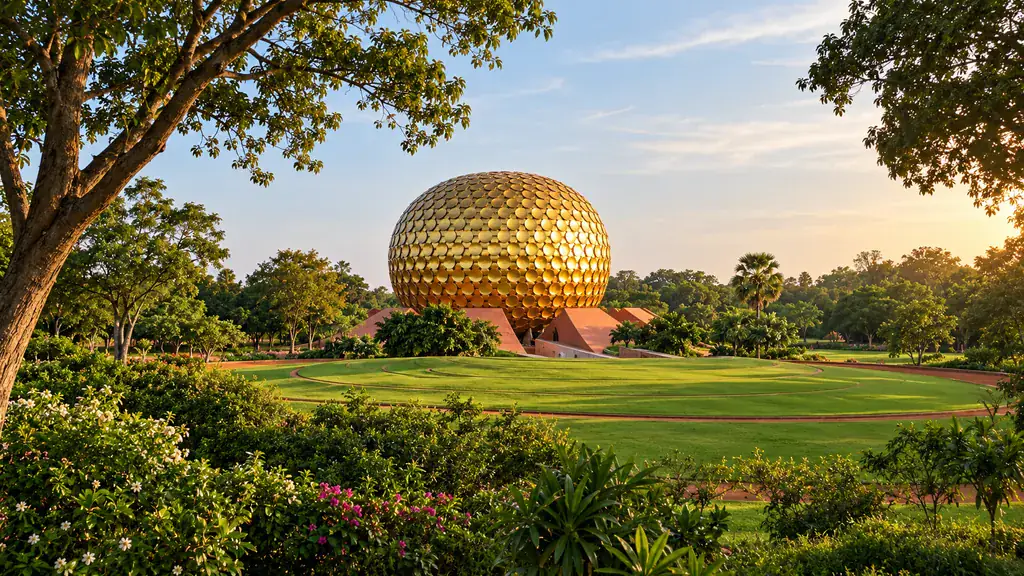
Auroville’s central meditation sphere, the Matrimandir, features 1,414 gold-leaf clad discs. Exterior Viewing Point passes are free on walk-in at the Visitors Centre, while Inner Chamber entry requires online advance booking 3 to 7 days ahead.
Approximately 12 kilometers north of the town center lies Auroville, an international universal township founded in 1968 under the endorsement of UNESCO and the Government of India. Auroville was conceived as a self-sustaining universal city where people of all nations live in peace and progressive harmony, free from political or religious divisions.
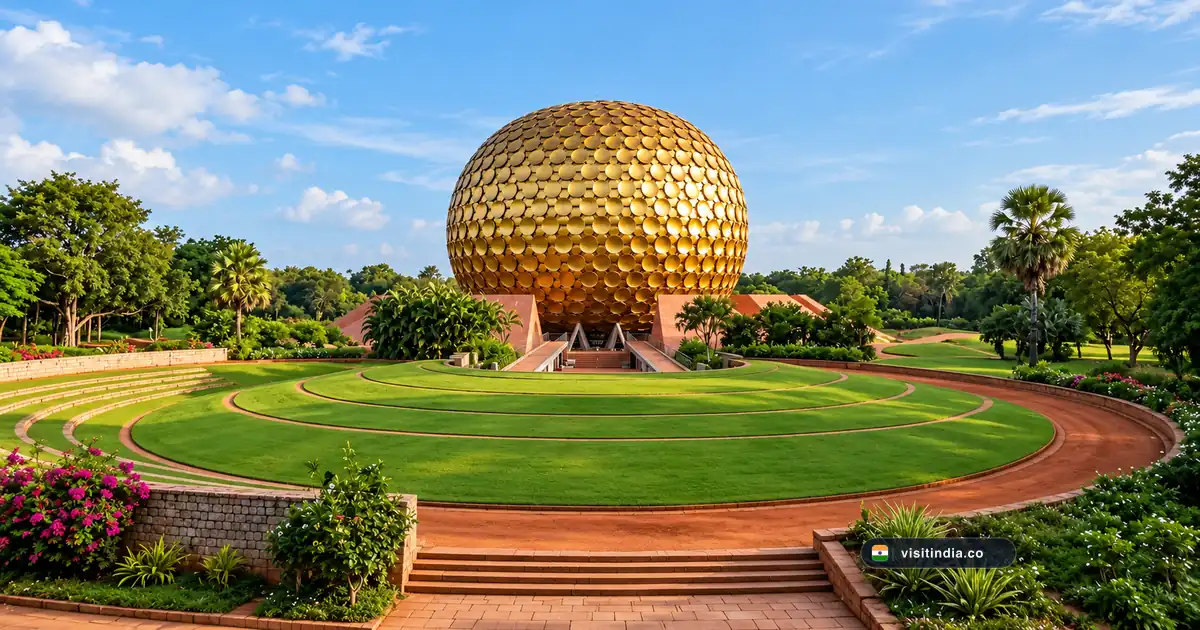
At the geographic center of Auroville stands the Matrimandir, often described as the soul of the community. The striking 29-meter-high golden geodesic sphere is covered with 1,414 gilded concave stainless steel discs. Inside the sphere lies an immaculate white marble chamber containing a 70-centimeter optically pure glass crystal globe illuminated by a single ray of sunlight directed downward through a rooftop heliostat.
Important
The Matrimandir inner meditation chamber is not a sightseeing attraction. Entry requires advance individual registration through the Auroville Foundation official portal. Booking slots open 3 to 7 days in advance online, and same-day access is strictly unavailable.
For complete pass booking instructions, timing schedules, and dress guidelines, explore our specialized Auroville Matrimandir booking guide. First-time casual visitors can obtain a free same-day pass at the Auroville Visitors Centre to walk along a 1-kilometer shaded forest path leading to the exterior Matrimandir Viewing Point.
Coastal Escapes: Paradise Beach, Serenity Beach, and Chunnambar
Puducherry’s coastline offers contrasting marine environments ranging from the sheltered estuary sandspit of Paradise Beach to the rolling surf breaks of Serenity Beach and the Blue Flag certified shores of Eden Beach.
Beyond its colonial streetscapes and spiritual sanctuaries, Puducherry features an appealing variety of coastal retreats along the Bay of Bengal. The coastal waters here feature a mix of calm backwater estuaries and rolling surf breaks suited for casual swimming and water sports.
Chunnambar Boat House and Paradise Beach Ferry Logistics
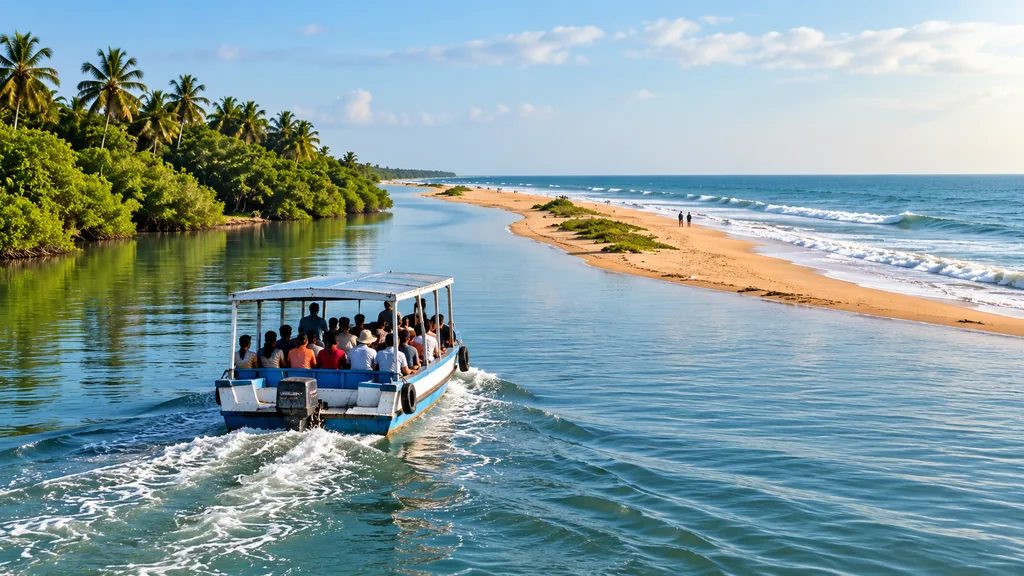
Motorboats depart Chunnambar Boat House from 9:00 AM to 4:00 PM, navigating 25 minutes through scenic mangrove estuaries to Paradise Beach. Adult round-trip boat tickets cost ₹354 including GST.
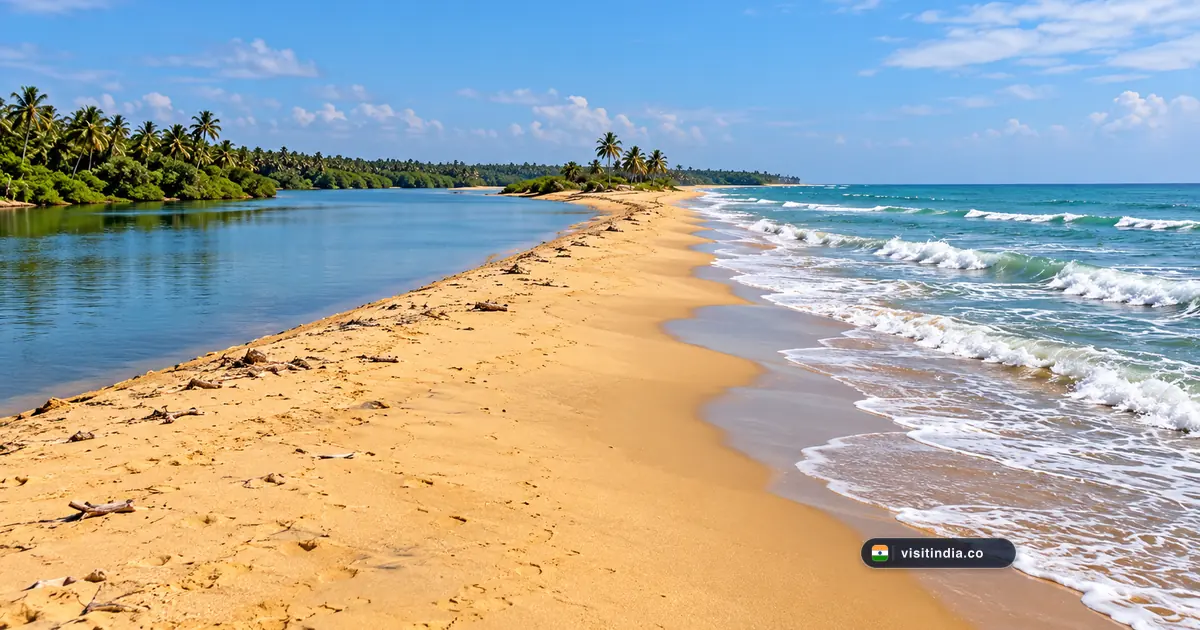
Paradise Beach ranks as the most celebrated shoreline in the territory. Located 8 kilometers south of town near Nonankuppam, this isolated golden sandbar is separated from the mainland by the broad Chunnambar river estuary. Visitors reach the beach by boarding government passenger ferries operated by the Puducherry Tourism Development Corporation from the Chunnambar Boat House.
The 25-minute scenic boat ride winds through tranquil mangrove creeks before arriving at the ocean sandbar. Adult round-trip ferry tickets cost approximately ₹354 including GST, with boats departing continuously from 9:00 AM until 4:00 PM. The beach itself features eco-friendly thatched resting gazebos, coconut water vendors, and volleyball nets. Strong undercurrents can develop near the river mouth, making swimming advisable only in designated flagged safety zones.
Surfing at Serenity Beach and Blue Flag Standards at Eden Beach
Serenity Beach features rock groynes that generate peeling surf breaks ideal for beginner surf lessons. Further south, Eden Beach offers certified lifeguards, clean amenities, and international Blue Flag eco-credentials.
Further north along the East Coast Road lies Serenity Beach, a favorite destination for surf enthusiasts. The beach features a long rock pier that extends into the ocean, creating a natural breakwater that generates consistent, beginner-friendly peeling waves. Several certified surf academies operate directly on the beach, offering 90-minute introductory surf lessons starting from ₹1,800 per session.
Travelers looking for a comprehensive breakdown of water conditions, ferry tariffs, and coastal safety rules should review our complete Pondicherry beaches guide. The guide covers alternative quiet beaches including Eden Beach, which holds prestigious international Blue Flag eco-certification for water cleanliness and sustainable coastal amenities.
Franco-Tamil Creole Gastronomy: Culinary Traditions and Heritage Bakeries
Puducherry’s unique Franco-Tamil Creole cuisine fuses European reduction sauces with Tamil coconut, tamarind, and local spice blends. Signature specialties include Fish Assad, prawn vadouvan curry, and wood-fired baguettes.
Puducherry’s culinary identity represents an authentic fusion shaped by more than two centuries of French presence on the Tamil coast. Known regionally as Franco-Tamil Creole food, this culinary tradition marries French culinary techniques with traditional southern Indian spices, aromatics, and seafood.
Unlike fiery Tamil curries or creamy French stews, Creole dishes seek an equilibrium where rich coconut cream, mild green chilies, and tangy vinegar harmonize without overpowering fresh catches from the Bay of Bengal.
Signature Creole Dishes: Fish Assad and Vadouvan Seasoning
Fish Assad balances delicate coconut milk and mild spices with vinegar, creating a gentle alternative to fiery curries. Vadouvan is an aromatic French adaptation of Tamil sun-dried shallot and garlic spice balls.
The definitive centerpiece of Franco-Tamil home cooking is Fish Assad. This aromatic fish curry utilizes firm ocean fish fillets simmered in coconut milk infused with ground turmeric, ginger, green chilies, and a splash of white vinegar. The vinegar mimics the European tradition of deglazing while brightening the sweetness of fresh coconut cream.
Another foundational culinary element is Vadouvan, known locally as French onion masala. Vadouvan originated as a colonial adaptation of traditional Tamil vadavam, which consists of shallots, garlic, mustard seeds, fenugreek, and castor oil rolled into balls and sun-dried. French chefs incorporated this dried seasoning into slow-cooked mutton roasts, prawn curries, and vegetable gratins.
White Town French Bakeries, Cafes, and Filter Coffee
White Town’s historic bakery tradition produces fresh butter croissants, pain au chocolat, and crusty baguettes. These European breakfast offerings coexist seamlessly with aromatic South Indian filter coffee in the Tamil Quarter.
Mornings in White Town begin with the aroma of freshly baked bread wafting from wood-fired brick ovens. Traditional bakeries produce crisp baguettes (pain de campagne), flaky almond croissants, and savory quiches that honor classic French patisserie standards.
Courtyard cafes housed within restored colonial mansions offer tranquil outdoor garden seating shaded by mango and frangipani trees. A few blocks west across the Grand Canal, active local tiffin mess houses serve crisp ghee roast dosas, fluffy idlis, and piping hot South Indian filter coffee poured with theatrical flair from stainless steel tumblers.
Territorial Enclaves: Karaikal, Mahe, and Yanam
The Union Territory includes three outlying coastal enclaves preserved from French India: Karaikal on the Kaveri delta in Tamil Nadu, Mahe on Kerala’s Malabar coast, and Yanam on the Godavari river in Andhra Pradesh.
A distinctive political legacy of the 1954 French cession is that Puducherry does not exist as a single geographic parcel. The Union Territory administers three detached coastal territories spread across three different Indian states.
Karaikal Pilgrimage and Port Enclave
Located 130 kilometers south along the Tamil Nadu coast, Karaikal is famous for the ancient Karaikal Ammaiyar Temple, sandy Arasalar riverfront beaches, and the nearby pilgrimage town of Nagore.
Karaikal spans 160 square kilometers within the fertile Kaveri delta. The historic settlement centers on the Karaikal Ammaiyar Temple, dedicated to one of the 63 celebrated Nayanmar Shaivite saints. Pilgrims flock here during the annual Mangani Festival to witness sacred mango-throwing rituals.
The town also features clean sandy shorelines where the Arasalar river empties into the sea. Karaikal serves as an excellent base for visiting the historic seaside Danish fort at Tharangambadi (Tranquebar) and the famous dargah at Nagore.
Mahe and Yanam: Arabian Sea and Delta Outposts
Mahe sits 600 kilometers west on Kerala’s Malabar coast with scenic hillside walkways along the Mayyazhi river. Yanam lies 800 kilometers north along Andhra Pradesh’s Godavari delta, featuring French colonial riverside monuments.
Mahe occupies barely 9 square kilometers on the Arabian Sea, bordered by the Kannur and Kozhikode districts of Kerala. The hillside enclave is known for the scenic Mayyazhi river walkway, historic St. Theresa’s Church, and sweeping coastal viewpoints.
Yanam covers 30 square kilometers along the Gautami Godavari river in Andhra Pradesh. The waterfront boulevard features a French-style replica of the Eiffel Tower, colonial obelisks, and riverfront parks overlooking mangrove delta channels.
Puducherry 3-Day Sightseeing Itinerary and ECR Driving Route
A standard 3-day Puducherry tour dedicates Day 1 to White Town and the Promenade, Day 2 to Auroville forest trails and surfing, and Day 3 to Paradise Beach backwaters and Tamil Quarter markets.
The coastal highway route from Chennai offers one of the most scenic road trips in southern India, making driving or riding a motorcycle a memorable experience.
The East Coast Road (ECR) Driving Circuit
Driving from Chennai to Puducherry spans 150 kilometers along State Highway 49. The scenic coastal highway passes Mahabalipuram shore temples, salt pans, and casuarina groves in approximately 3.5 hours.
Travelers departing Chennai typically plan a morning stop at the Mahabalipuram UNESCO monuments, located 55 kilometers into the drive. Exploring the 7th-century Shore Temple and the monumental rock-cut bas-relief of Arjuna’s Penance takes approximately two hours.
Continuing south along the ECR, motorists pass the expansive salt pans of Marakkanam before crossing the Union Territory boundary into Puducherry. The entire drive takes roughly 3.5 hours excluding stops, with smooth tarmac, toll plazas, and coastal eateries offering ocean views.
Suggested 3-Day Sightseeing Schedule
The table below outlines a balanced 72-hour touring itinerary for first-time visitors.
| Day | Morning Session (8:00 AM to 12:30 PM) | Afternoon Session (2:00 PM to 5:30 PM) | Evening Session (6:00 PM to 9:00 PM) |
|---|---|---|---|
| Day 1: French Quarter Heritage | Self-guided White Town walking tour; Church of Our Lady of the Angels; French War Memorial | Puducherry Museum; Sri Aurobindo Ashram courtyard and bookstore | Sunset walk along vehicle-free Goubert Avenue; dinner at a French heritage courtyard cafe |
| Day 2: Auroville & Forest Trails | Early transit to Auroville Visitors Centre; documentary screening; shaded walk to Matrimandir Viewing Point | Artisan boutiques at Auroville Visitors Centre; quiet lunch at a farm-to-table organic bakery | Sunset surf lesson or coffee at Serenity Beach; evening dinner in the Tamil Quarter |
| Day 3: Coastal Waterways & Crafts | Chunnambar Boat House ferry ride across backwaters to Paradise Beach; beach walk | Return ferry; explore traditional woodcraft and handloom shops along Mission Street | Goubert Market spice and flower stalls; twilight seaside stroll along Promenade Beach |
Logistics: How to Reach, Local Scooter Rentals, and Seasonality
Puducherry is accessed via Chennai Airport (135 km) or Puducherry Railway Station (PDY). Within town, automatic scooters rent for ₹350 to ₹500 per day, making trips to Auroville and Chunnambar convenient.
Planning transit and local mobility ahead ensures a stress-free travel experience across the territory’s diverse zones.
Air, Rail, and Road Transportation Options
Puducherry Railway Station links with daily express services from Chennai, Tirupati, and Bengaluru. Direct SETC and PRTC buses depart frequently from Chennai CMBT terminus.
Puducherry Airport (PNY) operates regional turboprop flights connecting directly to Bengaluru and Hyderabad under the central government’s regional connectivity scheme. However, flight frequencies can vary seasonally. Most national and international travelers fly into Chennai International Airport (MAA), located 135 kilometers to the north. From Chennai Airport, pre-paid taxis charge between ₹2,800 and ₹3,600 for the 3.5-hour transfer directly to Puducherry hotels.
Puducherry Railway Station (PDY) terminates near the southern end of the town center, roughly 1 kilometer from White Town. The station handles express trains from Chennai Egmore, Tirupati, Bengaluru, and New Delhi.
The broader Chennai transit hub connects with express rail corridors documented in our guide to Vande Bharat Express tourist routes, facilitating rapid overland journeys from southern metropolitan hubs. Frequent government air-conditioned buses operated by SETC and PRTC also run round-the-clock between Chennai’s CMBT bus terminus and Puducherry, with fares averaging ₹180 to ₹250.
Local Scooter Rentals and Cycle Logistics
Scooter rental shops on Mission Street supply 110cc automatic mopeds. Helmets are mandatory under Union Territory traffic laws, and valid driving licenses must be presented.
Puducherry is exceptionally pedestrian-friendly within White Town and the immediate Tamil Quarter. However, renting a scooter or automatic gearless moped offers the most convenient way to travel outward toward Auroville (12 km) or Chunnambar (8 km).
Scooter rental shops line Mission Street and Rangapillai Street. Daily rental rates typically range between ₹350 and ₹500 per day for a 110cc scooter, depending on the season. A valid driving license and a refundable deposit (or original identity document) are required. Helmets are mandatory under Union Territory traffic regulations.
Climate and Seasonal Windows
Puducherry experiences a tropical maritime climate characterized by three distinct annual phases:
- Winter Window (October to March): This is the ideal travel season. North-east monsoon showers in November give way to clear skies and gentle maritime breezes. Daytime temperatures range from 24°C to 30°C, with comfortable evenings averaging 20°C.
- Summer Window (April to June): Late spring and early summer bring intense tropical heat and elevated coastal humidity. Midday temperatures frequently exceed 38°C, making midday walking uncomfortable.
- Monsoon Window (July to September): The territory receives moderate rainfall during the south-west monsoon, resulting in lush foliage and fewer tourist crowds.
Frequently Asked Questions About Puducherry Travel
How many days are recommended for a Puducherry trip?
A stay of 3 full days allows comfortable exploration of White Town, Auroville, and coastal beaches without rushing. Travelers wishing to experience meditation programs or surf courses typically extend their stay to 5 days.
What is the best way to travel from Chennai to Puducherry?
Traveling by road along the East Coast Road (SH 49) offers the smoothest route across 150 kilometers with scenic Bay of Bengal views. Air-conditioned express buses and private taxis complete the journey in roughly 3 to 3.5 hours.
Can visitors enter the Auroville Matrimandir inner chamber on the same day?
Same-day entry into the inner chamber is strictly prohibited under Auroville foundation regulations. Visitors must submit an individual online booking request between 3 and 7 days in advance via the official Auroville portal.
How do travelers reach Paradise Beach?
Paradise Beach is an isolated sandspit accessible primarily by passenger ferries departing from the Chunnambar Boat House 8 kilometers south of town. Motorboats operate from 9:00 AM to 4:00 PM and take approximately 25 minutes each way.
What is authentic Franco-Tamil Creole food in Puducherry?
Franco-Tamil Creole cuisine blends French culinary methods with Tamil coconut milk, tamarind, and local aromatics. Signature dishes include Fish Assad coconut curry, prawn vadouvan shallot masala, and crusty wood-fired baguettes.
What is the difference between White Town and Tamil Quarter?
White Town features French colonial grid planning with mustard stucco villas, arched gates, and private courtyards. The Tamil Quarter preserves traditional Dravidian architecture with street-facing carved wooden thinnai verandahs.
Which month is best to visit Puducherry?
The winter window from October through March brings mild sea breezes and comfortable daytime temperatures ranging from 20°C to 30°C. Summer months between April and June experience high humidity and afternoon temperatures above 38°C.
What vehicles are allowed on the Promenade Beach road in the evening?
Goubert Avenue along Promenade Beach is closed to all motorized traffic daily between 6:00 PM and 7:30 AM. During these pedestrian-only hours, the seafront boulevard is exclusively accessible to walkers, runners, and cyclists.