Ajanta and Ellora Caves Guide: Kailash Temple, Murals & Timings
Comprehensive guide to Ajanta and Ellora Caves: Kailash Temple Cave 16, ancient Buddhist murals, closed days, ticket booking, and Aurangabad transit.
Carved directly into the volcanic basalt cliffs of the Sahyadri ranges in northern Maharashtra, the rock-cut complexes of Ajanta and Ellora represent the pinnacle of ancient Indian rock architecture and mural painting. Located roughly 100 kilometers apart, these two UNESCO World Heritage sanctuaries preserve centuries of religious harmony, spiritual dedication, and artistic brilliance across Buddhism, Hinduism, and Jainism.
Ajanta & Ellora Essentials
- Primary Base City: Chhatrapati Sambhajinagar (Aurangabad), Maharashtra.
- Transit Distances: Ellora sits 30 km northwest; Ajanta sits 100 km northeast of the city.
- Weekly Closed Days: Ajanta Caves are closed on Mondays; Ellora Caves are closed on Tuesdays.
- Signature Highlights: Cave 16 monolithic Kailash Temple at Ellora; Cave 1 Padmapani mural at Ajanta.
- Recommended Duration: 2 full days (one day dedicated to each cave complex).
- Best Season to Visit: October to March for mild winter daytime temperatures.
While travelers frequently speak of Ajanta and Ellora in a single breath, the two sites differ substantially in age, geographic setting, and artistic medium. Ajanta comprises 30 exclusively Buddhist caves excavated along a horseshoe-shaped gorge between the second century BCE and the fifth century CE, celebrated for delicate tempera fresco paintings.
In contrast, Ellora features 34 monumental rock-cut cave temples spanning a two-kilometer basalt cliff face, excavated between the sixth and tenth centuries CE. Ellora reflects the coexistence of Buddhist, Hindu, and Jain faiths, crowned by the monolithic Kailash Temple.
Official preservation registries maintained by the Archaeological Survey of India monument database catalog both complexes among the greatest architectural achievements of ancient human civilization.
| Key Characteristic | Ajanta Caves | Ellora Caves |
|---|---|---|
| Religious Affiliation | Exclusively Buddhist (Theravada and Mahayana) | Multi-faith (12 Buddhist, 17 Hindu, 5 Jain) |
| Total Number of Caves | 30 caves (including unfinished chambers) | 34 caves open to tourists (over 100 total) |
| Primary Artistic Medium | Detailed wall fresco paintings and chaitya halls | Massive monolithic stone sculptures and temples |
| Weekly Closed Day | Every Monday | Every Tuesday |
| Distance from Hub | 100 km northeast of Chhatrapati Sambhajinagar | 30 km northwest of Chhatrapati Sambhajinagar |
| Historical Period | 2nd Century BCE to 5th Century CE | 6th Century CE to 10th Century CE |
Ellora Cave 16: The Monolithic Kailash Temple Engineering Marvel
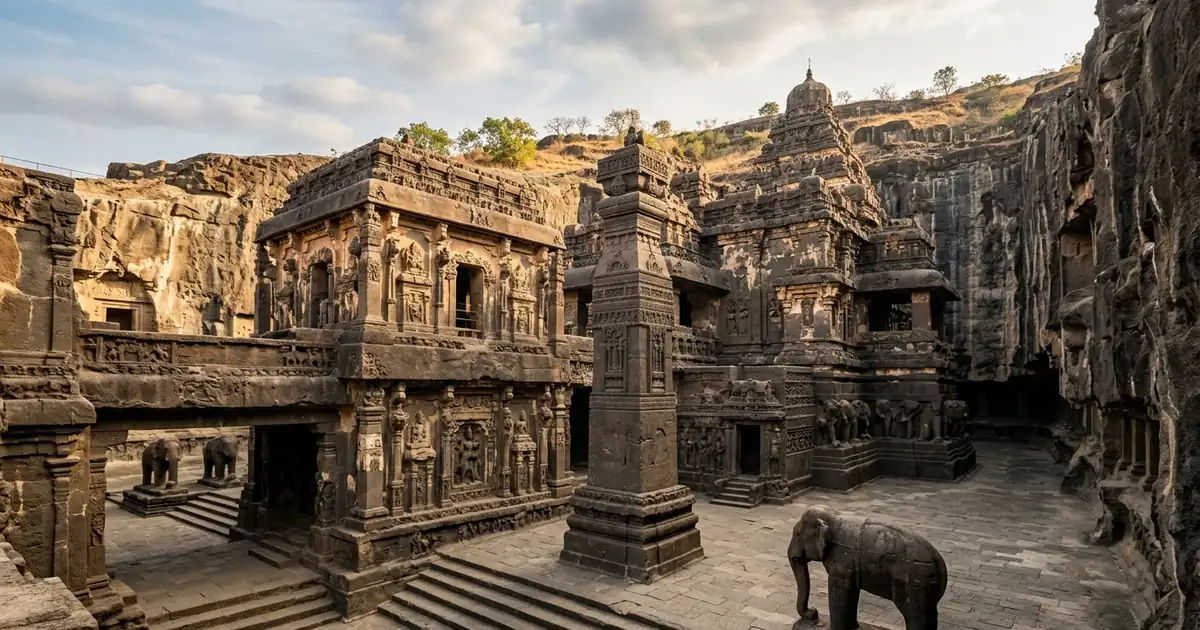
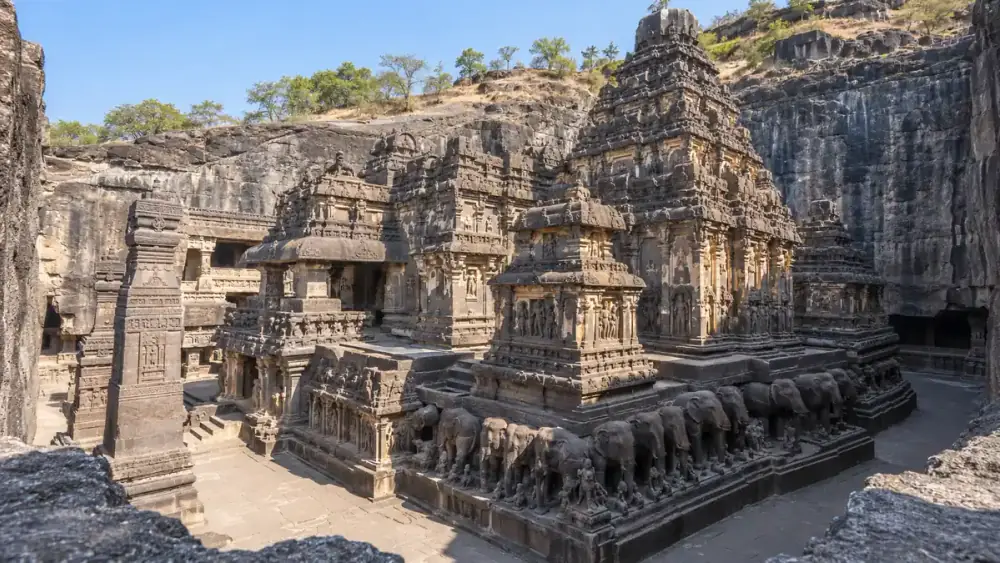
Cave 16 at Ellora, universally known as the Kailash Temple (Kailasanatha), is recognized by global architectural historians as the most remarkable rock-cut monument in the world. Unlike conventional stone temples assembled from quarried stone blocks, the entire multi-story complex was carved out of a single towering volcanic basalt cliff face.
Devotees and heritage enthusiasts often pair a visit to this monolithic wonder with the nearby Jyotirlinga shrine detailed in our Grishneshwar Jyotirlinga guide, located less than one kilometer from the cave ticket gate.
Top-Down Excavation Technique of Rashtrakuta Builders
Commissioned in the eighth century CE by King Krishna I of the Rashtrakuta Dynasty, the construction of Kailash Temple required an astonishing engineering method. Master masons began at the summit of the basalt cliff and carved vertically downward into the mountainside.
Over 200,000 tonnes of solid rock were manually chiseled away using only iron hammers, cold chisels, and wooden wedges without the aid of modern blasting or power machinery. Because the carvers worked from top to bottom, there was zero room for structural error. Every pillar, archway, decorative ceiling, and stone elephant had to be visualized accurately within the solid rock before the surrounding stone was removed.
Dravidian Shikhara, Stone Elephants & Courtyard Obelisks
The finished temple replicates Mount Kailash, the sacred Himalayan abode of Lord Shiva. The central sanctuary rises over 32 meters high, crowned by a pyramidal Dravidian stone tower (shikhara) adorned with miniature barrel-vaulted pavilions:
- Life-Sized Elephants: A colossal frieze of life-sized war elephants and mythical lions lines the plinth of the main assembly hall, giving the visual impression that the entire stone temple rests on the backs of these beasts.
- Victory Obelisks (Dhvajastambhas): Flanking the central courtyard stand two freestanding monolithic stone pillars rising nearly seventeen meters high, carved with geometric and floral bands.
- Connecting Bridges: Rock-cut stone skywalks originally linked the upper galleries of the entrance gateway to the central Nandi mandapa before sections suffered earthquake wear over centuries.
Ravana Shaking Mount Kailash Bas-Relief
Along the southern exterior gallery of the temple plinth rests one of ancient India’s most expressive sculptural reliefs: Ravananugraha Murti. The massive panel depicts the demon king Ravana trapped beneath Mount Kailash, attempting to shake the mountain with his twenty muscular arms.
Above him, Lord Shiva sits calmly in meditation with Goddess Parvati, who clings to Shiva’s arm in startled apprehension. With quiet composure, Shiva presses his big toe downward onto the floor, effortlessly pinning Ravana beneath the immense weight of the mountain and crushing his imperial pride.
Exploring Ellora: Buddhist Caves, Hindu Shrines & Jain Excavations
Beyond Cave 16, Ellora features 33 additional rock-cut caves spread along the curved scarp of the Charanandri hills. The caves are numbered chronologically from south to north, guiding travelers through the evolution of Indian religious iconography.
State tourism assistance and heritage walking circuits are coordinated through the Maharashtra Tourism Development Corporation portal for visitors arriving in the Marathwada region. Travelers combining these ancient caves with coastal and hill destinations can plan wider regional routes using our Maharashtra travel guide.
Cave 10: The Carpenter’s Cave (Vishwakarma Chaitya)
Cave 10 represents the only Buddhist prayer hall (chaitya-griha) at Ellora, dating to roughly 650 CE. It is widely known as the Vishwakarma Cave or the “Carpenter’s Cave” because early rock cutters meticulously carved the stone ceiling ribs to imitate curved wooden rafters:
- Acoustic Vault: The arched cathedral ceiling directs sound toward the central stupa, creating resonant acoustic echoes during vocal chanting.
- Colossal Buddha: Fronting the central votive stupa sits a massive 3.3-meter-tall statue of Lord Buddha seated in the preaching posture (Dharmachakra Pravartana Mudra).
- Sunlight Gallery: An elevated arched music balcony (horseshoe sun-window) allows natural morning sunlight to illuminate the Buddha’s face while leaving the outer corridors in soft shadow.
Cave 15: Dasavatara Cave and Early Chalukya Influences
Cave 15, named the Dasavatara Cave, began as an open Buddhist monastery before being converted into a monumental two-story Hindu temple during the Rashtrakuta era. The open courtyard leads into a pillared upper gallery containing dynamic stone bas-reliefs illustrating the incarnations of Lord Vishnu:
- Narasimha Slaying Hiranyakashipu: One of the most famous Hindu sculptures in India, showing the half-man, half-lion avatar springing fiercely from a stone pillar to pin the arrogant demon king across his knee.
- Shiva as Nataraja: A graceful panel depicting Shiva performing the cosmic dance of destruction and creation surrounded by celestial musicians.
Caves 30 to 34: The Jain Group and Indra Sabha
Located at the northernmost end of the Ellora cliff, the Jain group was excavated during the ninth and tenth centuries under the patronage of the Digambara sect. These caves feature exceptionally dense, delicate filigree stone carving:
- Cave 32 (Indra Sabha): The most elaborate Jain excavation, featuring a two-story court entered through a stone gateway. The upper hall is adorned with intricate lotus ceiling medallions, dancing figures, and seated statues of Tirthankaras Mahavira and Parshvanatha.
- Matanga and Siddhaika: Colossal guardian deities seated beneath fruiting trees, carved with exquisite jewelry and fine textile patterns.
- Cave 30 (Chhota Kailash): A scaled-down monolithic excavation modeled directly on the great Kailash Temple of Cave 16.
The Ajanta Caves: Buddhist Fresco Murals, Jataka Tales & Chaityas
While Ellora celebrates monolithic stone carving, Ajanta is globally renowned for ancient mural paintings that set the foundation for classical Asian art. Situated within an isolated semicircular river bend, these caves served as seasonal monastics retreats (varshavasa) for Buddhist monks.
Cultural travelers evaluating major historical destinations across the country frequently rank Ajanta alongside the top places to visit in India.
Waghora River Horseshoe Gorge Geography and Discovery by John Smith
The Ajanta caves were carved into a sheer 76-meter crescent cliff face overlooking the Waghora River gorge. Following the decline of Buddhism in central India by the sixth century CE, dense jungle foliage overtook the canyon, hiding the cave entrances for more than 1,200 years.
In April 1819, a British cavalry officer named John Smith was hunting tigers along the ravine when a young tribal boy pointed out the hidden facade of Cave 10. Smith climbed down the gorge and scratched his name onto a stone pillar inside, initiating modern archaeological recovery of the lost canyon.
Cave 1 and Cave 2: Padmapani and Vajrapani Fresco Masterpieces
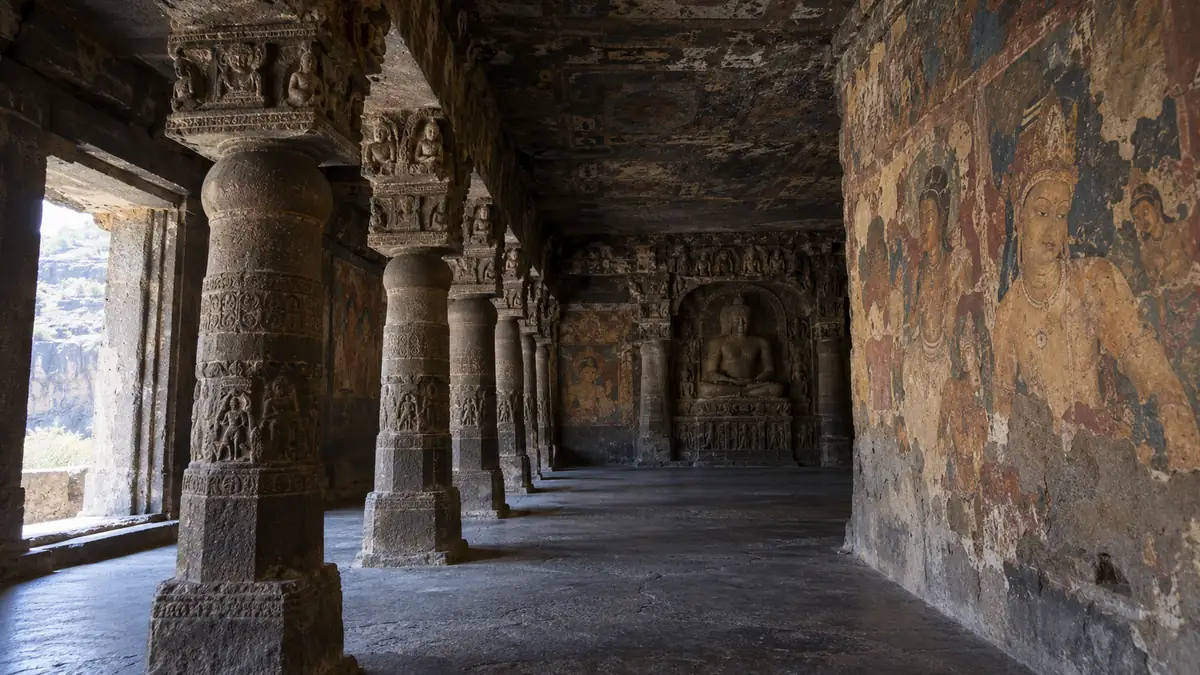
Cave 1 is a grand Mahayana monastery (vihara) containing the most celebrated paintings in Buddhist history. The artists used a unique tempera technique, applying a base layer of ferruginous clay, cow dung, and rice husks over the rock, coated with fine lime plaster before painting with mineral pigments:
- Bodhisattva Padmapani: Flanking the inner sanctum doorway, this iconic painting portrays the Bodhisattva of Compassion holding a blue lotus blossom. His gentle gaze, curved posture, and pearl jewelry convey deep spiritual calm.
- Bodhisattva Vajrapani: Standing opposite Padmapani, this protector figure holds a diamond thunderbolt, symbolizing spiritual strength and determination.
- Jataka Tales: The surrounding walls narrate stories from Lord Buddha’s previous lives, including the Mahajanaka Jataka and Sibi Jataka, depicting royal palaces, foreign merchants, ship voyages, and rural village life.
Cave 19 and Cave 26: Elongated Parinirvana Reclining Buddha
Cave 19 and Cave 26 are elaborate chaitya prayer halls distinguished by carved stone ribbed ceilings and ornate exterior entrance arches. Cave 26 houses one of the most poignant monumental sculptures in ancient art:
- The Reclining Buddha (Mahaparinirvana): Spanning seven meters in length along the left aisle wall, the sculpture depicts Lord Buddha passing into final peace between two sacred Sal trees.
- Mourning Disciples: Beneath his reclining form, grieving disciples weep in sorrow, while celestial beings above rejoice at his spiritual liberation.
Visitor Information: Closed Days, Opening Hours & ASI Entry Fees
Planning an efficient journey to Ajanta and Ellora requires careful attention to weekly closed days, as visiting on the wrong day is the most common travel mistake made by independent tourists.
National ticketing guidelines and safety protocols coordinated through the Ministry of Tourism Incredible India portal mandate digital entry booking to avoid extended ticket lines at monument gates.
| Practical Aspect | Ajanta Caves Information | Ellora Caves Information |
|---|---|---|
| Weekly Closed Day | Closed Every Monday | Closed Every Tuesday |
| Daily Visiting Hours | 9:00 AM to 5:00 PM | 6:00 AM to 6:00 PM (Sunrise to Sunset) |
| Indian Citizen Entry Fee | ₹40 per person (ASI digital ticket) | ₹40 per person (ASI digital ticket) |
| Foreign Tourist Entry Fee | ₹600 per person | ₹600 per person |
| Internal Transport Shuttle | ₹25 - ₹40 green eco-bus from T-Junction | Internal walking and golf carts for Cave 29/32 |
| Photography Policy | Strictly no camera flash permitted inside caves | Tripods require special ASI permissions |
The Critical Closed Days Schedule: Ajanta Monday vs. Ellora Tuesday
Remember the simple scheduling rule: Ajanta is closed on Mondays; Ellora is closed on Tuesdays.
Never plan to visit both complexes on the same calendar day. The distance between Ajanta and Ellora is approximately 105 kilometers across rural highways, requiring a 2.5 to 3 hour drive. Attempting to see both in one day results in extreme physical exhaustion and leaves inadequate time to appreciate the art.
ASI Ticket Booking, Photography Rules & Lighting Flash Restrictions
To preserve fragile mineral pigments from heat and ultraviolet deterioration, the Archaeological Survey of India strictly enforces conservation rules:
- Zero Camera Flash: The use of camera flash, video lights, and incandescent torches is strictly forbidden inside all painted caves at Ajanta. Cave interiors feature dim, low-temperature fiber-optic lighting designed to protect pigments.
- Footwear Policy: Visitors must remove shoes before stepping onto carpeted viewing pathways inside primary painted chambers (Cave 1, Cave 2, and Cave 16 at Ajanta).
- Eco-Bus Transfers at Ajanta: Private cars and taxis must park at the Ajanta T-Junction parking complex four kilometers before the caves. Electric and low-emission state buses shuttle tourists from the parking plaza to the cave steps for ₹25 to ₹40 per trip.
How to Reach: Chhatrapati Sambhajinagar Transit & Day Tours
Chhatrapati Sambhajinagar (formerly Aurangabad) serves as the universal transit gateway and accommodation base for touring both cave systems. The city offers modern airport facilities, railway links, and regional highways.
Pilgrims combining rock-cut heritage with holy temple trails often coordinate excursions toward the sacred shrine detailed in our Shirdi Sai Baba Temple guide.
Air and Railway Links to Chhatrapati Sambhajinagar (Aurangabad)
The city connects smoothly with national transit networks:
- By Air: Chhatrapati Sambhajinagar Airport (IXU) operates daily direct commercial flights from Mumbai, New Delhi, Hyderabad, and Bengaluru.
- By Train: Aurangabad Railway Station (station code AWB) connects directly to Mumbai CSMT via the daily Janshatabdi Express and Vande Bharat Express, completing the journey in roughly six hours.
- By Road: The modern Samruddhi Mahamarg expressway links Mumbai and Pune to Chhatrapati Sambhajinagar in four to five hours.
MSRTC Electric AC Shuttles and Hired Taxi Tariffs
Travelers have several transport choices from the city center:
- Hired Private Taxis: The most flexible option for couples and families. A round-trip private AC sedan charter costs approximately ₹1,800 to ₹2,200 for Ellora and Daulatabad Fort, and ₹3,500 to ₹4,200 for a full-day excursion to Ajanta.
- MSRTC State Buses: Budget travelers can board regular government state transport buses departing every 30 minutes from the Central Bus Stand to Ellora (Verul village) for ₹50 per person.
- MTDC Guided Tour Coaches: Maharashtra Tourism runs organized day-coach tours departing morning from the MTDC Holiday Resort near the railway station.
Combining Ellora with Daulatabad Fort and Bibi Ka Maqbara
Because Ellora lies only 30 kilometers from the city, visitors easily combine their cave tour with two adjacent historic monuments along the same road:
- Daulatabad Fort (Devagiri): A formidable twelfth-century hill fortress featuring a deep moat, three concentric stone defense walls, and a famous dark subterranean maze (Andhari or Bhool Bhulaiya) designed to confuse invading armies.
- Bibi Ka Maqbara: Built in 1668 by Prince Azam Shah in memory of his mother Dilras Banu Begum, this elegant marble mausoleum resembles the Taj Mahal and is known locally as the “Taj of the Deccan.”
Curated 2-Day Ajanta and Ellora Travel Itinerary
This classic 2-day loop ensures you experience both archaeological complexes during optimal daylight hours without rushing through sensitive painted chambers.
Day 1: Ellora Caves, Kailash Temple & Daulatabad Fort
- 07:30 AM: Depart Chhatrapati Sambhajinagar along the northwest highway toward Ellora.
- 08:30 AM: Arrive at Ellora Caves before tourist groups. Head directly to Cave 16 (Kailash Temple) to admire the morning sunlight illuminating the eastern courtyard friezes.
- 11:00 AM: Explore the southern Buddhist cave cluster, focusing on Cave 10 (Vishwakarma Chaitya) and Cave 12.
- 01:00 PM: Enjoy a traditional Maharashtrian lunch of pithla bhakri and dal khichdi at a local garden restaurant near Verul.
- 02:30 PM: Take a short transfer to the northern Jain caves (Cave 32 Indra Sabha) to inspect the fine ceiling carvings.
- 04:00 PM: Stop at Daulatabad Fort on the return drive to explore the lower ramparts and Cannon Point.
- 07:00 PM: Return to your hotel in Chhatrapati Sambhajinagar for dinner.
Day 2: The Ajanta Caves Painted Gorge Excursion
- 07:00 AM: Depart early for the 100-kilometer drive northeast toward Ajanta.
- 09:30 AM: Park at the Ajanta T-Junction, board the green eco-shuttle bus, and ascend the entrance steps to the gorge.
- 10:00 AM: Spend your morning exploring the celebrated painted chambers of Cave 1 and Cave 2 while daylight filters through the porticos.
- 12:30 PM: Walk down to the central canyon to admire Cave 10 (the earliest chaitya hall) and the ancient river view.
- 01:30 PM: Savor lunch at the MTDC restaurant located at the cave entrance plaza.
- 02:30 PM: Explore Cave 19 and Cave 26 to witness the monumental seven-meter Reclining Buddha.
- 04:30 PM: Board the return shuttle bus to the parking plaza to browse local semi-precious stone craft shops.
- 07:30 PM: Arrive back in Chhatrapati Sambhajinagar.
Frequently Asked Questions About Ajanta and Ellora
How many days are needed to visit both Ajanta and Ellora?
Two full days are essential. Devote one full day to Ellora Caves, Grishneshwar Temple, and Daulatabad Fort, and a separate full day for the 200-kilometer round-trip journey to the Ajanta Caves gorge. Attempting to see both sites on the same day is not recommended due to transit distances.
Are Ajanta and Ellora caves open on Sundays?
Yes, both Ajanta Caves and Ellora Caves remain completely open on Sundays and public national holidays. However, note the strict weekly closure schedule: Ajanta is closed every Monday, while Ellora is closed every Tuesday.
Is photography permitted inside the caves?
Photography is permitted for personal use, but camera flash is strictly banned inside all caves at Ajanta to protect the ancient mural paintings from light damage. Tripods, drones, and commercial video gear require advance written permission from the Archaeological Survey of India.
Are there many steps to climb at Ajanta and Ellora?
Ellora is mostly level and involves easy walking along a flat paved pathway, though accessing upper galleries of Cave 16 and Cave 32 involves stone staircases. Ajanta is located along a ravine cliff face, requiring climbing concrete staircases to reach the cave terraces. Manual sedan chairs (palkis) carried by licensed porters are available for elderly travelers at reasonable government rates.
What should travelers wear and pack for the caves?
Wear lightweight cotton clothing, a sun hat, sunglasses, and comfortable walking shoes with good traction for walking across smooth rock surfaces. Carry a reusable water bottle, hand sanitizer, personal medications, and adequate cash currency. Bring a light flashlight or ensure your smartphone has a flashlight for inspecting unpainted dark stone carvings where artificial lights are limited.