Khajuraho Temples Guide: Western Group, Sculptures & Timings
Comprehensive guide to Khajuraho temples: Kandariya Mahadeva, Western Group, Lakshmana Temple, Jain shrines, tantric carvings, light shows, and transit.
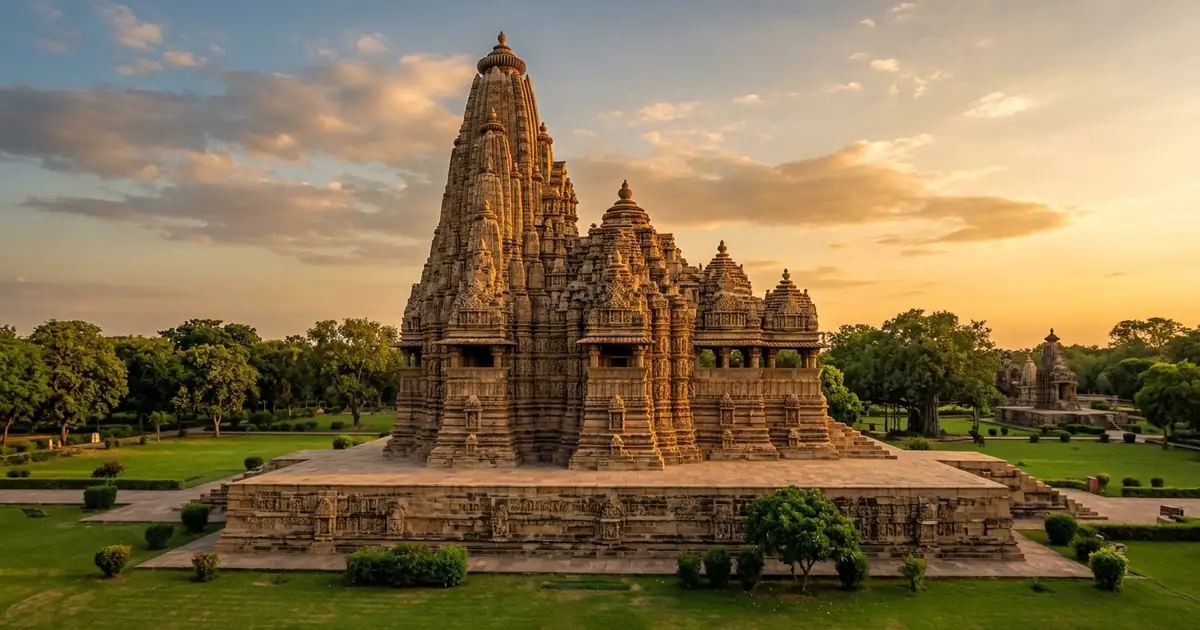
Rising above the quiet forested plains of the Chhatarpur district in northern Madhya Pradesh, the temples of Khajuraho represent the zenith of medieval Indian temple architecture and stone sculpting. Built between 950 and 1050 CE under the patronage of the Chandela Rajput dynasty, this UNESCO World Heritage complex originally numbered eighty-five monumental sandstone sanctuaries spread across twenty square kilometers.
Khajuraho Temples Essentials
- Geographic District: Chhatarpur District, Bundelkhand region, Madhya Pradesh.
- Heritage Status: UNESCO World Heritage Site inscribed in 1986.
- Architectural Style: Nagara Latina style built from fine-grained Panna sandstone.
- Temple Groups: Western Group (Primary/Enclosed), Eastern Group (Jain), Southern Group.
- Signature Masterpiece: Kandariya Mahadeva Temple with 872 sculpted figures.
- Best Season to Visit: October to March for cool daytime temperatures and clear skies.
- Daily Operating Hours: Sunrise to Sunset (Western Group opens from 6:00 AM to 6:00 PM).
Today, twenty-two well-preserved temples survive, celebrated globally for their soaring curvilinear towers (shikharas) and exceptionally expressive stone carvings. Cultural travelers frequently pair Khajuraho with Madhya Pradesh’s other two UNESCO World Heritage sites, covered in our guide to Sanchi Stupa and Bhimbetka from Bhopal.
Official administrative documentation maintained on the Chhatarpur District official tourist portal notes that the name Khajuraho derives from the ancient Sanskrit word Kharjuravahaka, meaning “the bearer of date palms.” Two golden date palm trees originally framed the imperial gates of the royal capital.
| Temple Cluster | Location & Character | Prominent Temples Included | Admission Protocol |
|---|---|---|---|
| Western Group | Centered around manicured park lawns | Kandariya Mahadeva, Lakshmana, Vishwanatha, Chitragupta | Paid ASI ticket required (enclosed complex) |
| Eastern Group | Near old Khajuraho village | Parsvanatha, Adinatha, Shantinatha, Ghantai | Free public access (Jain temple compound) |
| Southern Group | 3 km south along the Khudar River | Dulhadev Temple, Chaturbhuj Temple | Free public entry managed by ASI |
| Living Shrines | Western Group perimeter | Matangeshwar Temple | Free public Hindu worship daily from 5:00 AM |
The Western Group of Temples: Kandariya Mahadeva & Lakshmana
The Western Group represents the largest, most concentrated, and artistically sophisticated cluster of temples at Khajuraho. Set within expansive green lawns maintained by the Archaeological Survey of India, these sanctuaries stand elevated upon high stone terraces (jagatis).
Unlike early flat-roofed temples, these Nagara structures feature an interconnected longitudinal axis consisting of an entrance porch (ardhamandapa), main assembly hall (mahamandapa), inner ambulatory corridor (pradakshina), and dark sanctum (garbhagriha).
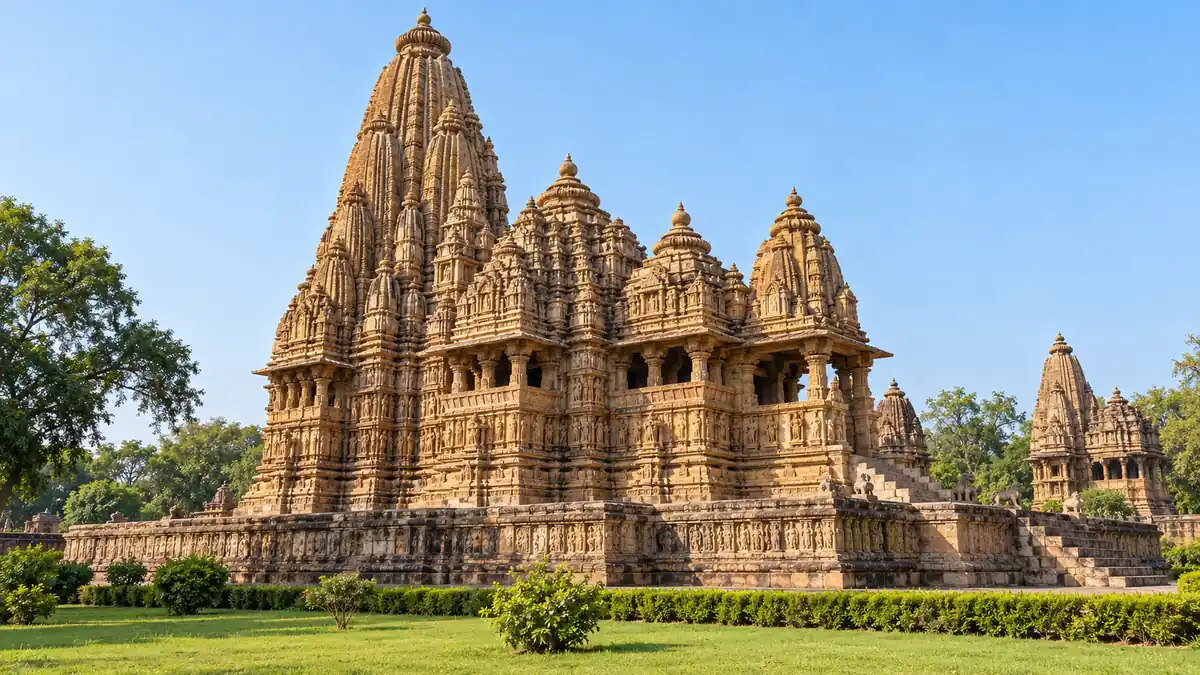
Kandariya Mahadeva: The 31-Meter Sandstone Pinnacle
The Kandariya Mahadeva Temple stands as the grandest architectural achievement of the Chandela builders. Commissioned around 1030 CE by King Vidyadhara to commemorate his military resistance against Mahmud of Ghazni, the temple honors Lord Shiva as the “Great God of the Cave.”
The central shikhara rises thirty-one meters into the sky, constructed as a mountain of stone. Eighty-four miniature subsidiary spires (urushringas) cluster symmetrically around the main tower, creating the visual impression of Mount Kailash surrounded by Himalayan mountain peaks:
- Sculptural Richness: The exterior walls are adorned with 872 carved sandstone figures, each roughly one meter high, carved with extraordinary three-dimensional depth.
- Inner Sanctum: Inside the cool, unlit sanctum rests a polished dark marble Shiva lingam, approached through an elaborately carved floral torana gateway.
Lakshmana Temple: The Complete Panchayatana Layout
Dedicated to Lord Vishnu, the Lakshmana Temple was completed around 954 CE under King Yashovarman. It remains one of the finest surviving examples of a complete panchayatana layout, featuring a central sanctum surrounded by four subsidiary corner shrines on a massive stone terrace:
- Frieze of Daily Life: The exterior plinth features an uninterrupted horizontal frieze depicting royal hunting parties, cavalry parades, war elephants, musicians, and village dancers.
- Three-Headed Vaikuntha Vishnu: The inner sanctum enshrines a sacred three-headed stone image of Vishnu combining human, lion (Narasimha), and boar (Varaha) aspects, cast in bronze-hued stone originally brought from the Himalayas.
Vishwanatha and Chitragupta Sun Temples
Directly east of the central axis stands the Vishwanatha Temple, built by King Dhanga in 1002 CE. It features a separate Nandi pavilion sheltering a monolithic, highly polished black basalt statue of Nandi the bull measuring over two meters in length.
To the north sits the Chitragupta Temple, the only sun temple in Khajuraho. The inner shrine contains a finely carved statue of Surya the Sun God standing in his celestial chariot drawn by seven galloping horses, holding two blooming lotuses in his hands.
Decoding the Sculptural Art: Mithuna Figures & Tantric Symbolism
Khajuraho is widely famous in popular culture for its erotic carvings, yet these panels represent less than ten percent of the total sculptural artwork adorning the temple facades. The vast majority of the carvings depict everyday medieval Indian life, spiritual devotion, mythology, and secular pageantry.
Comprehensive state heritage archives published by Madhya Pradesh Tourism explain the architectural, cosmological, and philosophical context behind these world-famous friezes.
The Proportion of Erotic Carvings in Context
The stone walls of Khajuraho form an open-air encyclopaedia of classical Indian civilization. Visitors wandering along the terraces observe stonemasons, carpenters, teachers with pupils, farmers, musicians, and royal court ceremonies.
Erotic imagery (mithuna figures) appears primarily along the exterior junction walls (sandhi-kshetra) connecting the main assembly hall to the sanctum. In Hindu architectural treatises (Vastu Shastra), these joining walls represent the transitional boundary between the outer material world and the unmanifest spiritual realm within.
Apsaras, Surasundaris & Daily Medieval Life Depictions
Among the most captivating works of art are the celestial nymphs (surasundaris and apsaras) carved along the pillar brackets and exterior wall bands:
- Everyday Expressions: Sculptors captured women engaged in unselfconscious daily routines: applying red vermilion to their hair parting, removing a thorn from the sole of a foot, writing love letters on birch bark, wringing wet hair after a bath, and looking into polished bronze mirrors.
- Graceful Movement: The figures display flowing contours, arched backs, heavy anklets, and delicate pearl necklaces that convey remarkable motion despite being carved from hard sandstone.
Tantric Kaula-Kapalika Philosophy and Auspicious Junctions
Historians trace the philosophical roots of Khajuraho’s erotic iconography to the medieval Tantric traditions of the Kaula and Kapalika sects, which enjoyed royal patronage under Chandela kings. In Tantric thought, physical union represents the metaphysical fusion of Prakriti (creative feminine energy) and Purusha (cosmic masculine consciousness).
Furthermore, classical architectural texts consider depictions of physical intimacy to be auspicious protective talismans (mangala), warding off lightning strikes, malevolent spirits, and negative omens from sacred buildings.
The Eastern Group: Parsvanatha, Adinatha & Jain Heritage
Located approximately one kilometer east of the Western Group near old Khajuraho village, the Eastern Group reflects the religious tolerance of the Chandela kings, who generously financed both Hindu and Jain monastic sanctuaries. Similar architectural traditions and harmonious multi-faith patronage flourished in neighboring regions, notably at the Bhoramdeo Temple and Sirpur Buddhist circuit in Chhattisgarh.
The Jain cluster is enclosed within a quiet modern walled garden compound where visitors remove footwear to explore three exquisite tenth-century temples maintained by the local Jain community.
Parsvanatha Temple and Intricate Textile Carvings
The Parsvanatha Temple is the largest and most decorative Jain sanctuary in Khajuraho. Originally consecrated in 954 CE during the reign of King Dhanga, it features remarkable architectural symmetry with an enclosed inner ambulatory corridor:
- Exterior Carvings: The outer walls display some of the most refined relief sculptures in the entire complex, including graceful celestial maidens applying eye kohl and adjusting heavy waist ornaments.
- Multi-Faith Inclusivity: Despite being a Jain shrine, the outer walls feature depictions of Hindu deities like Vishnu, Shiva, and Brahma, reflecting shared cultural iconography.
Adinatha and Shantinatha Shrines
Directly north of Parsvanatha stands the Adinatha Temple, a compact sanctuary dedicated to the first Jain Tirthankara, Rishabhanatha. The exterior shikhara features rhythmic tiers of miniature corner spires and delicate floral bands.
Nearby, the Shantinatha Temple functions as a modern place of active Jain worship. While its exterior has been extensively renovated over the past two centuries, the inner sanctum preserves a colossal 4.5-meter-tall dark basalt image of Tirthankara Shantinatha dating to 1028 CE.
The Ghantai Temple Pillar Ruins
Sitting isolated near the entrance to the old village, the Ghantai Temple preserves only its entrance portico and pillared hall. It derives its local name from the ornate carved stone chains and bells (ghanta) decorating its octagonal pillars.
An archway frieze portrays the sixteen auspicious dreams seen by Trishala, the mother of Lord Mahavira, before his divine birth.
The Southern Group & Living Worship: Dulhadev and Matangeshwar
The Southern Group sits isolated amidst agricultural fields roughly three kilometers south of the central monument complex along the banks of the Khudar River. Exploring these tranquil shrines provides a peaceful counterpoint to the busy tourist gardens of the Western Group.
Pilgrims studying the pan-Indian spiritual geography of Lord Shiva can compare these regional central Indian shrines with the sacred traditions documented in our 12 Jyotirlingas pilgrimage guide.
Dulhadev Temple: Late Chandela Dynamic Forms
Built between 1100 and 1150 CE, Dulhadev Temple marks the final phase of Chandela architectural activity in Khajuraho. Dedicated to Lord Shiva as the “Holy Bridegroom,” the temple features dynamic stone carvings:
- Octagonal Hall Ceiling: The ceiling of the main assembly hall features elaborate corbelled stone rings supported by bracket figures of flying celestial nymphs.
- Rhythmic Carving: The sculptures display sharper angles and more stylized forms than the earlier tenth-century masterpieces, signaling the transition into the late medieval Bundelkhand style.
Matangeshwar Temple: Continuous Living Morning Worship
Situated just outside the boundary fence of the Western Group, Matangeshwar Temple is the only monument at Khajuraho that has maintained active, unbroken worship since the tenth century:
- Colossal Lingam: The inner sanctum houses an enormous eight-foot-tall polished stone Shiva lingam measuring nearly twenty feet in circumference, said to grow upward by the length of a sesame seed every year.
- Morning Prayers: From 5:00 AM daily, local villagers and visiting pilgrims climb the steep stone steps carrying brass pots of holy river water, bilva leaves, and milk to perform traditional morning abhishek.
Evening Sound & Light Show and the Khajuraho Dance Festival
Visiting Khajuraho extends well into the evening hours, when historical monuments become backdrops for narrative light installations and national performing arts celebrations.
Official conservation guidelines registered with the Archaeological Survey of India ensure that evening lighting systems use low-temperature lamps that do not stress ancient sandstone masonry.
Western Group Sound and Light Show Timings and Languages
The Madhya Pradesh Tourism Department stages an open-air Sound and Light Show (Son-et-Lumiere) every evening on the lawns of the Western Group:
- Narrative Voice: The legendary baritone voice of actor Amitabh Bachchan narrates the English and Hindi programs, recounting the mythological origins of the Chandelas and the rediscovery of the jungle ruins.
- Winter Timings: The English show runs from 6:30 PM to 7:25 PM; the Hindi show follows from 7:40 PM to 8:35 PM.
- Admission Charges: Tickets cost approximately ₹250 for Indian adults and ₹700 for foreign visitors, purchasable at the evening ticket window.
The Annual February Dance Festival Against Lit Temples
Every February, Khajuraho hosts its world-famous week-long classical dance festival. Foremost exponents of Kathak, Bharatanatyam, Odissi, Mohiniyattam, and Kuchipudi perform on a massive open-air stage erected directly before the Chitragupta and Vishwanatha temples.
Detailed venue layouts, dates, and seating access can be reviewed in our companion Khajuraho Dance Festival guide.
Visitor Logistics: Entry Tickets, Guided Tours & Panna Day Trips
Khajuraho is a compact, pedestrian-friendly heritage town. Understanding ticketing options, transport corridors, and regional wildlife excursions helps you maximize your stay.
Wildlife enthusiasts frequently pair a heritage tour of Khajuraho with the tiger safari circuits outlined in our Bandhavgarh National Park safari guide, located four hours southeast by highway.
| Logistical Domain | Standard Details | Traveler Recommendation |
|---|---|---|
| ASI Western Group Ticket | ₹40 Indians; ₹600 Foreigners | Book digital QR tickets online to skip morning entry queues |
| Authorized Guide Tariffs | ₹1,500 - ₹2,000 for 3-4 hours | Hire only ASI-certified guides wearing official photo badges |
| Local Town Transit | Bicycles, e-rickshaws, auto-rickshaws | ₹600 - ₹800 full-day auto charter covers Eastern & Southern groups |
| Nearest Airport | Khajuraho Airport (HJR, 5 km) | Scheduled domestic flights from New Delhi during winter |
| Nearest Railway Link | Khajuraho Station (KURJ, 8 km) | Daily overnight express trains connecting Delhi, Bhopal, and Prayagraj |
ASI Ticket Booking and Licensed Audio Guides
Admission tickets for the Western Group can be purchased online via the official ASI portal or through QR code boards at the entrance gate. A single digital ticket grants full-day access to the Western Group and the nearby Archaeological Museum.
Visitors seeking independent exploration can rent official multi-language GPS audio guide handsets at the gate counter for ₹200. These devices provide detailed commentaries explaining the history and iconography of each temple along the path.
How to Reach Khajuraho by Air, Train, and Road
Despite its quiet rural location, Khajuraho offers excellent multi-modal transit connections:
- By Air: Khajuraho Airport (HJR) is located only five kilometers from the Western Group, handling daily winter flights from New Delhi.
- By Train: Khajuraho Railway Station (KURJ) connects to New Delhi via the Gita Jayanti Express and Khajuraho Vande Bharat Express. For nationwide mainline routes, Satna Junction (115 km) and Jhansi Junction (175 km) offer frequent connections.
- By Road: Smooth four-lane state highways connect Khajuraho with Jhansi (3.5 hours), Gwalior (5 hours), and Orchha (3.5 hours).
Day Trips to Panna Tiger Reserve and Raneh Falls
Travelers staying in Khajuraho for more than two days can easily explore two remarkable natural attractions located nearby:
- Raneh Falls & Ken River Canyon (20 km): A dramatic natural rock canyon carved from multi-colored crystalline granite, including pink, green, and red rock formations. The Ken River plunges into a 30-meter-deep chasm with seasonal cascading waterfalls.
- Panna National Park (30 km): A renowned Project Tiger reserve known for scenic teak forests, deep gorges, and excellent tiger tracking drives along the Madla and Hinouta safari gates. Complete permit bookings, gate choices, and gharial boat rides are detailed in our Panna tiger safari and Raneh Falls guide.
Curated 2-Day Khajuraho Travel Itinerary
This structured 2-day itinerary balances temple exploration, local cuisine, and natural attractions at an unhurried pace. Travelers planning extended journeys across central India can incorporate this route into our comprehensive Madhya Pradesh travel guide.
Day 1: Western Group Masterpieces & Evening Sound and Light Show
- 06:00 AM: Attend early morning prayer rituals and view the colossal lingam at Matangeshwar Temple.
- 08:00 AM: Enter the Western Group gardens as morning sunlight illuminates the eastern facades.
- 08:30 AM: Spend two hours inspecting the intricate relief carvings and towering shikhara of Kandariya Mahadeva.
- 10:30 AM: Explore the Lakshmana Temple panchayatana layout and the Nandi pavilion of Vishwanatha Temple.
- 01:00 PM: Enjoy authentic Bundelkhandi cuisine, including Dal Bafla served with pure ghee, at a local heritage restaurant.
- 03:00 PM: Browse the stone sculpture galleries at the Archaeological Survey of India Museum.
- 06:30 PM: Take your seat on the Western Group lawns to watch the evening Sound and Light Show.
Day 2: Eastern Jain Temples, Southern Group & Raneh Falls
- 07:30 AM: Hire an auto-rickshaw or rental bicycle to explore the Eastern Group Jain temples (Parsvanatha and Adinatha).
- 09:30 AM: Walk through the rural alleys of old Khajuraho village to photograph traditional mud houses and village stepwells.
- 11:00 AM: Drive south to tour the octagonal carved ceiling of Dulhadev Temple and the Chaturbhuj sanctuary.
- 01:00 PM: Savor lunch before departing for an afternoon road trip to Raneh Falls and the Ken Gharial Sanctuary.
- 03:30 PM: Admire the multi-hued crystalline granite gorge and spot crocodiles along the Ken River.
- 06:30 PM: Return to Khajuraho town for souvenir shopping, picking up miniature brass figurines and hand-woven Bundelkhandi textiles.
Frequently Asked Questions About Khajuraho Temples
Why were the Khajuraho temples built with erotic carvings?
Erotic carvings (mithuna) at Khajuraho represent less than ten percent of the total sculptural artwork. In classical Hindu cosmology and Tantric philosophy, physical union symbolizes the metaphysical union of human soul (Atman) with cosmic consciousness (Brahman). Furthermore, classical architectural treatises considered erotic depictions to be auspicious protective talismans that shielded sacred structures from lightning and negative energies.
How many temples survive at Khajuraho today?
Out of the original eighty-five temples constructed by the Chandela dynasty between 950 and 1050 CE, exactly twenty-two temples survive today across three geographic clusters. The surviving temples are preserved and protected by the Archaeological Survey of India as a UNESCO World Heritage site.
What is the best time of year to visit Khajuraho?
The best time to visit Khajuraho is during the cool winter months from October to March. Daytime temperatures remain pleasant between 15°C and 28°C, making outdoor walking across open stone terraces comfortable. Visiting in late February allows travelers to attend the annual Khajuraho Dance Festival.
Is Khajuraho safe for solo and international travelers?
Yes, Khajuraho is a quiet, hospitable heritage town with low crime rates. Local residents and shopkeepers are accustomed to welcoming international tourists. Standard travel precautions apply: agree on auto-rickshaw fares in advance, hire only licensed ASI guides wearing official badges, and carry adequate cash currency for small village purchases.
How much time is needed to explore the temples properly?
A minimum of two full days is recommended to explore the monuments comfortably. This schedule allows one full day for the extensive Western Group and evening light show, and a second day to tour the Eastern Jain group, Southern temples, and nearby natural attractions like Raneh Falls.