Sanchi Stupa & Bhimbetka from Bhopal: Complete Guide
Plan your trip to Sanchi Stupa and Bhimbetka from Bhopal. Discover verified timings, ASI ticket fees, Torana gateways, rock shelters, and 2-day itineraries.
Flanking the historic state capital of Bhopal to the north and south lie two of the most significant UNESCO World Heritage monuments in the Indian subcontinent. Travelers organizing excursions to sanchi stupa and bhimbetka from bhopal discover an extraordinary chronological journey through human cultural evolution, spanning from ten-thousand-year-old Stone Age cave paintings to the quiet third-century BCE Buddhist monastic hills.
To the north, Emperor Ashoka’s Great Stupa at Sanchi preserves classical Mauryan architecture and intricate Satavahana stone gateways depicting Jataka folk narratives. To the south, the forested sandstone cliffs of Bhimbetka shelter over seven hundred prehistoric rock galleries painted with natural mineral pigments by early hunter-gatherers across central Madhya Pradesh.
Visitor & Architectural Essentials
- Dual UNESCO Inscriptions: Sanchi Stupa (inscribed in 1989 for classical Buddhist art) and Bhimbetka Rock Shelters (inscribed in 2003 for Paleolithic and Mesolithic cave art).
- Geographical Base: Bhopal serves as the central springboard; Sanchi lies 46 km northeast, while Bhimbetka lies 45 km south.
- Daily Operating Hours: Sanchi Stupa opens daily from sunrise to sunset (6:00 AM to 6:00 PM); Bhimbetka opens daily from 7:00 AM to 6:00 PM.
- Admission Tariffs: Sanchi charges ₹40 for Indian citizens and ₹600 for foreigners; Bhimbetka charges ₹25 for Indians and ₹300 for foreigners, plus a ₹100 vehicle toll.
- Recommended Duration: A dedicated two-day itinerary allows travelers to visit Sanchi and the Udayagiri rock-cut caves on Day 1, followed by Bhimbetka and Bhojpur on Day 2.
The Dual UNESCO Heritage Circuit from Bhopal
Central Madhya Pradesh is unique in offering two globally celebrated heritage monuments situated within an hour’s drive of its capital city. While both sites are protected under the central jurisdiction of the Archaeological Survey of India Bhopal Circle, they represent entirely distinct cultural epochs separated by thousands of years.
According to district heritage registries maintained by the District Administration Raisen Official Tourism Directory, both monuments are located in Raisen district, connected to Bhopal by smooth multi-lane highways. Sanchi preserves stone masonry and Buddhist monastic dormitories, while Bhimbetka preserves raw rock crags carved by nature and decorated by prehistoric humans.
Sanchi Buddhist Monuments: Ashokan Foundations and Toranas
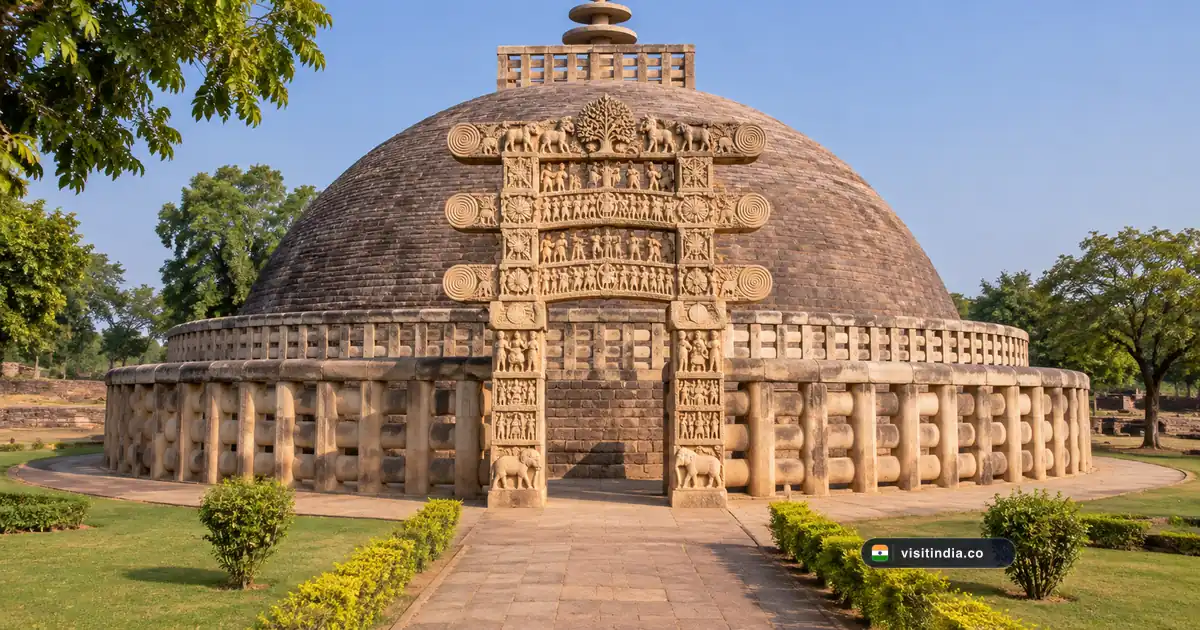
The Buddhist complex at Sanchi was founded in the third century BCE by Mauryan Emperor Ashoka, whose Greek-influenced wife Devi hailed from neighboring Vidisha. Ashoka erected the initial brick core of the Great Stupa along with a monolithic polished sandstone pillar bearing his royal edicts.
During the subsequent Sunga and Satavahana dynasties, the stupa was doubled in volume, clad in dressed stone masonry, and crowned with a three-tiered parasol (chhatra) representing the Three Jewels of Buddhism: the Buddha, the Dharma, and the Sangha. Surrounding the hemispherical dome stand four magnificent stone gateways (toranas), carved with astonishing micro-reliefs illustrating the life of Siddhartha Gautama and his previous incarnations.
Bhimbetka Rock Shelters: Mesolithic Art in Vindhyan Forests
Discovered in 1957 by Indian archaeologist Dr. Vishnu Shridhar Wakankar, the Rock Shelters of Bhimbetka sit inside the Ratapani Wildlife Sanctuary at the southern foot of the Vindhyan mountains. Over 750 rock shelters are spread across ten square kilometers, containing paintings that span the Upper Paleolithic, Mesolithic, Chalcolithic, and medieval eras.
The ancient artists utilized natural earth pigments including hematite red ochre, white limestone, manganese black, and copper-mineral green, bound with animal fat and tree saps. These indelible pigments have survived millennia exposed to atmospheric elements, depicting wild bison, rhinoceroses, communal hunts, stick-figure battle scenes, and birth rituals that chronicle the birth of human imagination.
| Heritage Monument | Era / Dynasty | Primary Material | UNESCO Year | Key Visual Landmark |
|---|---|---|---|---|
| Great Stupa (Sanchi) | 3rd c. BCE to 1st c. CE (Mauryan / Satavahana) | Chiseled sandstone and brick | 1989 | 4 carved torana gateways with Jataka panels |
| Stupa 3 (Sanchi) | 2nd c. BCE (Sunga Period) | Sandstone masonry | 1989 | Preserves relics of Sariputra and Mahamoggallana |
| Zoo Rock (Bhimbetka) | Mesolithic (c. 8,000 BCE) | Quartzite sandstone with ochre | 2003 | 45 animal figures including bison and rhinos |
| Auditorium Cave (Bhimbetka) | Lower Paleolithic / Acheulian | Massive cathedral-like shelter | 2003 | Deep bedrock cupules dating back over 100,000 years |
| Udayagiri Caves (Vidisha) | 4th to 5th c. CE (Gupta Empire) | Rock-cut sandstone caves | ASI Protected | Colossal 12-foot monolithic Varaha rock relief |
Sanchi Stupa Architecture: Stupas, Toranas, and Monasteries
National conservation guidelines established by the Archaeological Survey of India protect the surrounding hill, where visitors encounter an archaeological park housing three primary stupas, monolithic pillar stumps, and ruined stone monasteries. The hill was selected by Ashoka because it stood secluded from civic bustle, yet adjacent to the wealthy mercantile river hub of Vidisha.
A complete exploration of the hillside ruins takes between two and three hours. Visitors circumambulate the Great Stupa along the lower stone processional terrace (pradakshinapatha), moving clockwise to inspect the ceremonial gateways that guard the four cardinal points.
The Four Carved Torana Gateways of Stupa 1
The four stone torana gateways of the Great Stupa, erected around 35 BCE by guild artisans from Vidisha, are celebrated among the greatest masterpieces of early Indian sculptural art. Because early Buddhist doctrine followed an aniconic tradition, the Buddha is never shown in human form; he is symbolized by empty thrones, footprints, royal umbrellas, wheel motifs (dharmachakra), and the sacred Bodhi tree.
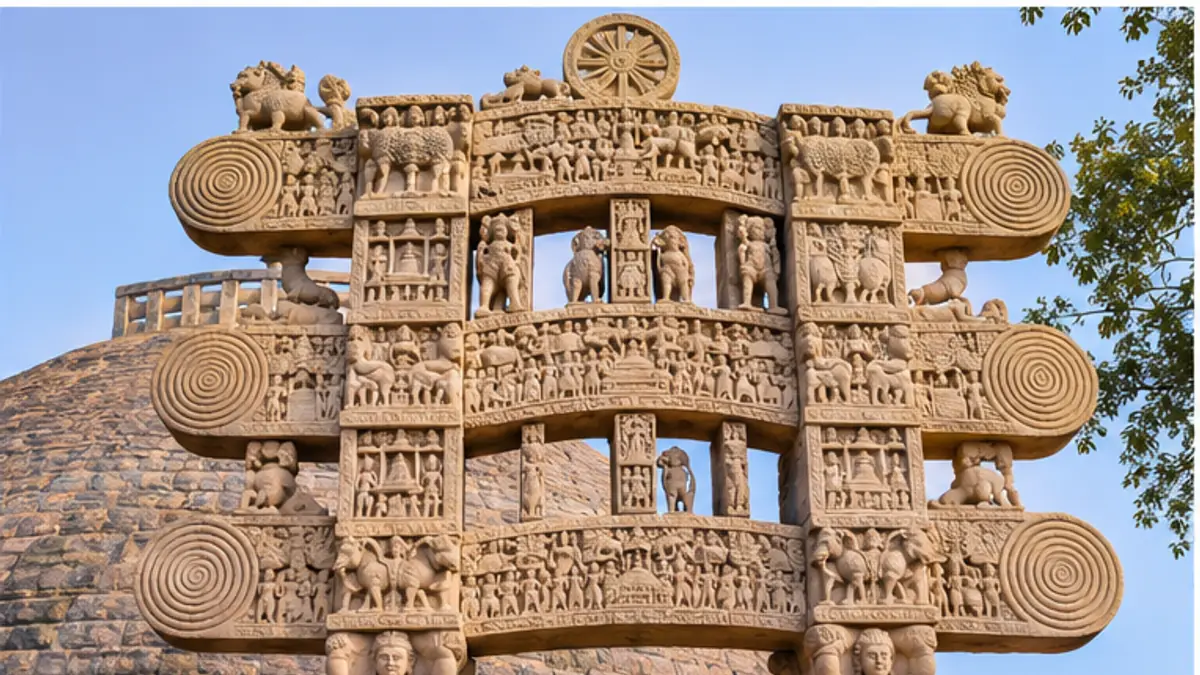
Each gateway consists of two square upright pillars supporting three horizontal curved architraves separated by sculpted stone blocks:
- Northern Gateway: The best-preserved torana, crowned by a stone wheel of law and featuring the famous miracle of Sravasti where the Buddha walked on water and emitted fire.
- Eastern Gateway: Depicts the Great Departure (Mahabhinishkramana), showing Prince Siddhartha riding out of Kapilavastu on his horse Kanthaka, supported by celestial spirits so his departure remained silent.
- Southern Gateway: The oldest gate, depicting the distribution of the Buddha’s holy relics among eight royal clans following his cremation at Kushinagar.
- Western Gateway: Shows the Temptation of Mara, where demon hordes attempt to disrupt Siddhartha’s meditation beneath the Bodhi tree.
Stupa 3, Monasteries, and the Ashoka Pillar
A short walk northeast brings visitors to Stupa 3, built during the Sunga dynasty with a single carved southern gateway. In 1851, British explorer Sir Alexander Cunningham excavated the inner chamber and discovered the sacred bone relics of the Buddha’s foremost disciples, Sariputra and Mahamoggallana, which are now housed in the modern Chetiyagiri Vihara.
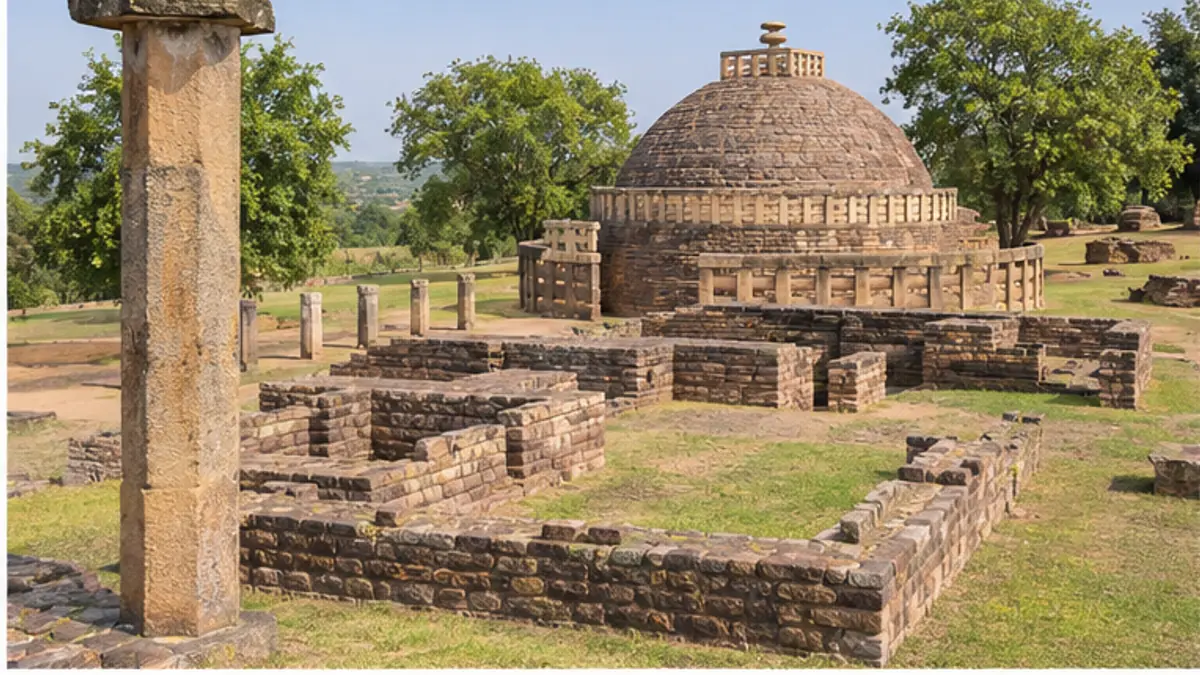
Near the southern gateway of Stupa 1 lie the shattered fragments of the Ashoka Pillar, renowned for its glassy Mauryan polish. The original bell capital, featuring four back-to-back lions similar to the Sarnath capital, is preserved inside the nearby Sanchi Archaeological Museum alongside early stone sculptures and copper coins.
Pro Tip
Morning Photography Lighting: Arrive at Sanchi at 7:30 AM to catch the low morning sun striking the relief panels of the Eastern and Southern gateways. The hilltop grounds are peaceful, offering clear light before midday heat and tour buses arrive.
Bhimbetka Rock Shelters: Prehistoric Art in Rock Caverns
Located inside the dense teak and sal forests of Ratapani, the Bhimbetka rock shelters look out over the fertile Narmada valley. Weathered into natural sandstone cliffs over millions of years by wind and seasonal water erosion, these cavernous formations provided shelter to generations of prehistoric hominids.
The Archaeological Survey of India has created a comfortable wooden and stone walking pathway that loops past fifteen of the most significant decorated shelters. A guided walk takes approximately ninety minutes, allowing visitors to inspect rock paintings that remain vivid despite having no artificial glass coverings.
Shelter 3: The Auditorium Cave and Cupules
The walking circuit begins at Shelter 3, known as the Auditorium Cave. Resembling a towering natural cathedral with a high ceiling supported by massive rock pillars, this shelter preserves an ancient boulder in its center flanked by deep cup-like indentations (cupules).
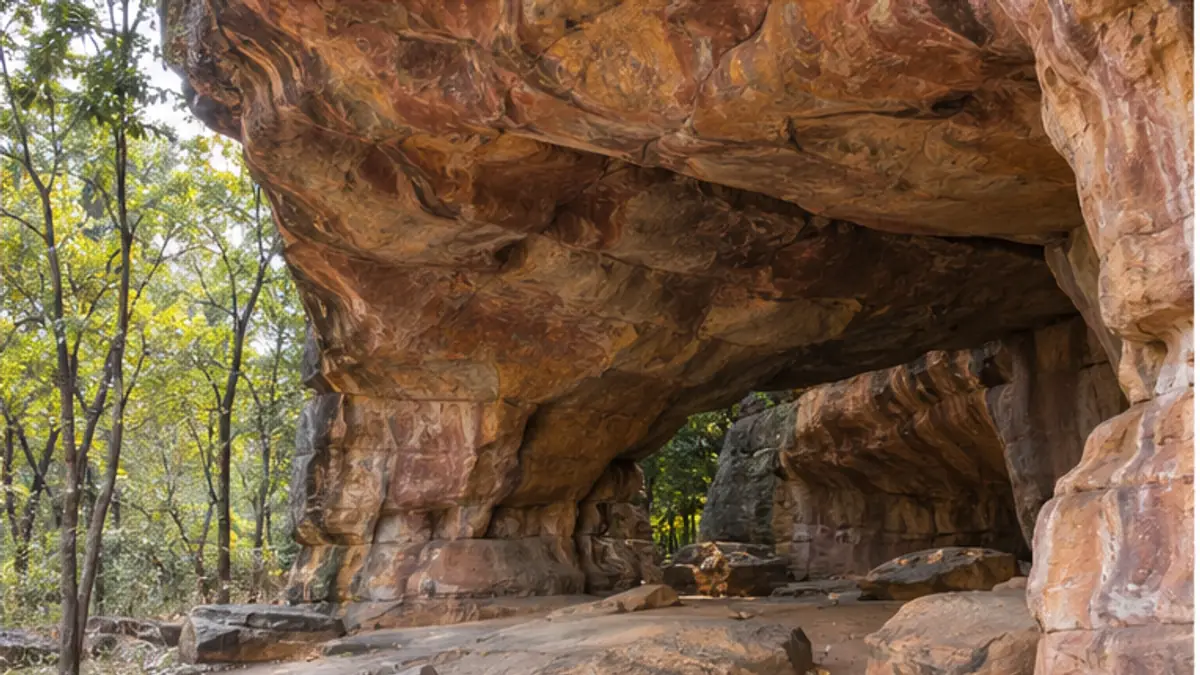
Radiometric dating of the surrounding strata suggests these cupules were hammered into the bedrock during the Acheulian period over one hundred thousand years ago, making them among the oldest cultural marks left by human hands anywhere on the globe. Excavations here also revealed stone hand axes, scrapers, and cleavage tools used by Homo erectus.
Shelter 15: The Celebrated Zoo Rock
The most famous painted shelter at Bhimbetka is Shelter 15, aptly named Zoo Rock. This expansive rock wall contains over four hundred individual animal and human figures painted in overlapping layers from the Mesolithic to the historic period.
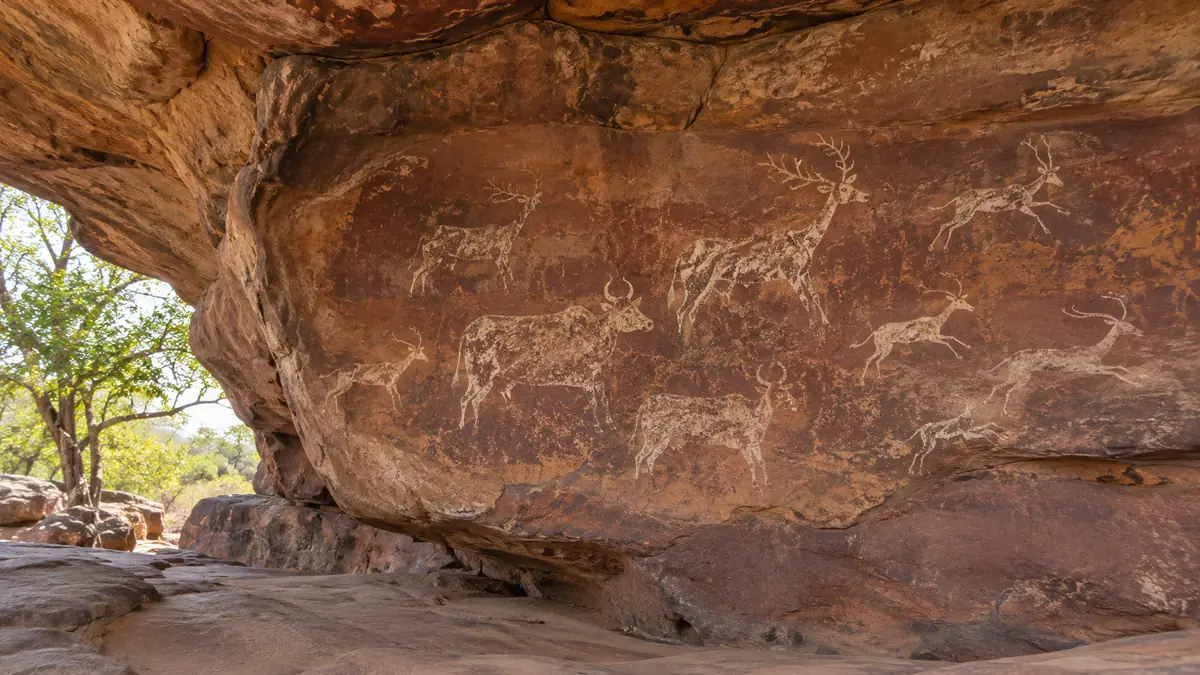
The composition depicts forty-five distinct animal species drawn with dynamic observational realism, including wild gaurs, sambar deer, barking deer, wild boars, peacocks, and horned rhinoceroses. Mesolithic hunters are shown running alongside their prey carrying barbed spears, bows, and nets, demonstrating early communal hunting methods and seasonal foraging rituals.
| Shelter Number | Common Name | Art Period | Dominant Color | Primary Scene Depicted |
|---|---|---|---|---|
| Shelter 3 | Auditorium Cave | Acheulian / Paleolithic | Natural stone | Cupules and deep stone hand-axe layers |
| Shelter 4 | Rang Mahal (Color Palace) | Mesolithic to Chalcolithic | Deep red and white | Multi-tiered animal figures and hunters |
| Shelter 6 | Boar Rock | Mesolithic (c. 6,000 BCE) | Red hematite ochre | Colossal mythical boar chasing small hunter |
| Shelter 15 | Zoo Rock | Mesolithic / Chalcolithic | White, red, and green | 45 animal species in communal migration |
| Shelter 16 | Family Cave | Mesolithic | Red ochre | Mother holding child inside household cave |
En-Route Detours: Udayagiri Caves and Bhojpur Temple
To create an unforgettable central Indian heritage circuit, travelers should incorporate two exceptional historical detours situated along the driving routes to Sanchi and Bhimbetka.
These side excursions can be paired with northern Madhya Pradesh itineraries connecting the temple complexes of Khajuraho Temples with the river valleys of the Narmada and Betwa.
Udayagiri Caves and the Colossal Varaha Panel
Located thirteen kilometers northeast of Sanchi near the town of Vidisha, the Udayagiri Caves comprise twenty rock-cut sanctuaries excavated from an isolated sandstone ridge between 390 and 425 CE during the golden age of the Gupta Empire under Chandragupta II Vikramaditya.
The undisputed highlight is Cave 5, which houses the colossal 12-foot rock relief of Varaha, the boar incarnation of Lord Vishnu. The panel depicts Varaha rising triumphant from the cosmic ocean, supporting the delicate figure of the Earth Goddess Bhudevi upon his tusk, while rows of celestial sages, rivers, and musicians celebrate the cosmic rescue.
Bhojpur Shiva Temple and the 18-Foot Monolithic Lingam
Situated twenty-eight kilometers southeast of Bhopal along the road to Bhimbetka stands Bhojpur, founded in the eleventh century by the legendary polymath king Raja Bhoj of the Paramara dynasty. The Bhojeshwar Temple is a massive unfinished sandstone temple containing one of the largest stone Shiva lingams in India.
Carved from a single block of dark granite, the lingam measures 7.5 feet in height and 17.8 feet in circumference, resting upon a massive two-tiered square platform. Surrounding the temple, the quarry bedrock still preserves the master architectural plans, diagrams, and stone ramps chiseled into the rock, providing an extraordinary look at eleventh-century construction engineering.
Visiting Hours, Ticket Prices, and Practical Information
Coordinating your sightseeing schedule across Sanchi and Bhimbetka requires knowing the ticketing guidelines established by the Archaeological Survey of India. Both sites permit photography, although commercial filming requires advance permits.
Official visitor regulations are maintained under the Madhya Pradesh Tourism Development Corporation. Purchasing digital admission passes through the central government heritage portal allows travelers to avoid weekend ticketing queues.
Operational Hours Across Both UNESCO Sites
Travelers should schedule their day around the following daily operating hours:
- Sanchi Buddhist Monuments: Open daily from sunrise to sunset (approximately 6:00 AM to 6:00 PM). The ASI Sanchi Archaeological Museum operates from 9:00 AM to 5:00 PM (strictly closed on Fridays).
- Bhimbetka Rock Shelters: Open daily from 7:00 AM to 6:00 PM. The ticket booth ceases issuing entry passes at 5:30 PM.
- Udayagiri Caves (Vidisha): Open daily from 9:00 AM to 5:00 PM.
- Bhojpur Temple: Open daily from 6:00 AM to 7:00 PM (active worship).
Admission Fees, Guide Tariffs, and Vehicle Charges
The ticket pricing structure differs slightly between the two monuments:
- Sanchi Stupa: Indian citizens, visitors from SAARC countries, and BIMSTEC citizens pay ₹40 per adult ticket. Foreign nationals pay ₹600 per ticket. Children below fifteen years of age enter free of charge.
- Bhimbetka Rock Shelters: Indian citizens pay ₹25 per adult ticket; foreign nationals pay ₹300 per ticket. Vehicles driving up the forest road to the shelter parking lot pay a forest road toll of ₹100 per car.
- Local Guides: Official ASI-certified guides are available at the entrance of both sites. Recommended guide fees are ₹300 for a one-hour tour and ₹500 for a two-hour in-depth tour explaining the Jataka gateway panels or prehistoric cave pigments.
| Site Name | Indian Citizens | Foreign Nationals | Vehicle Toll | Museum Entry |
|---|---|---|---|---|
| Sanchi Stupa | ₹40 | ₹600 | Free outside gate | ₹5 (Free on non-Fridays with stupa pass) |
| Bhimbetka Shelters | ₹25 | ₹300 | ₹100 (Car entry) | Self-guided path |
| Udayagiri Caves | ₹25 | ₹300 | Free roadside parking | No museum on site |
| Bhojpur Temple | Free (Temple entry) | Free (Temple entry) | ₹20 (Panchayat fee) | Active worship shrine |
How to Reach Sanchi and Bhimbetka from Bhopal
Bhopal serves as the most convenient transportation gateway for exploring central Madhya Pradesh, offering direct air, train, and expressway connections from across India. Because Sanchi lies north of the city and Bhimbetka lies south, visitors should base themselves in Bhopal and take day trips along opposite highway axes.
Travelers continuing west across Malwa can connect this central circuit with the sacred Jyotirlinga shrines documented in our guide to Ujjain Mahakal Mandir.
Transit from Bhopal to Sanchi Stupa (North Axis)
Connecting to Sanchi is easy by either private road transport or Indian Railways:
- By Road: Sanchi is situated forty-six kilometers northeast of Bhopal along the paved State Highway 19 via Salamatpur. A private taxi takes roughly one hour, costing between ₹1,500 and ₹2,200 for a round-trip day hire including Udayagiri Caves.
- By Train: Sanchi has its own railway station (SCI) where several daily passenger trains and express trains stop, making the 45-minute journey from Bhopal Junction for under ₹50.
- By Bus: Regular state transport buses depart Bhopal Nadra bus stand every thirty minutes for Vidisha, dropping passengers at the Sanchi crossroads at the base of the hill.
Transit from Bhopal to Bhimbetka (South Axis)
Reaching Bhimbetka requires traveling south through the Vindhyan foothills:
- By Road: Bhimbetka lies forty-five kilometers south of Bhopal along National Highway 46 (Bhopal-Hoshangabad Highway). The drive takes roughly one hour through scenic countryside, turning off at the signposted railway crossing near Obedullaganj.
- By Bus: Regular state buses heading toward Hoshangabad or Pachmarhi drop passengers at the Bhimbetka turnoff on the highway, from where visitors must walk or take an auto-rickshaw three kilometers up the forest hill to the ticket gate.
- Private Taxi Recommendation: Because public transit between the highway and the rock shelters is limited, hiring a private taxi from Bhopal for ₹2,000 to ₹2,500 is the most practical choice.
Curated 2-Day Central Heritage Circuit Itinerary
While hurried travelers attempt to cover Sanchi and Bhimbetka in a single long day, dedicating two full days allows you to explore both UNESCO complexes along with Udayagiri Caves and Bhojpur Temple without rushing:
Day 1: North Circuit to Sanchi Stupa and Udayagiri Caves
Depart Bhopal at 8:00 AM, driving northeast through Salamatpur to arrive at Sanchi Stupa by 9:00 AM. Spend 2.5 hours exploring the Great Stupa, examining the aniconic carvings on the four torana gateways, and touring Stupa 3.
At 11:30 AM, visit the ASI Archaeological Museum at the foot of Sanchi Hill. Drive thirteen kilometers to Vidisha for lunch, then spend the afternoon exploring the Gupta-era rock relief of Varaha at Cave 5 of Udayagiri Caves. Return to Bhopal by 5:30 PM for a sunset walk along the Upper Lake (Bhojtal).
Day 2: South Circuit to Bhimbetka and Bhojpur Temple
Depart Bhopal at 8:30 AM, driving south toward Hoshangabad to reach the Rock Shelters of Bhimbetka by 9:30 AM. Follow the marked walking path for two hours to view Auditorium Cave, Zoo Rock, and Boar Rock.
At 12:30 PM, drive north twenty kilometers to the temple town of Bhojpur. Savor lunch at an MP Tourism roadside cafe before touring the massive unfinished Bhojeshwar Shiva Temple. Return to Bhopal by 4:00 PM to explore the tribal culture galleries at the Madhya Pradesh Tribal Museum.
Frequently Asked Questions About Sanchi and Bhimbetka
Can travelers visit Sanchi Stupa and Bhimbetka in a single day?
Visiting both sites in a single day is physically possible by private car, but requires over four hours of total driving because Sanchi lies forty-six kilometers north of Bhopal and Bhimbetka lies forty-five kilometers south. A two-day itinerary is strongly recommended to tour the monuments and their adjacent cave sites comfortably.
What are the opening hours for Sanchi Stupa?
The Great Stupa and surrounding Buddhist monuments at Sanchi are open daily from sunrise to sunset, approximately 6:00 AM to 6:00 PM. The ASI Sanchi Archaeological Museum operates from 9:00 AM to 5:00 PM and is closed on Fridays.
How old are the rock paintings at Bhimbetka?
The rock paintings at Bhimbetka date primarily from the Mesolithic period (around 8,000 BCE to 10,000 BCE), with some continuous painted layers extending into the Chalcolithic and medieval eras. Bedrock cupules discovered inside Auditorium Cave date back over one hundred thousand years to the Lower Paleolithic Acheulian period.
What are the entry fees for visiting Sanchi and Bhimbetka?
The Archaeological Survey of India charges ₹40 for Indian citizens and ₹600 for foreign visitors at Sanchi Stupa. At Bhimbetka, entry costs ₹25 for Indian citizens and ₹300 for foreign visitors, plus an additional ₹100 vehicle fee for cars driving up the forest road.
Which town serves as the best lodging base for visiting both sites?
The capital city of Bhopal serves as the most convenient base for exploring both UNESCO monuments. Bhopal offers a wide range of heritage hotels, direct railway connectivity at Rani Kamlapati and Bhopal Junction, and flights from major Indian metros.
What makes the gateways at Sanchi Stupa architecturally significant?
The four torana gateways at Sanchi, carved around 35 BCE, represent the finest surviving examples of early Buddhist narrative sculpture. Because the Buddha was depicted aniconically in early art, the bas-reliefs represent him through symbolic emblems such as footprints, parasols, empty thrones, and the wheel of law.