Hoysala Temples: Belur, Halebidu & Somanathapura Guide
Plan your visit to the UNESCO Hoysala Temples of Belur, Halebidu, and Somanathapura with timings, ASI ticket fees, star-shaped architecture, and routes.
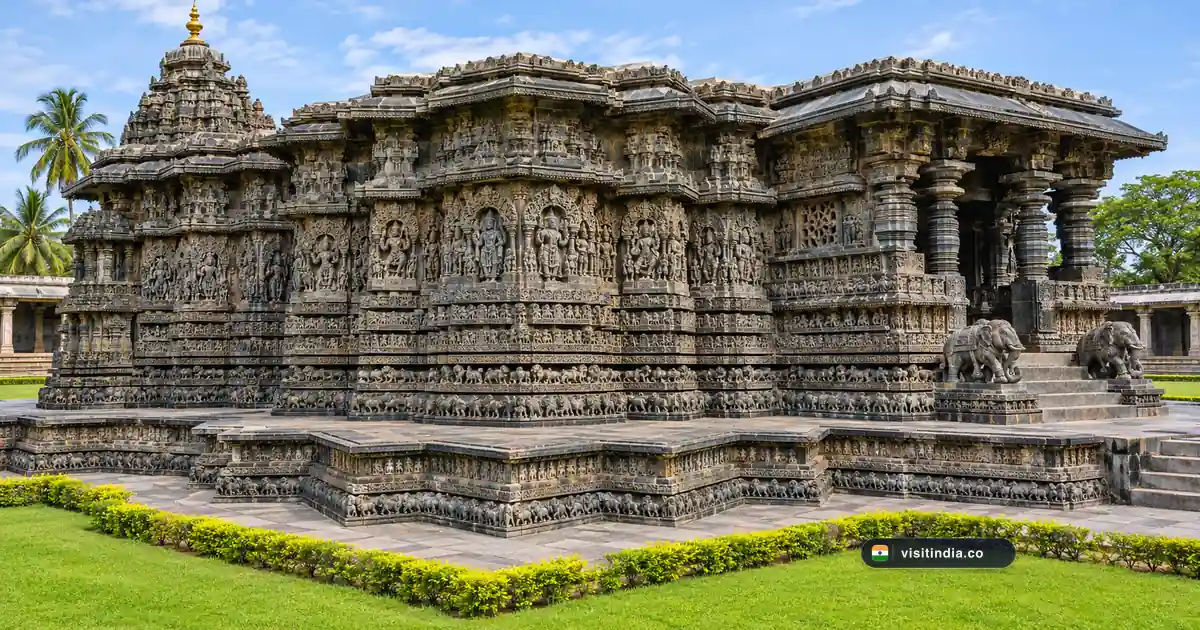
Carved from dense greenish-grey chloritic schist with microscopic precision, the belur halebidu somanathapura hoysala temples stand as the crowning achievement of medieval South Indian architecture. Inscribed in September 2023 as India’s 42nd UNESCO World Heritage property under the official title Sacred Ensembles of the Hoysalas, this extraordinary triad of twelfth- and thirteenth-century temples captures the pinnacle of Vesara sculptural genius.
Built under the patronage of the Hoysala Empire, these sanctuaries transformed soft soapstone into lace-like filigree, star-shaped plinths, and thousands of relief figures depicting dancers, deities, and epic battles. Today, touring these monuments provides cultural travelers with an unforgettable architectural journey across southern Karnataka.
Visitor & Architectural Essentials
- UNESCO Inscription: Sacred Ensembles of the Hoysalas encompasses Chennakeshava Temple at Belur, Hoysaleswara Temple at Halebidu, and Keshava Temple at Somanathapura.
- Primary Architectural Medium: Chloritic schist (talc-carbonate soapstone) that allowed sculptors to achieve intricate undercut openwork detailing.
- Transit Hubs: Hassan serves as the ideal lodging base for Belur and Halebidu, while Mysuru provides easy road access to Somanathapura.
- Daily Access: Belur opens daily from 6:30 AM to 9:00 PM; Halebidu and Somanathapura operate from 8:30 AM to 5:30 PM.
- Ticketing Rules: Belur is an active shrine with free entry; Halebidu and Somanathapura charge standardized ASI fees of ₹25 for Indians and ₹300 for foreigners.
The UNESCO Sacred Ensembles of the Hoysalas Explained
The UNESCO serial inscription protects three exceptional temple complexes that represent the stylistic flowering of the Hoysala dynasty between the eleventh and fourteenth centuries. The temples were designed on polygonal star-shaped stone platforms (jagati) that create a zigzagging surface, multiplying the wall space available for narrative relief carvings.
According to regional preservation archives maintained by the District Administration Hassan Portal, these complexes illustrate the transition from traditional Dravidian and Nagara styles into an independent Vesara idiom. Rather than building towering external entrance gateways (gopurams), Hoysala architects focused their creative energies on the ornate horizontal ornamentation of the temple base, mandapa pillars, and vimanas.
Historical Patronage of King Vishnuvardhana and King Narasimha III
The architectural golden age commenced in 1117 CE under King Vishnuvardhana, who commissioned the grand Chennakeshava Temple at Belur to commemorate his military triumphs over Chola viceroys at Talakadu. A convert from Jainism to Vaishnavism under the guidance of the saint Sri Ramanujacharya, Vishnuvardhana poured imperial wealth into the Belur and Halebidu sanctuaries.
More than a century later in 1268 CE, the high commander Dandanayaka Somanatha served King Narasimha III by erecting the intact Keshava Temple at Somanathapura on the banks of the Kaveri River. This later masterpiece demonstrates how the Hoysala aesthetic reached mature technical perfection even as political pressures gathered along the northern frontier.
The Wonder of Chloritic Schist Soapstone Carving
The defining technical secret of Hoysala architecture was the selection of chloritic schist, commonly known as potstone or soapstone. When freshly quarried, this metamorphic rock is remarkably soft and workable, allowing craftsmen to carve delicate ornaments, finger rings, jewelry beads, and lace headpieces with fine iron chisels.
Over decades of exposure to air, the mineral composition reacts with atmospheric moisture and oxidizes, hardening into tough, resilient rock. This unique petrological property allowed Hoysala sculptors to execute three-dimensional undercut friezes where stone figures seem suspended freely from the temple walls.
| Temple Monument | Location / District | Commenced / Patron | Dedication / Layout | Key Sculptural Marvel |
|---|---|---|---|---|
| Chennakeshava Temple | Belur, Hassan District | 1117 CE (King Vishnuvardhana) | Lord Vishnu (Ekakuta single shrine) | 42 Madanika bracket figures and pierced stone screens |
| Hoysaleswara Temple | Halebidu, Hassan District | 1121 CE (King Vishnuvardhana / Ketamalla) | Lord Shiva (Dvikuta twin shrines) | Double Nandi pavilions and continuous elephant friezes |
| Keshava Temple | Somanathapura, Mysuru District | 1268 CE (General Somanatha / Narasimha III) | Lord Vishnu (Trikuta triple shrines) | Three intact 16-point star vimana spires and ceiling domes |
Chennakeshava Temple Belur: The Jewel of the Yagachi River
Positioned on the banks of the Yagachi River in the ancient capital city of Velapuri (modern Belur), the Chennakeshava Temple is the only monument among the three that remains in active daily worship. Enclosed within a sprawling rectangular walled prakara, the temple complex features a grand seventeenth-century Dravidian entrance gopuram added by the Vijayanagara rulers.
Visitors stepping onto the polished granite flagstones encounter a central sanctum standing upon a three-foot-high star-shaped plinth. The temple took one hundred and three years across three generations of royals to reach completion, creating a visual compendium of medieval philosophy and folklore, situated just thirty kilometers southeast of the coffee plantation ranges of Chikmagalur.
The 42 Madanika Bracket Figures of Belur
The undisputed artistic highlights of Chennakeshava are the forty-two exterior and interior bracket sculptures known as Madanikas or Salabhanjikas. Perched beneath the overhanging eaves, these celestial maidens depict musicians, dancers, hunters, and courtly figures in dynamic poses.
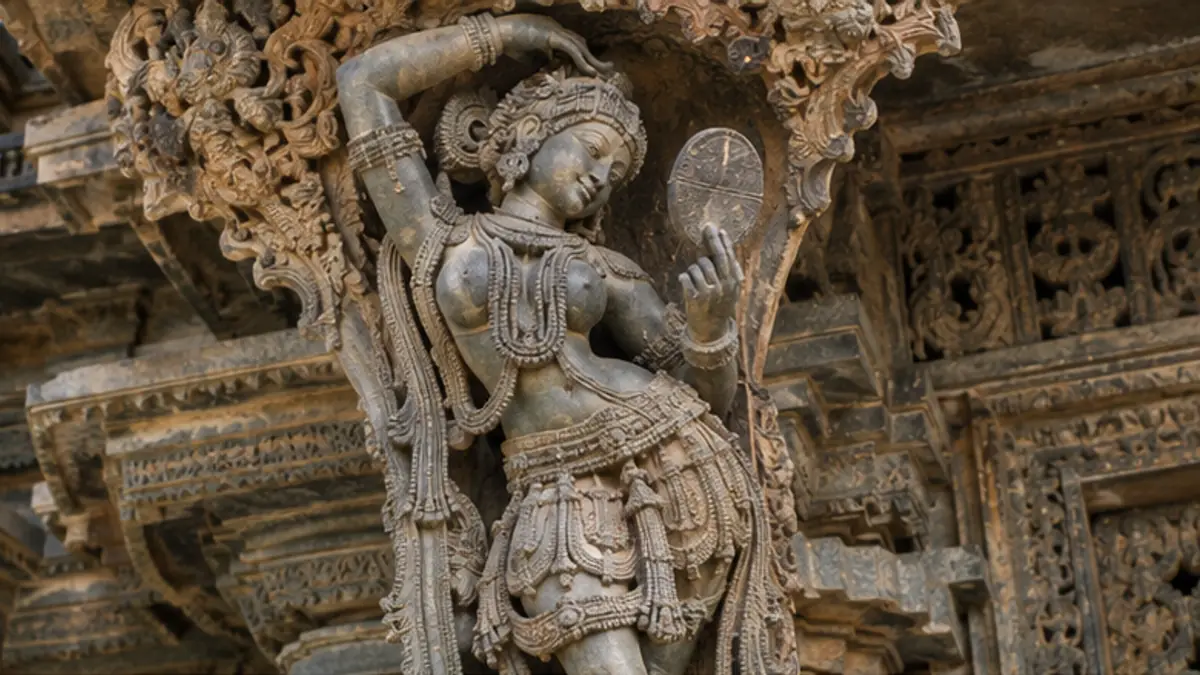
Among the most famous figures is the Darpana Sundari (Beauty with the Mirror), who admires her reflection while adjusting her hair jewelry, and the Shukabhashini, who converses playfully with a perched parrot. Inside the central navaranga hall, four additional polished black basalt bracket figures represent the queen Shantala Devi, celebrated as an accomplished classical dancer.
The Sculpted Base Friezes and Jali Screen Windows
The outer base of the temple is wrapped in eight horizontal bands of relief carvings that encircle the entire structure. The bottom-most frieze contains approximately 650 stone elephants, each depicted in a distinct marching posture, symbolizing imperial strength and stability.
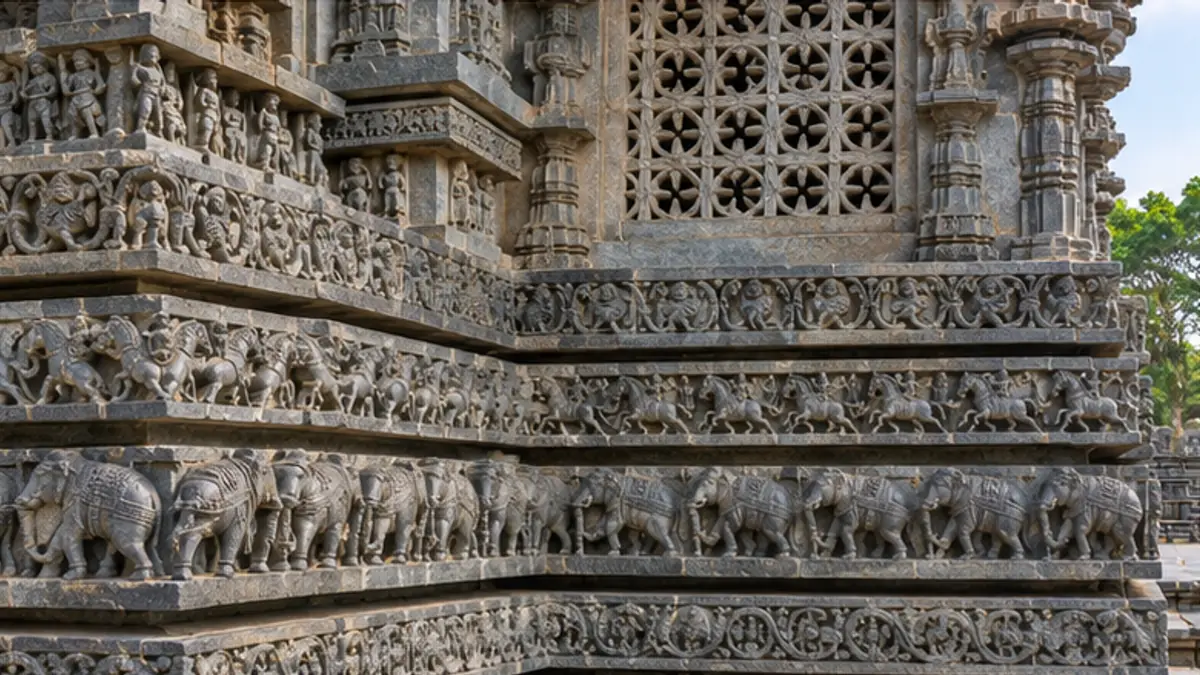
Above the elephants run friezes of lions for courage, creeping floral foliage for natural abundance, galloping horses for agility, and continuous narrative scenes drawn from the Mahabharata, Ramayana, and Bhagavata Purana. To illuminate the dark inner pillared hall while keeping out torrential monsoon winds, architects installed twenty pierced stone jali screens, each carved with intricate geometrical patterns.
Pro Tip
Temple Shoe Keeping and Socks: Because Chennakeshava is an active temple, footwear must be deposited at the official counter near the eastern gopuram for ₹10. During sunny afternoons between 11:30 AM and 3:30 PM, the stone flagstones become scorching hot; carrying a clean pair of cotton socks makes walking across the courtyard comfortable.
Hoysaleswara Temple Halebidu: The Twin Monolithic Citadel
Located just sixteen kilometers northeast of Belur lies Halebidu, known historically as Dwarasamudra, the royal capital of the Hoysala Empire. The Hoysaleswara Temple is a colossal dvikuta (two-shrined) temple complex dedicated to Lord Shiva, housing identical sanctums for Hoysaleswara and Shantaleswara.
Although the complex was sacked during fourteenth-century raids by the Delhi Sultanate and never fully completed with superstructure spires, its ground-level stone bas-reliefs are regarded by art historians as the most expansive in all of India. The sheer density of sculptured surfaces around the perimeter creates an overwhelming visual spectacle that rivals the monumental stone complexes found across Hampi.
The Dvikuta Twin Sanctums and Monolithic Nandi Mandapas
Each of the two sanctums is fronted by an open pillared Nandi mandapa containing a colossal couchant bull carved from a single block of dark chloritic schist. The southern Nandi bull is the sixth-largest in India, draped in meticulously carved stone flower garlands, small bells, and ornamental saddle trappings polished to a glossy luster.
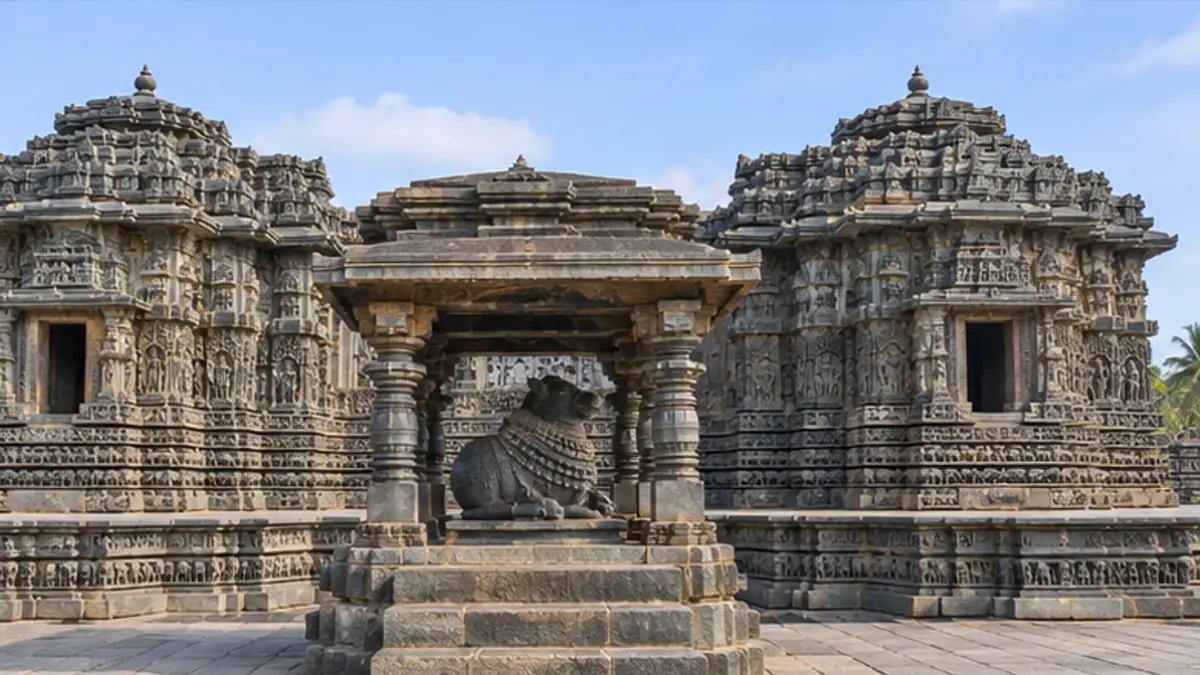
Between the twin sanctums stands an open hall featuring lathe-turned circular pillars of extraordinary symmetry. These massive stone columns were rotated against heavy stone lathes lubricated with water and abrasive sand, producing mirror-smooth concentric rings that reflect ambient daylight.
Mythological Wall Reliefs and the Garuda Pillar
The exterior walls of Hoysaleswara feature hundreds of large-format sculptures depicting Hindu deities, including dancing Ganesha, Shiva as Nataraja, and Vishnu in diverse avatars. Each composition measures nearly three feet in height, adorned with multi-tiered crowns and dangling pearl necklaces carved with astonishing depth.
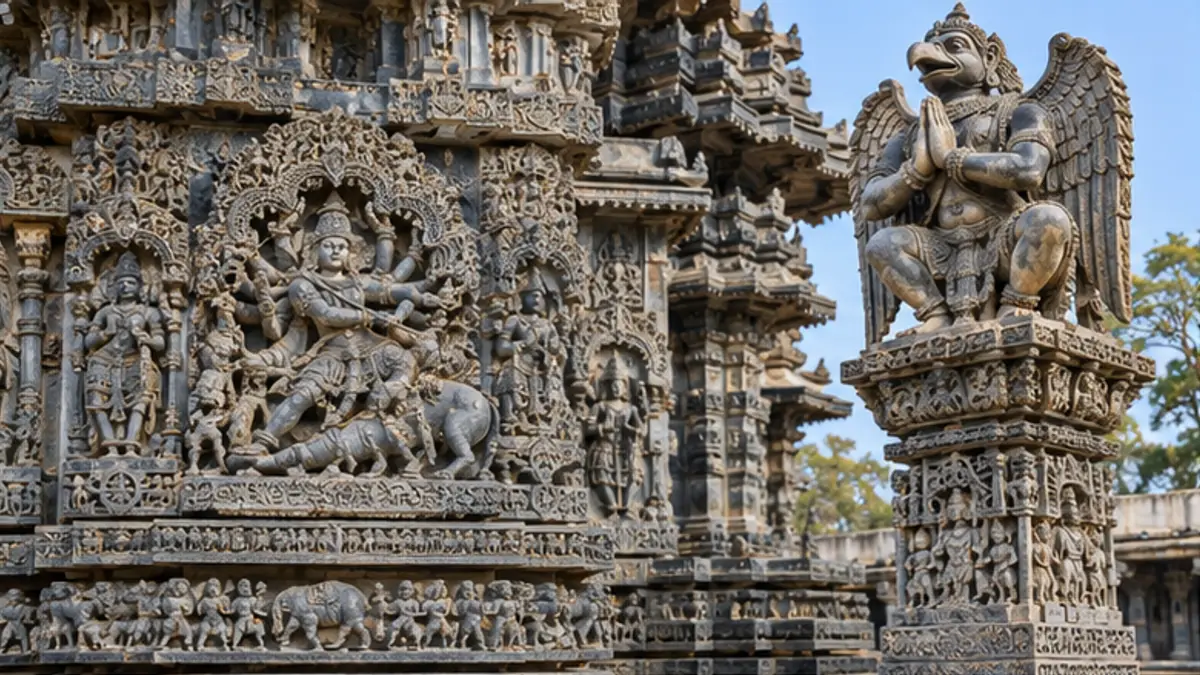
In the southern courtyard stands the solemn Garuda Pillar, erected in memory of Kuruva Lakshma, a trusted bodyguard of King Veera Ballala II. Following the ancient tradition of Garudas (elite royal warriors who swore sacred vows to live and die with their sovereign), Lakshma and his regiment committed ritual suicide at this site upon the death of their monarch.
| Feature Comparison | Chennakeshava (Belur) | Hoysaleswara (Halebidu) | Keshava (Somanathapura) |
|---|---|---|---|
| Temple Dedication | Lord Vishnu | Lord Shiva (Twin Shrines) | Lord Vishnu (Triple Shrines) |
| Active Worship | Yes (Daily pujas & aartis) | No (Protected ASI monument) | No (Protected ASI monument) |
| Temple Spire Status | Replaced over time | Superstructures incomplete | All 3 shikharas fully intact |
| Key Attraction | Madanika dancing brackets | Monster friezes & double Nandis | Symmetrical star plan & ceilings |
| Typical Visit Duration | 2 to 2.5 hours | 2 hours | 1.5 hours |
Keshava Temple Somanathapura: The Triple-Shrined Masterpiece
Situated thirty-five kilometers east of Mysuru in the quiet village of Somanathapura, the Keshava Temple represents the final, most refined expression of Hoysala architecture. Unlike the open courtyard settings of Belur and Halebidu, Somanathapura is built inside an enclosed cloistered courtyard lined with sixty-four miniature shrine cells.
The temple is arranged in a symmetrical trikuta (triple sanctum) plan, with three identical shrines sharing a common central hall. Most importantly, Somanathapura is the only major Hoysala temple where all three stone shikharas (spires) have survived completely intact, providing a rare glimpse of how Belur and Halebidu appeared at their imperial zenith along the Kaveri River basin before it flows west toward the highlands of Coorg.
The Intact Stellate Shikharas and Cloistered Prakara
The three vimana towers rise through sixteen-pointed star plans, tapering upward in harmonious rhythmic tiers crowned by stone kalasa urns. Every tier is encrusted with miniature niches, ornamental scrollwork, and tiny guardian figures aligned along vertical axes.
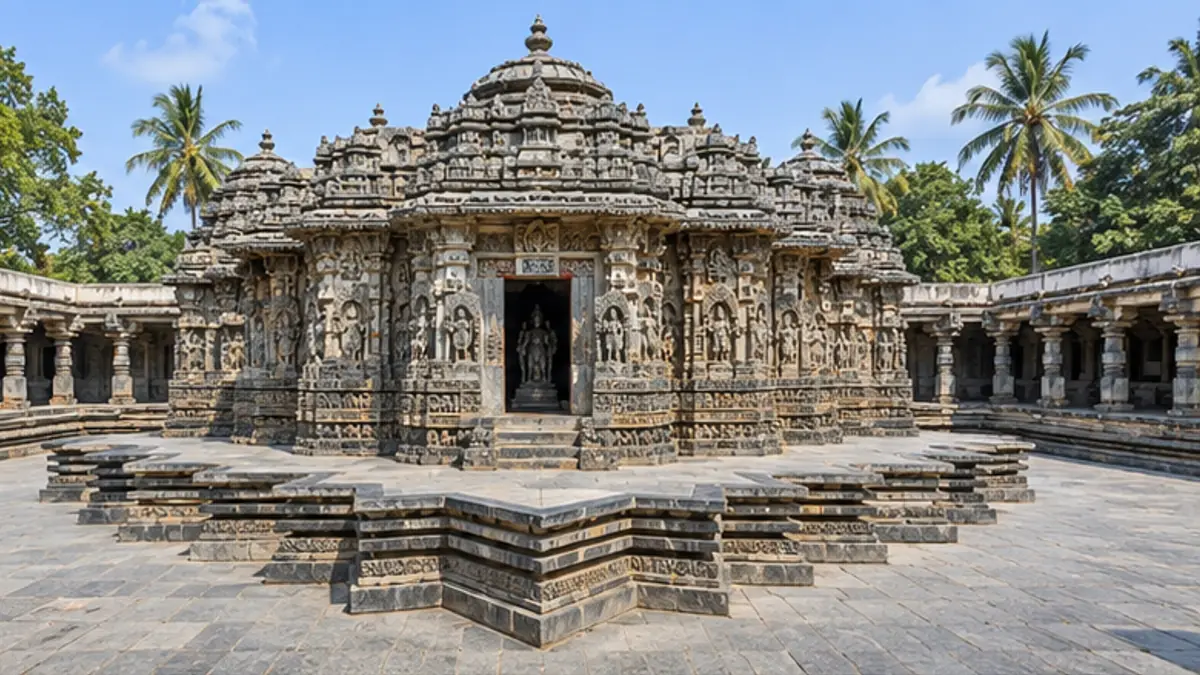
Walking through the perimeter cloister allows travelers to appreciate the structural symmetry of the overall compound. The temple floor is raised on an elevated platform that allows visitors to circumambulate (pradakshina) at eye level with the elaborate exterior wall friezes. For devotees combining nearby shrines on the same trip, Shravanabelagola Bahubali Statue darshan and timings outlines practical temple hours and local access.
The Sixteen Sculpted Navaranga Ceilings
Inside the pillared hall, travelers look up to discover sixteen distinct ceiling bays, each carved with a unique inverted lotus blossom or geometric medallion. These domed ceilings descend in concentric tiers, terminating in intricately carved central pendant buds that seem to defy gravity.
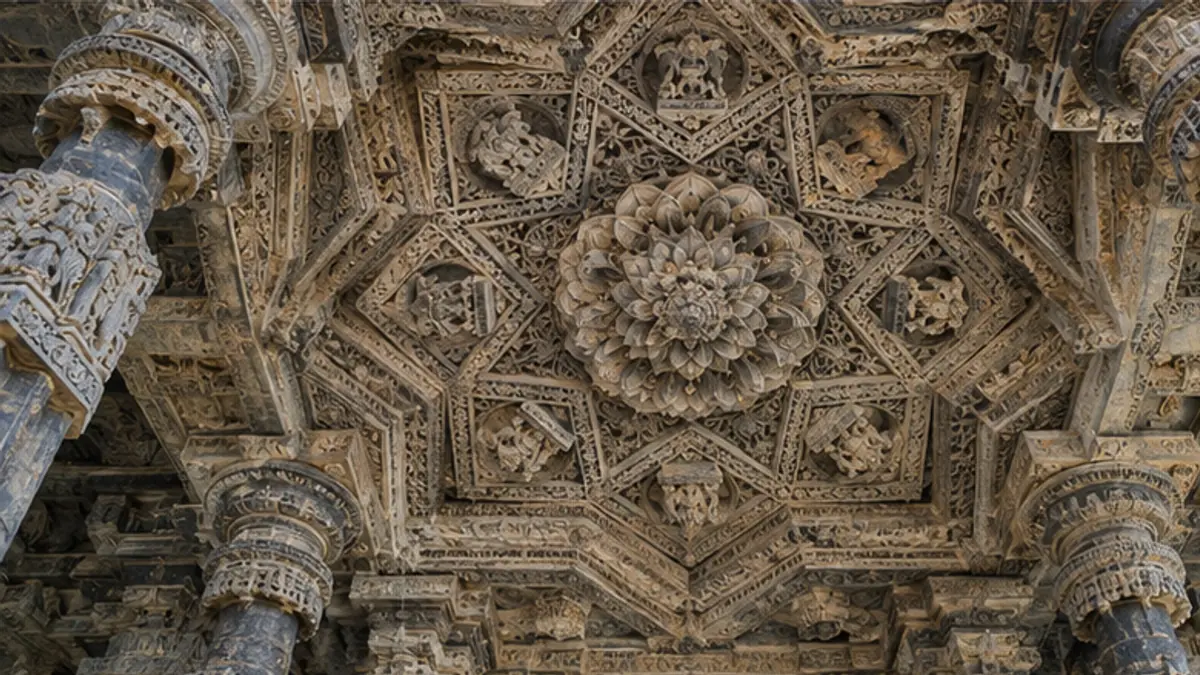
The sanctums originally housed three consecrated Vishnu idols: Keshava in the western shrine, Janardhana in the northern shrine, and Venugopala playing the flute in the southern shrine. While the original central Keshava idol was removed during past conflicts, the exquisite Venugopala image remains in place, surrounded by carved cows and cowherds mesmerized by divine music.
Visiting Hours, Daily Timings, and ASI Ticket Tariffs
Planning the daily schedule between Belur, Halebidu, and Somanathapura requires coordinating between active temple customs and central government monument regulations. Because Belur remains an active religious sanctuary, its gates open earlier and close later than the other two archaeological sites.
Official entry guidelines are managed under the Archaeological Survey of India, which protects Halebidu and Somanathapura as monuments of national importance. Both sites operate standard daytime ticketing schedules without midday gate closures.
Operational Hours Across the Three Shrines
Visitors should plan their sightseeing around the following daily operating hours:
- Chennakeshava Temple Belur: Gates remain open daily from 6:30 AM to 9:00 PM. Note that the inner sanctum doors close for daily rituals from 1:00 PM to 2:30 PM and again from 6:00 PM to 6:30 PM.
- Hoysaleswara Temple Halebidu: Open daily from 6:30 AM to 6:30 PM without midday closures. The adjacent ASI Archaeological Museum on the grounds operates from 9:00 AM to 5:00 PM (closed on Fridays).
- Keshava Temple Somanathapura: Open daily from 8:30 AM to 5:30 PM. The ticket counter ceases issuing passes at 5:00 PM.
Admission Costs, Camera Fees, and Guide Tariffs
Admission policies differ between the living temple at Belur and the ASI protected monuments at Halebidu and Somanathapura:
- Belur: Admission is completely free for all Indian and international visitors. Handheld mobile photography is permitted free of charge inside the outer courtyard, though photography is strictly prohibited inside the inner sanctum.
- Halebidu and Somanathapura: Indian citizens, SAARC members, and BIMSTEC visitors pay ₹25 per entry ticket. Foreign nationals from non-SAARC countries pay ₹300 per ticket. Children below fifteen years of age enter free of charge.
- Local Guides: Official ASI-licensed guides are available at the entrance gates of all three temples. Standard tariffs range from ₹300 for a one-hour tour to ₹500 for a comprehensive two-hour exploration of the friezes and inscriptions.
| Monument Site | Indian Citizens | Foreign Nationals | Photography Fee | Guide Charges (Standard) |
|---|---|---|---|---|
| Chennakeshava (Belur) | Free Admission | Free Admission | Mobile Free / Cameras restricted inside | ₹300 to ₹500 |
| Hoysaleswara (Halebidu) | ₹25 | ₹300 | Free (Commercial video requires permit) | ₹300 to ₹500 |
| Keshava (Somanathapura) | ₹25 | ₹300 | Free handheld cameras | ₹300 to ₹400 |
| Halebidu ASI Museum | ₹5 (Free for under 15) | ₹5 | No indoor photography | Self-guided gallery tour |
How to Reach the Hoysala Temples: Road, Rail, and Flight Routes
Because the three Hoysala temples are divided between two geographical districts, travelers must plan their transit sequence carefully. Belur and Halebidu are situated in Hassan district, while Somanathapura lies 140 kilometers south in Mysuru district.
Comprehensive regional travel itineraries and bus schedules can be accessed via the Karnataka State Tourism Development Corporation. Hiring a private taxi from Hassan or Bengaluru remains the most flexible option for covering the monuments efficiently.
Reaching Belur and Halebidu from Hassan and Bengaluru
The city of Hassan serves as the primary base camp for visiting Belur and Halebidu:
- By Train: Hassan Junction (HAS) is well connected to Bengaluru, Mysuru, and Mangaluru via frequent daily express trains. From Hassan, regular KSRTC state buses depart every fifteen minutes for Belur (35 km, 45 minutes) and Halebidu (31 km, 40 minutes).
- By Road from Bengaluru: The driving distance from Bengaluru to Belur is 220 kilometers via the four-lane National Highway NH-75 (Bengaluru-Mangaluru Highway). The drive takes roughly 3.5 to 4 hours, bypassing Nelamangala, Kunigal, and Channarayapatna.
- Between Belur and Halebidu: A smooth rural state highway connects the two towns across a distance of just sixteen kilometers, with local buses and shared auto-rickshaws making the trip in twenty-five minutes.
Reaching Somanathapura from Mysuru and Bengaluru
Somanathapura is located in a rural agricultural belt near the river town of Bannur:
- From Mysuru: Somanathapura is situated thirty-five kilometers east of Mysuru railway station. The drive takes roughly 45 to 60 minutes via the Mysuru-Bannur-Malavalli road through lush sugarcane and paddy fields.
- From Bengaluru: Travelers can reach Somanathapura directly from Bengaluru (135 km, 2.5 hours) by taking the Bengaluru-Mysuru Expressway, exiting near Mandya and heading south through Bannur.
Important
Combine Somanathapura with Mysuru: Because Somanathapura is located near Mysuru rather than Hassan, do not attempt to visit all three temples on the same single day by road. Instead, visit Belur and Halebidu from Hassan, and visit Somanathapura as a half-day excursion while staying in Mysuru.
Best Season to Visit and Recommended 2-Day Hoysala Circuit
The interior Deccan plateau of Hassan and Mysuru experiences mild winters and pleasant post-monsoon weather. Planning your visit during the cooler months ensures that outdoor temple exploration remains comfortable.
Travelers who appreciate ancient architectural heritage can pair this circuit with famous Karnataka destinations such as the monolithic historic rock sanctuaries of the Badami, Aihole, and Pattadakal circuit.
Weather Considerations: October to March Window
The ideal time to tour the Hoysala temples is between October and March, when daytime temperatures range comfortably between 18°C and 29°C. Clear blue skies provide optimal lighting conditions for photographing the intricate stone carvings and star-shaped plinths.
The southwest monsoon from June through September brings lush green countryside and filled river reservoirs, but wet soapstone can become slippery underfoot. The summer months of April and May bring hot afternoon sun, requiring early morning visits before stone platforms become uncomfortably warm.
Complete 2-Day Hoysala Temple Heritage Itinerary
This optimized two-day itinerary links all three UNESCO monuments with scenic road travel:
-
Day 1: Bengaluru to Shravanabelagola, Belur, and Halebidu
- Depart Bengaluru at 6:00 AM along NH-75 toward Hassan.
- Make a morning stop at Shravanabelagola (145 km) to climb the 650 stone steps of Vindhyagiri Hill and view the 57-foot monolithic statue of Lord Gommateshwara.
- Continue to Belur (85 km) for lunch and spend 2.5 hours exploring Chennakeshava Temple and its forty-two Madanika bracket figures.
- Drive sixteen kilometers to Halebidu by 3:30 PM to tour the twin Hoysaleswara Temple and visit the on-site ASI museum before sunset.
- Check into a hotel in Hassan (31 km) for the night, or drive northwest into the scenic coffee hills of Chikmagalur.
-
Day 2: Hassan to Somanathapura and Mysuru
- Depart Hassan after breakfast, driving south 115 kilometers via Holenarasipura toward Mysuru.
- Arrive at Somanathapura by 11:00 AM to explore the intact triple spires and sixteen vaulted ceilings of Keshava Temple.
- Proceed into Mysuru for lunch, exploring the royal palace in the afternoon, or continue southwest toward the misty plantations of Kodagu.
Frequently Asked Questions About Hoysala Temples
Why were Belur, Halebidu, and Somanathapura inscribed as UNESCO World Heritage sites?
The temples were inscribed as India’s 42nd UNESCO World Heritage site in 2023 under the title Sacred Ensembles of the Hoysalas. They represent the apex of Vesara architectural style, distinguished by star-shaped stone plinths, horizontal narrative friezes, and micro-relief sculptures carved from soft chloritic schist.
What is the distance between Belur and Halebidu?
Belur and Halebidu are situated sixteen kilometers apart in Hassan district, connected by a smooth two-lane state highway. The drive between the two temple towns takes approximately twenty to twenty-five minutes by private car, taxi, or local state bus.
Which is the best town to stay in when visiting Belur and Halebidu?
The district headquarters of Hassan serves as the most practical lodging base, situated thirty-five kilometers from Belur and thirty-one kilometers from Halebidu. Hassan offers a wide range of family-friendly hotels, multi-cuisine restaurants, and direct railway connections to Bengaluru and Mysuru.
Are photography and video allowed inside the Hoysala temples?
Handheld still cameras and mobile phone photography are permitted free of charge in the outer courtyards of all three temples and inside the mandapas of Halebidu and Somanathapura. However, mobile photography is strictly prohibited inside the inner sanctum of Chennakeshava Temple at Belur due to active religious worship.
Can travelers visit all three Hoysala temples in a single day?
Visiting all three temples in a single day is not recommended because Somanathapura lies 140 kilometers away from Belur in a different district. A relaxed two-day itinerary allows travelers to tour Belur and Halebidu together from Hassan on Day 1, and visit Somanathapura from Mysuru on Day 2.
What material was used to build the Hoysala temples?
Hoysala craftsmen constructed the temples using chloritic schist, a fine-grained talc-carbonate soapstone quarried locally across Karnataka. This rock is soft enough to carve intricate openwork details when fresh, but hardens over decades of atmospheric exposure into durable stone.