Mysore Palace: Timings, Tickets & Illumination Guide
Plan your visit to Mysore Palace with verified entry timings, illumination hours, ticket prices, sound and light show rules, and nearby city attractions.
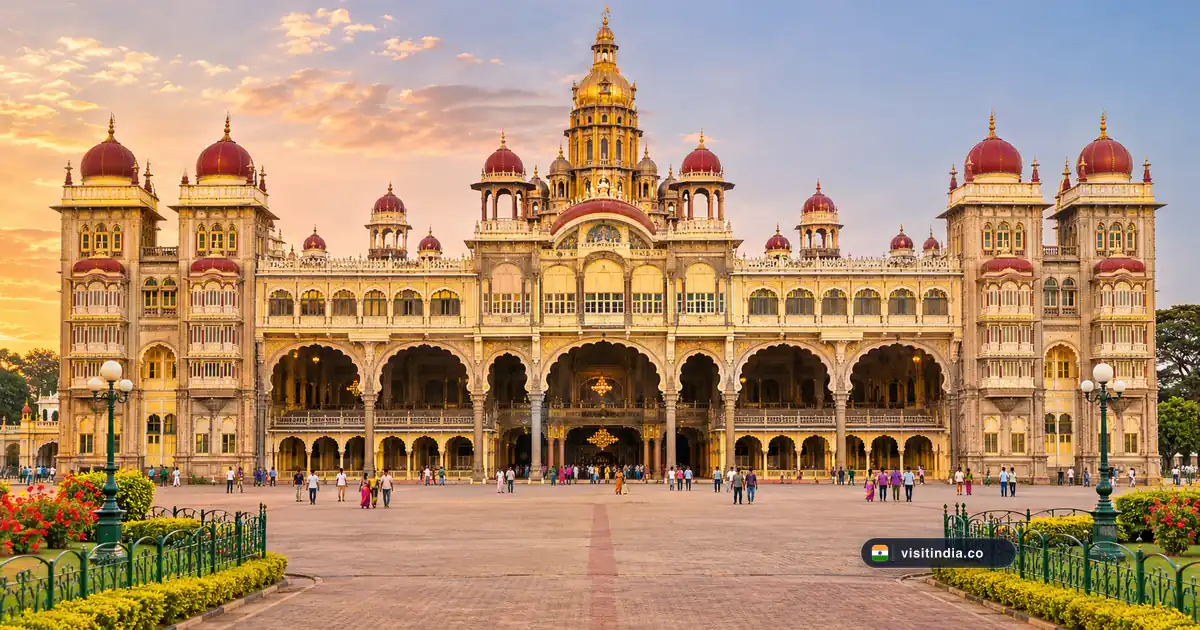
Standing as the ceremonial seat of the Wadiyar dynasty in the cultural heart of the city, the Amba Vilas royal residence attracts travelers seeking verified mysore palace timings tickets illumination details. Commissioned in 1897 and completed in 1912 after the original wooden palace burned down, this three-story grey granite monument blends Indo-Saracenic, Rajput, and Gothic architectural styles beneath majestic pink marble domes.
Beyond its magnificent exterior towers, the palace interior houses stained-glass marriage pavilions, mirrored private audience halls, and solid gold ceremonial howdahs that reflect centuries of regal heritage. Whether touring the museum galleries by day or watching 97,000 light bulbs illuminate the facade on Sunday evening, a trip to Mysuru remains an essential cultural highlight across southern Karnataka.
Visitor & Architectural Essentials
- Official Name: Amba Vilas Palace, designed by British architect Henry Irwin and consecrated in 1912 for Maharaja Krishnaraja Wadiyar IV.
- Daily Daytime Hours: Palace interior museum open daily from 10:00 AM to 5:30 PM; grounds open from 6:00 AM to 9:00 PM.
- Illumination Schedule: Exterior lit by 97,000 bulbs every Sunday and public holiday from 7:00 PM to 7:45 PM (free viewing from courtyard).
- Admission Charges: Adults ₹100, children aged 10 to 18 years ₹50, children under 10 free; audio guides available at the entrance.
- Footwear Policy: Shoes are strictly prohibited inside the royal residence; free designated shoe deposit counters operate near the Varaha Gate.
Understanding the Architecture and Royal History of Mysore Palace
The current Amba Vilas Palace was constructed between 1897 and 1912 under the direction of British consulting architect Henry Irwin. The royal court commissioned the new granite structure after a catastrophic fire destroyed the fourteenth-century wooden palace during the wedding celebrations of Princess Jayalakshammanni in 1897.
According to regional heritage records published by the District Administration Mysuru Official Tourism Directory, the palace incorporates fine grey granite quarried locally, accented with pink marble domes, deep archways, and sculpted stone brackets. The central five-story tower rises 145 feet above the surrounding gardens, crowned by a gilded dome that dominates the urban skyline.
Indo-Saracenic Synthesis: Rajput, Mughal, and Gothic Elements
The design of Mysore Palace represents one of the finest executions of Indo-Saracenic architecture in the world. Irwin harmonized classical Hindu temple plinths, Rajput cusped arches, Mughal vaulted domes, and European Gothic stained-glass clerestories into a unified regal residence.
The exterior facade features two open arcaded verandahs supported by paired granite pillars. Above the central arch sits an ornate sculpture of Gajalakshmi, the goddess of wealth and royal prosperity, depicted with caparisoned elephants pouring holy water over her seated form.
The Wadiyar Dynasty and Royal Dasara Tradition
The Wadiyars ruled the Kingdom of Mysuru almost continuously from 1399 until Indian independence, transforming their capital into a renowned patron of Carnatic music, Sanskrit literature, and classical arts. The palace remains the spiritual epicenter of the world-famous ten-day Mysuru Dasara (Nada Habba) festival celebrated each autumn.
During Vijayadashami, the final day of Dasara, the current royal scion performs traditional worship before the golden throne. The festival concludes with the Jumboo Savari, detailed in our guide to the Mysuru Dasara Jumbo Savari, where a decorated lead elephant carries the idol of Goddess Chamundeshwari seated inside a 750-kilogram golden howdah through the city streets.
| Palace Feature | Architectural Style | Materials Used | Key Visual Marvel |
|---|---|---|---|
| Central Tower | Indo-Saracenic / Rajput | Grey granite with pink marble dome | 145-foot gilded finial and brass flags |
| Kalyana Mandapa | Gothic / Scottish Ironwork | Cast iron, teak, Scottish stained glass | Octagonal peacock glass dome ceiling |
| Diwan-e-Khas | Mughal / Persianate | Polished marble, cast iron, gilded plaster | Turquoise fluted pillars and crystal chandeliers |
| Diwan-e-Aam | Dravidian / Renaissance | Heavy granite arches and painted ceilings | Open public durbar hall with gold leaf relief |
| Gombe Thotti | Indigenous Karnataka | Teakwood, ivory inlay, beaten brass | Royal doll collection and 84 kg golden howdah |
Inside Mysore Palace: Room-by-Room Tour and Highlights
Entering through the northern gatehouse, visitors step into an opulent labyrinth of ceremonial chambers, portrait corridors, and council halls. Each room reflects meticulous artisanal craftsmanship, combining imported European decorative glass with indigenous South Indian teakwood and ivory inlays.
A self-guided walking tour takes approximately 90 minutes to two hours to navigate the designated one-way tourist corridor. Visitors should pace their walk to inspect the delicate micro-reliefs, oil paintings by royal court artists, and brass gate latches that decorate each portal.
Gombe Thotti and the Golden Royal Throne
The interior tour begins on the ground floor at the Gombe Thotti (Dolls Pavilion), which houses a historic gallery of nineteenth-century ceremonial dolls, marble sculptures, and European bronzes. The centerpiece of this hall is the ceremonial wooden elephant howdah decorated with 84 kilograms of pure gold leaf.
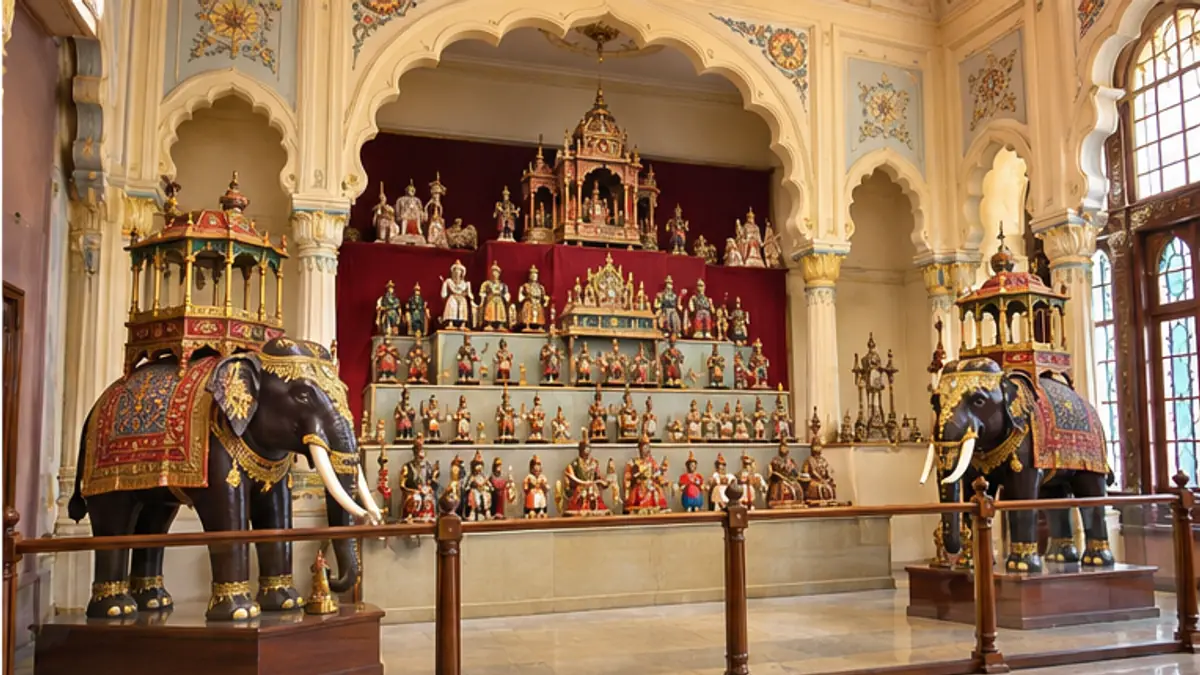
Nearby rests the legendary Royal Throne (Chinnada Simhasana), assembled from fig wood and encased in solid gold relief sheets depicting mythological motifs. According to dynastic lore, the throne originally belonged to the Pandavas of the Mahabharata and was retrieved from the Vijayanagara ruins before being passed down through generations of Wadiyar monarchs.
Kalyana Mandapa: The Royal Marriage Pavilion
The most photogenic chamber on the ground level is the Kalyana Mandapa (Octagonal Marriage Pavilion). This soaring hall features a vaulted octagonal glass ceiling fabricated by the renowned Scottish glazing firm Macfarlane and Company in Glasgow.
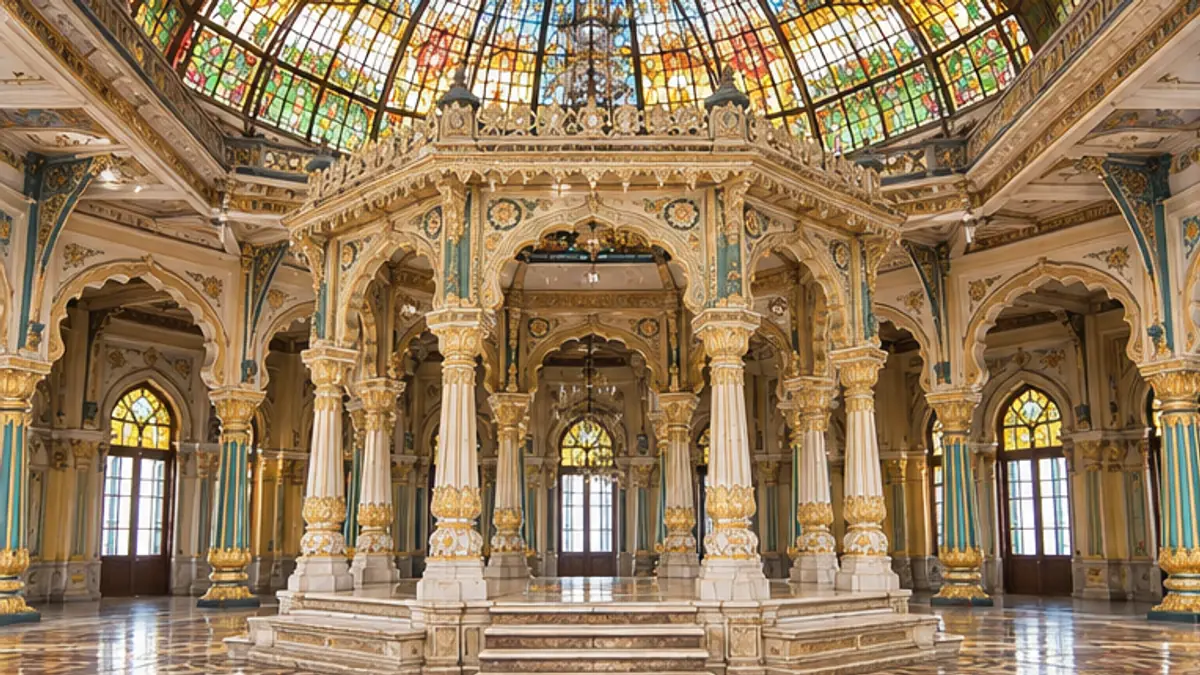
The stained-glass panels depict colorful dancing peacocks and floral creepers arranged in symmetrical geometric bays that bathe the hall in warm natural daylight. Beneath your feet, the floor is paved with imported English ceramic tiles laid in complex geometric patterns, while oil paintings along the perimeter depict royal Dasara processions from the early twentieth century.
Diwan-e-Khas and Diwan-e-Aam Durbar Halls
Ascending the grand stone staircase brings visitors to the first floor, where the private and public council chambers are located. The Diwan-e-Khas (Private Durbar Hall) served as the maharaja’s intimate executive chamber, featuring a dazzling colonnade of cast-iron pillars painted in bright turquoise blue and gilded with real gold leaf.
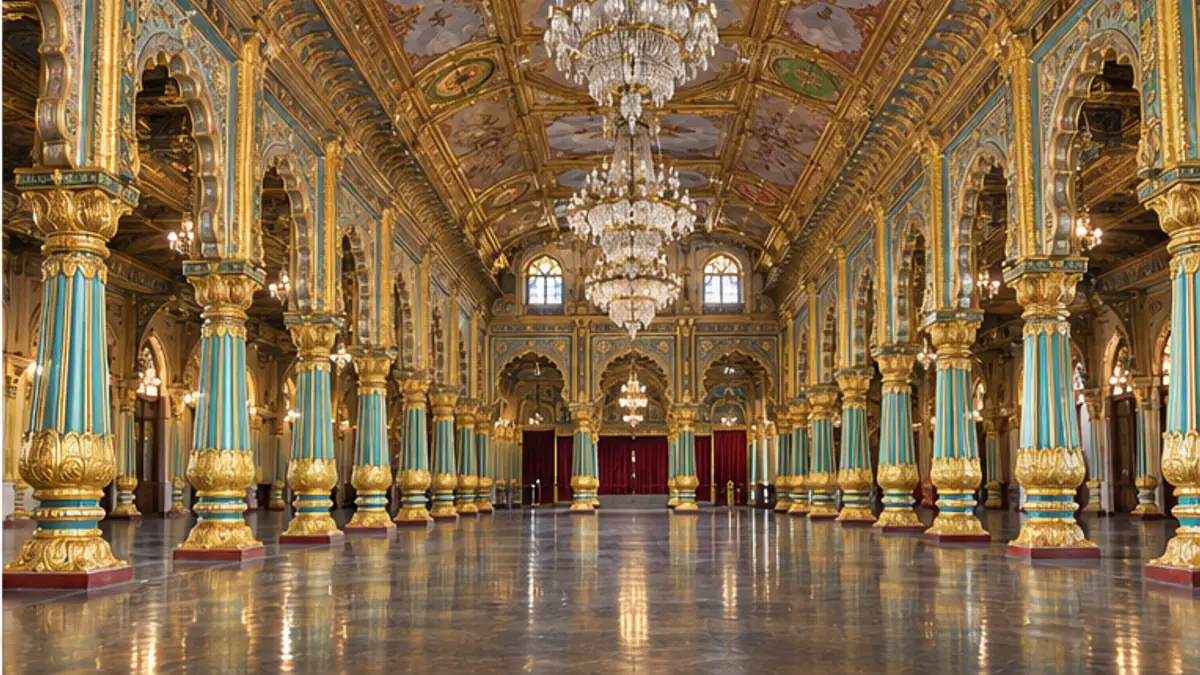
Adjacent stands the sprawling Diwan-e-Aam (Public Durbar Hall), a massive open gallery spanning over three hundred feet. Here, the king sat in state to address thousands of subjects gathered in the courtyard below, framed by massive painted arches, Italian marble flooring, and portraits of past royal rulers.
Pro Tip
Audio Guide Utilization: Renting an official multilingual audio guide at the entrance gate for ₹100 provides rich historical context for each numbered chamber. The automated handsets are available in English, Hindi, Kannada, French, German, and Spanish.
Mysore Palace Timings, Illumination Schedule, and Entry Tickets
Coordinating your arrival time is essential for enjoying both the daytime museum galleries and the evening lighting spectacle. The palace grounds follow separate operating hours from the interior state rooms, allowing evening visitors to enter the gardens for photography after museum galleries close.
Entry passes are managed under the Mysore Palace Board, with ticketing policies coordinated through the Karnataka State Tourism Development Corporation. Visitors can purchase tickets directly at the counter or pre-book digital admission tokens online to bypass weekend holiday queues.
Palace Interior Museum Operating Hours
The interior royal museum opens daily at 10:00 AM and closes at 5:30 PM throughout the entire year, including Sundays and national holidays:
- Last Entry: Ticket counters stop selling daytime museum admission passes at 5:00 PM.
- Museum Duration: Security personnel begin ushering visitors out of the interior halls at 5:30 PM sharp to prepare the palace for evening programs.
- Palace Grounds: The surrounding courtyards and landscaped gardens remain accessible from 6:00 AM to 9:00 PM daily.
The 97,000-Bulb Illumination Schedule and Light Show
The world-famous illumination of Mysore Palace takes place exclusively on Sundays, national public holidays, and during the ten days of Mysuru Dasara:
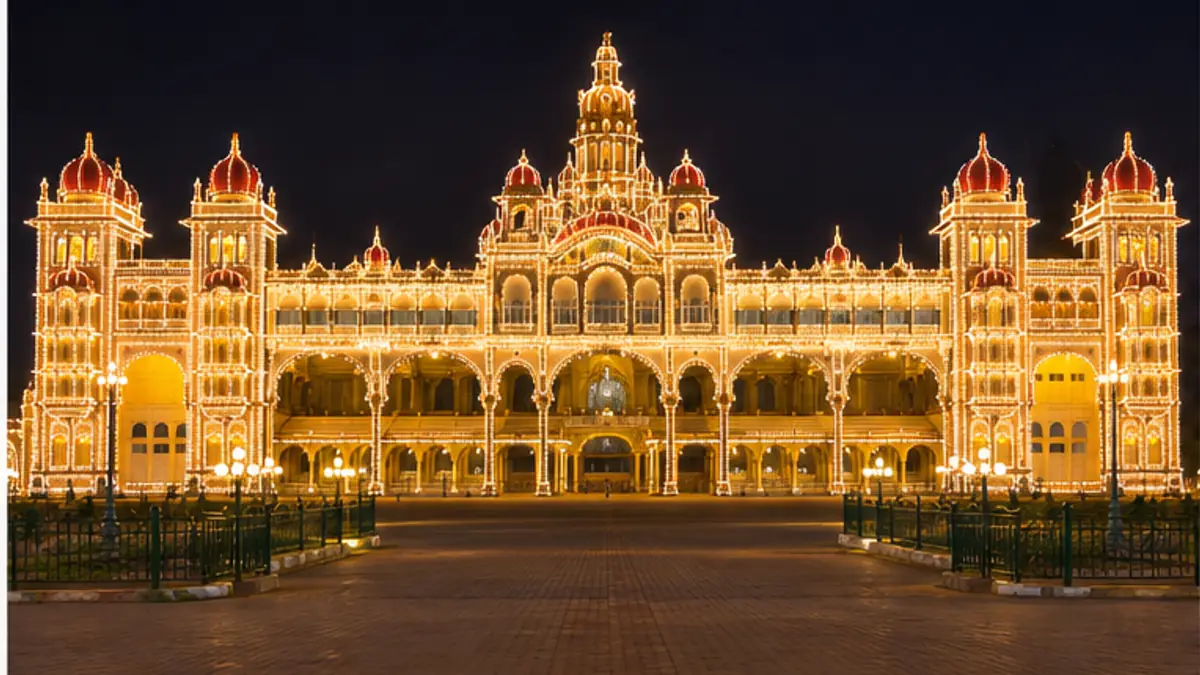
- Sunday Illumination Window: The entire exterior facade is illuminated by 97,000 incandescent light bulbs from 7:00 PM to 7:45 PM. Admission to the palace grounds to view the illumination is completely free of charge.
- Dasara Festival Illumination: During the autumn Dasara celebrations, the palace is lit every single evening from 7:00 PM to 9:00 PM, creating a magical festival atmosphere.
- Sound and Light Show (Son et Lumiere): On non-illumination evenings (Monday through Saturday), the palace hosts a 45-minute sound and light show dramatizing the history of Mysuru. The show runs from 7:00 PM to 7:45 PM in Kannada (Monday to Wednesday, Friday to Saturday) and English (Thursday and Saturday).
| Visitor Category | Daytime Palace Museum | Sound & Light Show (Kannada) | Sound & Light Show (English) | Sunday Illumination |
|---|---|---|---|---|
| Indian Adults | ₹100 | ₹90 | ₹120 | Free (Courtyard Entry) |
| Foreign Adults | ₹100 (Audio Guide ₹100 extra) | ₹90 | ₹120 | Free (Courtyard Entry) |
| Children (10 to 18 yrs) | ₹50 | ₹40 | ₹60 | Free (Courtyard Entry) |
| Children (Below 10 yrs) | Free | Free | Free | Free (Courtyard Entry) |
Essential Visitor Rules: Footwear, Cloakrooms, and Photography
Because Mysore Palace remains a revered state monument and a working royal temple complex, security guards enforce strict behavioral and dress guidelines. Knowing the entry protocols ensures you avoid delays at the metal detector turnstiles.
Visitors must pass through automated airport-style security scanners upon entering the outer gates. Large bags, sharp objects, and unsealed beverages are not permitted inside the palace museum.
Footwear Custody Counters at Varaha Gate
National conservation guidelines established by the Archaeological Survey of India require strict preservation of royal interiors, where footwear is forbidden:
- Free Shoe Counter: Visitors must deposit shoes, sandals, and sneakers at the official footwear counter located near the Varaha Gate entrance.
- Deposit Tokens: The attendants provide a numbered metal or plastic token in exchange for your shoes. While the official service is free, tipping attendants ₹10 to ₹20 upon retrieval is customary.
- Socks Recommended: During hot summer months, walking across the sunbaked stone courtyards leading to the shoe counters can be uncomfortable; wearing clean cotton socks protects your feet.
Photography and Camera Regulations
Photography regulations inside the palace have evolved in recent years to accommodate modern mobile travelers:
- Mobile Cameras: Handheld mobile phone photography is permitted inside the palace museum corridors, provided you do not use flash units or obstruct pedestrian traffic.
- DSLR and Video Cameras: Professional DSLR cameras, tripods, selfie sticks, and commercial filming equipment are strictly prohibited inside the state rooms without prior written permission from the Palace Board.
- Cloakroom Facilities: Secure luggage cloakroom lockers are available near the ticket counters for ₹20 to ₹50 per piece of baggage.
Top Attractions Near Mysore Palace in Mysuru City
While the palace serves as the centerpiece of any Mysuru itinerary, the surrounding royal city offers numerous historic temples, Gothic cathedrals, and traditional handicraft markets within a short auto-rickshaw ride. Culinary enthusiasts should explore the city’s royal sweets and breakfast heritage through our Bengaluru and Mysuru filter coffee and dosa trail.
Travelers can easily combine palace sightseeing with the ancient stone temples of the Hoysala temples at Somanathapura, located just thirty-five kilometers east along the scenic banks of the Kaveri River.
Chamundeshwari Temple atop Chamundi Hills
Rising 1,062 meters above the southeastern edge of the city, Chamundi Hills is crowned by the twelfth-century Sri Chamundeshwari Temple, dedicated to the tutelary goddess of the Wadiyar dynasty. The temple features a seven-story Dravidian gopuram decorated with intricate mythological relief carvings.
Pilgrims can reach the summit via a motorable road (13 km from the palace) or climb the ancient 1,008 stone steps cut into the hill slope. Halfway up the stone staircase sits the famous 16-foot monolithic Nandi bull, carved from a single boulder of black granite in 1659.
St. Philomena’s Cathedral and Brindavan Gardens
Positioned three kilometers north of the palace, St. Philomena’s Cathedral is one of the tallest churches in Asia, built in 1936 in the Neo-Gothic style inspired by Germany’s Cologne Cathedral. Its twin spires soar 175 feet into the sky, housing beautiful French stained-glass windows depicting the life of Christ and a relic of Saint Philomena in the subterranean crypt.
Twenty-one kilometers northwest of the city lies Brindavan Gardens, laid out below the massive Krishnarajasagara (KRS) Dam across the Kaveri River. Spanning sixty acres of terraced rose beds and fountains, the gardens host an illuminated musical dancing fountain show every evening from 6:30 PM to 8:00 PM.
| Attraction | Distance from Palace | Key Highlight | Best Visiting Hours |
|---|---|---|---|
| Chamundeshwari Temple | 13 kilometers | Monolithic Nandi and hilltop views | 7:30 AM to 1:30 PM, 3:30 PM to 6:00 PM |
| St. Philomena’s Cathedral | 3 kilometers | 175-foot twin Gothic spires and crypt | 8:00 AM to 6:00 PM |
| Devaraja Market | 1 kilometer | Fresh flowers, Mysore pak, and incense | 8:00 AM to 1:00 PM |
| Brindavan Gardens (KRS) | 21 kilometers | Musical fountain and illuminated terraces | 5:30 PM to 8:00 PM |
| Mysuru Zoo (Sri Chamarajendra) | 2 kilometers | Centuries-old botanical zoo and tigers | 8:30 AM to 5:30 PM (Closed Tuesdays) |
How to Reach Mysuru and Transit Connections Across Karnataka
Mysuru is among the best-connected tourism engines in southern India, linked to Bengaluru by high-speed expressways and modern electrified rail routes. Travelers can utilize Mysuru as a gateway to explore neighboring coffee plantations and wildlife reserves.
Regional state transport buses operate around the clock from the central KSRTC Suburb Bus Stand, providing frequent connections to the misty hill retreats of Coorg and the coffee estates of Chikmagalur.
Rail and Road Transit from Bengaluru
Connecting from Karnataka’s capital city is effortless due to upgraded transportation infrastructure:
- Bengaluru-Mysuru Expressway (NH-275): The ten-lane access-controlled expressway allows private cars, cabs, and luxury KSRTC Flybus coaches to cover the 140-kilometer journey from Bengaluru to Mysuru in roughly 90 minutes to two hours.
- Express Trains: Frequent daily trains, including the high-speed Vande Bharat Express and Shatabdi Express, connect KSR Bengaluru City Junction with Mysuru Junction in under two hours.
- Mysore Junction to Palace: From Mysuru Junction Railway Station, prepaid auto-rickshaws and app-based cabs reach the palace gates in less than ten minutes (2 km).
Air Transit via Mandakalli and Kempegowda Airports
Travelers arriving by air have two practical airport gateways:
- Mysuru Mandakalli Airport (MYQ): Situated ten kilometers south of the city center, Mandakalli Airport handles regional domestic flights connecting Mysuru directly with Chennai, Hyderabad, and Goa.
- Kempegowda International Airport Bengaluru (BLR): Located 185 kilometers away, Bengaluru’s international hub handles flights from worldwide destinations. Direct KSRTC Flybus air-conditioned coaches depart Bengaluru Airport every two hours, taking passengers straight to Mysuru without changing vehicles.
Recommended 2-Day Mysuru Royal Heritage Itinerary
To fully enjoy the architectural majesty of Mysore Palace along with the city’s gardens and cultural monuments, travelers should follow an organized two-day sightseeing plan. This route balances indoor gallery tours during the midday heat with cool outdoor explorations at sunrise and twilight.
Travelers with extra time can extend their road trip west toward the scenic Tibetan temples and prayer wheels at Namdroling Monastery in Bylakuppe.
Day 1: Royal Palace, Devaraja Market, and Evening Illumination
Begin Day 1 by arriving at Mysore Palace at 9:45 AM before large tourist buses arrive. Spend two hours touring the interior museum chambers, including the Gombe Thotti, Kalyana Mandapa, and the Diwan-e-Khas.
After exploring the palace, take a five-minute auto-rickshaw ride to the century-old Devaraja Market for lunch and sensory exploration of fresh jasmine garlands, Mysore silk scarves, and authentic hot Mysore pak from Guru Sweet Mart. In the late afternoon, visit St. Philomena’s Cathedral and the Mysuru Zoo before returning to the palace grounds by 6:45 PM to watch the magnificent Sunday illumination spectacle.
Day 2: Chamundi Hills, Somanathapura, and Brindavan Fountains
Start Day 2 early by driving up Chamundi Hills at 7:00 AM to beat the pilgrim rush at Sri Chamundeshwari Temple and photograph the giant Nandi monolith. Enjoy breakfast with fresh Mysore masala dosa and filter coffee at a local restaurant on the return drive.
In the afternoon, take a thirty-five-kilometer countryside drive east to Somanathapura to marvel at the thirteenth-century star-shaped Hoysala temple. Conclude your tour by driving northwest to Brindavan Gardens below the KRS Dam, enjoying an evening stroll through the illuminated rose gardens as the musical fountains dance against the night sky.
Frequently Asked Questions About Mysore Palace
What are the daily visiting hours for Mysore Palace?
The interior palace museum is open to visitors daily from 10:00 AM to 5:30 PM, with ticket counters closing at 5:00 PM. The outer palace grounds and courtyards open earlier at 6:00 AM and remain accessible until 9:00 PM.
On which days is Mysore Palace illuminated with light bulbs?
Mysore Palace is illuminated by 97,000 incandescent light bulbs every Sunday and on all government public holidays from 7:00 PM to 7:45 PM. During the ten days of the annual Mysuru Dasara festival, the illumination runs every evening from 7:00 PM to 9:00 PM.
How much does an entry ticket cost to visit Mysore Palace?
Daytime entry to the palace museum costs ₹100 for adults, ₹50 for children aged ten to eighteen years, and is completely free for children under ten years. Viewing the evening palace illumination from the outer courtyard grounds is free for all visitors.
Is footwear allowed inside Mysore Palace?
Footwear of all kinds is strictly prohibited inside the interior rooms of Mysore Palace to preserve historical flooring and uphold traditional sanctity. Visitors must leave their shoes at the designated free footwear deposit counter near the Varaha Gate.
Are mobile cameras permitted inside the palace museum?
Handheld mobile phone photography is permitted inside the palace rooms without any extra fee, provided visitors do not use flash units. However, professional DSLR cameras, tripods, and commercial video equipment are not permitted inside without prior official clearance.
How much time is needed to explore Mysore Palace?
A standard tour of the palace interior takes between 90 minutes and two hours to view the principal state rooms, marriage pavilion, and museum galleries. Visitors planning to watch the evening sound and light show or illumination should allocate an additional hour.