Golden Temple Coorg (Namdroling Monastery) Timings & Guide
Visit Namdroling Monastery (Golden Temple) in Bylakuppe, Kushalnagar near Coorg with verified 7 AM-7 PM timings, prayer hours, free entry rules, and Mysore routes.
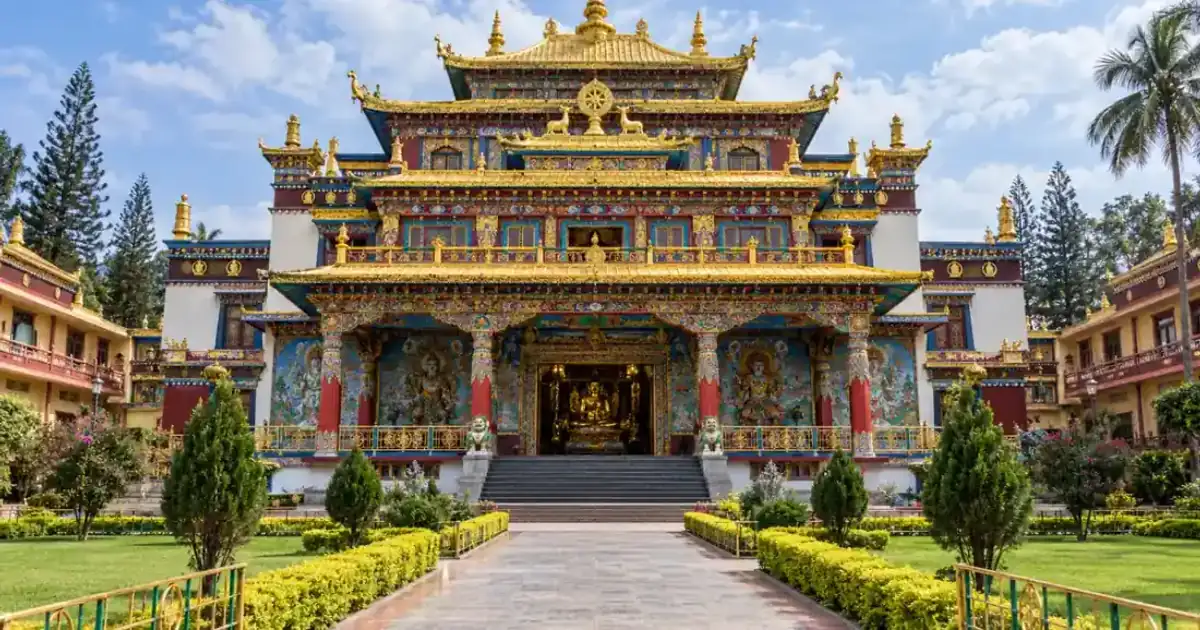
Namdroling Monastery, popularly known as the Golden Temple of Coorg, stands in the Tibetan settlement of Bylakuppe just 6 kilometers from Kushalnagar and 38 kilometers east of Madikeri in Karnataka. Established in 1963, it is the world’s largest teaching center of the Nyingma lineage of Tibetan Buddhism outside the Himalayas.
Thousands of travelers driving between Mysuru and Kodagu stop here daily to witness the 40-to-60-foot golden Buddha statues, colorful thangka murals, and synchronized monk prayer ceremonies. This field guide consolidates verified Kushalnagar Golden Temple timings, afternoon prayer hours, dress code expectations, free entry rules, and nearby Coorg transit routes.
Monastery Visitor Essentials
- Opening Hours: Main gates welcome visitors daily from 7:00 AM to 7:00 PM, with peak sightseeing between 9:00 AM and 6:00 PM.
- Signature Prayer Hour: Monks assemble inside the main hall for chanting, horns, and drums daily from 1:00 PM to 1:45 PM.
- Entry Ticket Fee: Admission is completely free (INR 0) for Indian and foreign travelers; nominal parking applies outside gates.
- Modest Dress Code: Shoulders and knees must be covered; footwear is removed at outdoor shoe racks before entering prayer halls.
- Closest Hub: Located 6 km from Kushalnagar bus stand and 85 km west of Mysuru Junction along NH275.
Golden Temple Coorg Timings, Prayer Chanting, and Daily Schedule
Namdroling Monastery opens daily from 7:00 AM to 7:00 PM, with tourist visitor flow concentrated between 9:00 AM and 6:00 PM. Morning gong and chanting take place around 8:30 AM to 9:15 AM, while the main afternoon communal prayer (Tsok) runs from 1:00 PM to 1:45 PM inside the Padmasambhava temple hall.
Unlike busy pilgrimage shrines with rigid ticket slots, Namdroling operates continuously as a living monastic university housing over 5,000 monks and nuns. Travelers pairing Bylakuppe with southern Karnataka temple routes such as Dharmasthala can plan an unhurried mid-morning arrival before the afternoon chanting begins.
| Activity / Area | Daily Schedule | Visitor Access |
|---|---|---|
| Main Temple Gates | 7:00 AM to 7:00 PM | Open daily to all visitors (Peak hours 9 AM to 6 PM) |
| Morning Gong & Chanting | 8:30 AM to 9:15 AM | Silent observation from rear hall seating |
| Main Afternoon Prayer (Tsok) | 1:00 PM to 1:45 PM | Seated observation permitted along side aisles |
| Monastic Courtyards & Gardens | 7:00 AM to 7:00 PM | Free walking access around stupas and prayer wheels |
| Souvenir & Book Stalls | 9:00 AM to 5:30 PM | Open to public outside main courtyard |
Morning Gong, Afternoon Chanting, and Best Visiting Hours
Arriving between 9:00 AM and 10:30 AM offers calm lighting across the gilded rooftops and open courtyard before Mysuru day-tripper buses arrive around midday. Photographers capture crisp outdoor reflections along the red-and-gold entrance facade during this cooler morning window.
Visitors wishing to experience deep liturgical soundscapes should schedule their hall visit between 1:00 PM and 1:45 PM, when hundreds of maroon-robed lamas chant together accompanied by long telescopic copper horns, cymbals, and ritual drums. Guests sit quietly on carpeted rear floor mats while prayers continue uninterrupted.
Courtyard Access, Monastic Colleges, and Festival Calendar
Manicured lawns surrounding the Golden Temple link the main Padmasambhava Vihara with Ngagyur Nyingma Shedra classrooms, retreat stupas, and tall cylindrical prayer-flag poles fluttering across Bylakuppe. Visitors can spin rows of brass prayer wheels clockwise along the outer circumambulation path.
Each February or March, Namdroling celebrates Losar (Tibetan New Year) with elaborate masked Cham dances, traditional horn fanfare, and festive butter-sculpture displays drawn from centuries-old Nyingma monastic customs. Current calendar updates are published through the Namdroling Monastery official monastic portal.
Entry Fee, Dress Code, and Prayer Hall Etiquette Rules
Entry to Namdroling Monastery Golden Temple in Bylakuppe is completely free (INR 0) for both Indian citizens and international visitors, with zero ticket charges for handheld still cameras. Respectful attire covering shoulders and knees, shoe removal before entering inner halls, and strict indoor silence are mandatory.
Because monks study, meditate, and perform daily pujas inside these spaces year-round, visitors are treated as respectful guests in an active religious academy rather than a commercial theme park. Heritage travelers accustomed to strict stone-shrine codes like Shravanabelagola sacred hill heritage will find Namdroling’s entry etiquette straightforward and welcoming.
| Visitor Parameter | Official Rule / Fee | Important Recommendation |
|---|---|---|
| Entry Ticket Cost | ₹0 (Free Admission) | Voluntary offerings accepted in hall donation boxes |
| Still Camera Fee | Free (₹0) | No tripods or flash permitted inside prayer halls |
| Video Recording | Free in courtyards | Keep audio muted inside inner sanctum |
| Footwear Rules | Removed at hall entrance | Use official shoe racks outside the stairs |
| Cloakroom Facilities | Counters outside gates | Small daypacks permitted inside courtyards |
Modest Dress Code, Footwear Counters, and Photography Norms
Visitors entering the Golden Temple should wear full-length trousers, jeans, long skirts, salwar suits, or knee-length dresses paired with sleeved tops. Sleeveless shirts, short beachwear, and caps must be avoided or covered with a shawl inside the Padmasambhava hall.
Footwear must be removed at the lower stone steps and deposited at attended shoe racks for a nominal token tip before walking barefoot onto the polished timber veranda. Flash photography, selfie sticks, and loud video commentary during chanting sessions are strictly prohibited.
Voluntary Donations, Butter Lamps, and Souvenir Stalls
Although entry carries no fee, visitors may offer voluntary contributions inside wooden donation boxes near the sanctum doors or light brass butter lamps at designated outdoor shelters. Proceeds support food, education, and housing for resident monks and nuns.
Just outside the main monastery arch, Tibetan cooperative shops and bookstalls sell hand-rolled incense, singing bowls, brocade prayer flags, and books on Buddhist philosophy without aggressive hawking.
Important
Active Classroom Decorum: Avoid stepping onto low monastic seating platforms or photographing young child monks at close range without consent, particularly during morning debate sessions in the courtyards.
Inside Padmasambhava Buddhist Vihara: Golden Statues and Thangka Murals
The centerpiece Padmasambhava Buddhist Vihara houses three monumental gold-plated statues rising 40 to 60 feet toward the coffered timber ceiling: Padmasambhava (Guru Rinpoche) flanked by Shakyamuni Buddha and Amitayus Buddha. Hand-painted Tibetan thangka murals and gilded mythological roof motifs cover the multi-tiered temple walls.
Despite popular nicknames, the Golden Temple is not cast from solid gold; its towering brass and copper sculptures and ornate spire roofs are plated in gold leaf that catches sunlight across Bylakuppe’s rolling farmland. The surrounding Western Ghats corridor links naturally onward to coastal shrines like the Kukke Subramanya Western Ghats temple pilgrimage guide.
The Three Towering Golden Buddha Statues and Zangdokpalri
Stepping through heavy lacquered wooden doors, visitors face a 60-foot statue of Guru Padmasambhava, revered as the lotus-born master who carried Vajrayana Buddhism into Tibet, flanked by 58-foot figures of Shakyamuni Buddha and Amitayus. Intricate lotus pedestals hold ceremonial offering bowls of saffron water, barley, and butter lamps.
Directly across the central paved courtyard stands the ornate multi-storey Zangdokpalri (Copper-Colored Mountain) Temple, crowned by gilded Dharma wheels and deer sculptures symbolizing the Buddha’s first sermon at Sarnath. Inside, vivid wall paintings depict celestial mandalas, guardian deities, and teachings of the Nyingma masters.
History of Bylakuppe Settlement and His Holiness Penor Rinpoche
Following the Tibetan exodus after 1959, the Karnataka state government allocated forested land near Bylakuppe in 1961 to establish Lugsum Samdupling, the first Tibetan refugee settlement in India. Two years later, in 1963, His Holiness Pema Norbu (Penor) Rinpoche founded Namdroling Monastery with just a handful of monks and bamboo huts.
Over six decades, the campus expanded into a thriving educational town complete with schools, a hospital, elderly homes, nunneries, and the Padmasambhava Buddhist Vihara inaugurated in 1999. Official cultural background is documented on the Kodagu District Administration tourism portal and Incredible India Karnataka travel guide.
How to Reach Golden Temple Coorg from Kushalnagar, Mysuru, and Bengaluru
Namdroling Monastery sits in Bylakuppe just 6 km from Kushalnagar bus stand, 38 km east of Madikeri, and 85 km west of Mysuru along NH275. Mysuru Junction (85 km) and Hassan Junction (82 km) are the closest broad-gauge railheads, while Kannur International Airport (CNN) lies 100 km southwest.
Road connectivity is smooth and well marked via the Mysuru–Hunsur–Kushalnagar highway corridor. Travelers driving west from the capital city along the Bengaluru to Mysuru culinary highway can stop for breakfast near Mysuru before reaching Bylakuppe before noon.
| Transit Mode | Nearest Station / Airport | Distance to Monastery | Driving Time |
|---|---|---|---|
| Air | Kannur International Airport (CNN) | 100 km | 2 hours 45 minutes |
| Air | Mangalore International Airport (IXE) | 170 km | 4 hours 15 minutes |
| Air | Kempegowda Airport Bengaluru (BLR) | 260 km | 5 hours 30 minutes |
| Rail | Mysuru Junction Railway Station (MYS) | 85 km | 2 hours 15 minutes |
| Rail | Hassan Junction Railway Station (HAS) | 82 km | 2 hours |
| Road | Kushalnagar Bus Station | 6 km | 15 minutes |
Road Route from Mysuru, Madikeri, and Bengaluru via NH275
Motorists driving from Bengaluru take the ten-lane Mysuru Expressway before turning onto SH88 and NH275 past Bilikere and Hunsur. Four kilometers before Kushalnagar town, an arched monastery gate on the left leads two kilometers down a quiet shaded avenue straight to Namdroling’s parking lot.
Travelers staying uphill in Madikeri or Virajpet descend 38 km east past Suntikoppa and Kushalnagar in roughly 50 to 60 minutes, making the Golden Temple an easy morning or afternoon excursion.
Kushalnagar KSRTC Buses, Autos, and Local Dining Stops
Frequent KSRTC ordinary and Rajahamsa buses connecting Mysuru and Madikeri stop every 15 minutes at Kushalnagar bus terminal or Bylakuppe Camp 1 gate. From Kushalnagar town center, metered or fixed-rate auto-rickshaws charge roughly INR 120 to INR 180 for the 15-minute ride to the monastery.
Surrounding Tibetan restaurants along the main street serve fresh steamed veg and chicken momos, hot thukpa noodle soup, butter tea, and tingmo bread, offering a memorable culinary contrast to Kodagu pork and filter coffee.
Best Time to Visit and Nearby Kushalnagar & Coorg Attractions
October through March brings pleasant 15 C to 27 C daytime weather across Bylakuppe and eastern Kodagu, making winter and early spring ideal for combining Namdroling Monastery with outdoor Coorg stops. Nearby highlights include Cauvery Nisargadhama Bamboo Island (7 km), Dubare Elephant Camp (15 km), and Chiklihole Reservoir (16 km).
Even during warmer April and May afternoons when temperatures touch 32 C, shaded marble hallways and tall campus trees keep the temple interior comfortably cool. July to September monsoon rains turn surrounding coffee and maize fields vivid emerald while keeping tourist coach crowds low.
Monsoon Mist vs Winter Festival Atmosphere
Winter travelers arriving between November and February experience crisp morning mist rolling off the Harangi backwaters alongside lively monastic study debates in open courtyards. During Losar celebrations in late February or March, extra crowds gather for traditional Cham mask performances, so arrive before 9:00 AM for parking.
Monsoon visits between June and August require a compact raincoat for walking between the Zangdokpalri shrine and Padmasambhava hall, though wet terracotta roofs gleam richly against dark storm clouds.
Half-Day Kushalnagar and Madikeri Circuit Plan
Start at 8:30 AM at Dubare Elephant Camp along the Cauvery riverbank, continue to Nisargadhama Island for shaded bamboo walks by 10:30 AM, and arrive at Namdroling Monastery ahead of the 1:00 PM prayer chanting. After Tibetan lunch in Bylakuppe, travelers exploring northern Kodagu ridges can continue toward Mallalli Falls in northern Kodagu or head straight up to Madikeri for sunset.
Pro Tip
Arrive Before 12:45 PM for Chanting: Enter the Padmasambhava hall 15 minutes before the 1:00 PM afternoon prayer begins so you can store footwear unhurriedly and find a quiet seated spot along the side carpet.
Frequently Asked Questions About Golden Temple Coorg
What are the opening and closing timings of Golden Temple Coorg?
Namdroling Monastery (Golden Temple) in Bylakuppe opens daily from 7:00 AM to 7:00 PM, though general sightseeing hours are busiest between 9:00 AM and 6:00 PM. Morning chanting runs roughly 8:30 AM to 9:15 AM, and the main afternoon prayer (Tsok) runs 1:00 PM to 1:45 PM.
Is there any entry fee or camera ticket at Namdroling Monastery?
No, admission to Namdroling Monastery Golden Temple is completely free (INR 0) for both Indian and foreign visitors. Handheld cameras are permitted outdoors free of charge, though tripods and flash photography are prohibited inside prayer halls.
What is the dress code for visiting Namdroling Monastery in Kushalnagar?
Visitors must wear modest clothing covering shoulders and knees, such as full trousers, jeans, long skirts, or salwar suits with sleeved tops. Footwear must be removed at outdoor racks before entering any prayer hall.
How far is Golden Temple Coorg from Kushalnagar and Mysuru?
Namdroling Monastery is located 6 km from Kushalnagar bus stand (15 minutes by auto), 38 km from Madikeri, and 85 km west of Mysuru Junction along NH275. Driving from Mysuru takes approximately 2 hours 15 minutes.
Is the Golden Temple in Coorg actually made of solid gold?
No, the statues and temple spires are crafted from brass and copper finished with gilded gold leaf plating rather than solid gold. The intricate hand-carved metalwork covers three towering 40-to-60-foot Buddha and Guru Rinpoche figures inside the main hall.
What is the best time to witness monk prayers at Namdroling Monastery?
The main communal prayer ceremony (Tsok) takes place daily between 1:00 PM and 1:45 PM inside the Padmasambhava Buddhist Vihara. Visitors may sit quietly at the back of the hall to observe the chanting, horns, and drums.