Shravanabelagola Bahubali Statue: Vindhyagiri Steps & Timings
Plan your Shravanabelagola Bahubali statue climb up Vindhyagiri Hill with 650-step timings, doli rates, dress code, Chandragiri route, and NH-75 transit.
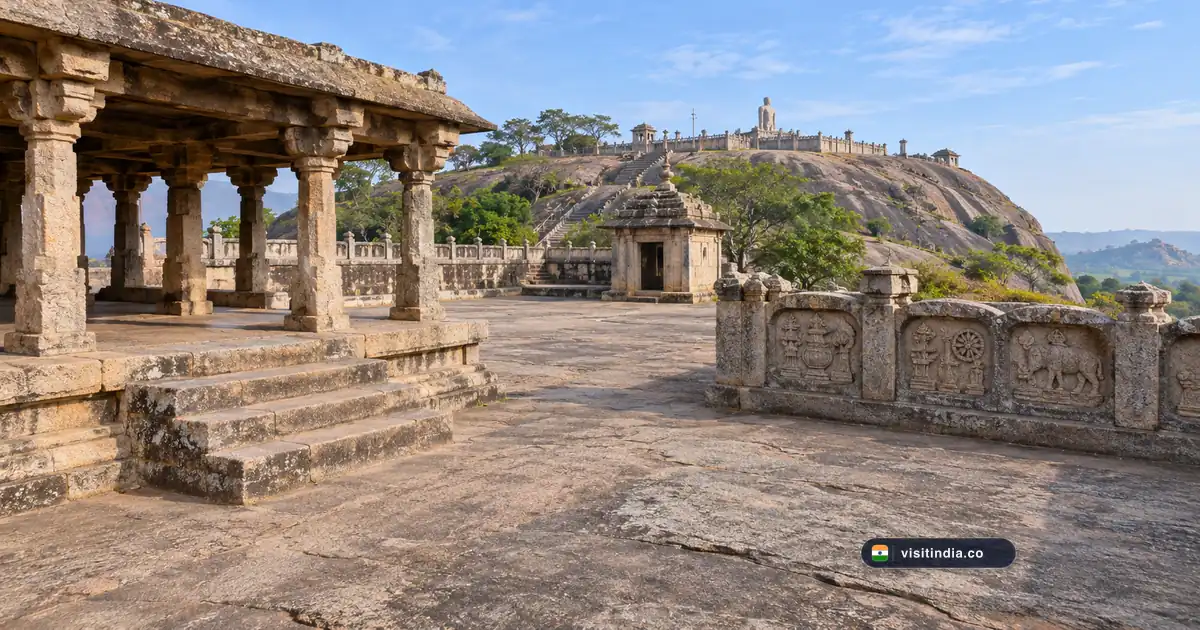
Rising above the granite plains of Hassan district in southern Karnataka, Shravanabelagola anchors one of India’s oldest and most revered Digambara Jain pilgrimage centers. Twin rocky hills, Vindhyagiri and Chandragiri, frame the historic stepped Kalyani pond at the heart of town and preserve over 800 ancient stone inscriptions alongside medieval temples.
Atop Vindhyagiri Hill stands the 57-foot (17.5-meter) monolithic statue of Lord Bahubali, also known as Gommateshwara, carved from a single block of fine-grained granite in 981 CE. Reaching the summit courtyard requires a barefoot climb up roughly 650 rock-cut steps, so planning around opening hours, heat on the bare stone, and doli palanquin logistics ensures a safe and rewarding darshan.
Darshan Essentials
- Location: Shravanabelagola in Channarayapatna taluk, Hassan district, Karnataka, situated 145 km west of Bengaluru off NH-75.
- Climb & Steps: Approximately 650 barefoot rock-cut granite steps lead up Vindhyagiri Hill; thick cotton socks are advised after 9:30 AM when the rock heats up.
- Daily Timings: Vindhyagiri Hill, Chandragiri Hill, town basadis, and Shri Matha open daily from 6:30 AM to 6:30 PM.
- Admission & Doli Rates: Monument entry is completely free; elderly or mobility-limited visitors can book a four-bearer doli palanquin at the base counter for around ₹700 round-trip.
- Nearest Transit: Shravanabelagola Railway Station (SBGA) lies 2 km away, Channarayapatna (CNPA) sits 12 km west, and Mysuru Airport (MYQ) is 85 km south.
Vindhyagiri Hill, the 57-Foot Bahubali Statue, and Ganga History
Carved from a single fine-grained granite block atop Vindhyagiri Hill in 981 CE, the 57-foot Bahubali statue was commissioned by Western Ganga minister Chavundaraya and forms the centerpiece of Shravanabelagola’s 12-year Mahamastakabhisheka tradition. Every architectural detail on the summit reflects over a millennium of unbroken Jain devotion and Ganga-era craftsmanship.
Chavundaraya’s 981 CE Commission and Kayotsarga Iconography
General and poet Chavundaraya commissioned the Gommateshwara monolith in 981 CE under Ganga King Rachamalla IV to depict Bahubali standing motionless in Kayotsarga meditation with carved madhavi creepers coiling up his arms and legs. According to Jain tradition, Bahubali was the son of the first Tirthankara, Rishabhanatha, who renounced his kingdom immediately after defeating his brother Bharata in a succession contest.
Standing rigidly upright in the sky-clad Digambara ascetic form, the figure conveys complete detachment through broad shoulders, elongated earlobes, curled hair ringlets, and a calm half-smile. At the base, sculpted anthills show small serpents and leafy vines creeping upward across his calves, thighs, and forearms to signify years of motionless penance.
Monolithic Dimensions and the 2030 Mahamastakabhisheka Cycle
Standing 57 feet (17.5 meters) high inside a stone-pillared suttalaya cloister, the sculpture hosts the grand Mahamastakabhisheka head-anointing festival every 12 years, with the next edition scheduled for 2030 following the February 2018 ceremony. Recognized by the Karnataka Tourism Shravanabelagola portal as one of the tallest free-standing ancient monoliths in the world, the statue stands on a carved lotus pedestal without external back support from ankle to crown.
During the Mahamastakabhisheka, engineers erect multi-tiered steel scaffolding behind the monument so devotees and ascetics can pour sanctified water, milk, sugarcane juice, turmeric, saffron paste, and sandalwood powder from hundreds of ritual kalashas. Outside festival years, the open-air granite courtyard remains unobstructed, allowing clear full-height viewing from both the base courtyard and upper gallery balconies.
Travelers comparing colossal Jain sculptures across Karnataka can pair this 10th-century monolith with the 39-foot modern granite Bahubali atop Ratnagiri Hill detailed in our visiting Dharmasthala Manjunatha Temple.
Vindhyagiri Trail Landmarks: Akhanda Bagilu, Tyagada Pillar, and Odegal Basadi
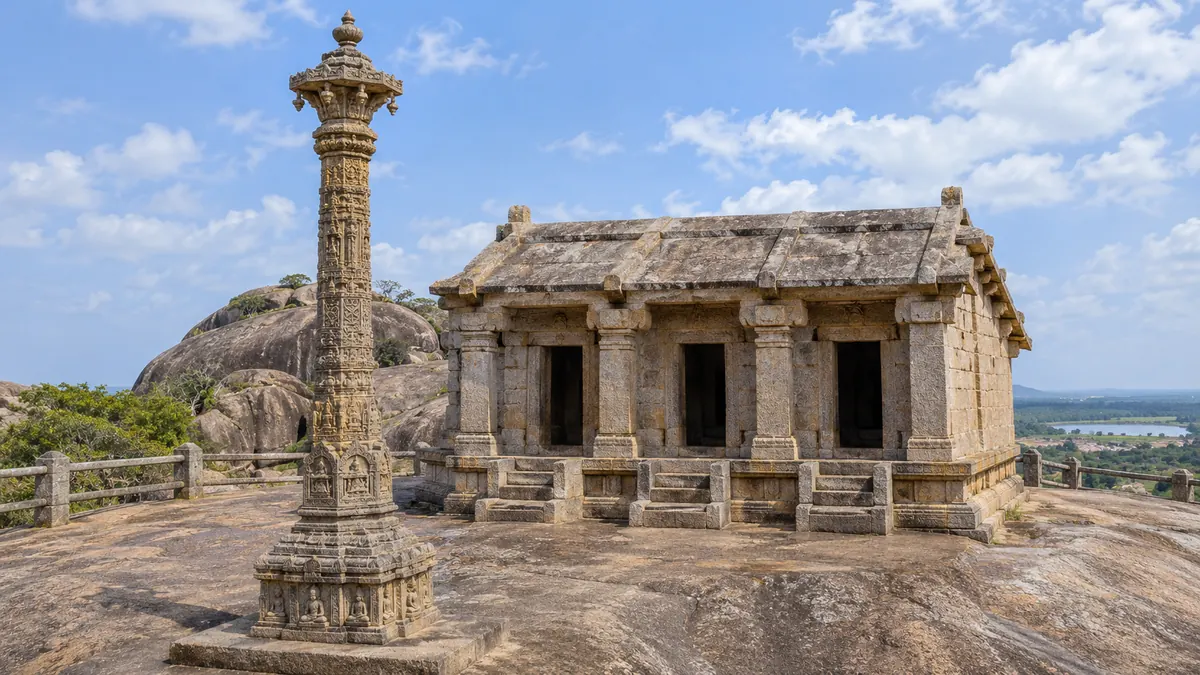
Midway up Vindhyagiri Hill, pilgrims pass the Gajalakshmi-carved Akhanda Bagilu stone gateway, the 10th-century Tyagada Brahma Pillar, and the triple-celled Odegal Basadi reinforced with stone props. Rather than rushing straight to the top, pausing at these intermediate shrines breaks the steep climb into manageable intervals while showcasing Ganga and Hoysala stonework.
| Monument on Vindhyagiri | Period & Patronage | Key Architectural Feature | Location on Climb |
|---|---|---|---|
| Gommateshwara Statue | 981 CE (Chavundaraya, Ganga Dynasty) | 57-foot (17.5 m) single-block granite monolith in Kayotsarga | Summit courtyard (650 steps) |
| Odegal Basadi | 14th Century (Vijayanagara / local patrons) | Triple-celled shrine reinforced with external stone props | Upper terrace near summit |
| Tyagada Brahma Pillar | 10th Century (Chavundaraya) | Carved 2-tiered pillar depicting Chavundaraya with his guru | Near Akhanda Bagilu gate |
| Akhanda Bagilu | 12th Century (Hoysala era) | Monolithic doorway lintel carved with Gajalakshmi motif | Upper third of stairway |
| Siddhara Basadi | 14th Century | Small granite sanctum housing seated Siddha image and inscriptions | Adjacent to outer courtyard |
Shravanabelagola Steps, Timings, and Daily Bhojana Schedule
Vindhyagiri Hill, Chandragiri Hill, and town basadis open daily from 6:30 AM to 6:30 PM, requiring a barefoot climb of roughly 650 rock-cut steps that become scorching after 10:00 AM under direct sun. Understanding the Shravanabelagola steps, timings, and meal schedules lets visitors time both hills without facing midday heat or missing temple kitchen hours.
Vindhyagiri, Chandragiri, and Shri Matha Opening Hours
The SDJMIMC Trust maintains uniform 6:30 AM to 6:30 PM visiting hours across Vindhyagiri Hill, Chandragiri Hill, the town basadis, and Shri Matha throughout the year without midday gate closures. Official schedules published by the Shri Kshetra Shravanabelagola Trust confirm that both hill stairways remain continuously open across morning and afternoon windows.
Although gates stay open at noon, crowd levels peak between 9:30 AM and 12:30 PM when weekend highway buses arrive from Bengaluru and Mysuru. Early risers reaching the Vindhyagiri base counter by 6:30 AM enjoy cool stone underfoot, unobstructed views of the statue, and quiet photography before tour groups gather.
How Many Steps Up Vindhyagiri and the Thick-Socks Heat Tip
Depending on the starting plinth, Vindhyagiri’s open granite stairway numbers between 620 and 700 steps (commonly counted as 650 steps) with metal handrails and zero footwear permitted on the bare rock. Most healthy adults complete the ascent in 25 to 40 minutes, whereas older travelers or families moving slowly should budget 45 to 60 minutes including rest stops.
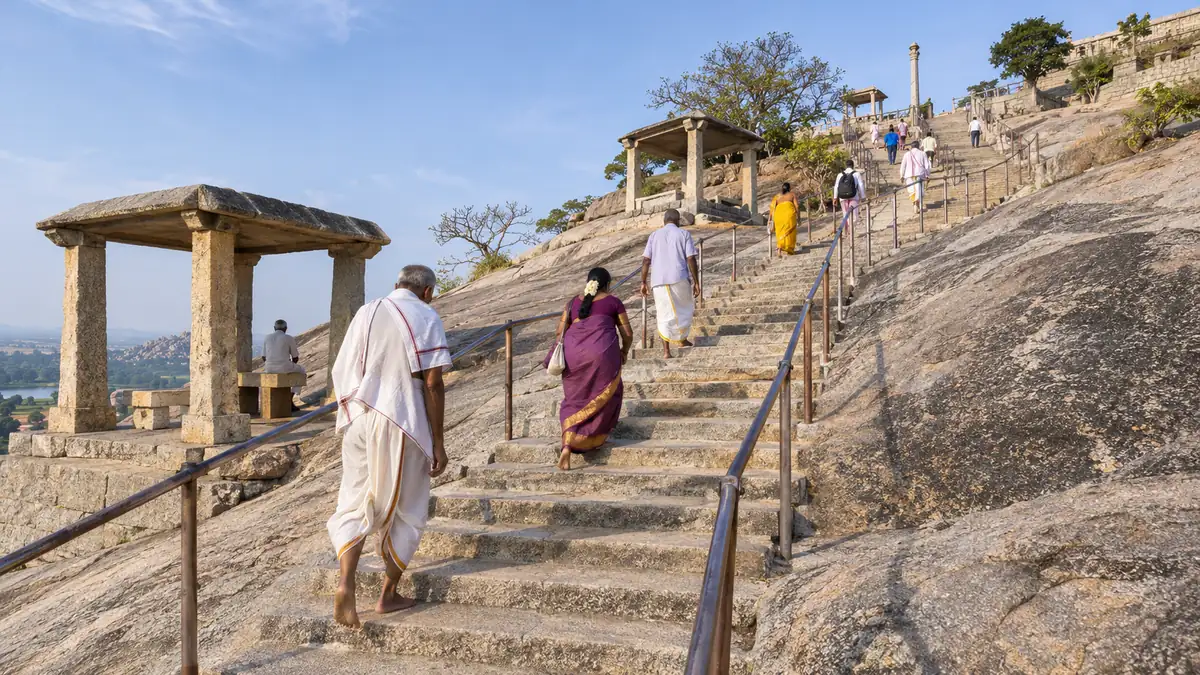
Because the eastern rock slope has virtually no tree canopy, bare stone surfaces absorb intense solar radiation from mid-morning onward. Visitors ascending after 9:30 AM should wear thick cotton socks in place of shoes, which remain permitted on the steps to shield soles from painful heat blisters while still observing the no-footwear rule.
Pilgrims tackling steep multi-hour mountain shrines elsewhere in India can compare this half-hour granite climb with the 3,800-step ascent detailed in our Palitana Shatrunjaya Jain temples guide.
Pro Tip
Beats-the-Heat Climb Strategy: Reach the Vindhyagiri footwear counter between 6:30 AM and 7:30 AM. Even in winter, pack a pair of thick dark cotton socks in your pocket in case your descent stretches past 10:00 AM, and carry a reusable steel water bottle since drinking water taps on top lack disposable cups.
Shri Matha Bhojana Meal Windows and Optimal Climb Hours
Ascending between 6:30 AM and 9:00 AM keeps the granite cool underfoot and lets visitors descend in time for traditional vegetarian Bhojana at Shri Matha served from 11:30 AM to 2:30 PM. Shri Matha also serves morning breakfast from 8:30 AM to 10:30 AM and an early sunset dinner from 4:30 PM to 6:30 PM in accordance with Jain dining customs.
| Facility or Complex | Daily Opening Time | Closing Time | Practical Visitor Notes |
|---|---|---|---|
| Vindhyagiri Hill & Bahubali Courtyard | 6:30 AM | 6:30 PM | Best climbed 6:30 AM to 9:00 AM or after 4:15 PM |
| Chandragiri Hill & Basadis | 6:30 AM | 6:30 PM | Approx. 200 to 250 steps; quieter afternoon alternative |
| Town Basadis (Bhandari & Akkana) | 6:30 AM | 6:30 PM | Flat town access; easy visit during midday heat |
| Shri Matha Morning Bhojana | 8:30 AM | 10:30 AM | Simple vegetarian breakfast at the community dining hall |
| Shri Matha Lunch Bhojana | 11:30 AM | 2:30 PM | Pure vegetarian Jain meals; voluntary donations welcomed |
| Shri Matha Evening Bhojana | 4:30 PM | 6:30 PM | Early dinner closing before nightfall |
Entry Fees, Doli Palanquin Rates, and Visitor Rules
Entry to Vindhyagiri Hill, Chandragiri Hill, and the Bahubali courtyard is completely free, while senior citizens or visitors unable to walk can hire a four-bearer doli palanquin at the base counter for roughly ₹700 round-trip. Knowing exact local service fees, cloakroom procedures, and temple etiquette prevents delays at the foothill checkpoints.
Free Entry vs. Doli Palanquin Services for Senior Citizens
Visitors pay zero entry tickets at Shravanabelagola, and elderly or mobility-limited travelers can arrange cane-chair doli bearers on a first-come, first-served basis at the Vindhyagiri foothill counter for about ₹700. Each doli uses a bamboo-pole chair carried by four registered bearers who ascend and descend the rock-cut stairs smoothly at a steady pace.
Online pre-booking is not offered for dolis, and bearer availability tightens rapidly on weekends, public holidays, and winter pilgrimage dates. Families traveling with senior citizens should arrive at the foothill counter before 8:00 AM to secure a token, confirm the current union tariff at the Trust desk, and agree on waiting time at the summit.
Footwear Cloakrooms, Thick Cotton Socks, and the No-Plastic Zone
Shoes must be deposited at supervised foothill cloakrooms for a nominal fee, plastic bags and bottles are prohibited under the strict No-Plastic Zone rule, and thick cotton socks protect feet on warm stone. Trust staff inspect daypacks near the base gateway and hold disposable plastic pouches, polythene wrappers, and single-use bottles until visitors return.
| Service or Requirement | Official Cost (INR) | Booking & Counter Location | Essential Rules |
|---|---|---|---|
| Hill & Temple Entry (All Visitors) | Free (₹0) | Direct entry at Vindhyagiri & Chandragiri gates | Same free access for Indian and foreign nationals |
| Doli Palanquin (Round-Trip) | Approx. ₹700 | Spot counter at Vindhyagiri base Trust office | First-come, first-served; confirm extra weight rates |
| Footwear & Bag Cloakroom | ₹10 to ₹20 (nominal) | Supervised stalls at both hill bases | Mandatory deposit for all shoes and sandals |
| Special Abhishekha / Seva | Varies by ritual | Shri Matha office & online trust desk | Confirm current seva receipt rates directly at office |
Dress Code, Leather Restrictions, and Photography Guidelines
Modest attire covering shoulders and knees is mandatory across all basadis, leather belts and bags should remain downstairs, and non-flash photography is permitted outside the immediate sanctum line. Short dresses, sleeveless tops, and knee-length shorts are turned away at the hill entrance gates by temple attendants.
Visitors should carry cloth sling bags instead of leather purses and avoid leaning against ancient carved pillars or rock inscriptions during photography. Similar conservative temple etiquette and footwear rules apply across major Karnataka shrines outlined in our Kukke Subramanya Temple guide.
Important
Senior Citizen & Plastic Checkpoint Notice: Doli palanquins operate primarily during cooler morning and late-afternoon windows and are limited in number on weekends. Leave all single-use plastic wrappers and leather belts in your vehicle or foothill locker before joining the stairway queue.
Chandragiri Hill, Kalyani Tank, and the Town Basadi Circuit
Across town from Vindhyagiri, the gentler Chandragiri Hill preserves over a dozen ancient Jain basadis, Bhadrabahu Cave, and 800-plus stone inscriptions linked to Emperor Chandragupta Maurya, connected by the central Kalyani stepped tank. Pairing both hills with the town basadis transforms a quick statue stop into an immersive architectural walk across 2,300 years of South Indian history.
Chandragiri Hill: Chandragupta Maurya, Bhadrabahu Cave, and Chavundaraya Basadi
Ascending roughly 200 to 250 steps up Chandragiri leads to the 10th-century Chavundaraya Basadi, Chandragupta Basadi, and the Bhadrabahu Cave commemorating Mauryan Emperor Chandragupta’s final ascetic years. In the late 4th century BCE, Acharya Bhadrabahu led a Jain migration south to this hill, where Chandragupta Maurya observed fast-unto-death penance (sallekhana).
Inside the stone enclosure, the 982 CE Chavundaraya Basadi features a two-tiered Dravidian superstructure dedicated to Neminatha, while the nearby Kuge Brahmadeva Pillar and 14 clustered shrines sit along smooth granite sheets. Because far fewer day-trippers climb Chandragiri, this hill delivers quiet courtyard views directly facing the colossal Bahubali silhouette across the valley.
Kalyani Stepped Tank, Bhandari Basadi, and Akkana Basadi
At the foot of the twin hills sits the stone-stepped Kalyani pond (Belagola), flanked in town by the 1159 CE Bhandari Basadi housing all 24 Tirthankaras and the 1181 CE Hoysala-style Akkana Basadi. The Kalyani tank gives Shravanabelagola its Kannada name (Belagola, meaning “white pond”, paired with Shravana for Jain ascetics), bordered by stone steps and pillared mandapas. Travelers extending their itinerary along this spiritual corridor can review Anandpur Sahib darshan and timings for queue hours, dress code, and entry rules.
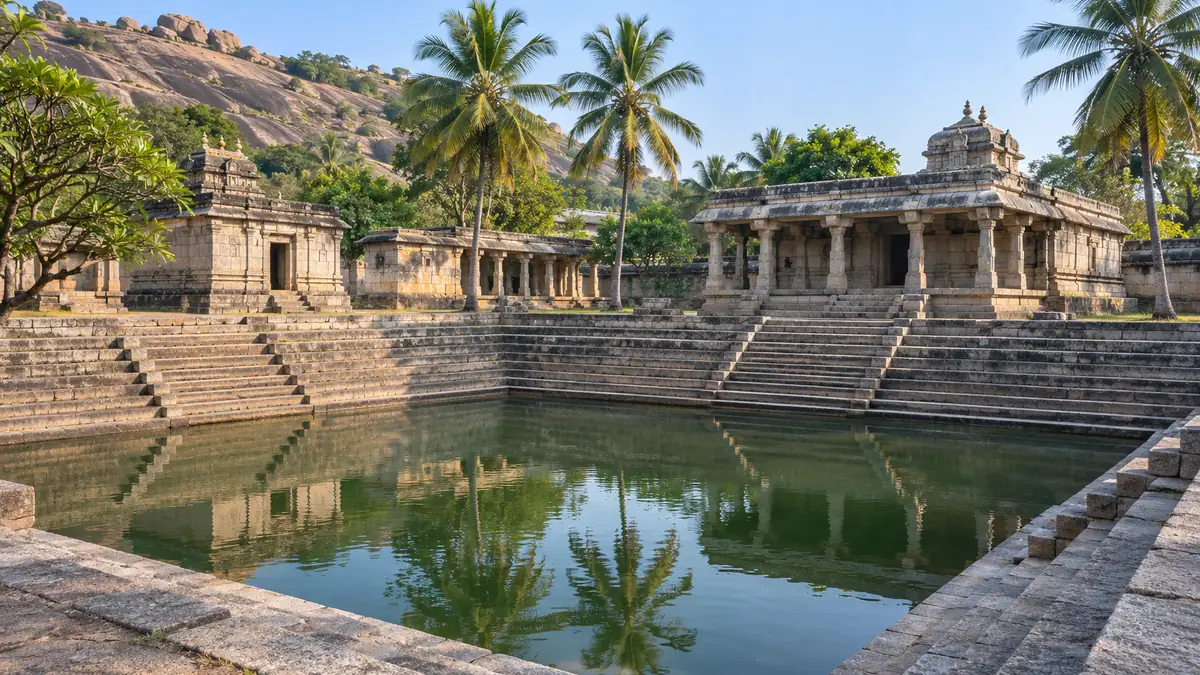
Built by Hulla Raja, treasurer to Hoysala King Narasimha I, Bhandari Basadi displays 24 matching black-stone Tirthankara images in a long dark-stone hall. A short walk north, Akkana Basadi features finely turned Hoysala soapstone lathe pillars dedicated to Parshvanatha; travelers interested in this sculptural dynasty can extend north to the UNESCO Hoysala temples of Belur, Halebidu, and Somanathapura.
Additional regional heritage sites, district monument directories, and circuit maps across Hassan are compiled on the Hassan District Administration tourist places directory.
Chronological Half-Day vs. Full-Day Walking Route
Plan 2.5 to 3 hours for an early-morning Vindhyagiri climb and courtyard darshan, and extend to 5 or 6 hours by adding Chandragiri Hill, Kalyani Tank, and town basadis before afternoon heat peaks. Follow this chronological route to avoid climbing exposed granite during peak midday sun:
- 6:30 AM – 8:30 AM (Vindhyagiri Hill & Bahubali Darshan): Deposit shoes at the base cloakroom, climb the 650 granite steps past Tyagada Brahma Pillar and Akhanda Bagilu, and spend 45 minutes in the summit courtyard.
- 8:45 AM – 9:30 AM (Breakfast Break & Kalyani Tank): Descend before the rock heats up, walk beside the stepped Kalyani pond, and stop at Shri Matha for morning Bhojana or local vegetarian tiffin.
- 9:45 AM – 11:15 AM (Chandragiri Hill Basadis): Ascend the shorter 200-step stairway up Chandragiri to visit Chavundaraya Basadi, Chandragupta Basadi, Bhadrabahu Cave, and panoramic viewpoints overlooking Vindhyagiri.
- 11:30 AM – 1:00 PM (Town Basadis & Shade): Tour the flat, shaded stone interiors of Bhandari Basadi and Akkana Basadi during midday warmth, followed by vegetarian lunch at Shri Matha before departing.
Best Time to Visit Shravanabelagola and Seasonal Climb Conditions
October through March provides the best weather for climbing Shravanabelagola’s bare granite hills, bringing crisp 15°C mornings and dry 26°C to 29°C afternoons compared to scorching summer stone and slick monsoon steps. Because both hills sit completely exposed to sun and rain, season selection directly determines barefoot comfort.
Winter Peak Season (October to March)
Between October and March, cool morning breezes and low humidity allow comfortable barefoot climbs up both Vindhyagiri and Chandragiri well past 9:30 AM. Morning temperatures hover between 15°C and 19°C, making dawn ascents pleasant without gloves or heavy layers while afternoon highs remain manageable around 27°C to 29°C.
Winter also brings the calmest highway driving conditions across southern Karnataka, making it easy to pair Shravanabelagola with coffee estates and misty viewpoints covered in our guide to places to visit in Coorg.
Summer Heat (April to June) and Monsoon Precautions (July to September)
Summer afternoons push exposed granite steps to blistering temperatures above 36°C, whereas southwest monsoon showers from July to September turn smooth rock steps slippery and require careful pacing. Between April and early June, treat 8:30 AM as the practical cutoff for starting an unshaded barefoot ascent, or postpone your climb until after 4:30 PM when evening shadows stretch across the eastern stairs.
During July through September, green scrub and cool clouds soften the Deccan plateau, yet rainwater sheets across polished granite steps near the summit. Hold the metal handrails on steeper flights, wear cotton socks with subtle grip texture if dampness chills the rock, and watch for sudden afternoon squalls.
| Season | Months | Daytime Temp Range | Granite Step Condition | Crowd Level & Strategy |
|---|---|---|---|---|
| Winter (Peak) | October to March | 15°C to 29°C | Cool until 9:30 AM; mild later | Moderate weekdays; busy weekends; ideal all-around window |
| Summer | April to June | 24°C to 37°C | Scorching by 10:00 AM | Low midday crowds; climb strictly 6:30–8:30 AM or 4:30–6:00 PM |
| Monsoon | July to September | 20°C to 27°C | Wet and slick on polished slopes | Quiet hills; grip handrails closely and allow extra descent time |
How to Reach Shravanabelagola by Road, Train, and Air
Shravanabelagola sits 145 km west of Bengaluru off NH-75 via Hirisave, 2 km from its own railway station (SBGA), 12 km from Channarayapatna (CNPA), 48 km from Hassan, and 85 km from Mysuru Airport (MYQ). Reliable highway buses, broad-gauge trains, and four-lane roads make it an effortless day trip or weekend stopover.
Driving from Bengaluru via NH-75 and KSRTC Bus Connections
Motorists drive 2.5 to 3 hours west along the Bengaluru-Mangaluru highway (NH-75) via Nelamangala, Kunigal, and Hirisave, while KSRTC buses drop passengers at Channarayapatna or direct Shravanabelagola stops. From Bengaluru, exit via Tumakuru Road to Nelamangala, join NH-75 past Yediyur, and turn left onto the marked state highway at Hirisave for the final 17 km stretch into Shravanabelagola town.
Travelers relying on state transit can check daily schedules toward Channarayapatna and Hassan on the Karnataka State Road Transport Corporation (KSRTC) portal. From Channarayapatna bus stand, frequent local buses and shared auto-rickshaws complete the 12 km transfer to Vindhyagiri base in 20 minutes.
Shravanabelagola (SBGA) vs. Channarayapatna (CNPA) and Hassan Railheads
Direct Bengaluru-Hassan intercity trains halt at Shravanabelagola station (SBGA, 2 km from Vindhyagiri), though Channarayapatna (CNPA, 12 km) and Hassan Junction (HAS, 48 km) offer broader express rail frequency. Auto-rickshaws wait outside SBGA for short 5-minute rides to the foothills (around ₹60 to ₹100), whereas taxis and buses connect CNPA and Hassan Junction to Shravanabelagola throughout the day.
Nearest Airports: Mysuru (MYQ) and Bengaluru (BLR)
Mysuru Mandakalli Airport (MYQ, 85 km) is the closest regional airfield, while Kempegowda International Airport in Bengaluru (BLR, 175 km) provides nationwide and international flight connections. Visitors flying into Mysuru often combine a 2-hour morning drive to Shravanabelagola with royal heritage sightseeing outlined in our Mysore Palace timings and illumination guide.
| Transit Hub | Distance to Shravanabelagola | Typical Travel Time | Best Last-Mile Transfer |
|---|---|---|---|
| Shravanabelagola Station (SBGA) | 2 km | 5 to 10 minutes | Auto-rickshaw outside station gate (₹60 to ₹100) |
| Channarayapatna (CNPA / Bus Hub) | 12 km | 20 to 25 minutes | Frequent KSRTC town buses or auto-rickshaws |
| Hassan Junction (HAS) | 48 km | 1 to 1.25 hours | Direct KSRTC bus or hired cab via NH-75 |
| Mysuru Airport (MYQ) / City | 85 km | 2 hours | Private taxi via Kikkeri and Krishnarajapet |
| Bengaluru City / Kempegowda (BLR) | 145 km (city) / 175 km (BLR) | 2.5 to 3.5 hours | Car or KSRTC coach along NH-75 via Hirisave |
Frequently Asked Questions About Shravanabelagola
How many steps lead up to the Bahubali statue on Vindhyagiri Hill?
Vindhyagiri Hill features between 620 and 700 rock-cut granite steps (commonly cited as 650 steps) leading directly to the Shravanabelagola Bahubali statue courtyard. Metal handrails run along steeper flights, and most visitors complete the barefoot ascent in 30 to 45 minutes.
What are the opening timings of Shravanabelagola temples and hills?
Vindhyagiri Hill, Chandragiri Hill, the town basadis, and Shri Matha open daily from 6:30 AM to 6:30 PM without midday closures. Climbing between 6:30 AM and 9:00 AM offers cool granite steps and calmer courtyard conditions.
Can visitors wear socks while climbing Vindhyagiri Hill barefoot?
Shoes and sandals are strictly prohibited anywhere on Vindhyagiri and Chandragiri hills and must be left at foothill cloakrooms. Wearing thick cotton socks is permitted and strongly recommended if you climb or descend after 9:30 AM when the bare stone turns hot.
Is doli palanquin service available for senior citizens at Shravanabelagola?
Yes, four-bearer cane-chair doli palanquins operate at the base of Vindhyagiri Hill for senior citizens and visitors unable to climb the steps on foot. Round-trip charges average around ₹700 and must be booked in person on a first-come, first-served basis at the foothill Trust counter.
Is there an entry fee to see the Shravanabelagola Bahubali statue?
Monument admission to Vindhyagiri Hill, Chandragiri Hill, and the Gommateshwara courtyard is completely free for both Indian citizens and foreign tourists. Only nominal charges of ₹10 to ₹20 apply at the foothill shoe-keeping stalls.
When is the next Mahamastakabhisheka festival at Shravanabelagola?
The grand Mahamastakabhisheka head-anointing ritual of the Bahubali statue takes place once every 12 years at Shravanabelagola. Following the February 2018 edition, the next Mahamastakabhisheka is scheduled for 2030.
How far is Shravanabelagola from Bengaluru and which railway station is closest?
Shravanabelagola lies 145 km west of Bengaluru along NH-75 via Hirisave, roughly a 2.5 to 3 hour drive by car or KSRTC bus. Shravanabelagola Railway Station (SBGA) is just 2 km from the foothills, while Channarayapatna (CNPA, 12 km) and Hassan Junction (HAS, 48 km) offer additional express trains.