Anandpur Sahib: Virasat-e-Khalsa Timings & Hola Mohalla
Plan your Sri Anandpur Sahib trip with Virasat-e-Khalsa timings, free pass rules, Takht Sri Keshgarh Sahib etiquette, Hola Mohalla dates, and rail access.
Sri Anandpur Sahib rises along the Shivalik foothills beside the Sutlej River in Punjab’s Rupnagar district, uniting two pillars of Sikh heritage within a two-kilometer walk. Travelers come here to confirm Anandpur Sahib Virasat-e-Khalsa timings alongside 24-hour darshan at Takht Sri Keshgarh Sahib, where Guru Gobind Singh founded the Khalsa in 1699.
Planning a single day or festival visit requires checking the museum’s Monday closures, free timed-entry pass counters, and the annual Hola Mohalla martial calendar. Across the wider planning a visit to Punjab, no other town pairs a contemporary 27-gallery heritage complex with living 17th-century fortified shrines and round-the-clock community langar kitchens.
Pilgrim & Museum Essentials
- Location: Sri Anandpur Sahib lies in Rupnagar district, Punjab (PIN 140118), 85 km north of Chandigarh along National Highway 205.
- Virasat-e-Khalsa Timings: The museum opens Tuesday through Sunday from 10:00 AM to 4:30 PM, and closes every Monday, on major national holidays, and during January 24 to 31 and July 24 to 31 maintenance windows.
- Admission & Audio Guides: Museum entry and gurdwara langar meals are free; visitors collect timed-entry passes at on-site counters using photo ID (maximum 10 per person) and deposit an original ID card for free audio guides.
- Gurdwara Dress Code: Takht Sri Keshgarh Sahib and Qila Anandgarh Sahib operate 24 hours daily, requiring covered heads, bare feet after depositing shoes at the free Joda Ghar, and zero tobacco or leather inside sanctums.
- Hola Mohalla & Transit: Hola Mohalla runs February 27 to March 3, 2026 and March 23 to 25, 2027; Anandpur Sahib Railway Station (ANSB) sits 2 km from the shrines, while Chandigarh Airport (IXC) is 85 to 90 km south.
Sacred Legacy and Moshe Safdie Architecture at Anandpur Sahib
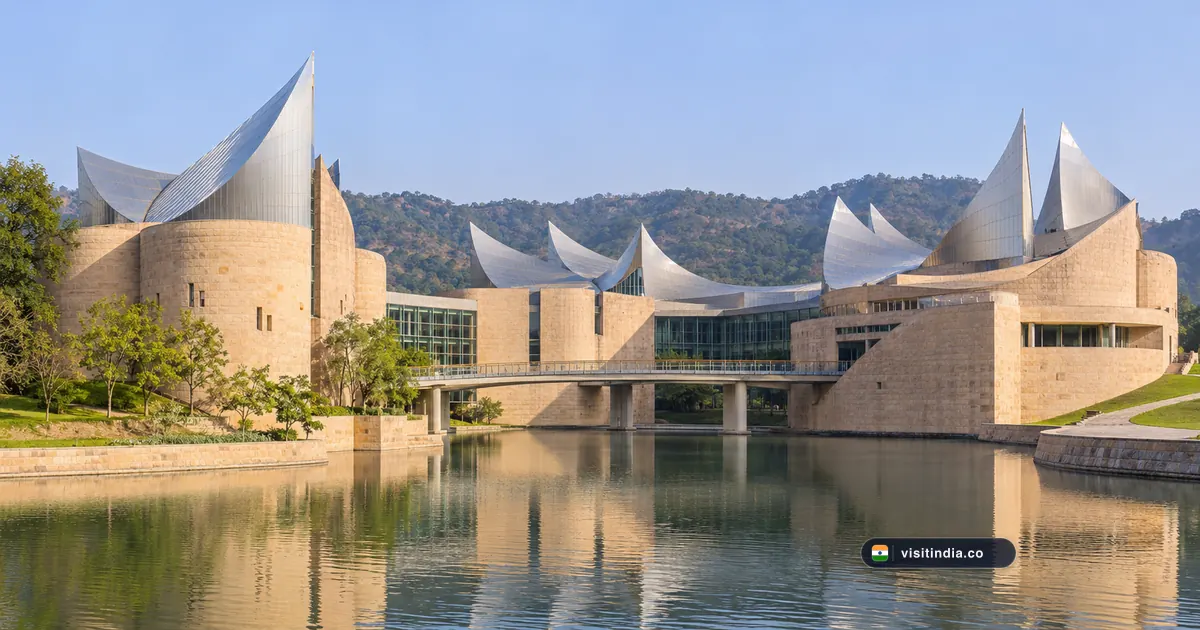
Sri Anandpur Sahib was established by Guru Tegh Bahadur in 1665 and became the birthplace of the Khalsa Panth under Guru Gobind Singh on Baisakhi in 1699. Opposite the historic hill shrines, Moshe Safdie’s Virasat-e-Khalsa opened in November 2011 with sandstone towers and stainless-steel petal roofs.
The town’s dual character sets it apart from purely archaeological sites across northern India. Religious devotion continues unbroken inside white-marble gurdwara courtyards while visitors cross a deep ravine to trace five centuries of Punjabi history inside climate-controlled galleries.
From Guru Tegh Bahadur’s 1665 Foundation to the 1699 Khalsa
Guru Tegh Bahadur purchased land near the village of Makhowal in 1665 from the ruler of Bilaspur, founding a settlement initially named Chakk Nanaki. Later renamed Anandpur Sahib, meaning City of Bliss, the town grew under the tenth Guru, Guru Gobind Singh, into a fortified spiritual headquarters.
On Baisakhi in 1699, Guru Gobind Singh convened thousands of followers at Keshgarh hill and initiated the Panj Piare (Five Beloved Ones) through the Amrit ceremony. That moment formalized the Khalsa order, establishing distinct ethical discipline, unshorn hair, and egalitarian brotherhood recorded by the Rupnagar District Administration Virasat-e-Khalsa portal.
To defend the town against hill chieftains and imperial Mughal forces, Guru Gobind Singh constructed five interconnected forts around the settlement perimeter. Qila Anandgarh Sahib anchored the southern flank, reinforced by Lohgarh Sahib, Fatehgarh Sahib, Holgarh Sahib, and Kesgarh Sahib at the center.
Moshe Safdie’s Boat and Five-Petal Steel Architecture
Architect Moshe Safdie designed the 75-to-100-acre Virasat-e-Khalsa campus to rise organically from sandy Shivalik cliffs on either side of a natural ravine. A 165-meter (540-foot) arched pedestrian bridge spans a seven-acre network of terraced reflecting pools, linking the western public gateway with the eastern exhibition complex.
Rather than repeating golden onion domes found on traditional gurdwaras, Safdie sculpted hand-chiseled buff sandstone walls topped by sweeping concave stainless-steel roofs. According to project specifications published by Safdie Architects, the eastern complex splits into two symbolic forms: a boat-shaped wing housing historical archives and a five-petal cluster honoring the Panj Piare.
Those concave steel plates tilt upward to catch daylight and reflect bright sky tones toward Takht Sri Keshgarh Sahib on the neighboring ridge. Travelers interested in modern civic landmarks across this region can compare Safdie’s sandstone geometry with Le Corbusier’s concrete monuments featured in our Rock Garden and Capitol Complex Chandigarh guide.
Note
Architectural & Spatial Benchmarks
- Inauguration Date: Opened to the public on November 25, 2011, commemorating the 300th anniversary of the Khalsa.
- Campus Scale: Spans 75 to 100 acres across western auditorium/library facilities and eastern gallery wings.
- Water & Bridge: Features a 165-meter stone-clad pedestrian bridge crossing seven acres of calm reflecting reservoirs.
- Gallery Count: Houses 27 permanent multimedia exhibition galleries organized chronologically across two main phases.
Virasat-e-Khalsa Timings, Free Pass Rules, and Cloakroom Protocol
Virasat-e-Khalsa opens Tuesday through Sunday from 10:00 AM to 4:30 PM and remains closed every Monday, on major national holidays, and during bi-annual maintenance from January 24 to 31 and July 24 to 31. Admission is free, though every guest requires a timed-entry pass issued against photo identification.
Understanding pass counters, maintenance shutdowns, and strict bag rules prevents wasted morning trips from Chandigarh or Amritsar. Unlike neighboring gurdwaras that welcome pilgrims through the night, the museum enforces strict daily entry windows and security screening at the western gate.
| Complex / Facility | Operating Days & Hours | Weekly & Annual Closures | Entry Cost & Pass Rule |
|---|---|---|---|
| Virasat-e-Khalsa Museum | Tue to Sun, 10:00 AM to 4:30 PM | Closed Mondays; Jan 24–31 & Jul 24–31; Republic Day, Independence Day, Gandhi Jayanti, Dussehra, Diwali | Free; timed-entry pass required (max 10 per ID) |
| Museum Audio Guide Desk | Tue to Sun, 10:00 AM to 4:00 PM | Same as museum calendar | Free with original photo ID card deposit |
| Entrance Foyer Cloakroom | Tue to Sun, 9:45 AM to 5:00 PM | Same as museum calendar | Free baggage & camera storage |
| Takht Sri Keshgarh Sahib | Open 24 hours daily | None (open all 365 days) | Free entry; no pass required |
| Qila Anandgarh Sahib & Baoli | Open 24 hours daily | None (open all 365 days) | Free entry; no pass required |
Museum Opening Hours and Bi-Annual Maintenance Closures
The museum ticket counters and exhibition galleries operate continuously from 10:00 AM to 4:30 PM from Tuesday through Sunday without a midday lunch shutdown. Last entry occurs before 4:30 PM, so arriving later than 2:30 PM leaves insufficient time to walk all 27 halls.
Every Monday is reserved for deep technical upkeep of audio-visual projectors and motorized dioramas across the complex. The administration also closes the complex twice yearly for eight-day maintenance schedules from January 24 to January 31 and July 24 to July 31, alongside national holidays including January 26, August 15, October 2, Dussehra, and Diwali.
Before booking intercity trains, verify seasonal notices on the Rupnagar District Administration Tourism Directory. If your Punjab schedule falls on a Monday, dedicate Monday morning to the 24-hour gurdwaras and visit Virasat-e-Khalsa on Tuesday morning at 10:00 AM.
Free Entry Pass Counters and Audio Guide ID Deposits
Although general admission is completely free for Indian and foreign travelers, visitors cannot walk straight across the bridge without a barcoded timed-entry pass. Two physical pass counters operate on site: one near the parking plaza entrance and a second approach counter coming from Gurdwara Qila Anandgarh Sahib.
One adult presenting a valid government photo ID, such as an Aadhaar card, driving license, or passport, can obtain passes for up to 10 family members or group travelers. Online advance slots are also released during high-crowd weekends to stagger gallery footfall.
Right inside the Entrance Foyer after clearing the first introductory hall, visitors reach the multilingual audio-guide counter. Devices are issued free in Punjabi, Hindi, and English after depositing an original physical photo ID, which staff return once you hand back the handset at the gallery exit. Visitors carrying personal smartphones and wired or Bluetooth earphones can alternatively download the official Virasat-e-Khalsa mobile app for synchronized room-by-room narration.
Cloakroom Rules, Camera Bans, and the 27 Galleries
All backpacks, suitcases, large handbags, tripods, DSLR cameras, water bottles, and outside food are barred inside the museum galleries. Visitors must check bags at the free Entrance Foyer cloakroom before scanning their pass at the security turnstiles.
Inside the 27 permanent galleries, photography, flash, and video recording are strictly prohibited to protect sensitive light installations and maintain uninterrupted crowd flow. Exterior courtyard walks along the reflecting pools and arched pedestrian bridge remain open for handheld architectural photography.
Inside the galleries, visitors move smoothly along ascending curved ramps past hand-painted murals, illuminated folk instruments, and audio-guided scenes covering Guru Nanak Dev’s travels, the compilation of the Adi Granth, the martyrdom of Guru Arjan Dev and Guru Tegh Bahadur, and the creation of the Khalsa. Travelers planning broader historical museum stops across the state can pair this experience with the Jallianwala Bagh and Partition Museum guide in Amritsar.
Pro Tip
Beat the Midday Queue Strategy Reach the parking-plaza pass counter by 9:45 AM on weekdays to collect a 10:00 AM entry slot and pick up an audio guide before school groups arrive around 11:30 AM. Carry one extra original photo ID per traveler if two people in your group want separate audio-guide handsets.
Takht Sri Keshgarh Sahib, Qila Anandgarh Sahib, and Langar Etiquette
Takht Sri Keshgarh Sahib, one of Sikhism’s five temporal Takhts, stays open 24 hours daily alongside Qila Anandgarh Sahib and its 130-step Baoli Sahib. All visitors must cover their heads, remove footwear at the Joda Ghar, and avoid leather or tobacco on shrine grounds.
Every shrine in Anandpur Sahib welcomes visitors of all faiths, nationalities, and backgrounds free of charge. Following respectful Sikh gurdwara protocol ensures smooth access to the main prayer halls, relic displays, and community dining facilities.
Sanctum Protocol, Head Coverings, and Sacred Relics
Before crossing the marble threshold at Takht Sri Keshgarh Sahib, every visitor must remove shoes and socks at the free Joda Ghar counter and collect a numbered token. Next, step through the shallow running-water foot trough to rinse dust from your feet before climbing the broad white-marble terrace.
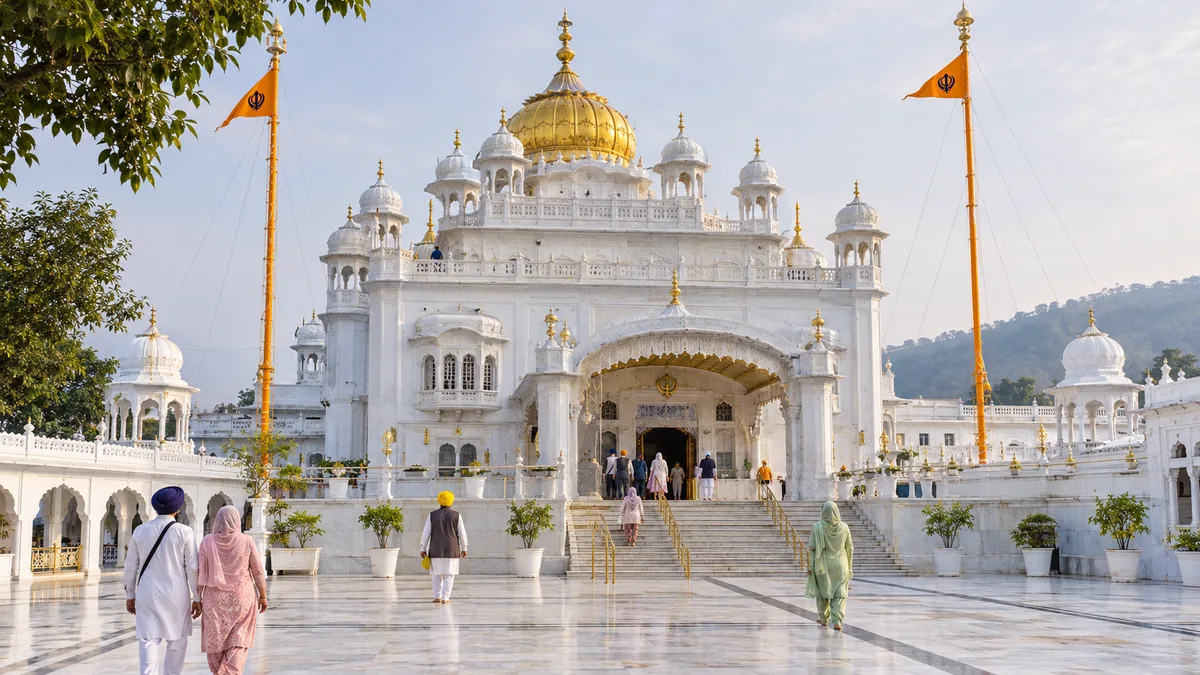
Covering the head at all times is mandatory across courtyard walkways, prayer halls, and langar spaces. Baseball caps and hats are not accepted; wear a clean scarf, dupatta, or cotton bandana (rumal), available free in collection bins at the main gateway. Modest clothing covering shoulders and knees is expected, while tobacco, cigarettes, vapes, alcohol, and intoxicants are strictly forbidden anywhere on shrine grounds.
Inside the main sanctum, visitors bow respectfully before the Guru Granth Sahib and sit quietly during Gurbani Kirtan hymns. Priests also exhibit sacred 17th-century weapons associated with Guru Gobind Singh, including his khanda double-edged sword, karad, and matchlock musket, documented on the Shiromani Gurdwara Parbandhak Committee Takht Sri Keshgarh Sahib page. Photography is restricted inside the inner relic enclosure, so confirm permission with a volunteer sevadar before lifting a phone.
Participating in Guru Ka Langar and Visiting Qila Anandgarh Sahib
Adjacent to Takht Sri Keshgarh Sahib, the Guru Ka Langar dining hall serves hot, freshly prepared vegetarian meals free throughout the day and evening. Volunteers distribute divided steel plates and spoons before guiding guests onto carpeted floor mats arranged in egalitarian rows called pangat.
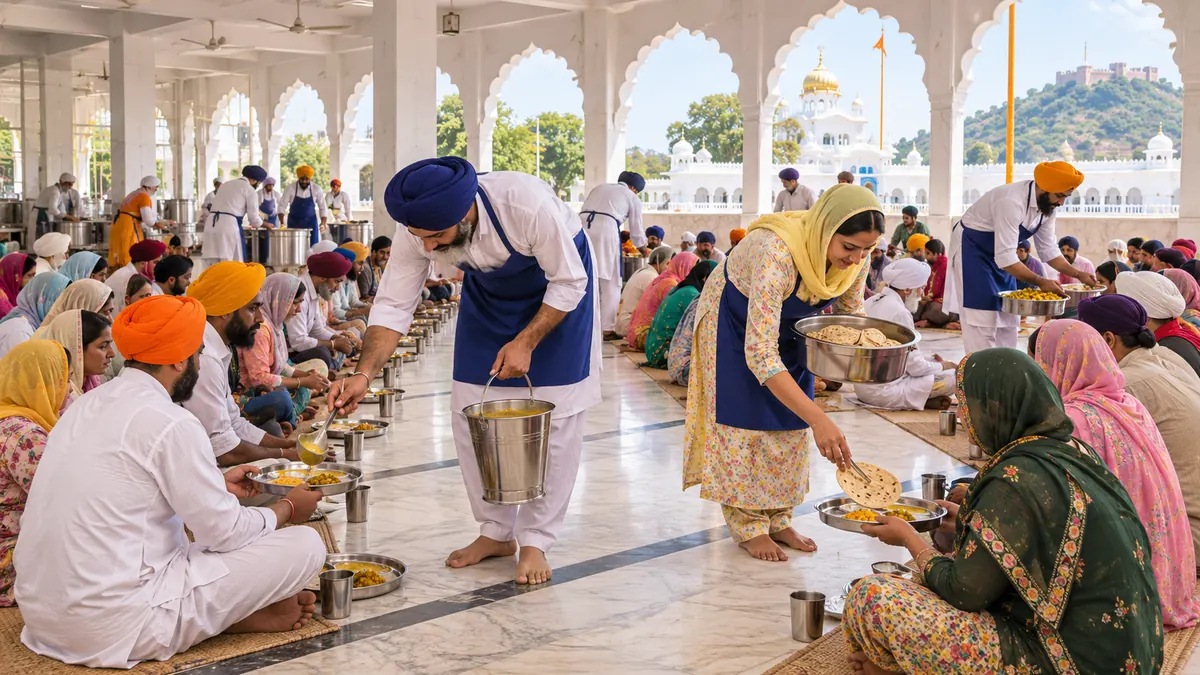
- Sit in Pangat Rows: Take an open spot on the floor mat beside fellow pilgrims; chair seating is arranged along the perimeter for elderly guests or visitors with knee mobility limitations.
- Receive Simple Vegetarian Food: Sevadars serve whole-wheat rotis, slow-simmered lentils (dal), seasonal sabzi, and sweet kheer rice pudding; cup your palm over your plate or say a polite thank you if you prefer to skip an item.
- Avoid Food Waste: Accept only portions you will comfortably finish, as leaving uneaten food on plates is considered disrespectful.
- Return Utensils: Carry used steel plates and cups to the designated washing window where volunteers scrub and sterilize them in running water.
- Walk to Qila Anandgarh Sahib: Exit the shrine south along the town road for 1.2 km (a 12-to-15-minute walk or ₹30 e-rickshaw ride) to reach Qila Anandgarh Sahib, the main hilltop fort built by Guru Gobind Singh in 1689.
- Descend Baoli Sahib: Inside the fort courtyard, descend over 130 stone steps into the cool subterranean Baoli Sahib stepwell, built to guarantee fresh drinking water during prolonged sieges.
Visitors planning a wider Sikh pilgrimage trail across the state can connect Anandpur Sahib’s Takht circuit with Amritsar’s central sanctuary in our pilgrimage planning for Golden Temple Amritsar, including Palki Sahib timings and SGPC sarai lodging rules.
Hola Mohalla Festival: Dates, Nihang Gatka, and Shobha Yatra Guide
Instituted by Guru Gobind Singh in 1699 right after Holi, Hola Mohalla takes place from February 27 to March 3, 2026 and March 23 to 25, 2027. Nihang Sikh warriors lead gatka sword duels, bareback horsemanship, tent-pegging, and the Shobha Yatra from Takht Sri Keshgarh Sahib.
While neighboring states celebrate Holi with colored powder and playful water splashes, Guru Gobind Singh transformed the spring gathering into a three-day display of physical readiness, archery, swordsmanship, and communal unity. More than half a million pilgrims converge on Anandpur Sahib each March, filling roadside langar tents from Kiratpur Sahib to the town center.
| Festival Aspect | 2026 & 2027 Verified Schedule | Primary Location in Town | Visitor Viewing & Safety Advice |
|---|---|---|---|
| Hola Mohalla 2026 | February 27 to March 3, 2026 | Takht Sri Keshgarh Sahib & Charan Ganga | Book Rupnagar or Chandigarh stays 60 days ahead |
| Hola Mohalla 2027 | March 23 to March 25, 2027 | Takht Sri Keshgarh Sahib & Charan Ganga | Peak crowds arrive on the final two days |
| Nihang Gatka & Horsemanship | Mornings & early afternoons (10:00 AM to 3:00 PM) | Charan Ganga Stadium & Holgarh grounds | Stay behind perimeter barriers during gallops |
| Grand Shobha Yatra | Final festival afternoon (~2:00 PM onward) | Starts at Takht Sri Keshgarh Sahib to Qila Anandgarh Sahib | Carry minimal bags; follow police barricades |
| 24-Hour Community Langar | Continuous throughout all festival days | Every gurdwara and highway approach camp | Dress modestly; keep head covered at all camps |
2026 and 2027 Dates and the Three-Day Festival Rhythm
Hola Mohalla follows the lunar Bikrami calendar, opening immediately after Holi in late February or March. In 2026, festivities span February 27 to March 3, while the 2027 gathering runs from March 23 to March 25, with early pilgrim convoys arriving from Kiratpur Sahib two days prior. For devotees combining nearby shrines on the same trip, Velankanni Church Shrine Basilica darshan and timings outlines practical temple hours and local access.
During the opening two days, Sikh scholars recite devotional poetry (kavi darbar) and kirtan inside temporary shamiana pavilions around Takht Sri Keshgarh Sahib and Gurdwara Holgarh Sahib. Every approach lane turns into an open-air hospitality corridor where village volunteers hand out warm jalebis, spiced tea, and full vegetarian thalis to passing travelers.
Accommodations inside Anandpur Sahib, including SGPC pilgrim sarais, fill weeks ahead of the festival. Travelers visiting during peak festival dates should book hotels in Rupnagar (Ropar, 42 km south) or Chandigarh and commute in early by morning train or highway bus before road diversions take effect.
Nihang Horsemanship at Charan Ganga and the Shobha Yatra
The visual centerpiece of Hola Mohalla unfolds inside the wide sandy arena at Charan Ganga Stadium along the town’s edge. Dressed in electric-blue robes, saffron waistbands, and tall dumalla turbans ringed with steel quoits (chakrams), Nihang Singh warriors perform centuries-old Khalsa martial traditions.
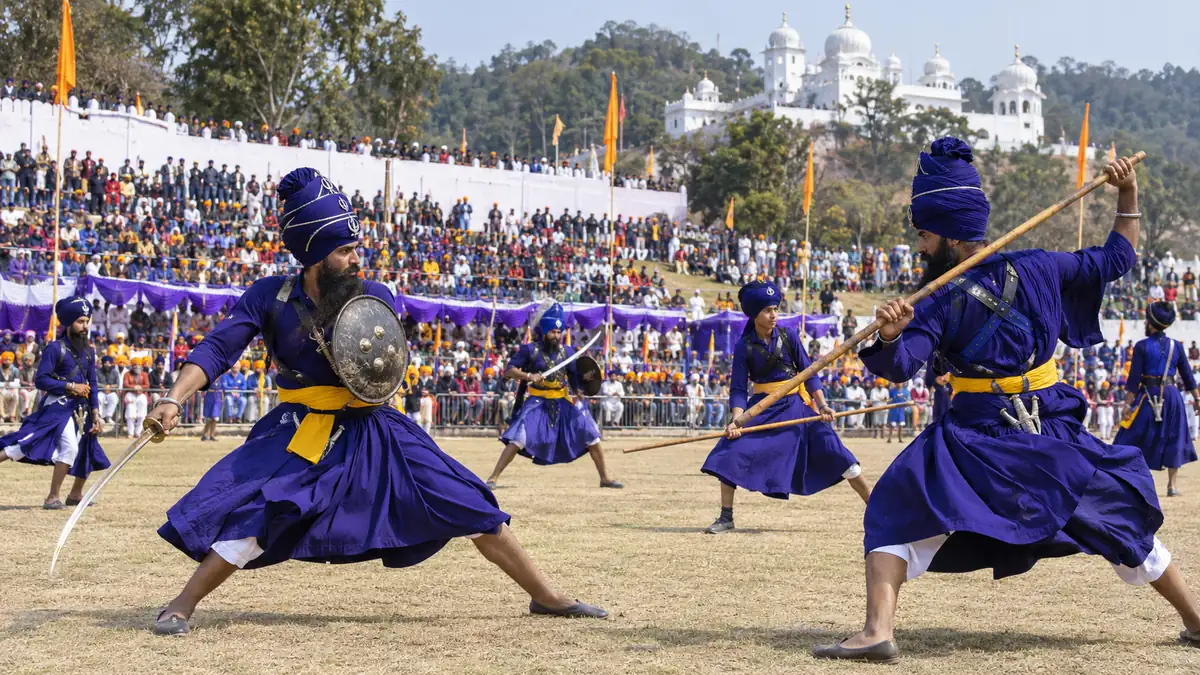
Demonstrations begin with synchronized gatka duels using wooden sticks, shields, and blunted swords accompanied by deep nagara war drums. Crowds then clear the central track for high-speed equestrian feats: riders lean low off galloping saddles to spear wooden pegs from the turf and balance upright across the backs of two running horses side by side.
On the culminating afternoon, the grand Shobha Yatra (Mahalla procession) departs Takht Sri Keshgarh Sahib behind Nishan Sahib saffron banners and caparisoned horses. Marching through town past Qila Anandgarh Sahib and Lohgarh Sahib, the procession blends devotional hymns with martial salutes before concluding at dusk.
Families with young children or photographers carrying telephoto lenses should claim elevated seating steps around Charan Ganga by 9:30 AM. Keep cameras and valuables secured in zipped front pockets amid dense procession crowds.
Best Season, Recommended Itinerary, and Nearby Naina Devi Excursion
October through March offers ideal Shivalik foothill weather between 10°C and 24°C for walking between gurdwaras and Virasat-e-Khalsa. Visitors with a full day can add Sri Naina Devi Ji Temple, located 22 km uphill across the Himachal Pradesh border.
Positioned where the Sutlej plain meets the outer Himalayan foothills, Anandpur Sahib experiences sharper seasonal swings than coastal destinations. Matching your travel dates to winter clarity or spring festival energy keeps walking circuits comfortable across open marble courtyards.
| Season | Months | Day / Night Temp (°C) | Visitor Conditions & Crowd Level |
|---|---|---|---|
| Autumn & Winter Peak | October to February | 6°C to 24°C | Crisp morning air, clear Shivalik views, mild afternoon walks; moderate crowds |
| Hola Mohalla & Baisakhi | March to mid-April | 16°C to 32°C | High-energy festivals in March and April 13–14; heavy pilgrim influx |
| Peak Summer | May to June | 26°C to 41°C | Hot midday marble courtyards; visit shrines at dawn and museum indoors 10 AM–1 PM |
| Monsoon | July to September | 25°C to 34°C | Green Shivalik hillsides, humid afternoons; watch late-July museum closure (Jul 24–31) |
Seasonal Weather Matrix Across the Shivalik Foothills
Between October and February, daytime temperatures sit comfortably between 15°C and 24°C, making the walk from Virasat-e-Khalsa to Takht Sri Keshgarh Sahib and Qila Anandgarh Sahib effortless. Early morning mist from December to mid-January clears by 9:30 AM, leaving bright golden sunlight across the museum’s reflecting pools and sandstone bridge.
Summer temperatures rise sharply in May and June, frequently reaching 40°C by early afternoon. During summer months, schedule outdoor gurdwara darshan before 8:30 AM, spend late morning inside air-conditioned Virasat-e-Khalsa galleries, and wait until sunset before walking to Qila Anandgarh Sahib. Monsoon showers between July and September turn the Shivalik ridge emerald green, though travelers must avoid the museum’s scheduled July 24 to 31 maintenance shutdown.
Full-Day Town Circuit and Sri Naina Devi Ji Side Trip
A well-paced one-day itinerary covers every major landmark without rushing through the museum’s 27 audiovisual rooms:
- 10:00 AM to 1:00 PM (Virasat-e-Khalsa Museum): Collect free entry passes at the parking-plaza counter at 9:45 AM, deposit backpacks in the Entrance Foyer cloakroom, pick up a free audio guide with photo ID, and tour both exhibition wings.
- 1:00 PM to 3:00 PM (Takht Sri Keshgarh Sahib & Langar): Walk or ride an e-rickshaw 1.5 km to Takht Sri Keshgarh Sahib, cover your head, deposit footwear at the Joda Ghar, pay respects in the Darbar hall, and share lunch in the Guru Ka Langar hall.
- 3:15 PM to 4:15 PM (Qila Anandgarh Sahib & Baoli Sahib): Continue 1.2 km south to Qila Anandgarh Sahib to inspect the 17th-century fort walls and descend the 130 steps of Baoli Sahib.
- 4:30 PM to 6:30 PM (Optional Sri Naina Devi Ji Extension): Hire a local taxi for the 22-km uphill drive into Himachal Pradesh’s Bilaspur district to visit Sri Naina Devi Ji Temple, one of the 51 Shakti Peethas, using the hillside ropeway cable car or stone steps before dusk. Travelers extending their Himalayan journey north from Bilaspur can map mountain circuits in our Himachal Pradesh travel guide.
Important
Senior Citizen & Accessibility Note Virasat-e-Khalsa provides smooth gently sloped ramps, elevators, and complimentary wheelchairs on request at the Entrance Foyer for visitors traveling with senior citizens. At Takht Sri Keshgarh Sahib, battery carts and ground-level access paths help elders avoid steep staircases where needed.
How to Reach Anandpur Sahib by Train, Air, and NH 205 Road
Anandpur Sahib Railway Station (ANSB) lies 2 km from Takht Sri Keshgarh Sahib on the Sirhind-Nangal Dam broad-gauge line with Jan Shatabdi and Vande Bharat connectivity. Shaheed Bhagat Singh International Airport in Chandigarh (IXC) sits 85 to 90 km south along NH 205.
Reaching Sri Anandpur Sahib from Delhi, Chandigarh, or Amritsar is straightforward thanks to electrified Northern Railway tracks and four-lane state highways. Choosing the railhead directly saves highway tolls and transfers right into the town center.
| Transit Mode | Hub & Code | Distance to Town | Typical Travel Time & Service Notes |
|---|---|---|---|
| Railway (Direct) | Anandpur Sahib Station (ANSB) | 2 km to shrines | 10 mins by auto; served by Una Jan Shatabdi & Amb Andaura Vande Bharat |
| Airport (Closest) | Chandigarh International Airport (IXC) | 85 to 90 km | 1.5 to 2 hours via NH 205 (Zirakpur, Kurali, Rupnagar) |
| Airport (Western Punjab) | Sri Guru Ram Dass Jee Airport Amritsar (ATQ) | 215 km | 3.5 to 4 hours via NH 3 and Rupnagar highway |
| Intercity Bus | Chandigarh ISBT Sector 43 | 80 km | 2 hours via frequent Punjab Roadways & HRTC Nangal/Una buses |
| Highway Drive (Delhi) | New Delhi via NH 44 & NH 205 | 320 to 340 km | 5.5 to 6.5 hours via Panipat, Ambala, and Rupnagar |
Trains to Anandpur Sahib (ANSB) and Last-Mile Autos
Anandpur Sahib Railway Station (Station Code: ANSB) connects directly to New Delhi, Ambala, Chandigarh, and Una on an electrified Northern Railway corridor. High-speed morning and afternoon options include the New Delhi–Una Jan Shatabdi Express and the Amb Andaura Vande Bharat Express, covering the Delhi run in roughly four hours and forty minutes.
Before finalizing rail bookings, confirm seasonal train timetables and regional route advisories on the official Incredible India Punjab portal. Outside the station exit, shared e-rickshaws and private auto-rickshaws charge ₹30 to ₹80 for the five-to-ten-minute transfer to Takht Sri Keshgarh Sahib or Virasat-e-Khalsa.
Chandigarh Airport (IXC) Transfers and NH 205 Buses
Shaheed Bhagat Singh International Airport (IATA: IXC) in Mohali/Chandigarh serves as the nearest commercial airport, receiving daily flights from Delhi, Mumbai, Bengaluru, Hyderabad, Pune, and international Middle East hubs. Prepaid airport taxis and app-based cabs drive north along four-lane National Highway 205 via Kurali, Rupnagar, and Kiratpur Sahib, reaching Anandpur Sahib in 1.5 to 2 hours.
Budget travelers landing at IXC can take a 25-minute local cab to Chandigarh Sector 43 ISBT and board frequent Punjab Roadways or HRTC buses bound for Nangal Dam or Una, all of which stop directly at Anandpur Sahib bus stand. Visitors planning a pre-flight stopover in the union territory can organize architectural sights and sector hotels using our Chandigarh travel guide.
Frequently Asked Questions About Anandpur Sahib
What are the opening timings and closed days of Virasat-e-Khalsa?
Virasat-e-Khalsa opens Tuesday through Sunday from 10:00 AM to 4:30 PM without a midday break, and it remains closed every Monday. The museum also closes on Republic Day, Independence Day, Gandhi Jayanti, Dussehra, Diwali, and during scheduled bi-annual maintenance from January 24 to 31 and July 24 to 31.
Is there an entry fee for Virasat-e-Khalsa Museum or Takht Sri Keshgarh Sahib?
Admission to both Virasat-e-Khalsa Museum and Takht Sri Keshgarh Sahib is completely free for Indian citizens and international visitors. At Virasat-e-Khalsa, every visitor must collect a free timed-entry pass at the on-site counter or official portal with a valid photo ID, capped at 10 passes per applicant.
How do the audio guide and cloakroom work inside Virasat-e-Khalsa?
Backpacks, handbags, DSLR cameras, and food items must be deposited at the free Entrance Foyer cloakroom before entering the 27 exhibition galleries. Multilingual audio guides in Punjabi, Hindi, and English are issued free inside the foyer against an original physical government photo ID deposit, or accessed via the official mobile app on personal earphones.
What dress code and photography rules apply at Takht Sri Keshgarh Sahib and Virasat-e-Khalsa?
Inside Takht Sri Keshgarh Sahib and Qila Anandgarh Sahib, visitors must cover their heads with a scarf or rumal, deposit shoes and socks at the free Joda Ghar, and avoid carrying tobacco or alcohol. Photography is allowed in the exterior courtyards and reflecting pools of Virasat-e-Khalsa, but strictly prohibited inside the museum galleries and inner shrine relic displays.
When is Hola Mohalla celebrated at Anandpur Sahib in 2026 and 2027?
Hola Mohalla takes place immediately after Holi in spring, running from February 27 to March 3 in 2026 and from March 23 to March 25 in 2027. Major highlights include Nihang Sikh gatka martial arts, bareback horsemanship, and tent-pegging at Charan Ganga stadium alongside the culminating Shobha Yatra procession from Takht Sri Keshgarh Sahib.
How can travelers reach Anandpur Sahib from Chandigarh Airport and Delhi?
Shaheed Bhagat Singh International Airport in Chandigarh (IXC) lies 85 to 90 km south of Anandpur Sahib, reachable in 1.5 to 2 hours by taxi or Sector 43 ISBT bus along NH 205. Direct express trains including the Una Jan Shatabdi Express and Amb Andaura Vande Bharat Express link New Delhi and Chandigarh to Anandpur Sahib Railway Station (ANSB), just 2 km from the main shrines.
How much time is needed to explore Virasat-e-Khalsa and the gurdwaras?
Plan 2.5 to 3 hours to walk through all 27 multimedia galleries inside Virasat-e-Khalsa at an unhurried pace with the audio guide. Adding Takht Sri Keshgarh Sahib, a meal at the Guru Ka Langar hall, and Qila Anandgarh Sahib with its 130-step Baoli Sahib creates a complete five-to-six-hour full-day itinerary.