Ajmer Sharif Dargah & Taragarh Fort: Timings, Qawwali & Guide
Plan Ajmer Sharif Dargah and Taragarh Fort with summer and winter Khidmat hours, Roshni qawwali timings, Deg tabarruk, dress code, and Pushkar transit.
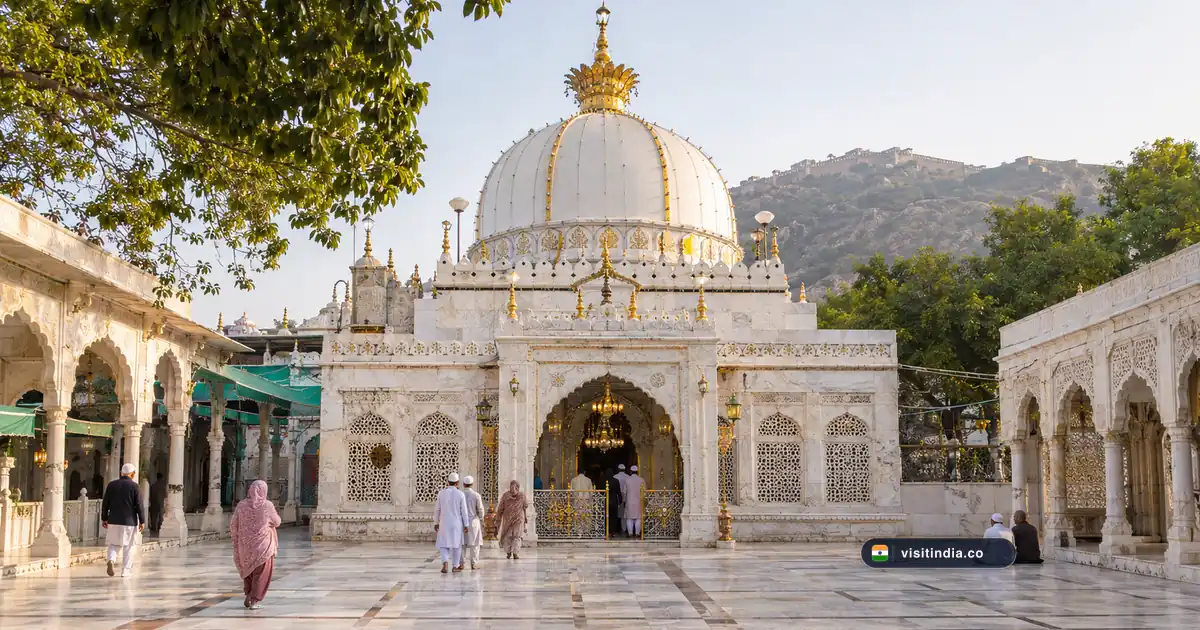
At the foot of the rugged Aravalli ridge in central Rajasthan, Ajmer Sharif Dargah guards the white marble tomb of the 13th-century Sufi master Khwaja Moinuddin Chishti. Rising directly behind the shrine’s crowded bazaars, the stone ramparts of Taragarh Fort crown the summit of Taragarh Hill nearly 400 meters above the valley floor.
Understanding Ajmer Sharif Dargah timings, evening qawwali sessions, and Urs crowd windows turns a chaotic lane walk into a focused pilgrimage. Combining morning courtyard prayers with the adjacent 12th-century Adhai Din Ka Jhonpra, the Taragarh ridge ascent, and a sunset circuit at Ana Sagar Lake anchors one of the richest heritage stops on any Rajasthan travel circuit.
Shrine & Heritage Essentials
- Location: Ajmer Sharif Dargah sits in Dargah Bazaar, Ajmer, Rajasthan, at the base of Taragarh Hill in the Aravalli Range.
- Seasonal Gate Hours: Ajmer Sharif Dargah opens daily from 4:00 AM to 10:00 PM in summer (April to September) and 5:00 AM to 9:00 PM in winter (October to March).
- Daily Rituals: Morning and afternoon Khidmat cleaning close the inner tomb briefly, while the evening Roshni candle ceremony begins 15 minutes before sunset and Mehfil-e-Sama qawwali starts around 10:00 PM.
- Entry & Attire: General entry to Ajmer Sharif Dargah, Adhai Din Ka Jhonpra, and Taragarh Fort is free, and both men and women must cover their heads and leave shoes at Nizam Gate stands.
- Transit Access: Ajmer Junction Railway Station lies 2 km away, Kishangarh Airport sits 29 km northeast, and Pushkar lies 15 km across the Nag Pahar mountain pass.
Sacred Legacy and Architecture of Ajmer Sharif Dargah
Ajmer Sharif Dargah is the 13th-century resting place of Khwaja Moinuddin Chishti, founder of the Chishti Sufi order in South Asia. Surrounded by white Makrana marble courtyards, Mughal ceremonial gates, and massive charity cauldrons, the shrine welcomes pilgrims of every faith seven days a week.
Visitors approaching through the narrow stone lanes of Dargah Bazaar step out of commercial clamor into consecutive marble enclosures financed over seven centuries by Delhi sultans, Mughal emperors, and princely states. According to the Incredible India Ajmer Destination Guide, the complex blends Rajput stone craftsmanship with Indo-Islamic domes and scalloped arches across an active living sanctuary.
Khwaja Moinuddin Chishti and Mughal Patronage
Born in Sistan around 1141 CE, Khwaja Moinuddin Chishti settled in Ajmer in the late 12th century and earned the title Garib Nawaz, benefactor of the poor, before his death in 1236 CE. Sultan Ghiyasuddin Khilji of Malwa erected the earliest stone dome over the grave in the 15th century, establishing the core tomb chamber.
Successive Mughal rulers transformed the modest sanctuary into an imperial pilgrimage complex. Emperor Akbar walked barefoot from Agra to Ajmer in thanksgiving in 1568, financing the Akbari Mosque inside the western courtyard, while Emperor Jahangir and Emperor Shah Jahan added marble screens, gilded railings, and the white Shah Jahani Mosque.
Unlike isolated hilltop citadels such as Amer Fort, Nahargarh, and Jaigarh near Jaipur, Ajmer Sharif Dargah grew organically around living neighborhood quarters. Centuries of continuous endowment layered silver doors, carved marble jali balustrades, and copper cauldrons onto the original medieval tomb.
Nizam Gate, Buland Darwaza, and Jannati Darwaza
Pilgrims enter the complex from the eastern bazaar through Nizam Gate, constructed in 1915 with sandstone and stucco arches funded by Mir Mahbub Ali Khan, Nizam VI of Hyderabad. Beyond Nizam Gate rises the tall Shah Jahani gateway and the 15th-century Buland Darwaza, where officials hoist the ceremonial white flag to open the annual Urs festival.
Near the western wall of the marble tomb enclosure stands the Jannati Darwaza, also known as the Bahishti Darwaza or Gate of Paradise. Framed by hammered silver panels, this sacred doorway stays locked most of the year and opens only on four occasions: the six days of Urs Sharif, Eid-ul-Fitr, Eid-ul-Adha, and the Urs of Khwaja Usman Harooni.
| Architectural Feature | Patron / Era | Material & Function | Visitor Access |
|---|---|---|---|
| Nizam Gate | Nizam of Hyderabad (1915) | Painted masonry main southern entrance from Diggi Bazaar | Open during all Dargah gate hours |
| Buland Darwaza | Sultan Mahmud Khilji (15th century) | Tall stone portal hosting the annual Urs flag-hoisting | Open courtyard passage daily |
| Mazar-e-Sharif | Ghiyasuddin Khilji & Shah Jahan | White Makrana marble dome, lotus finial, silver railings | Open except during Khidmat cleaning |
| Jannati Darwaza | Mughal-era silver doorway | Ceremonial western gate into the tomb verandah | Opens only during Urs and Eid |
| Badi Deg & Choti Deg | Emperors Akbar (1567) & Jahangir (1613) | Hammered copper cauldrons for community sweet rice | Visible in the inner courtyard daily |
Badi Deg and Choti Deg Sacred Tabarruk
Inside the central courtyard between Buland Darwaza and the main tomb sit two colossal copper cauldrons used for cooking charitable sweet rice known as Niaz or tabarruk. Emperor Akbar presented the Badi Deg in 1567, a vessel capable of cooking roughly 4,800 kg of rice, sugar, pure ghee, saffron, and dry fruits in a single firing.
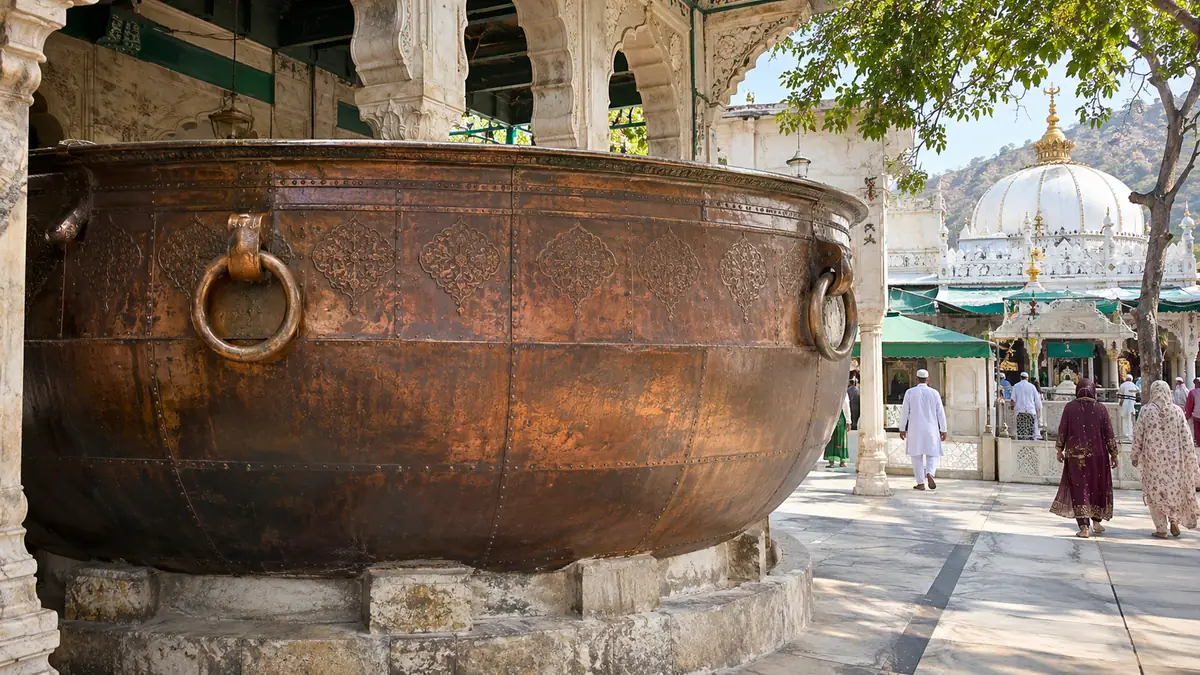
Across the courtyard stands the Choti Deg donated by Emperor Jahangir in 1613, holding up to 2,240 kg of sweet rice. Devotees sponsor full or partial Deg cookings to fulfill personal vows, after which attendants scoop out the hot saffron rice with long wooden paddles and distribute blessed portions to waiting pilgrims and Ajmer’s poor.
Note
Deg cooking fires burn on demand when families or groups sponsor a cauldron, most frequently on Thursday nights, Fridays, and during the annual Urs week. Visitors who simply wish to taste tabarruk can accept small portions distributed near the courtyard steps without paying brokers.
Ajmer Sharif Dargah Timings, Khidmat, Qawwali, and Urs Sharif
Ajmer Sharif Dargah opens daily from 4:00 AM to 10:00 PM during summer (April to September) and from 5:00 AM to 9:00 PM during winter (October to March), operating seven days a week including Sundays. Daily access pauses briefly inside the tomb chamber during Khidmat cleaning services and scheduled prayer windows, while Roshni illumination and nocturnal qawwali anchor the evening routine.
Planning your arrival around these ritual shifts prevents unexpected waits outside closed silver doors. Crowds peak sharply on Thursday evenings, Friday midday Jummah prayers, and school holidays across Rajasthan.
Summer vs. Winter Gate Hours and Khidmat Rituals
When main gates unlock at 4:00 AM in summer or 5:00 AM in winter, hereditary attendants called Khadims enter the inner Mazar-e-Sharif for the morning Khidmat. During this roughly 45-minute service, attendants sweep the marble floor, change silk tomb covers (ghilaf), scatter fresh rose petals, and apply attar perfume while devotees wait in the outer courtyard.
A second afternoon Khidmat begins around 3:00 PM and finishes near 4:00 PM, during which Khadims offer sandalwood paste (sandal), recite Fateha prayers, and distribute blessed flowers. Women pilgrims are traditionally not permitted inside the inner tomb chamber during the afternoon Khidmat window and remain in the outer marble verandahs.
| Ritual / Session | Summer Timing (Apr-Sep) | Winter Timing (Oct-Mar) | Sanctum Access & Field Notes |
|---|---|---|---|
| Main Gates & Morning Khidmat | 4:00 AM to 5:00 AM | 5:00 AM to 6:00 AM | Khadims clean inner tomb; pilgrims wait outside |
| Morning Ziyarat (General Darshan) | 5:00 AM to 2:45 PM | 6:00 AM to 2:45 PM | Calmest queues between 5:30 AM and 8:30 AM |
| Afternoon Khidmat & Sandal | 3:00 PM to 4:00 PM | 3:00 PM to 4:00 PM | Inner tomb restricted; women wait in courtyard |
| Roshni Lighting Ceremony | ~6:30 PM to 7:15 PM | ~5:30 PM to 6:15 PM | Begins 15 minutes before sunset Maghrib prayer |
| Karka Closing Bell & Mehfil-e-Sama | 9:30 PM to 11:00 PM | 8:30 PM to 10:30 PM | Qawwali follows night prayers in Sama Khana |
Roshni Lighting Ceremony and Mehfil-e-Sama Qawwali
Around 15 minutes before the evening Maghrib sunset prayer, traditional drummers strike the ceremonial danka kettledrums near Choti Deg to announce Roshni. Khadims carry lit brass lamps and tall wax candles into the tomb interior, singing Persian couplets as warm light fills the marble dome.
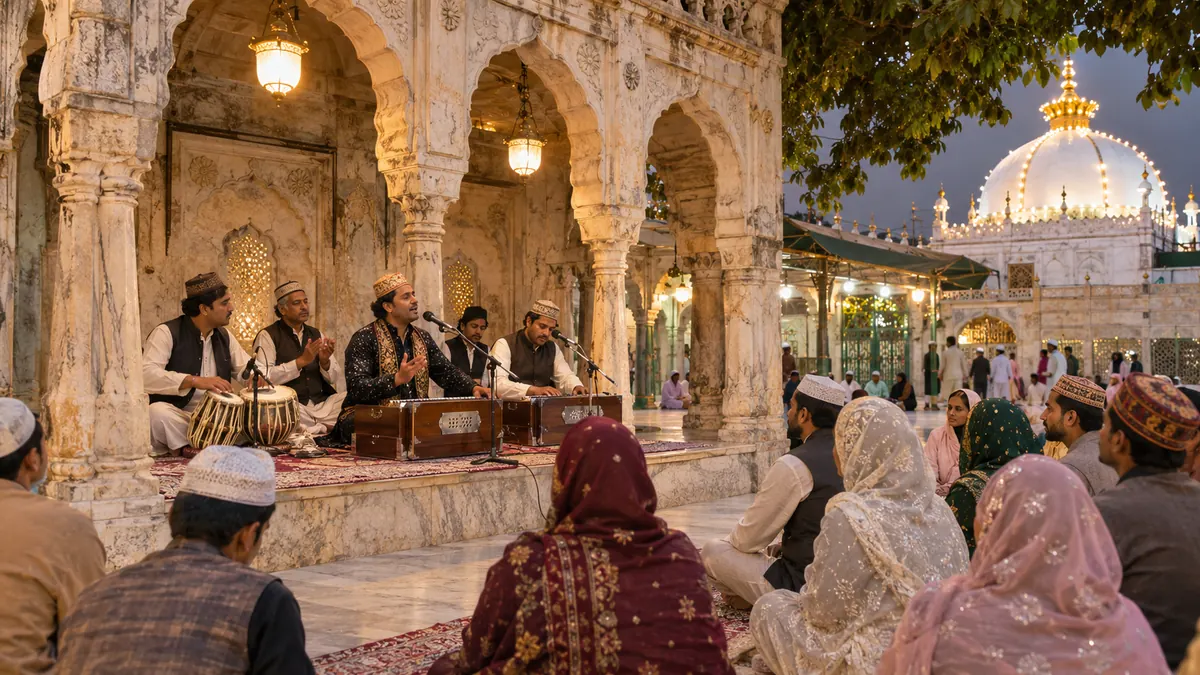
Following the night Isha prayer and the Karka closing bells, devotional singers gather in the adjacent Sama Khana courtyard hall for Mehfil-e-Sama qawwali around 10:00 PM. Traditional qawwals perform centuries-old Sufi poetry accompanied by harmonium, tabla, and dholak without modern stage amplification, with extended Thursday night and Friday afternoon sessions drawing the largest crowds.
Pro Tip
Arrive by 5:15 PM in winter or 6:15 PM in summer to secure a seated spot along the Begami Dalan marble verandah before the Roshni drumbeat begins. Keep valuables in a zippered front pouch, as standing crowds compress quickly near the inner railings.
Annual Urs Sharif in the Lunar Month of Rajab
The annual Urs Sharif commemorates Khwaja Moinuddin Chishti’s mystical union with the divine during the first six days of Rajab, the seventh month of the Islamic lunar calendar. Because Rajab shifts roughly 10 to 11 days earlier every Gregorian year, travelers should verify regional festival calendars on the Incredible India Rajasthan Destination Portal before booking trains.
During Urs week, millions of pilgrims arrive from across India and abroad as Buland Darwaza hosts the ceremonial flag hoisting and the silver Jannati Darwaza opens continuously. On the sixth day of Rajab, the shrine observes Qul prayers with rosewater and sandalwood ablutions while qawwals perform through the night.
Entry Fees, Dress Code, and Nizam Gate Cloakroom Rules
Admission to Ajmer Sharif Dargah, Adhai Din Ka Jhonpra, and Taragarh Fort is completely free for both Indian citizens and foreign visitors, with no online ticket required. Mandatory dress rules apply to every visitor: both men and women must cover their heads, wear modest clothing covering shoulders and knees, and deposit shoes at Nizam Gate cloakrooms before entering marble courtyards.
Respecting local etiquette keeps movement smooth across narrow gates and crowded prayer halls. Unlike major Hindu shrines in Rajasthan such as Khatu Shyam Ji Temple, where online darshan slots regulate peak crowds, Ajmer Sharif Dargah operates entirely through open walk-in queues.
Head Covering, Modest Attire, and Sanctum Etiquette
Every visitor regardless of religion or nationality must keep their head covered inside the Dargah courtyard and inner sanctum. Women should drape a scarf, shawl, or dupatta loosely over their hair, while men wear a cotton skullcap or tie a clean handkerchief; affordable caps and scarves are sold on stalls outside Nizam Gate for ₹20 to ₹50.
Sleeveless tops, shorts, ripped denim, and skirts above the ankle are inappropriate inside the complex. Visitors should sit quietly along perimeter marble carpets if resting, avoid pointing outstretched feet toward the tomb, and refrain from talking loudly during prayer calls.
| Item / Service | Policy at Ajmer Sharif Dargah | Practical Cost or Counter Location |
|---|---|---|
| General Shrine Entry | Free for all faiths and nationalities | Walk-in via Nizam Gate; no VIP ticket required |
| Head Covering | Mandatory for both men and women | Bring scarf or buy skullcap outside (₹20 to ₹50) |
| Footwear Storage (Joota Ghar) | Mandatory removal before marble threshold | Official & shop stands outside Nizam Gate (₹10 to ₹20) |
| Large Luggage Cloakroom | Heavy bags restricted in dense lanes | Paid lockers in Diggi Bazaar & station cloakroom (₹50) |
| Mobile Phones & Cameras | Allowed in outer courtyard; barred inside tomb | Switch phones silent; no flash or commercial tripods |
Nizam Gate Footwear Counters, Security, and Photography
No footwear is allowed beyond the outer threshold of Nizam Gate. Authorized shoe-keeping stalls (joota ghar) line both sides of the Nizam Gate approach and charge ₹10 to ₹20 per pair in exchange for a numbered brass or plastic token, though travelers should avoid leaving shoes unattended on open steps.
Security personnel at the metal-detector gates inspect handbags and prohibit tripods, drones, tobacco, and alcohol. Handheld smartphones may capture wide courtyard architecture outside, but video recording and flash photography inside the silver-railed Mazar-e-Sharif tomb chamber are strictly forbidden.
Managing Deg Offerings and Authorized Khadims
First-time visitors frequently encounter self-appointed guides in Dargah Bazaar offering baskets of roses and velvet chadars at inflated prices or demanding hefty pledges. You are under no obligation to buy a chadar or accept unsolicited prayers; genuine offerings are entirely voluntary.
If you wish to offer a chadar or contribute toward Deg tabarruk, purchase a modest flower basket at fixed shop rates (typically ₹50 to ₹200) or deal strictly with registered Khadims inside the courtyard holding official identification. Never hand large cash sums to street touts promising privileged access inside closed ritual doors.
Walking Route: Adhai Din Ka Jhonpra, Taragarh Fort, and Ana Sagar Lake
A chronological Ajmer heritage loop begins at Nizam Gate at sunrise, walks 500 meters behind the shrine to Adhai Din Ka Jhonpra, climbs Taragarh Hill before mid-morning heat, and finishes along Ana Sagar Lake’s marble pavilions at sunset. Covering all four landmarks takes roughly 6 to 7 hours including transit and hillside breaks.
Combining the Dargah with these adjacent monuments reveals how Chauhan Rajput fortresses, early Indo-Islamic mosques, and Mughal lakeside gardens interlock within a compact 5 km radius. Heritage documentation for both Adhai Din Ka Jhonpra on Incredible India and Taragarh Fort on Incredible India outlines their medieval origins.
Adhai Din Ka Jhonpra Indo-Islamic Architecture
Walking 500 meters southwest from Nizam Gate along the steep lanes behind the Dargah brings you to Adhai Din Ka Jhonpra, protected by the Archaeological Survey of India (ASI). Open daily from 7:00 AM to 6:00 PM with free admission, this sandstone monument ranks among India’s oldest surviving mosques.
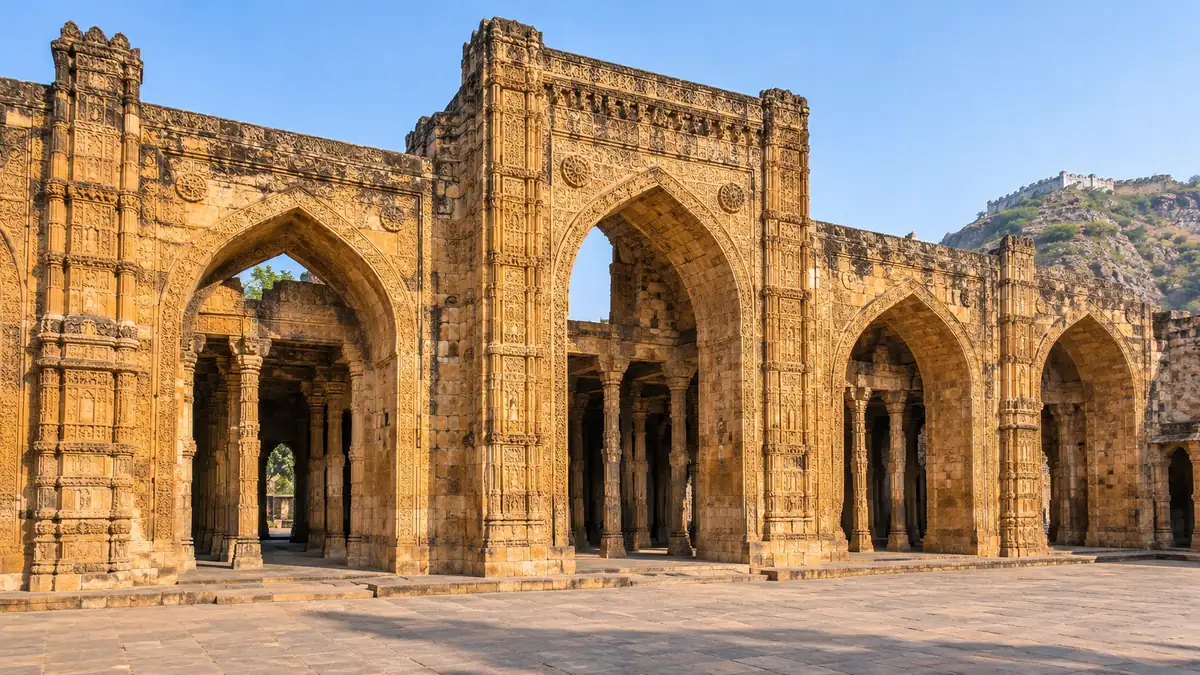
Originally constructed as a Sanskrit college by Chauhan king Vigraharaja IV in the mid-12th century, the hall was converted into a mosque between 1192 and 1199 CE by Qutb-ud-Din Aibak. Its yellow-sandstone screen wall displays seven towering pointed arches carved with Kufic and Tughra Quranic calligraphy, while the interior prayer hall rests on 70 intricately sculpted pillars salvaged from demolished Hindu and Jain temples.
Climbing Taragarh Fort vs. Taking the Motorable Road
Directly behind Adhai Din Ka Jhonpra begins the historic stone footpath ascending Taragarh Hill, locally called Taragarh Pahad. Built in the 12th century by Chauhan ruler Ajaypal and perched roughly 850 to 870 meters above sea level (nearly 400 meters above Ajmer city), Taragarh Fort commands panoramic views across the Aravalli basin. Travelers extending their itinerary along this spiritual corridor can review Lotus Temple & Nizamuddin Dargah Qawwali Delhi darshan and timings for queue hours, dress code, and entry rules.
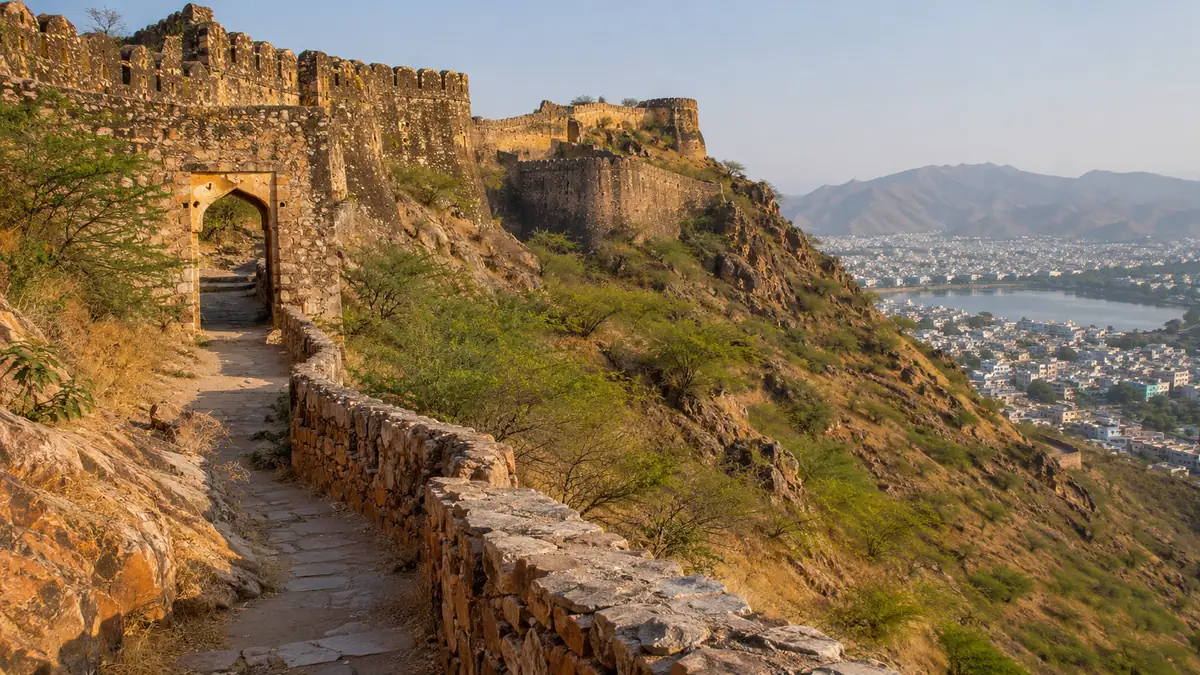
Travelers choosing between the direct climb and the road route face two completely different experiences:
- The Steep Footpath Climb (1 to 1.5 Hours): Beginning beside Adhai Din Ka Jhonpra, rough stone stairs and paved ramps wind steeply past old settlement gates up to the citadel. Start before 7:30 AM with sturdy walking shoes and 1 liter of drinking water, as shade disappears after mid-morning.
- The Motorable Taragarh Road (11 to 12 km / 25 to 30 Minutes): Taxis, private cars, and sturdy auto-rickshaws follow the winding tarmac loop around the western flank of the mountain. Expect sharp hairpin bends and narrow passing spots; a round-trip auto-rickshaw hire from Ajmer city with 1 hour of waiting typically costs ₹500 to ₹800.
| Heritage Stop | Distance from Dargah | Timings & Entry Fee | Core Architectural Highlight | Recommended Duration |
|---|---|---|---|---|
| Adhai Din Ka Jhonpra | 500 meters (7-min walk) | 7:00 AM to 6:00 PM (Free) | Seven calligraphy arches and carved 12th-century pillars | 45 minutes |
| Taragarh Fort (Footpath) | 2.5 km vertical trail | 6:00 AM to 8:30 PM (Free) | Bhim Burj bastion, Miran Sahib Dargah, city panorama | 2.5 to 3 hours round-trip |
| Taragarh Fort (Road) | 11 to 12 km by cab | 6:00 AM to 8:30 PM (Free) | Winding Aravalli hairpin drive to upper fort gates | 1.5 to 2 hours total |
| Ana Sagar Lake Baradaris | 2.5 km northwest | Open daily (Boating ₹150-₹250) | Shah Jahan’s white marble pavilions and Daulat Bagh | 1.5 hours at sunset |
Miran Sahib Dargah, Bhim Burj, and Ana Sagar Lake
Inside Taragarh Fort, open grass plateaus and weathered stone ramparts surround the 13th-century Dargah of Miran Syed Hussain Khangswar, the fort governor who fell defending the citadel in 1202 CE. Emperor Jahangir later gifted the white marble courtyard enclosure around Miran Sahib’s shrine, which still draws pilgrims up the mountain daily.
A short scramble west along the battlements reaches Bhim Burj, a massive circular artillery bastion built to support the historic Garbh Gunjam cannon, alongside deep rock-cut stepwells (jhalaras) that supplied water during medieval sieges.
Descending back into Ajmer by late afternoon, head 2.5 km northwest to Ana Sagar Lake, built between 1135 and 1150 CE by Arnoraja Chauhan and bordered by Shah Jahan’s five white marble Baradari pavilions and the lakeside Daulat Bagh gardens.
From Ajmer, many travelers continue 15 km northwest across the Aravalli pass to explore sacred bathing ghats and desert festivities covered in our Pushkar Camel Fair guide.
Best Time to Visit Ajmer Sharif Dargah and Taragarh Fort
October to March is the best season to visit Ajmer Sharif Dargah and Taragarh Fort, when cool desert winters keep daytime temperatures between 18°C and 28°C. Early mornings between 5:30 AM and 8:30 AM offer calm marble courtyards for prayers and bearable sun before climbing Taragarh Hill.
Seasonal shifts strongly affect barefoot marble walking and hilltop treks across central Rajasthan. Just as winter months bring crisp skies to western desert forts covered in our what to see in Jodhpur guide, Ajmer rewards travelers who align indoor shrine visits with afternoon heat.
Winter Season (October to March) and Crowd Windows
Between November and February, morning temperatures drop to 6°C to 12°C, making thick cotton socks welcome when walking barefoot across cold courtyard marble at dawn. Clear afternoon skies provide crisp visibility from Bhim Burj over Ana Sagar Lake and the distant Nag Pahar ridge toward Pushkar.
For the quietest shrine visit, target Tuesday or Wednesday mornings outside school vacation weeks. Friday afternoon prayers between 12:30 PM and 2:30 PM pack every courtyard to capacity, while Thursday evenings fill early for special qawwali gatherings.
Summer Heat and Monsoon Aravalli Views
From April through June, afternoon temperatures across Ajmer regularly reach 40°C to 45°C, heating exposed marble paving and granite staircases to blistering levels by 11:00 AM. During summer months, complete Taragarh Fort and Adhai Din Ka Jhonpra between 6:00 AM and 9:30 AM, then return to the Dargah only after 6:00 PM for Roshni.
Monsoon rains between July and September bring moderate showers and daytime highs around 26°C to 34°C, turning the rocky Aravalli slopes around Taragarh Fort emerald green and refilling Ana Sagar Lake. Carry shoes with strong rubber tread if hiking the stone path during damp monsoon mornings.
| Season | Months | Temperature Range | Crowd Level & Experience | Practical Field Tip |
|---|---|---|---|---|
| Peak Winter | October to March | 6°C to 28°C | High crowds; best hiking and sunset light | Carry warm shawl and thick socks for dawn marble |
| Hot Summer | April to June | 28°C to 45°C | Moderate daytime crowds; busy after sunset | Climb Taragarh at 6:00 AM; carry 2 liters water |
| Green Monsoon | July to September | 26°C to 34°C | Low tourist crowds; green hills and full lake | Use motorable road if stone hill steps are slick |
| Urs Sharif Week | 1st to 6th Rajab (Lunar) | Varies by solar year | Extreme pilgrimage density across Ajmer | Reserve trains and hotels 60 to 90 days ahead |
How to Reach Ajmer Sharif Dargah, Taragarh, and Pushkar
Ajmer Junction Railway Station sits just 2 km from Nizam Gate, while Kishangarh Airport lies 29 km northeast along National Highway 8. Travelers continuing to Pushkar cross the winding 14 to 15 km Nag Pahar mountain pass via State Highway 58 in 30 to 45 minutes by bus or private taxi.
Because narrow bazaar lanes around Ajmer Sharif Dargah restrict four-wheelers during peak daytime hours, final meters from nearby junctions work best by e-rickshaw or on foot. Rail connections from Delhi and Jaipur remain the fastest link into central Rajasthan.
Ajmer Junction Rail Links and Kishangarh Airport Transfers
By Train: Ajmer Junction (station code: AII) sits on the Delhi-Ahmedabad broad-gauge trunk line just 2 km east of Nizam Gate. High-speed trains including the Delhi Cantt-Ajmer Vande Bharat Express (roughly 5 hours 15 minutes) and the Ajmer Shatabdi Express (about 6 hours 30 minutes) connect daily from New Delhi.
Outside Ajmer Junction Platform 1, battery e-rickshaws and auto-rickshaws reach the Diggi Bazaar edge near Nizam Gate in 5 to 10 minutes for ₹60 to ₹100. Travelers with heavy suitcases should deposit luggage at the railway station cloakroom before entering the bazaar.
By Air: Kishangarh Airport (IATA: KQH) lies 27 to 30 km northeast of Ajmer (35 to 50 minutes by cab) with regional flights to Delhi, Hyderabad, and Ahmedabad, documented by the Airports Authority of India Kishangarh Airport portal. Prepaid cabs from Kishangarh terminal to Ajmer city cost ₹900 to ₹1,300.
For wider national and international flight schedules, land at Jaipur International Airport (IATA: JAI), located 135 km northeast via smooth six-lane NH-48 (2.5 to 3 hours by taxi), and pair the drive with our guide to notable viewpoints and monuments in Jaipur.
| Route / Origin | Primary Transit Mode | Distance & Duration | Typical Fare | Drop-Off & Last-Mile Advice |
|---|---|---|---|---|
| Ajmer Junction (AII) to Dargah | Auto / E-rickshaw | 2 km (5 to 10 minutes) | ₹60 to ₹100 | Drops near Diggi Bazaar; walk 300 m to Nizam Gate |
| Kishangarh Airport (KQH) to Ajmer | Prepaid Taxi / Cab | 27 to 30 km (40 minutes) | ₹900 to ₹1,300 | Direct NH-8 highway run into Ajmer center |
| Jaipur (JAI) to Ajmer | Express Train or Cab via NH-48 | 135 km (2 to 3 hours) | ₹150 train / ₹2,800 cab | Multiple daily trains plus 6-lane toll expressway |
| New Delhi to Ajmer | Vande Bharat / Shatabdi Express | 440 km (5.25 to 6.5 hours) | ₹950 to ₹2,270 | Book 30 days ahead in winter and Urs weeks |
| Ajmer to Pushkar (Nag Pahar) | RSRTC Bus or Private Taxi | 14 to 15 km (30 to 45 minutes) | ₹25 to ₹40 bus / ₹600 cab | Buses depart Ajmer Bus Stand every 20 minutes |
Crossing Nag Pahar to Pushkar and Local Rickshaw Fares
By Road to Pushkar: State Highway 58 climbs straight over the Nag Pahar (Snake Mountain) ridge separating Ajmer from Pushkar, offering sweeping views back over Ana Sagar Lake before descending 15 km into Pushkar valley.
Rajasthan State Road Transport Corporation (RSRTC) buses depart Ajmer Central Bus Stand every 20 minutes for ₹25 to ₹40, while private cabs charge ₹500 to ₹800 one-way or ₹1,200 to ₹1,600 for a half-day round trip.
Important
Four-wheel taxis cannot drive directly up to Nizam Gate between 8:00 AM and 10:00 PM due to pedestrian bazaar rules. Ask drivers to drop you at Diggi Chowk or the Station Road clock tower, then walk 5 to 8 minutes or take a shared e-rickshaw to the footwear stands.
Frequently Asked Questions About Ajmer Sharif Dargah
Is Ajmer Sharif Dargah open on Sunday and all days of the week?
Yes, Ajmer Sharif Dargah remains open seven days a week including Sundays from 4:00 AM to 10:00 PM in summer and 5:00 AM to 9:00 PM in winter. Inner tomb doors close briefly only during morning and afternoon Khidmat cleaning services and scheduled prayer windows.
What should men and women wear inside Ajmer Sharif Dargah?
Both men and women must cover their heads with a scarf, shawl, skullcap, or clean handkerchief before stepping into the marble courtyards of Ajmer Sharif Dargah. Modest clothing covering shoulders and knees is required, and footwear must be left at shoe stands outside Nizam Gate.
What time does qawwali start at Ajmer Sharif Dargah?
Nightly Mehfil-e-Sama qawwali sessions at Ajmer Sharif Dargah begin around 10:00 PM inside the Sama Khana hall following the Karka closing ceremony. Shorter devotional songs also follow evening Roshni candle lighting near sunset, with extended qawwali held every Thursday evening and Friday afternoon.
How to reach Taragarh Fort Ajmer by car from Ajmer Sharif Dargah?
To reach Taragarh Fort by car or auto-rickshaw from Ajmer Sharif Dargah, take the 11 to 12 km winding hill road around the western flank of Taragarh Hill, which takes 25 to 30 minutes. Fit hikers can instead climb the steep stone footpath starting behind Adhai Din Ka Jhonpra in 60 to 90 minutes.
How to reach Ajmer Sharif Dargah from Delhi by train or flight?
From Delhi, travelers reach Ajmer Junction (2 km from the Dargah) in roughly 5 hours 15 minutes on the Vande Bharat Express or 6.5 hours on the Ajmer Shatabdi Express. Air travelers can fly into Kishangarh Airport 29 km away or connect via our planning the Golden Triangle India Itinerary through Jaipur Airport 135 km northeast.
Is Ajmer Sharif Dargah open to non-Muslim visitors and foreign tourists?
Yes, Ajmer Sharif Dargah welcomes pilgrims and visitors of all faiths and nationalities with free entry throughout the year. Non-Muslim and international visitors are requested only to dress modestly, cover their heads, remove footwear at Nizam Gate, and observe quiet respect near the inner tomb.
How far is Pushkar from Ajmer Sharif Dargah?
Pushkar sits 14 to 15 kilometers northwest of Ajmer Sharif Dargah across the scenic Nag Pahar mountain pass on State Highway 58. Public RSRTC buses cover the route in 45 minutes for ₹25 to ₹40, while private taxis make the crossing in 30 minutes.