Salasar Balaji Temple Guide: Savamani Prasad, Timings & History
Plan your pilgrimage to Salasar Balaji Mandir in Rajasthan. Complete guide to bearded Hanuman history, Savamani prasad booking, darshan timings, and stays.
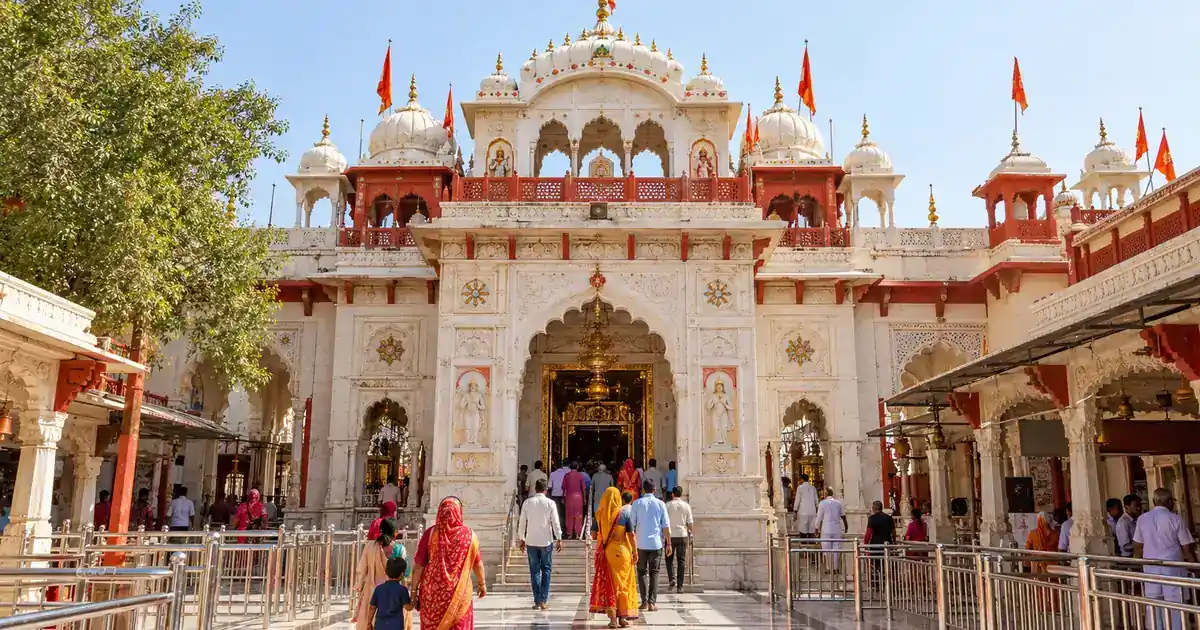
Salasar Balaji Mandir stands in the small town of Salasar in the Sujangarh tehsil of Churu district, Rajasthan. Situated along National Highway 658, this revered Hindu pilgrimage destination attracts millions of devotees from across India to seek the blessings of Lord Hanuman, worshiped here in a wholly unique iconographic form featuring a rounded face with a beard and mustache (Daadhi-Moochh wale Balaji).
The temple represents one of the most prominent centers of faith in western India, celebrated for its legendary founding in 1754 CE, its perpetually burning sacred flame (Akhand Jyoti), and the widespread devotional custom of offering Savamani (a ritual offering of approximately 50 kilograms of sweets). Together with Khatu Shyam Ji in neighboring Sikar district, Salasar Balaji forms the cornerstone of Rajasthan’s most popular devotional circuit.
Salasar Balaji Pilgrim Advisory
- Primary Sanctum Deity: Lord Balaji (Lord Hanuman), uniquely depicted with a round face, beard, and mustache.
- Sacred History: Consecrated on Shravan Shukla Navami in 1754 CE by ascetic devotee Mohandas Ji Maharaj.
- Signature Devotional Offering: Savamani (offering of 1.25 maunds or roughly 50 kg of pure desi ghee churma, peda, or laddu).
- Perpetual Fire (Dhuna): The sacred fire pit ignited by Mohandas Ji over two centuries ago burns continuously within the courtyard.
- Nearest Railhead: Sujangarh Railway Station (SUJH), situated 25 km west; Talchhapar Station is 26 km northwest.
Mythological History: Discovery of the Divine Murti
The history of Salasar Balaji begins in the rural village of Asota, located in the Ladnun tehsil of Nagaur district. On a Saturday in Shravan in the Hindu year 1811 (1754 CE), a humble Jat farmer was plowing his parched sandy field when the blade of his iron plow struck a solid stone buried in the soil.
When the farmer unearthed the object, he wiped away the accumulated desert sand to reveal a dark stone idol sculpted with the distinct image of Lord Hanuman with facial hair. At that very moment, the farmer’s wife arrived in the field carrying his afternoon meal of bajra roti and ghee. The farmer offered his meal to the idol with pure devotion.
That same night, the local landlord (Thakur) of Asota received a divine instruction in a dream commanding him to send the idol on a bullock cart to the village of Salasar. Concurrently, a pious devotee named Mohandas, living as a hermit in Salasar, received an identical vision from Lord Hanuman informing him that the idol was traveling toward his hermitage.
The bullock cart arrived in Salasar without a driver, coming to a natural halt at the exact spot where Mohandas was engaged in meditation. Mohandas and his disciple Udayram consecrated the idol with Vedic rites, establishing the sanctuary that continues to bless pilgrims today.
Devotees interested in Rajasthan’s deep spiritual traditions can contrast this desert sanctuary with the architectural marvels detailed in our comprehensive guide on places to visit in Rajasthan.
Iconography of the Bearded Balaji
Unlike standard depictions of Lord Hanuman across India portraying him as a fierce celibate warrior carrying the Gada or flying with the Dronagiri mountain, the idol at Salasar is profoundly unique.
- Facial Features: The stone murti depicts Balaji with a circular, benevolent face graced with a well-defined mustache and beard.
- Symbolic Meaning: Devotees believe this mature paternal form represents Hanuman in his most compassionate, forgiving aspect, ready to listen to the cries of his distressed devotees.
- Sindoor Adornment: The murti is coated daily with thick applications of holy vermilion paste (sindoor) and pure jasmine oil (chameli tel), leaving only the large expressive eyes visible to pilgrims.
- Gold Canopy: A magnificent solid silver and gold throne (Simhasana) frames the sanctum, surrounded by intricately carved figures of Lord Rama, Lakshmana, and Goddess Sita.
The Sacred Akhand Dhuna and Mohandas Samadhi
Directly adjacent to the main sanctum in the temple courtyard sits the Dhuna, the sacred ash-pit where saint Mohandas kept a holy fire burning throughout his decades of intense spiritual penance.
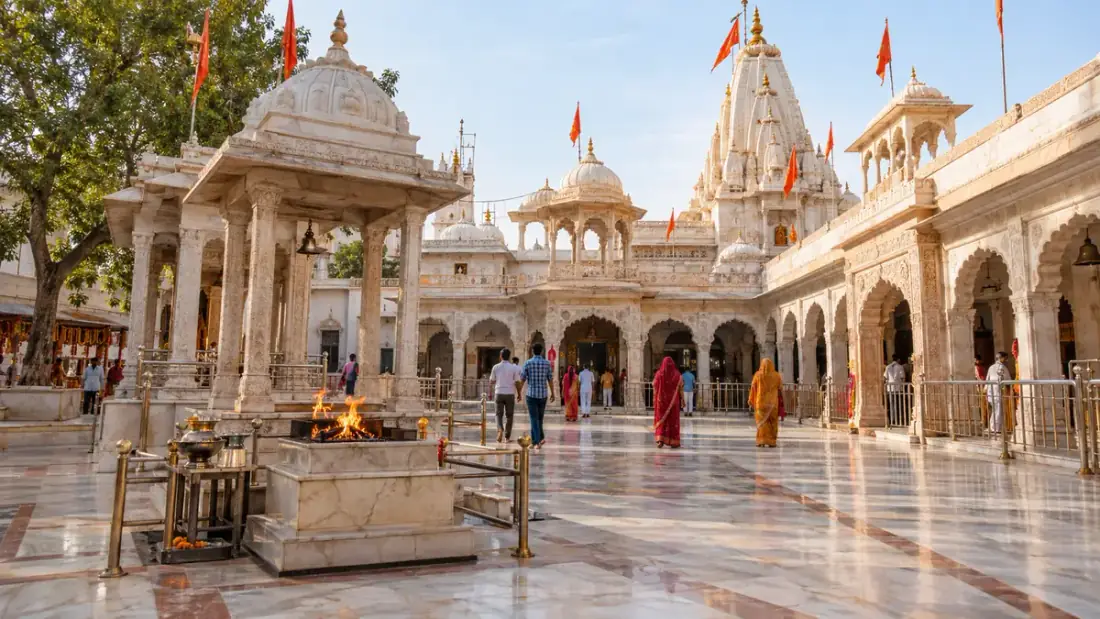
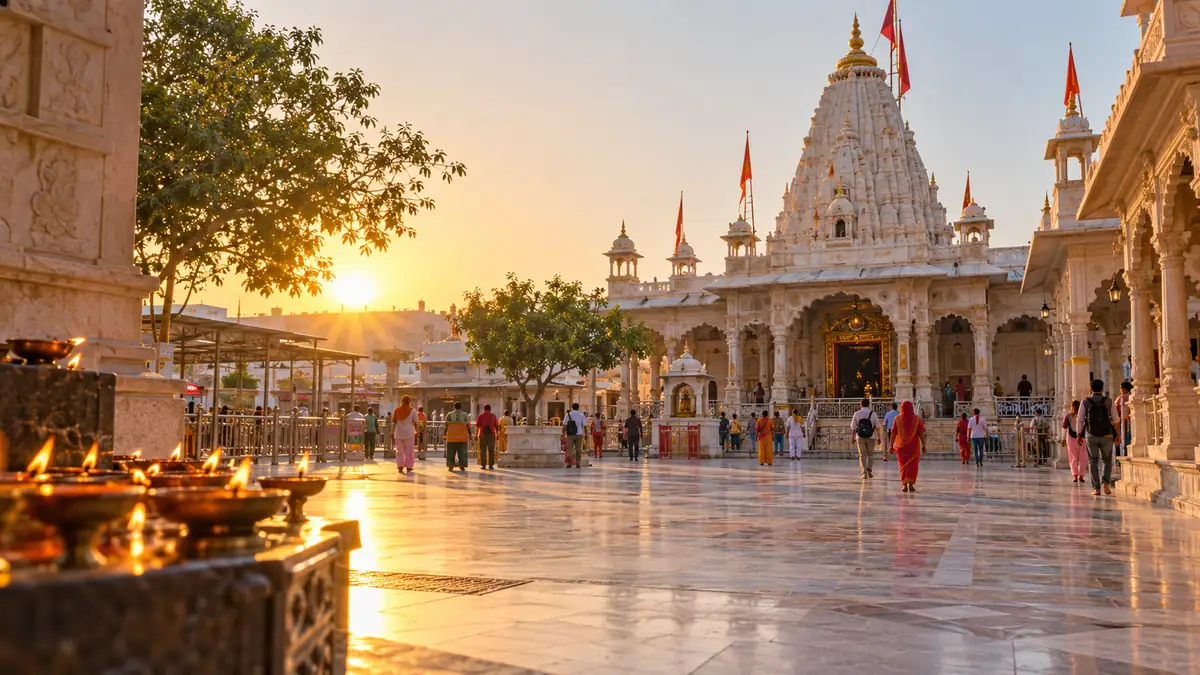
- Perpetual Flame: The fire within the Dhuna has remained continuously ignited without interruption for over 250 years.
- Vibhuti Blessing: Pilgrims collect sacred ash from the Dhuna, revering it as a miraculous talisman (Bhabhoot) capable of warding off physical sickness, negative influences, and mental distress.
- Mohandas Samadhi: A short walk from the main gate leads to the Samadhi temple of Mohandas Ji and his sister Kanhi Bai, where devotees offer quiet prayers in remembrance of their divine surrender.
Devotees seeking deeper insight into historic places of worship across North India can explore the sacred temple architecture documented in our Ayodhya Ram Mandir guide.
The Savamani Tradition: 50 kg Prasad Offering
The most widespread devotional practice at Salasar is the preparation and distribution of Savamani. The word originates from Sava (one and a quarter) and Mani (maund, an ancient Indian unit of weight equal to approximately 40 kg), designating an offering of roughly 50 kilograms of food.
Devotees sponsor a Savamani to fulfill vows made during times of severe illness, business hardship, family challenges, or upon the birth of a child.
| Savamani Variant | Primary Ingredients | Significance & Preparation |
|---|---|---|
| Desi Ghee Churma | Coarse wheat flour, bati crumbs, pure cow ghee, boora sugar, cardamom | The most traditional Rajasthani offering; highly auspicious |
| Besan Laddu | Roasted chickpea flour, desi ghee, almonds, pistachios | Preferred for convenient family distribution and longer shelf life |
| Mawa Peda | Pure condensed milk solids, saffron, green cardamom | Rich dairy offering favored during winter pilgrimage months |
| Dal Bati Churma | Complete traditional cooked feast with spiced lentils | Distributed directly to pilgrims at temple dining halls |
How to Book and Offer Savamani
- Registered Halwai Kiosks: The temple trust licenses authorized confectioners (halwais) operating within the temple perimeter to maintain strict purity and food safety.
- Weighing & Consecration: The prepared sweets are loaded into stainless steel vessels, weighed on official electronic scales, and carried to the sanctum for Bhog offering by the priests.
- Distribution: Devotees receive a portion as sanctified prasad to carry home to relatives, while the remainder is distributed freely among visiting pilgrims and local community kitchens.
Details on authorized confectioners and municipal food inspection notices are maintained on the Churu District Administration portal.
Daily Darshan Timings, Aartis & Temple Schedule
Salasar Balaji Mandir opens before sunrise and remains accessible throughout the day without extended afternoon gate closures.
| Timing Window | Liturgical Event | Pilgrim Experience |
|---|---|---|
| 5:00 AM – 5:30 AM | Mangala Aarti | Dawn awakening ceremony; relatively quiet queue |
| 8:15 AM – 9:00 AM | Shringaar Aarti & Chola Pooja | Deity adorned with fresh garments and fragrant silver foil |
| 11:00 AM – 12:30 PM | Rajbhog Aarti | Grand midday food offering; Savamani bhog presentation |
| 6:30 PM – 7:30 PM | Sandhya Aarti | Evening musical prayer with conches, bells, and brass lamps |
| 9:30 PM – 10:00 PM | Shayan Aarti & Gate Closure | Concluding night hymns before the sanctum curtains draw shut |
On full moon days (Purnima) and Tuesdays, the temple often operates continuously throughout the night to accommodate massive crowds arriving from neighboring states.
The Epic Khatu-Salasar Pilgrimage Circuit
A major tradition among North Indian pilgrims is completing the dual shrine pilgrimage linking Khatu Shyam Ji and Salasar Balaji in a single coordinated journey.
The distance between Khatu and Salasar is approximately 105 kilometers, connected smoothly via state highways through Ringas, Sikar, and Laxmangarh. Pilgrims traditionally begin by seeking the blessings of Lord Shyam before traveling northwest to present their Nishans or Savamani at the feet of Balaji.
Travelers planning this combined spiritual tour can follow the complete route logistics and festival schedules detailed in our visiting Khatu Shyam Ji Temple.
Annual Fairs & Festival Crowds: Chaitra & Ashvin Purnima
Salasar hosts two colossal annual religious gatherings (Lakhi Melas) that draw more than one million pilgrims each:
- Chaitra Purnima (Hanuman Jayanti): Celebrated in March or April, this festival commemorates the birth of Lord Hanuman. Thousands of walking pilgrims (Padyatris) march along desert highways carrying red and saffron flags from Haryana, Punjab, and Delhi.
- Ashvin Purnima (Sharad Purnima): Held in September or October under the full moon, celebrated with sweet kheer offerings exposed to nighttime moonlight on temple rooftops.
During these festival windows, the district police implement one-way pedestrian barricades stretching up to three kilometers outside the town perimeter to ensure orderly movement and prevent stampedes.
How to Reach Salasar Balaji Temple
Salasar is centrally situated in northern Rajasthan, accessible via well-maintained national and state highway networks.
| Travel Mode | Primary Terminal Hub | Transit Instructions to Salasar |
|---|---|---|
| By Train | Sujangarh Railway Station (SUJH) | Situated 25 km west. Regular passenger and express trains link to Jodhpur, Delhi Sarai Rohilla, and Bikaner. Taxis and buses run every 15 minutes to Salasar. |
| By Road from Jaipur | Sindhi Camp Bus Stand / Jaipur City | 165 km northwest via NH52 and Sikar (3.5 hours drive). Deluxe AC buses operate hourly. |
| By Road from Delhi | Dhaula Kuan / Gurugram | 315 km west via Rewari, Jhunjhunu, and Fatehpur Shekhawati (6 hours drive). |
| By Air | Jaipur International Airport (JAI) | Located 175 km southeast. Taxis reach Salasar in approximately 4 hours along the toll expressway. |
Train passengers can confirm direct express timetables through the official Indian Railways IRCTC portal. Regional travel itineraries across the Shekhawati desert corridor are published on the Rajasthan Tourism Official Portal. Pilgrims traveling through Sikar or Churu can combine temple darshan with the open-air fresco mansions detailed in our comprehensive Shekhawati Havelis guide via Laxmangarh and Fatehpur.
Dharamshalas, Bhojanalayas & Where to Stay
Salasar offers an extensive network of charitable dharamshalas and modern private hotels built by merchant families from across India:
- Trust Dharamshalas: Over 200 large dharamshalas operate in town, offering clean air-conditioned family rooms and attached bathrooms for donations between ₹500 and ₹1,500. Prominent trusts include the Sharda Seva Sadan and Balaji Seva Trust.
- Bhojanalayas: Most dharamshalas run pure vegetarian community dining halls serving unlimited thali meals (dal, bati, churma, roti, sabzi, and kadhi) for nominal token charges of ₹50 to ₹100.
- Private Hotels: Contemporary hotels with elevator access and secure car parking cluster along the Sujangarh and Laxmangarh approach roads, charging ₹1,800 to ₹3,800 per night.
Travelers exploring northern Rajasthan can connect this journey with the royal palaces and forts highlighted in our guide to the best places to visit in Jaipur.
Frequently Asked Questions About Salasar Balaji
Why does Lord Hanuman have a beard and mustache at Salasar?
The murti at Salasar appeared naturally to farmer Mohan in Asota village with a beard and mustache. Saint Mohandas had meditated upon Lord Hanuman in this mature, paternal form, and the deity manifested in accordance with his devotee’s prayer.
How much does a Savamani prasad offering cost?
The cost of a Savamani offering ranges between ₹11,000 and ₹18,000 depending on the selected sweet: pure desi ghee churma, besan laddu, or mawa peda, covering approximately 50 kilograms of sweets prepared by authorized halwais.
Is online registration required for darshan at Salasar Balaji?
On regular weekdays, online registration is not mandatory, and pilgrims can enter through the open queues. During Chaitra Purnima and peak festival weeks, the temple committee occasionally activates time-slotted online passes to manage crowd density.
Which railway station is nearest to Salasar Balaji Mandir?
Sujangarh Railway Station (SUJH), located 25 kilometers west of Salasar, is the closest railway station. Other nearby stations include Didwana (42 km) and Sikar Junction (55 km).
What is the significance of the Dhuna at Salasar Balaji?
The Dhuna is the holy fire pit lit by ascetic devotee Mohandas Ji over two centuries ago. Its sacred flame has burned continuously ever since, and pilgrims apply its holy ash (vibhuti) to their foreheads for spiritual protection, fitting into the broader devotional circuits featured in our guide to the best places to visit in India.