Best Places to Visit in Jaipur: 1, 3, and 5 Day Itineraries
Explore the best places to visit in Jaipur, including Amer Fort, Hawa Mahal, City Palace, Jantar Mantar, Nahargarh, entry fees, timings, and itineraries.
Jaipur, the capital of Rajasthan, was founded in 1727 AD by Maharaja Sawai Jai Singh II as India’s first planned city laid out according to Vastu Shastra principles. Inscribed as a UNESCO World Heritage Site in 2019, the city features terracotta-pink fortifications, hilltop citadels, royal residential palaces, and stone astronomical observatories.
Jaipur Travel Essentials
- Jaipur was founded in 1727 AD by Maharaja Sawai Jai Singh II as India’s first planned grid-layout city and capital of Rajasthan.
- The optimal travel season spans October through March, offering comfortable winter temperatures between 12°C and 28°C for outdoor monument exploration.
- Signature landmarks include UNESCO-inscribed Amer Fort and Jantar Mantar, the 953-casement Hawa Mahal, City Palace, and Nahargarh Fort.
- Jaipur International Airport connects domestic and international flights 12 km south, while Jaipur Junction links express trains from Delhi and Mumbai.
Travelers planning an extended exploration of desert kingdoms can review our master guide on places to visit in Rajasthan.
Visitor Essentials and Jaipur Sightseeing Overview
Jaipur splits into two primary zones: the walled inner city characterized by pink bazaars, Hawa Mahal, and City Palace, and the rugged Aravalli ridge north of town which cradles Amer Fort, Jaigarh Fort, and Nahargarh Fort. Travelers seeking sacred day-trips beyond Jaipur’s royal palaces often journey 80 km northwest into the Shekhawati region to visit the renowned Krishna shrine described in our Khatu Shyam Ji Temple guide.
| Monument Name | Location / Distance | Timings | Entry Fee (Indian / Foreigner) | Ideal Duration |
|---|---|---|---|---|
| Amer Fort | 11 km north of center | 8:00 AM to 5:30 PM, 6:30 PM to 9:15 PM | ₹100 / ₹500 | 2.5 to 3 hours |
| Hawa Mahal | Badi Choupad, Old City | 9:00 AM to 5:00 PM | ₹50 / ₹200 | 1 hour |
| City Palace | Jaleb Chowk, Old City | 9:30 AM to 5:00 PM, 7:00 PM to 10:00 PM | ₹300 / ₹700 | 2 hours |
| Jantar Mantar | Tripolia Bazaar, Old City | 9:00 AM to 5:00 PM | ₹50 / ₹200 | 1.5 hours |
| Nahargarh Fort | Aravalli Hills (15 km) | 10:00 AM to 5:30 PM | ₹50 / ₹200 | 2 hours |
| Jaigarh Fort | Cheel ka Teela, Amer | 9:00 AM to 5:00 PM | ₹100 / ₹200 | 1.5 hours |
| Albert Hall Museum | Ram Niwas Garden | 9:00 AM to 5:00 PM, 7:00 PM to 10:00 PM | ₹40 / ₹300 | 1.5 hours |
The Rajasthan Department of Archaeology sells a convenient composite ticket costing ₹100 for Indian citizens and ₹500 for foreign travelers, valid for two consecutive days across Amer Fort, Hawa Mahal, Jantar Mantar, Nahargarh Fort, and Albert Hall Museum.
Travelers seeking Thar Desert dune excursions can pair their palace tours with desert safaris in Jaisalmer.
Iconic Forts of the Aravalli Hills
The northern boundary of Jaipur is guarded by three interconnected fortifications built along the steep quartzite ridges of the Aravalli mountain range, detailed in our comprehensive Amer Fort, Nahargarh, and Jaigarh guide.
Amer Fort (Amber Palace) and Sheesh Mahal
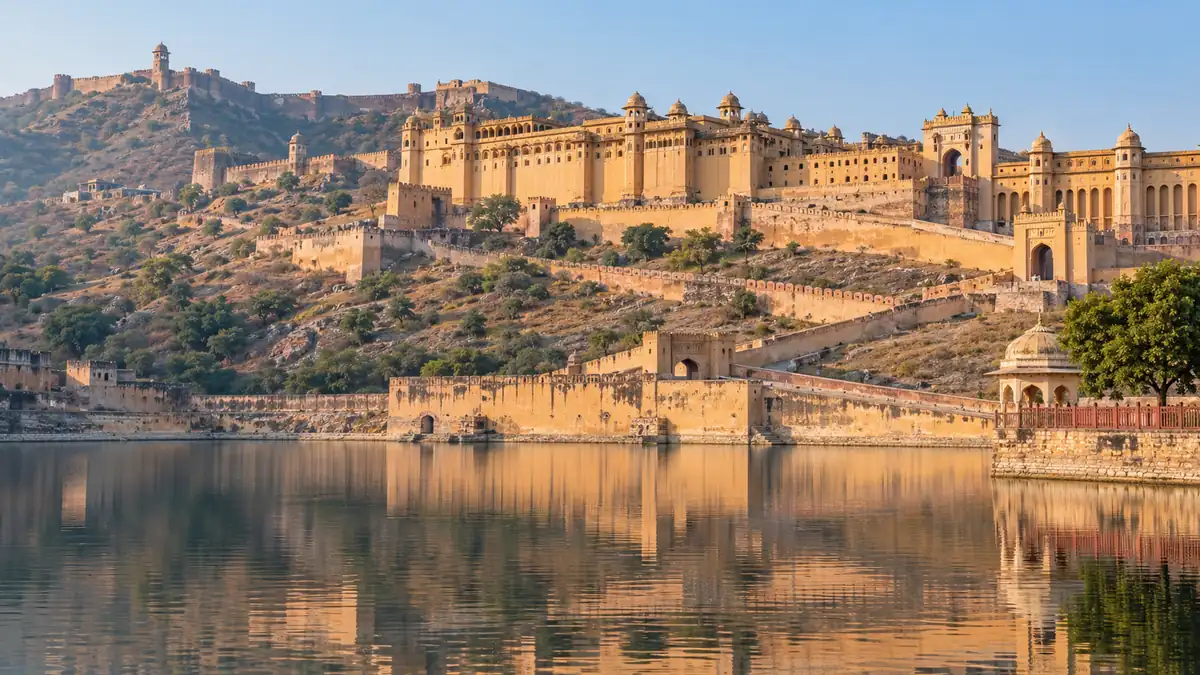
Amer Fort was begun in 1592 AD by Raja Man Singh I and expanded by Mirza Raja Jai Singh, constructed from yellow and pink sandstone overlooking Maota Lake. The citadel features four successive courtyards, including the Jaleb Chowk for victory parades and Diwan-e-Aam for public petitions.
The highlight of the third courtyard is the Sheesh Mahal (Hall of Mirrors), decorated with convex Belgian glass foils and mirrored concave plasterwork that illuminate the entire room with a single candle. Visitors can explore the underground escape tunnels connecting Amer with the military redoubts of Jaigarh Fort above.
Nahargarh Fort Sunset Battlements
Nahargarh Fort stands on a sheer 700-foot cliff overlooking the entire Jaipur urban basin, built in 1734 AD by Sawai Jai Singh II as a defensive retreat. The compound contains the Madhavendra Bhawan, featuring nine identical two-story residential suites built by Sawai Madho Singh for his nine royal consorts.
The western battlements serve as the most popular viewpoint in Jaipur for watching the evening sun set over the city rooftops. The fort grounds also house the Jaipur Wax Museum and open-air rooftop dining terraces.
Jaigarh Fort and Jaivana Cannon
Constructed in 1726 AD to protect Amer Fort and its royal cannon foundry, Jaigarh Fort never fell to enemy assault. The fortress houses Jaivana, which was cast within the fort grounds in 1720 AD and measured as the world’s largest wheeled cannon on wheels, possessing a 50-ton barrel and an effective firing range of 35 kilometers.
The complex retains subterranean water storage reservoirs capable of holding 6 million gallons of rainwater collected from surrounding mountain slopes.
Official monument tickets and conservation updates are published on the Rajasthan Tourism Official Jaipur Destination Portal.
Royal Palaces, Observatories, and City Landmarks
The central district of Jaipur houses the royal monuments constructed when Sawai Jai Singh relocated his royal capital downhill from Amer to the plains in 1727 AD. As part of the classic Golden Triangle India Itinerary logistics and transport tips, Jaipur pairs these palatial structures with the Mughal monuments of Delhi and the Taj Mahal in Agra.
Hawa Mahal (Palace of Winds)
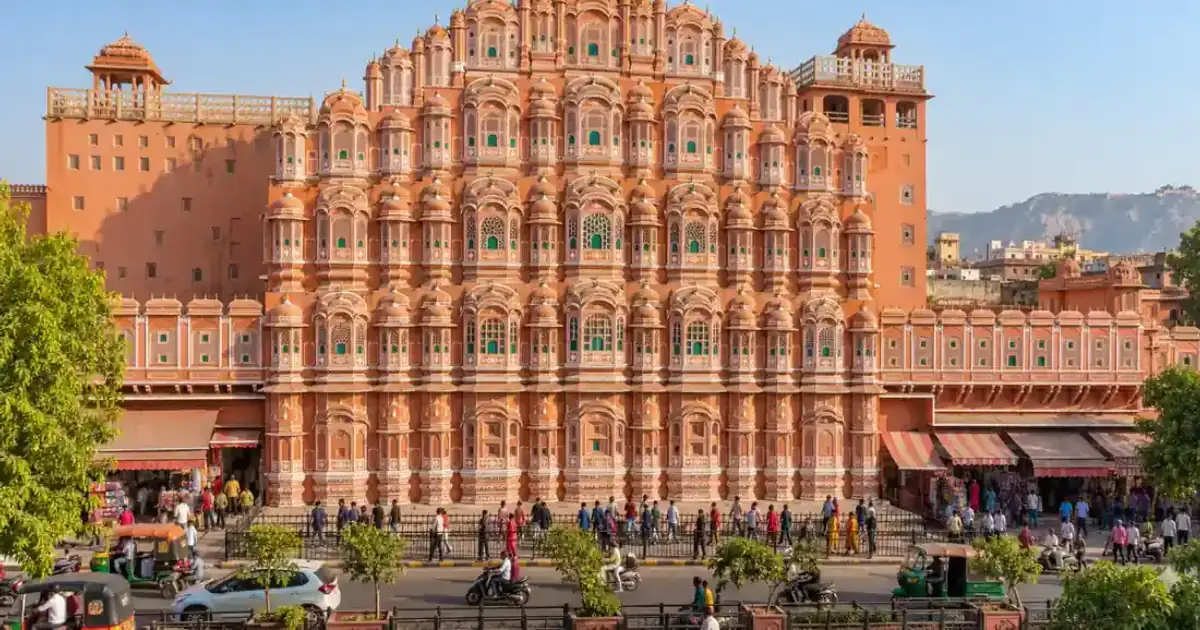
Erected in 1799 AD by Sawai Pratap Singh and designed by Lal Chand Ustad, Hawa Mahal is a five-story pyramidal screen constructed from red and pink sandstone. The facade incorporates 953 finely carved stone casement windows (jharokhas) designed to allow royal ladies to watch street pageants without violating purdah modesty.
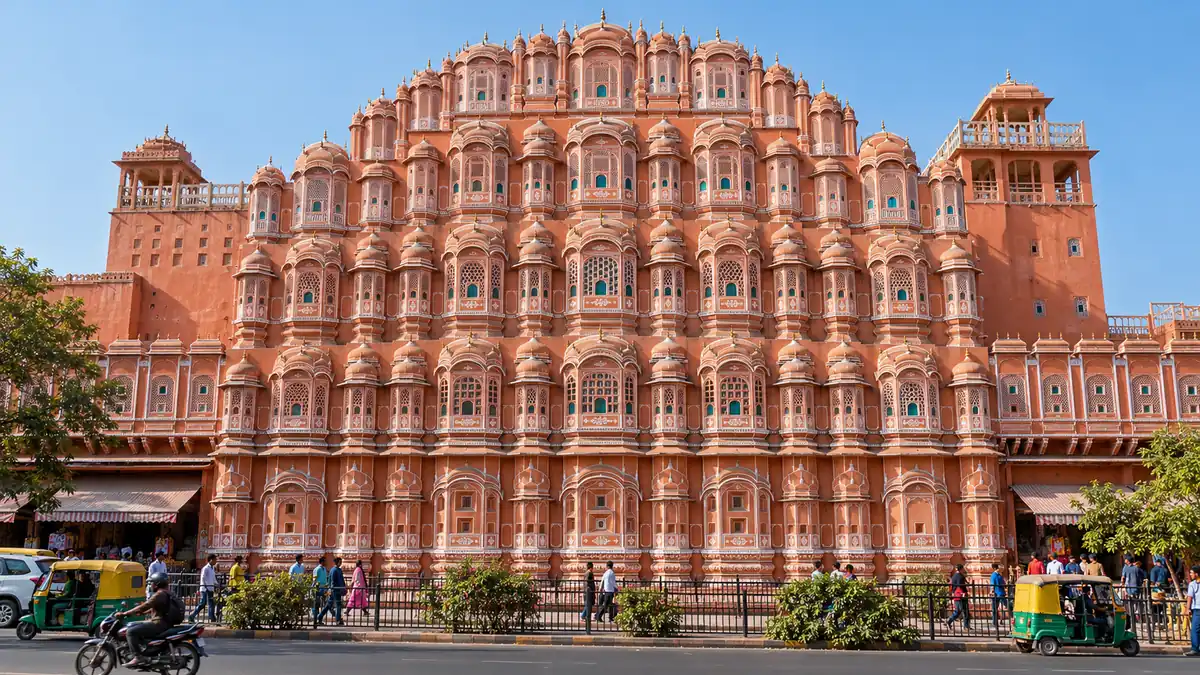
The structure operates without internal staircases to the upper floors, utilizing sloping pedestrian ramps instead. The miniature windows create a natural Venturi airflow effect, maintaining cool drafts during summer months.
City Palace and Chandra Mahal Museum
City Palace occupies a central sector of the walled city, founded in 1727 AD and retaining administrative suites used by the royal family of Jaipur to this day. Visitors enter through the grand Virendra Pol into Mubarak Mahal, an ornate reception pavilion displaying royal textiles, Kashmiri pashminas, and embroidered court robes.
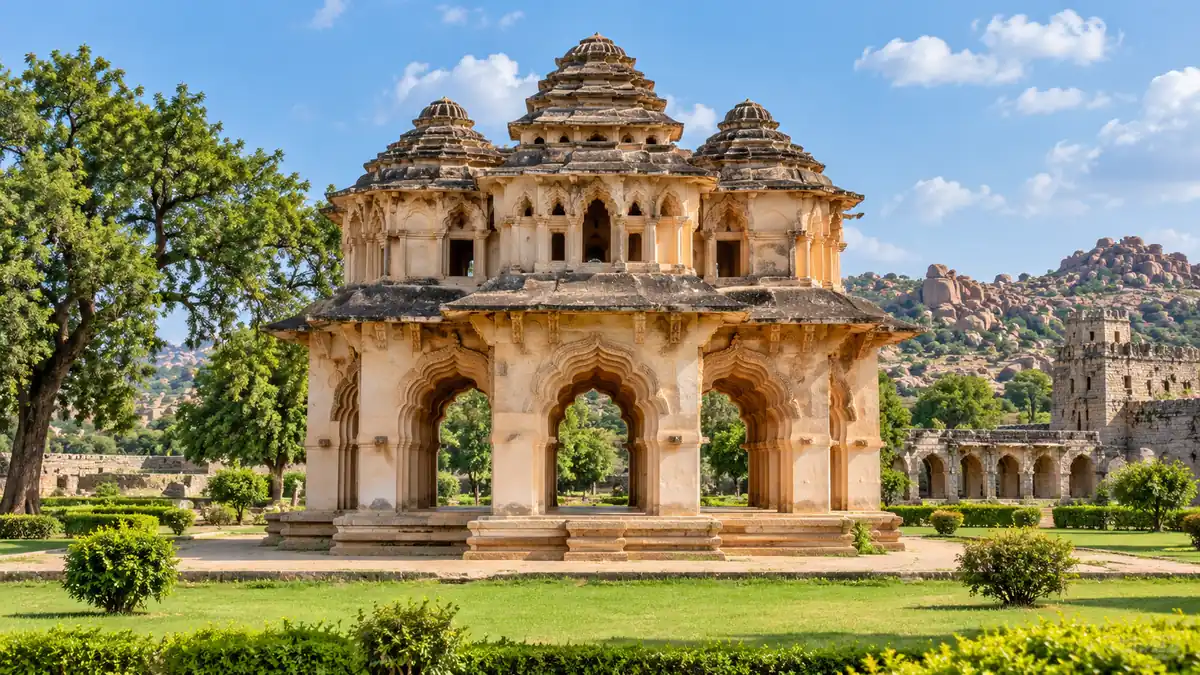
The inner Sarvatobhadra courtyard displays two colossal sterling silver water vessels (Gangajalis) measuring 1.6 meters tall and weighing 340 kilograms each, certified by Guinness World Records as the largest silver objects ever cast. The seven-story Chandra Mahal crowns the inner gardens with peacocks and miniature portraits.
Jantar Mantar Astronomical Observatory
Constructed between 1728 and 1734 AD by astronomer-king Sawai Jai Singh II, Jantar Mantar preserves 19 massive stone architectural instruments designed to measure time, predict eclipses, and track celestial orbits. The complex represents the best-preserved historic astronomical observatory in India.
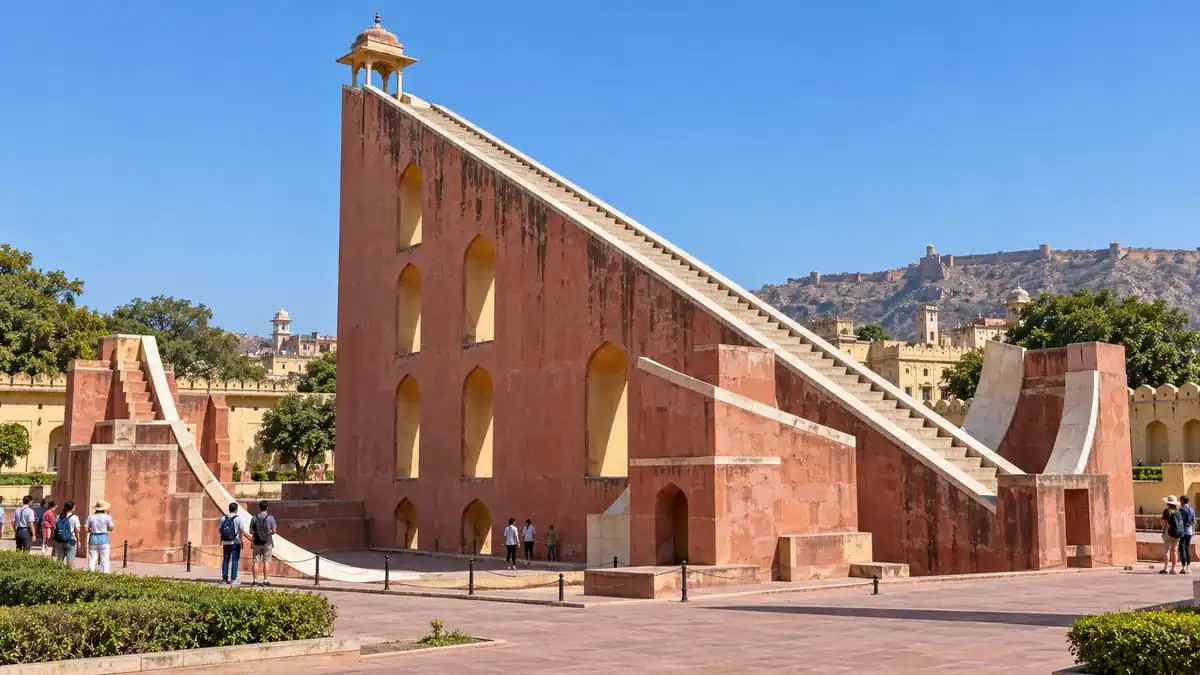
The dominant instrument is the Vrihat Samrat Yantra, a 27-meter tall stone gnomon sundial capable of calculating local solar time to an accuracy of two seconds. The site was inscribed on the UNESCO World Heritage register in 2010.
Jal Mahal in Man Sagar Lake
Jal Mahal is an 18th-century royal pleasure lodge situated in the center of Man Sagar Lake on the northern highway to Amer. The palace is constructed from red sandstone and appears to float on the water surface; while four stories remain submerged beneath lake waters, only the top floor stands visible above the waterline.
While interior access is currently restricted to government conservation personnel, the lakeside promenade provides clear photographic angles of the water reflection framed by the Aravalli hills.
National heritage preservation standards and cultural calendars are detailed on the Incredible India Jaipur City Guide.
Heritage Museums, Sacred Shrines, and Traditional Bazaars
Jaipur supports a rich craft economy based on block-printed textiles, blue pottery, and gemstone cutting, alongside ancient temple sites.
Albert Hall Museum in Ram Niwas Garden
Designed by Sir Samuel Swinton Jacob and opened in 1887, Albert Hall represents the oldest public museum in Rajasthan. The Indo-Saracenic building combines carved stone domes, floral stone pillars, and open courtyards set in Ram Niwas Garden.
The museum galleries exhibit Persian carpets, metal sculptures, coins, and a Ptolemaic-era Egyptian mummy dating to 322 BC. Floodlights illuminate the exterior facade after sunset, attracting hundreds of pigeons and evening walkers.
Galtaji Temple (Monkey Temple)
Galtaji is an ancient Hindu pilgrimage center tucked into a narrow rock mountain gorge 10 km east of Jaipur. The complex features natural freshwater mountain springs that cascade down from the cliffs into seven sacred stone bathing tanks (kunds).
Hundreds of rhesus macaque monkeys inhabit the surrounding rocky cliffs, giving the temple its popular colloquial name. The highest pavilion atop the ridge is dedicated to Surya, the sun god, providing panoramic morning views across the eastern valley.
Traditional Bazaars of the Walled City
The grid avenues of the Old City are organized into specialized artisan craft quarters. Johari Bazaar serves as the epicenter of precious gemstones, silver jewellery, and traditional Kundan-Meenakari enameling.
Bapu Bazaar and Nehru Bazaar are famous for traditional camel leather mojari footwear and hand-block-printed textiles, including Sanganeri and Bagru cotton prints. Bazaars generally operate Monday through Saturday from 10:30 AM to 8:30 PM. Food lovers strolling through Johari Bazaar should not miss sampling authentic pyaaz kachoris and saffron malai ghevar documented in our Jaipur street food guide.
District transit advisories and parking zones are published on the District Administration Jaipur Tourist Guide.
Curated 1-Day, 3-Day, and 5-Day Jaipur Travel Itineraries
Grouping your sightseeing between the walled historic core and the mountain ridge reduces transit delays across city gates.
1-Day Itinerary: The Royal Classic Highlights
- Morning (8:30 AM to 12:00 PM): Ascend Amer Fort early to explore the Sheesh Mahal, then take photos of Jal Mahal on the return drive into town.
- Afternoon (1:00 PM to 4:30 PM): Tour City Palace, view the silver Gangajali urns, and study the giant sundials at Jantar Mantar.
- Evening (5:00 PM to 7:30 PM): Photograph the pink facade of Hawa Mahal, shop for souvenirs in Johari Bazaar, and enjoy a traditional Rajasthani thali.
3-Day Itinerary: Complete Forts, Palaces, and Bazaars
- Day 1: Classic inner-city landmarks covering Hawa Mahal, City Palace, Jantar Mantar, and evening lights at Albert Hall Museum.
- Day 2: Ridge fortress circuit including Amer Fort, Jaigarh Fort’s giant cannon, and sunset tea overlooking the city at Nahargarh Fort.
- Day 3: Heritage excursion to Galtaji monkey temple, blue pottery workshops, and textile shopping in Bapu Bazaar.
5-Day Itinerary: Deep Heritage, Stepwells, and Craft Villages
- Days 1–3: Complete the comprehensive 3-day fort and palace itinerary.
- Day 4: Day trip to the ancient 8th-century Chand Baori stepwell at Abhaneri and the ghost fort of Bhangarh.
- Day 5: Artisan day trip to Sanganer and Bagru villages to observe hand-block printing, followed by onward highway travel to the monuments of Fatehpur Sikri or southward toward the royal Mewar bastions outlined in our Chittorgarh travel guide.
Frequently Asked Questions About Places to Visit in Jaipur
How many days are enough for a Jaipur trip?
Three full days provide sufficient time to tour the major Aravalli ridge forts of Amer, Jaigarh, and Nahargarh alongside City Palace, Hawa Mahal, and local bazaars. Travelers wishing to include craft excursions to Bagru, stepwells at Abhaneri, or wildlife at Jhalana Leopard Safari should plan for 4 to 5 days.
What is the composite ticket for Jaipur monuments?
The Rajasthan Department of Archaeology composite ticket costs ₹100 for Indian citizens and ₹500 for foreign travelers, remaining valid for two consecutive days. It covers entry to Amer Fort, Hawa Mahal, Jantar Mantar, Nahargarh Fort, and Albert Hall Museum, saving substantial queue time and cost compared to individual tickets.
Which is the best fort to visit in Jaipur?
Amer Fort is the most important fort to visit due to its vast palaces, detailed mirrorwork inside the Sheesh Mahal, and lakeside courtyards. Travelers seeking quiet sunset viewpoints over the city skyline often prefer Nahargarh Fort, while weapons enthusiasts favor Jaigarh Fort.
What is the best time of year to visit Jaipur?
The best travel period runs from October through March when cool, dry winter weather with daytime temperatures between 18°C and 28°C makes outdoor exploration comfortable. Summer months from April through June bring extreme desert heat with temperatures regularly exceeding 42°C.
How do travelers connect Jaipur with Golden Triangle sites in Delhi?
Jaipur forms the western apex of the classic Golden Triangle route, linked to New Delhi by the Delhi-Mumbai Expressway and express trains. Many travelers begin their tour in the capital visiting modern architectural landmarks like the one detailed in our Akshardham Temple Delhi guide before driving to Jaipur.