15 Best Places to Visit in Chittorgarh: Fort & Palaces
Plan your trip with the best places to visit in Chittorgarh including Chittorgarh Fort, Vijay Stambh, Padmini Palace, timings, tickets, and routes.
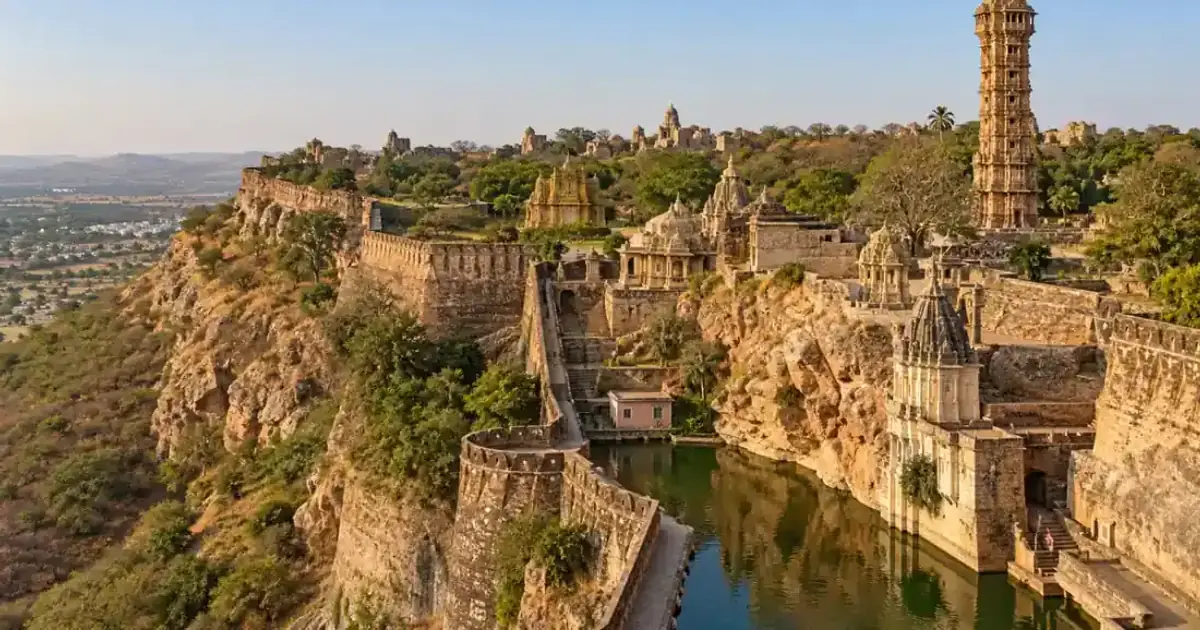
Chittorgarh stands as one of the most historically significant fortress cities in Rajasthan, serving as the ancestral capital of the Kingdom of Mewar. Crowned by a 700-acre hilltop citadel that rises 180 meters above the southern plains, the city preserves legendary stories of Rajput valor and enduring resistance.
Today, travelers explore ancient victory towers, stone water reservoirs, and intricately carved temples spread across this UNESCO World Heritage Site.
Visitor Essentials
- Chittorgarh Fort spans across a 700-acre rocky plateau elevated 180 meters above the southern plains of Rajasthan.
- Monument gates open daily from 9:00 AM to 5:00 PM, with Archaeological Survey of India tickets costing ₹40 for Indian citizens and ₹600 for foreign visitors.
- Key architectural landmarks inside include the 37-meter-tall Vijay Stambh, the 22-meter-tall Kirti Stambh, Padmini Palace, and Rana Kumbha Palace.
- Chittorgarh connects conveniently to Udaipur (115 km southwest) and Jaipur (310 km northeast) via direct express trains and National Highway 48.
Top Heritage Attractions and Monuments in Chittorgarh
Chittorgarh offers a vast complex of royal palaces, commemorative victory spires, and historic stepwells contained largely within its hilltop perimeter. Visitors typically spend four to six hours exploring the primary fort circuit by car or authorized auto-rickshaw.
| Landmark Name | Architectural Style | Visiting Hours | Entry Fee Details |
|---|---|---|---|
| Chittorgarh Fort Complex | Rajput Military Citadel | 9:00 AM – 5:00 PM | ₹40 Indians, ₹600 Foreigners |
| Vijay Stambh (Victory Tower) | 9-Story Red Sandstone & Marble | 9:00 AM – 5:00 PM | Included in Fort ticket |
| Kirti Stambh (Tower of Fame) | 7-Story Solanki Jain Tower | 9:00 AM – 5:00 PM | Included in Fort ticket |
| Padmini Palace | Water-Moated Summer Pavilion | 9:00 AM – 5:00 PM | Included in Fort ticket |
| Rana Kumbha Palace | 15th-Century Mewar Royal Court | 9:00 AM – 5:00 PM | Included in Fort ticket |
| Meera Temple | Indo-Aryan Krishna Shrine | 9:00 AM – 5:00 PM | Free admission inside Fort |
| Gaumukh Reservoir | Rock-Cut Sacred Spring Reservoir | 9:00 AM – 5:00 PM | Free admission inside Fort |
Official preservation records published on the Chittorgarh District Administration Tourism Portal document how the plateau was engineered to support over 84 water reservoirs, ensuring long-term supplies during extended warfare. Today, approximately twenty-two water bodies remain active within the fort walls.
Chittorgarh Fort: Bastions, Seven Pol Gates, and Historic Sieges
Chittorgarh Fort features an imposing 13-kilometer defensive wall punctuated by circular bastions and sheer stone ramparts. The winding uphill road enters the fortress through seven monumental gateway checkpoints, known locally as pols.
Starting from Padan Pol at the base, travelers pass through Bhairon Pol, Hanuman Pol, Ganesh Pol, Jodla Pol, Laxman Pol, and Ram Pol. Memorial stone chhatris honouring fallen Mewar generals Jaimal and Kalla Rathore stand between Bhairon Pol and Hanuman Pol, marking the exact sites of their heroic resistance during the 1568 siege by Mughal Emperor Akbar.
Travelers organizing regional circuits can consult our comprehensive Rajasthan travel guide to align fort visits with neighboring royal palaces in Mewar and Marwar. Chittorgarh Fort underwent three major historic sieges, by Alauddin Khilji in 1303, Bahadur Shah of Gujarat in 1535, and Akbar in 1568, each culminating in the rite of Jauhar to protect honor.
Rana Kumbha Palace represents the oldest surviving residential complex inside the citadel. Constructed in the fifteenth century with dressed stone and decorative brackets, the palace features an underground vault where Queen Padmini and noblewomen are believed to have committed Jauhar.
Vijay Stambh and Kirti Stambh: Towers of Victory and Fame
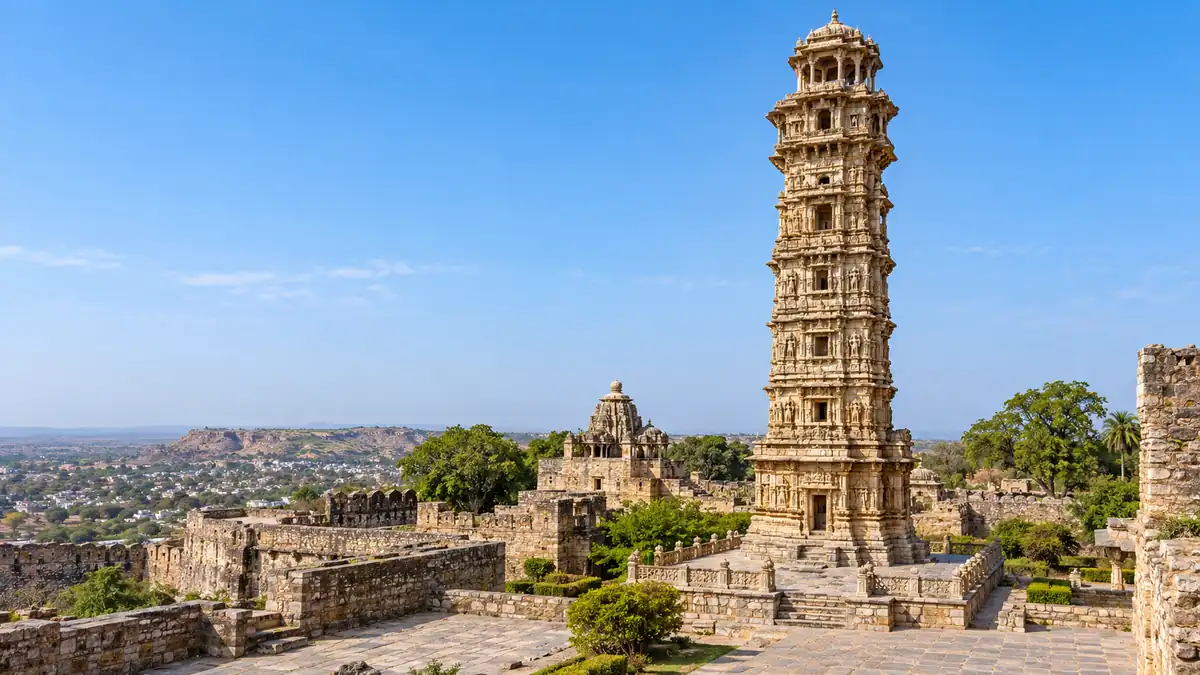
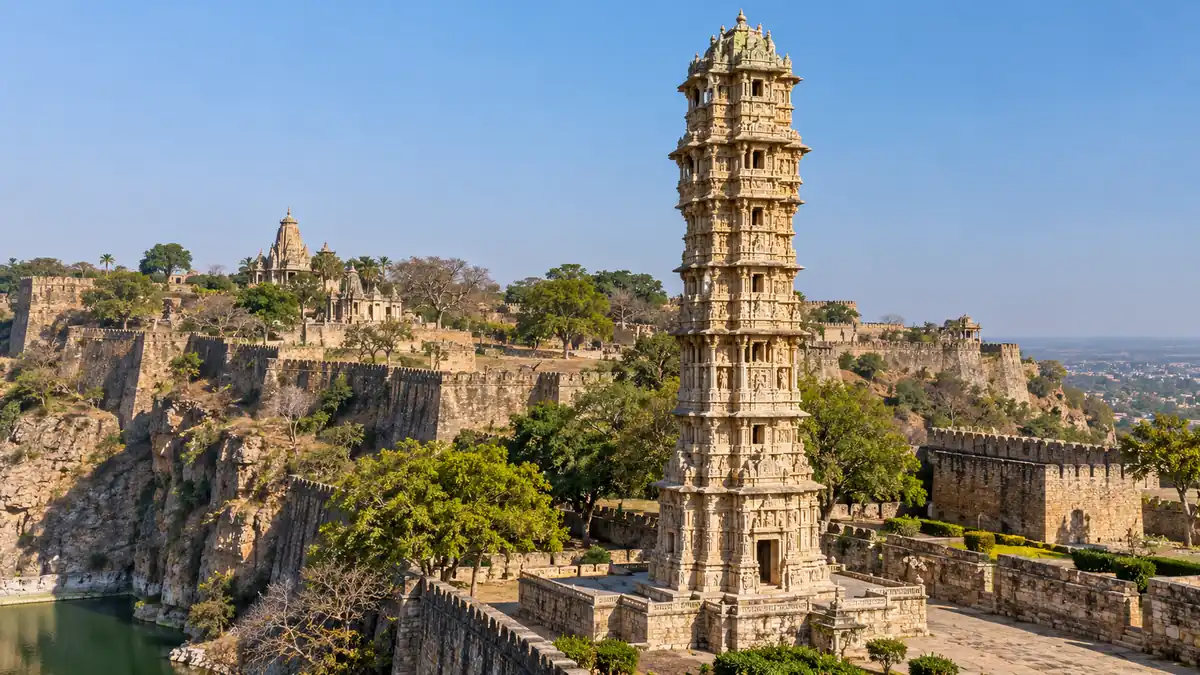
Vijay Stambh, or the Tower of Victory, serves as the most prominent architectural symbol of Chittorgarh. Maharana Kumbha commissioned the nine-story monument between 1448 and 1458 CE to celebrate his military triumph over the joint armies of Malwa and Gujarat led by Mahmud Khilji.
The tower stands 37.19 meters tall on a raised stone plinth measuring 14.3 meters across. Every exterior face is embellished with intricate stone carvings depicting Hindu deities, musical instruments, weapons, and seasonal motifs.
The Rajasthan Tourism Chittorgarh Portal details how visitors can ascend the narrow 157-step interior stone spiral staircase to reach the open viewing gallery on the ninth tier. The upper balcony provides sweeping views of the Mewar countryside and the lower city of Chittor.
Kirti Stambh stands approximately one kilometer north of Vijay Stambh, measuring 22 meters in height. A wealthy Jain merchant named Jijaji Rathod erected this seven-story tower during the twelfth century to honor Rishabhanatha, the first Jain Tirthankara. Maharana Kumbha’s architectural patronage extended across southern Rajasthan; travelers can explore his mountain citadel and the nearby marble temple in our Kumbhalgarh Fort and Ranakpur guide.
The exterior walls display finely carved relief figures of naked Tirthankaras and sacred celestial maidens representing the Digambara Jain tradition.
Padmini Palace and Gaumukh Reservoir: Legends of Mewar
Padmini Palace stands beside a scenic lotus pond in the southern section of the fort complex. Originally designed as a three-story summer residence, the white pavilion combines cooling breezes with panoramic views of the water moat.
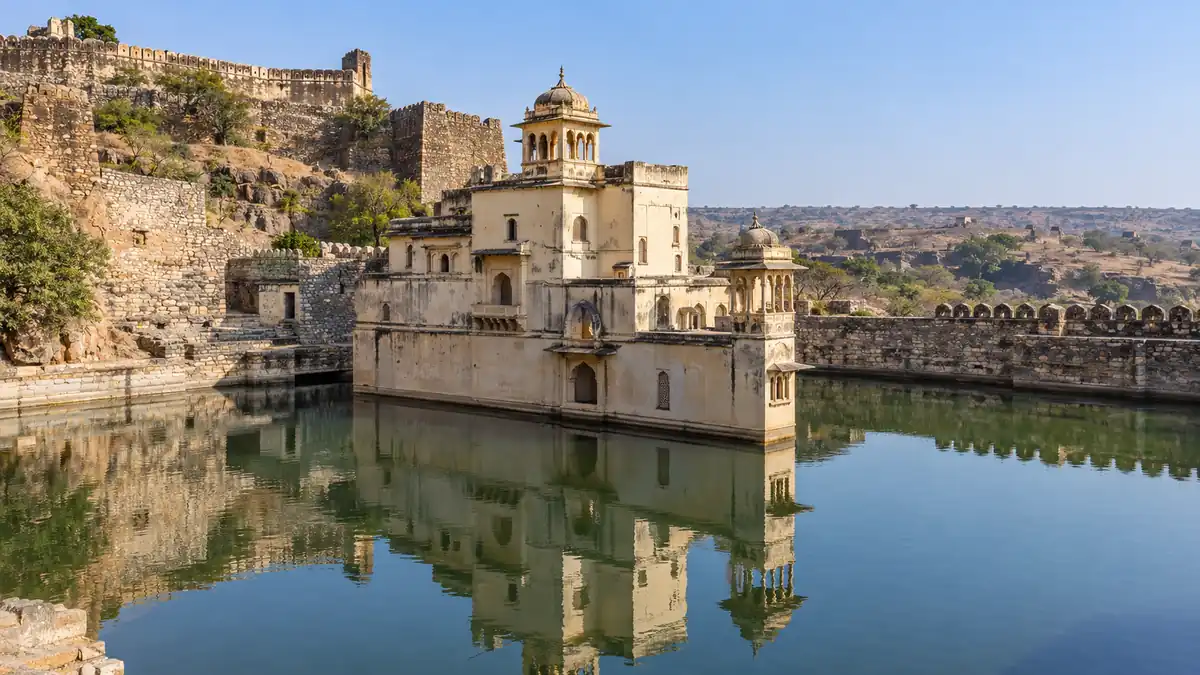
Local legends recount that Alauddin Khilji was permitted to glimpse the reflection of Queen Padmini in a bronze mirror placed within the palace chamber, sparking the fatal battle of 1303.
Architectural comparisons with other grand palatial complexes can be explored in our review of key landmarks and neighborhoods in Jaipur, which highlights later Rajput palace styles developed in Amber and the Pink City.
Just northwest of the palace lies the Gaumukh Reservoir, a deep rock-cut basin fed by an underground natural mountain spring. Water streams steadily from a carved stone cow’s mouth into the stepped pool, where pilgrims continue to take ritual dips before entering adjacent Shiva shrines.
Sacred Shrines: Meera Temple, Kalika Mata, and Samaddhisvara
Meera Temple honors the legendary sixteenth-century poet-saint Meera Bai, who renounced royal wealth to dedicate her life to Lord Krishna. Built during the reign of Rana Kumbha in the classical Indo-Aryan shikhara style, the temple features a high plinth, an intricately vaulted mandapa, and stone relief panels illustrating Krishna’s pastimes.
A small memorial shrine honoring Meera Bai’s spiritual guru, Saint Ravidas, stands in the courtyard, preserving his carved footprints.
Devotees of historic stone craft can compare these sacred structures with the intricately carved desert temples described in our guide on places to visit in Jaisalmer.
Kalika Mata Temple stands nearby on an eighth-century stone platform originally built as a Sun Temple before its rededication to Goddess Durga in the fourteenth century. Samaddhisvara Temple, located adjacent to Gaumukh Reservoir, preserves a towering three-faced stone idol of Lord Shiva carved during the eleventh century under King Bhoja of the Paramara dynasty.
Best Time to Visit Chittorgarh and Seasonal Travel Tips
Chittorgarh experiences arid desert-fringe climate conditions, making the winter months from October to March the ideal travel window. Daytime temperatures range comfortably between 18°C and 28°C, providing pleasant conditions for walking across open stone terraces and ascending monument towers.
Summer arrives from April through June with intense daytime heat frequently exceeding 42°C, which makes midday fort exploration challenging.
Travelers combining fort tours with camel safaris can explore the winter landscapes of Sam Sand Dunes Jaisalmer for complete desert excursions. Visitors touring Chittorgarh should carry refillable water bottles, wear broad-brimmed sun hats, and use comfortable walking shoes with firm rubber traction for navigating uneven cobblestones and steep staircases.
An evening sound and light show held near the Rana Kumbha Palace narrates the history of Mewar in both Hindi and English from 7:00 PM onwards.
How to Reach Chittorgarh by Train, Flight, and Highway
Chittorgarh Junction serves as a major broad-gauge railway interchange connecting directly to Delhi, Mumbai, Jaipur, Kota, and Ahmedabad. Daily superfast express trains like the Chetak Express link the city to national hubs with comfortable overnight sleeper services.
The nearest commercial airport is Maharana Pratap Airport in Dabok, Udaipur, located 90 kilometers southwest along a smooth four-lane highway.
The Incredible India Chittorgarh Heritage Profile notes that National Highway 48 connects Chittorgarh smoothly to both Udaipur and Bhilwara. State transport buses run every thirty minutes between Udaipur Central Bus Stand and Chittorgarh, covering the distance in under two hours.
Travelers touring the desert state in February can also coordinate their trip with the celebrated Jaisalmer Desert Festival to experience traditional folk dances, camel races, and regional music.
Frequently Asked Questions About Places to Visit in Chittorgarh
How much time is needed to visit Chittorgarh Fort?
Touring Chittorgarh Fort requires approximately four to six hours to explore the primary towers, palaces, temples, and stepwells comfortably. Visitors should hire an auto-rickshaw or drive a private vehicle between dispersed monument clusters inside the plateau.
What are the entry ticket prices for Chittorgarh Fort?
Admission to Chittorgarh Fort costs ₹40 for Indian citizens and ₹600 for foreign travelers when booked at official monument counters. Entry tickets cover access to all primary Archaeological Survey of India monuments inside the fort walls.
Can vehicles enter inside Chittorgarh Fort?
Yes, private cars, tourist taxis, and auto-rickshaws can drive freely through the seven historic gates up to the plateau. Paved interior roads connect each major palace complex and temple parking area.
Is Vijay Stambh open for climbing?
The interior spiral staircase of Vijay Stambh is open to visitors, allowing travelers to climb 157 steps to the ninth floor for panoramic views. Visitors with limited mobility or claustrophobia should exercise caution as the stairwell is narrow and dim.
How far is Chittorgarh from Udaipur?
Chittorgarh is located approximately 115 kilometers northeast of Udaipur via the six-lane National Highway 48. The road journey takes about two hours by private taxi or state transport bus; explore our comprehensive guide to Udaipur sightseeing guide for City Palace tours and Lake Pichola sunset boat cruises.