Khatu Shyam Ji Temple: Nishan Yatra & Darshan Timings Guide
Plan your pilgrimage to Khatu Shyam Ji Temple in Rajasthan. Complete guide to Ringas Nishan Yatra, Falgun Mela dates, VIP darshan pass, timings, and hotels.
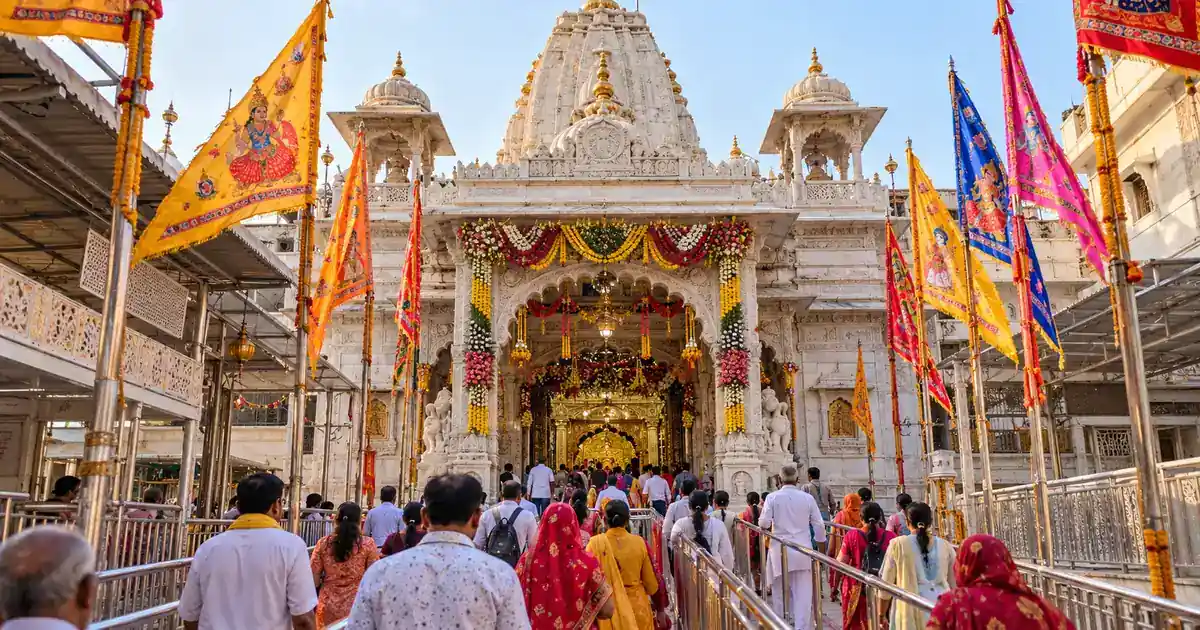
Khatu Shyam Ji Temple stands in the historic village of Khatu in the Sikar district of Rajasthan, approximately 80 kilometers northwest of Jaipur. Revered by millions of devotees across northern and western India as the supreme fulfiller of wishes (Haare Ka Sahara), this sacred shrine is dedicated to Barbarika, the grandson of the Pandava warrior Bhima, worshiped here as an incarnation of Lord Krishna.
The temple is widely celebrated for its grand annual Falgun Lakhi Mela and the deeply devotional 17-kilometer barefoot Nishan Yatra that commences from the railway junction town of Ringas. Pilgrims carry colorful triangular flags while chanting hymns of devotion, creating an extraordinary atmosphere of spiritual enthusiasm across the arid plains of the Shekhawati region.
Khatu Shyam Ji Pilgrim Advisory
- Sanctum Deity: Lord Shyam (Barbarika’s sacred head, known as Sheesh Ke Daani).
- Key Regional Titles: Haare Ka Sahara, Teen Baandhari, and Lakha-Daata.
- The Signature Ritual: Nishan Yatra, a 17-kilometer foot procession carrying holy flags from Ringas to Khatu.
- Peak Annual Gathering: Falgun Lakhi Mela (Phalguna Shukla Shasthi to Dwadashi, typically in February or March).
- Nearest Railhead: Ringas Junction (RGS), located 17 km southeast along National Highway 52.
The Epic Legend of Barbarika: The Supreme Head Sacrifice
The origin of Khatu Shyam Ji is rooted in the events preceding the catastrophic eighteen-day Mahabharata war on the plains of Kurukshetra. Barbarika was the son of Ghatotkacha and the warrior princess Maurvi (Kamkantika).
Through rigorous childhood penance, Barbarika had received three infallible divine arrows (Teen Baan) from Goddess Kamakhya and Lord Shiva. A single arrow marked all enemy targets, the second marked all protected allies, and the third destroyed the enemy targets before returning safely to his quiver.
Bound by a solemn oath to his mother to always fight on the side that was losing (Haare Ka Sahara), Barbarika set out for Kurukshetra. Recognizing that Barbarika’s vow would inevitably force him to switch sides continuously until both armies were completely annihilated, Lord Krishna disguised himself as a wandering Brahmin to test his resolve.
Krishna challenged the young warrior to pierce all the leaves of an ancient Peepal tree with a single arrow. As Barbarika strung his bow, Krishna discreetly hid one fallen leaf under his foot. The miraculous arrow pierced every leaf on the branches and then hovered insistently over Krishna’s foot, revealing Barbarika’s unmatched prowess.
Devotees seeking deeper insight into the battlefield origins of this epic can consult our guide to sacred heritage Kurukshetra travel highlights.
The Gift of the Head (Sheesh Daan)
Knowing Barbarika could not be defeated in combat, Krishna asked for the ultimate charity (Bhiksha): Barbarika’s own head. Without hesitation, Barbarika drew his sword and severed his head, presenting it as an offering on the morning of Shukla Ekadashi.
Pleased by his supreme selflessness, Lord Krishna blessed Barbarika with three divine boons:
- He would be worshiped throughout the Kaliyuga under Krishna’s own name, Shyam.
- No devotee who approaches him with a sincere heart in distress would return empty-handed.
- His severed head would be placed atop a nearby hillock to witness the entire Mahabharata conflict from beginning to end.
Following the battle, Barbarika declared that he saw only Krishna’s Sudarshana Chakra executing divine justice across the field. Centuries later, his consecrated head was discovered buried in the sands of Khatu village and installed in the temple sanctum.
Temple Architecture, Sanctum Murti & Shyam Kund
The original stone shrine was constructed in 1027 CE by Raja Roopsingh Chauhan and his consort Maharani Narmada Kanwar. The complex underwent extensive expansion in 1720 CE under Diwan Abhai Singh of Marwar.
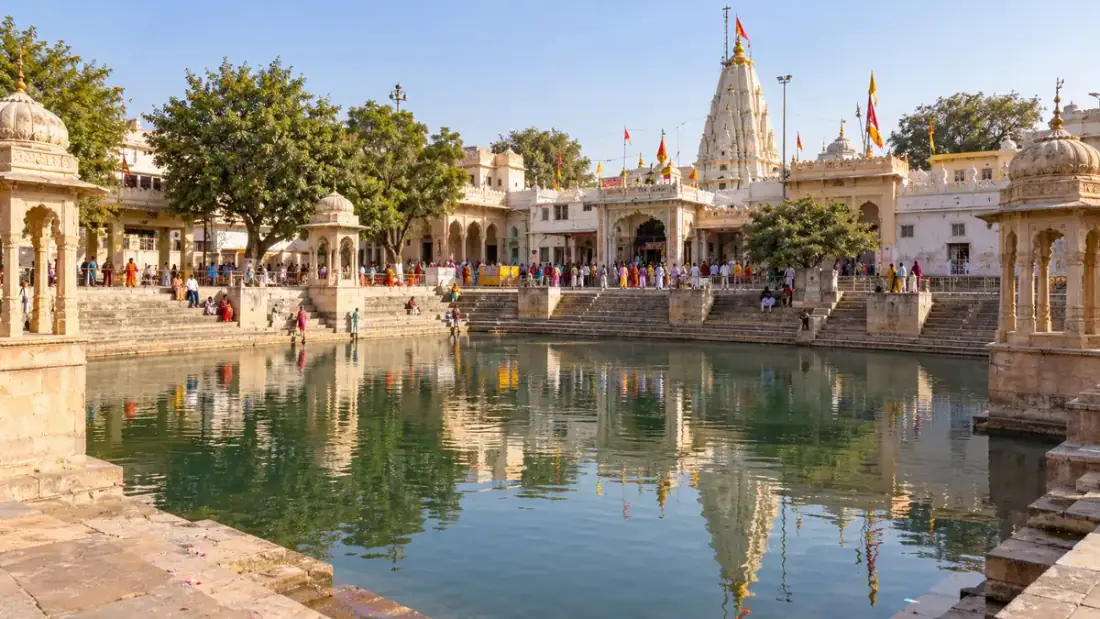
Crafted from pure white Makrana marble and local yellow sandstone, the temple displays traditional Rajput architectural elements, featuring sculpted floral archways, chhatris, and open courtyards. Devotees can contrast this desert marble architecture with the stone palace bastions documented in our master guide on places to visit in Rajasthan.
The Sanctum Murti
Inside the inner sanctum, only the divine head of Lord Shyam (Sheesh) is worshiped. The sacred stone head is adorned each morning with fresh floral garlands, fragrant roses, and a gold or silver crown.
The facial features are highlighted by large, compassionate eyes carved from rare black stone. Devotees offer pure cow milk pedas, fragrant rose petals, and traditional churma prasad to the deity.
The Sacred Shyam Kund
Located near the main temple is the holy Shyam Kund, the stepped stone reservoir from which Barbarika’s head was historically retrieved.
- Tradition: Pilgrims bathe in the separate men’s and women’s sections of the kund before joining the darshan queue.
- Healing Beliefs: The water of Shyam Kund is regarded as spiritually purifying, believed to alleviate physical ailments and mental anguish.
The Nishan Yatra: 17 km Sacred Flag Pilgrimage
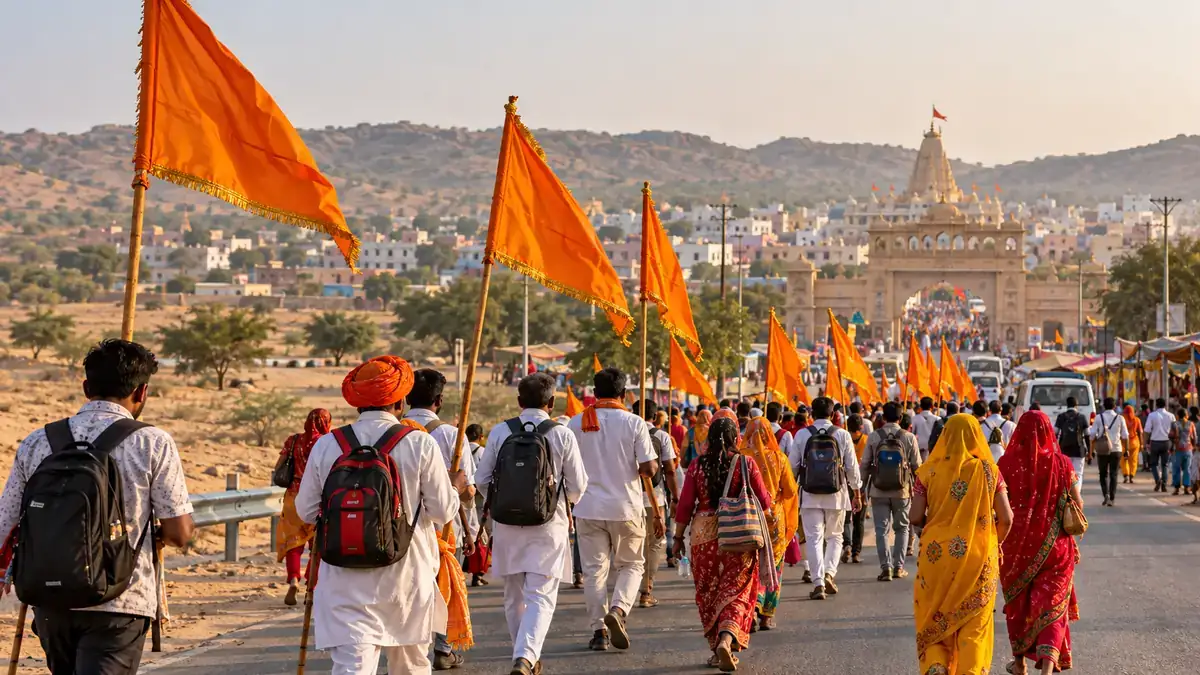
The most cherished pilgrimage practice at Khatu is the Nishan Yatra. Devotees purchase a brightly colored triangular satin flag (Nishan) decorated with tinsel borders, peacocks, and images of Lord Shyam mounted on a bamboo staff.
| Pilgrimage Phase | Typical Timing | Route Instructions |
|---|---|---|
| Flag Consecration | Early morning at Ringas | Pujan of the Nishan at the Ringas Bhairav or Hanuman temples |
| Foot Journey | 5 to 6 hours walking | Dedicated pedestrian walkway along the 17 km Ringas-Khatu road |
| Seva Camps En Route | Continuous along the highway | Free refreshments, medical aid, foot massages, and drinking water |
| Nishan Surrender | Upon entering Khatu sanctum | Flags are presented to temple priests and placed at the deity’s feet |
Pilgrims walk barefoot along the paved corridor, singing devotional bhajans (Haare Ka Sahara, Baba Shyam Hamara) accompanied by the rhythm of dholaks and brass cymbals. Carrying the Nishan on foot is believed to fulfill deeply held personal vows (Mannat).
The Annual Falgun Lakhi Mela
The annual Falgun Lakhi Mela takes place during the bright half of the lunar month of Phalguna (typically February or March), culminating on the auspicious day of Amalaki Ekadashi.
During this five-day festival, over four million pilgrims from across India converge upon Khatu village. The entire town transforms into a sea of saffron flags and celebratory colors. Special pedestrian holding zones, mist cooling fans, and 24-hour medical emergency stations are erected by the district administration.
- Peak Rush Days: Phalguna Shukla Navami, Dashami, and Ekadashi.
- Crowd Advisory: Expect queue waiting times of 6 to 12 hours during the peak mela days. Advance hotel bookings are essential months ahead.
- Official Security: Over 5,000 police personnel and volunteers manage the continuous one-way pedestrian circuits to ensure crowd safety. Official safety advisories can be reviewed via the Sikar District Administration portal.
Daily Darshan Timings, Sevas & Temple Schedule
The temple operates long daily shifts to handle the relentless influx of pilgrim groups.
| Season | Morning Darshan Hours | Afternoon Break | Evening Darshan Hours |
|---|---|---|---|
| Winter (October to March) | 5:30 AM – 12:30 PM | Closed 12:30 PM – 4:00 PM | 4:00 PM – 9:00 PM |
| Summer (April to September) | 4:30 AM – 12:30 PM | Closed 12:30 PM – 4:30 PM | 4:30 PM – 10:00 PM |
| Ekadashi & Mela Days | Continuous 24-hour darshan | No afternoon closure | Open overnight with brief aarti breaks |
The Five Sacred Daily Aartis
- Mangala Aarti (Dawn): Performed when the temple doors first open to greet the deity with camphor lamps.
- Shringaar Aarti (Morning): Celebrates the completion of the daily floral decoration and crowning ceremony.
- Bhog Aarti (Noon): Traditional lunch offerings consisting of kheer, churma, and sweets.
- Sandhya Aarti (Dusk): Grand twilight worship accompanied by drums, conches, and multi-tiered brass oil lamps.
- Shayan Aarti (Night): Lullaby hymns recited before the sanctum curtains close for the night.
Devotees interested in Krishna traditions in western India can contrast this Shekhawati shrine with the coastal sanctum featured in our Dwarkadhish Temple Dwarka guide.
Online VIP Pass & Smart Queue Booking
To streamline pilgrim movement, the Shri Shyam Mandir Committee operates an online e-pass facility through its official temple portal.
- Regular Queue: Completely free. Pilgrims move through zig-zag covered waiting corridors equipped with drinking water fountains and overhead fans.
- Special Darshan Pass: During high-demand weekends and festival periods, visitors can register online for time-slotted darshan passes, reducing waiting times to approximately 45 to 60 minutes.
- Senior Citizens & Divyangjan: Dedicated battery-operated shuttle carts and priority access ramps operate from the outer parking grounds to the inner sanctum.
How to Reach Khatu Shyam Ji Temple
Khatu village enjoys convenient road and rail connectivity via nearby transport junctions.
| Transport Mode | Terminal Hub | Travel Route to Temple Gates |
|---|---|---|
| By Train | Ringas Junction (RGS) | Located 17 km away. Direct express trains arrive daily from Delhi Sarai Rohilla, Jaipur, Rewari, and Ahmedabad. Shared jeeps and buses run continuously to Khatu (25 minutes). |
| By Road from Jaipur | Sindhi Camp Bus Stand / Jaipur City | 80 km northwest via the Jaipur-Sikar Highway (NH52). Private taxis reach Khatu in 1.5 to 2 hours. |
| By Road from Delhi | Dhaula Kuan / IFFCO Chowk | 275 km southwest via NH48 to Kotputli, then state highway via Neem Ka Thana to Ringas (5.5 hours drive). |
| By Air | Jaipur International Airport (JAI) | Situated 92 km southeast. Hired cabs provide door-to-door transit directly to Khatu village. |
Travelers can coordinate train itineraries and book express reservations through the official IRCTC portal. Regional heritage excursions across the desert state are detailed on the Rajasthan Tourism Official Portal.
Pairing Khatu with Nearby Holy Shrines
Pilgrims frequently combine Khatu Shyam Ji with other sacred monuments across the Shekhawati and Jaipur districts:
- Salasar Balaji: Dedicated to Lord Hanuman, located 105 km northwest in Churu district. The Khatu-Salasar pilgrimage is one of Rajasthan’s most popular combined spiritual circuits.
- Jeen Mata Temple: An ancient 1,000-year-old Shakti shrine dedicated to Goddess Durga, located just 28 km north of Khatu in a rugged mountain valley.
- Jaipur Cultural Landmarks: Conclude your pilgrimage by touring the pink city’s palaces and bazaars outlined in our guide to the best places to visit in Jaipur.
Travelers seeking a broader holiday plan across the desert state can coordinate extended highway routes via the Shekhawati heritage towns.
Accommodation: Dharamshalas and Hotels in Khatu
Khatu village features over 350 charitable dharamshalas, ashrams, and private hotels managed by devotional communities from Kolkata, Mumbai, Delhi, and Haryana:
- Community Dharamshalas: Provide clean air-cooled and air-conditioned family rooms for nominal donations of ₹400 to ₹1,200 per day. Many operate in-house pure vegetarian dining halls serving hot meals.
- Private Hotels: Modern hotels along the Ringas Road offer deluxe rooms, generator backup, and secure parking for ₹1,800 to ₹3,500 per night.
- Advance Booking: During Ekadashi dates and the Falgun Mela, all accommodations fill to capacity weeks in advance. Securing verified rooms before arriving is strongly recommended.
Frequently Asked Questions About Khatu Shyam Ji Temple
Why is Khatu Shyam Ji called Sheesh Ke Daani?
He is called Sheesh Ke Daani (the donor of the head) because Barbarika severed and donated his own head to Lord Krishna as an act of absolute charity prior to the Mahabharata war.
How long does the Ringas to Khatu Nishan Yatra take?
The 17-kilometer walking route from Ringas to Khatu generally takes between 4 and 6 hours at a moderate walking pace. The road is flat and lined with community refreshment tents.
What is the best day of the month to visit Khatu Shyam Ji?
The most auspicious dates are the monthly Shukla Paksha Ekadashi and Dwadashi. Devotees visit during these dates to participate in special aartis and receive sanctified prasad.
Is photography permitted inside the temple?
Photography and video recording are strictly prohibited inside the main sanctum sanctorum. Security guards monitor queues to ensure mobile phones remain stowed away in pockets or bags.
What food or prasad is offered to Lord Shyam?
Devotees traditionally offer pure cow milk pedas, kheer, roasted gram, sugar crystals (mishri), and traditional Rajasthani churma to the deity, fitting into broader devotional circuits mapped in our guide to the best places to visit in India.