Best Places to Visit in Fatehpur Sikri: Monuments & Guide
Explore the top places to visit in Fatehpur Sikri with updated ASI timings, entry tickets, Buland Darwaza history, Salim Chishti tomb, and Agra routes.
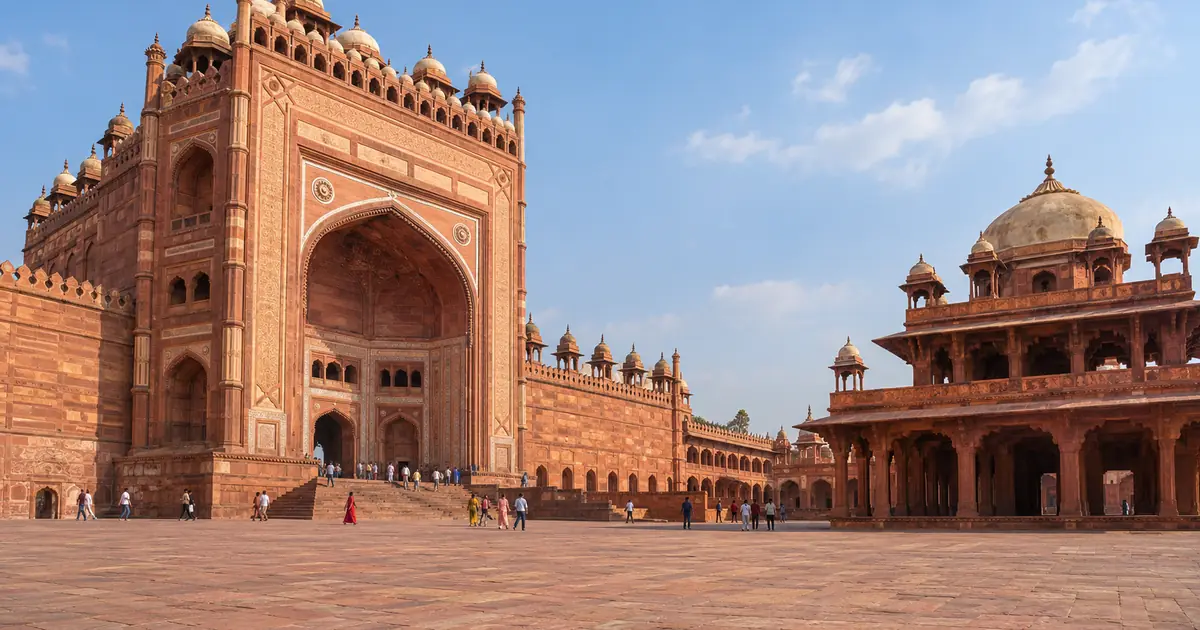
Fatehpur Sikri stands on an elevated rocky ridge in Agra district, Uttar Pradesh, 37 kilometers west of Agra city along National Highway 21. Commissioned in 1571 by the third Mughal Emperor, Akbar the Great, this fortified red sandstone complex served as the imperial capital of the Mughal Empire until 1585.
Inscribed as a UNESCO World Heritage Site in 1986, the city represents a unique fusion of Persian court geometry with indigenous Rajasthani and Gujarati stonecraft. Travelers visit from across the globe to admire the monumental Buland Darwaza gateway, the white marble mausoleum of Sufi saint Sheikh Salim Chishti, and open ceremonial palace courtyards.
Monument & Visitor Essentials
- Fatehpur Sikri is located in Agra district, Uttar Pradesh, 37 kilometers west of Agra city along National Highway 21.
- Monuments open daily from sunrise to sunset (roughly 6:00 AM to 6:30 PM), with Friday prayers observed at the adjacent Jama Masjid.
- ASI palace admission costs ₹50 for Indian citizens and ₹610 for foreign tourists, while the Jama Masjid and Buland Darwaza courtyard is free.
- Buland Darwaza stands 54 meters (177 feet) high, marking Emperor Akbar’s 1575 conquest of Gujarat.
- October through March provides comfortable sightseeing temperatures between 12°C and 26°C for exploring the sandstone courtyards.
Fatehpur Sikri Timings, ASI Entry Fees, and Ticket Booking
Fatehpur Sikri monuments open daily from sunrise to sunset, generally between 6:00 AM and 6:30 PM. Tickets for the imperial palace complex cost ₹50 for Indian visitors and ₹610 for international travelers, bookable cashless online through the Archaeological Survey of India portal or via on-site QR code stands.
Children under the age of 15 enter free of charge upon presenting proof of age at the barrier. Access to the religious quadrangle containing Buland Darwaza, the grand Jama Masjid, and the Dargah of Sheikh Salim Chishti requires no ticket, as it functions as an active place of worship.
Official ticketing guidelines and conservation updates are maintained on the Archaeological Survey of India Fatehpur Sikri Portal. Visitors park vehicles at the designated municipal parking lot near the highway junction and take electric shuttle buses for the final 1-kilometer uphill ascent to the gates. Travelers touring Uttar Pradesh’s red sandstone landmarks often compare Agra’s Mughal forts with Ambedkar Park Lucknow timings for evening city visits.
| Visitor Parameter | Indian Nationals / SAARC | Foreign Tourists | Booking Method |
|---|---|---|---|
| Imperial Palace Complex | ₹50 per person | ₹610 per person | ASI cashless online or on-site QR |
| Jama Masjid & Buland Darwaza | Free Entry | Free Entry | Open public religious access |
| Children (Under 15 Years) | Free | Free | Valid age proof required |
| Electric Shuttle Bus (Round Trip) | ₹10 per passenger | ₹10 per passenger | Paid at parking transit hub |
| Monument Timings | Sunrise to Sunset | Sunrise to Sunset | Open seven days a week |
Pro Tip
Purchase your ASI palace e-ticket on your smartphone before arriving at the parking lot to skip lines at the mobile network checkpost.
Buland Darwaza: Architecture and History of the Victory Gate
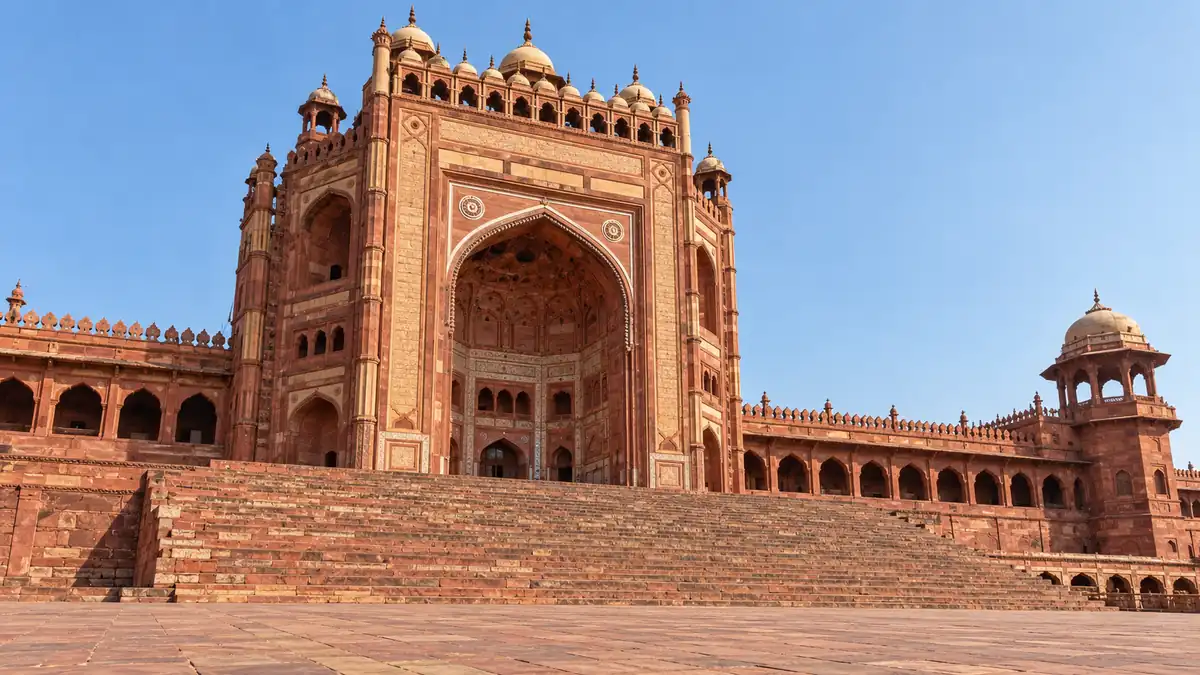
Rising 54 meters (177 feet) from ground level, Buland Darwaza was constructed in 1575 to commemorate Akbar’s triumphant military campaign in Gujarat. Serving as the ceremonial southern portal of the Jama Masjid, this red sandstone archway stands as one of the tallest monumental gateways across Asia.
The exterior facade incorporates red and buff sandstone adorned with white marble inlays and Quranic inscriptions rendered in Naskh script. Forty-two steep stone steps ascend from the lower road to the monumental arch, emphasizing imperial authority over the surrounding plains.
A famous Persian inscription carved into the central arch quotes Jesus Christ on the transient nature of worldly power: “The world is a bridge, pass over it, but build no house upon it.” Examining this massive victory portal provides an architectural bridge toward the imperial white marble achievements found at the Taj Mahal in Agra.
Tomb of Sheikh Salim Chishti and Jama Masjid Courtyard
The Tomb of Sheikh Salim Chishti gleams in pure white Makrana marble within the vast red sandstone quadrangle of the Jama Masjid. Completed in 1581, the shrine honors the Sufi mystic whose prayers Emperor Akbar credited with granting him a male heir, Prince Salim, who later reigned as Emperor Jahangir.
The mausoleum features delicate pierced marble jali screens carved in geometric star patterns, serpentine brackets supporting eaves, and an inner chamber inlaid with mother-of-pearl. Devotees of all faiths tie red cotton threads onto the marble lattices while offering silent prayers for children and good fortune.
Surrounding the tomb, the grand congregational mosque spans an expansive courtyard capable of holding thousands of worshippers. Regional cultural programs and pilgrimage visitor notes are cataloged on the Uttar Pradesh Tourism Fatehpur Sikri Guide.
Travelers exploring northern heritage circuits frequently pair this spiritual pilgrimage stop with ancient riverside traditions documented across what to see in Varanasi.
Top Places to Visit in the Imperial Palace Complex
The secular palace quarter lies immediately northeast of the mosque enclosure, housing royal apartments, administrative courts, and recreational pavilions.
Diwan-i-Khas and the Central Pillar
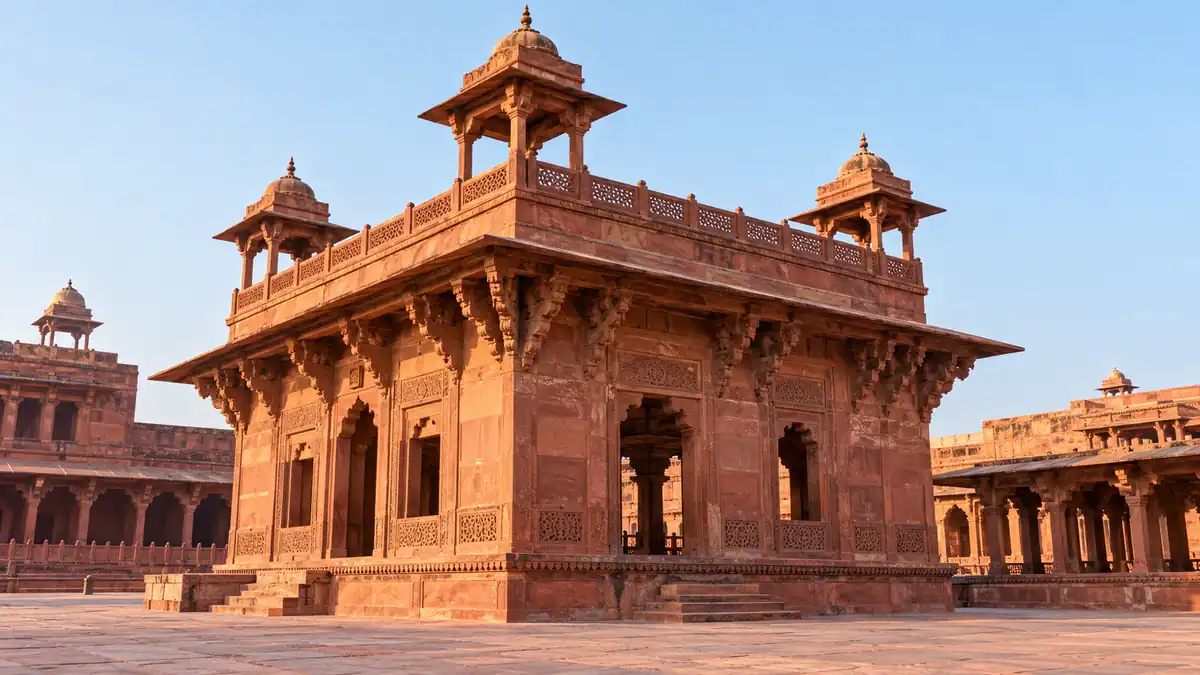
The Diwan-i-Khas, or Hall of Private Audiences, appears as a modest cubic pavilion from outside, but reveals an extraordinary central stone pillar inside. Thirty-two serpentine brackets support a circular platform where Akbar sat during philosophical discourses with scholars of various faiths.
Panch Mahal Five-Story Pavilion
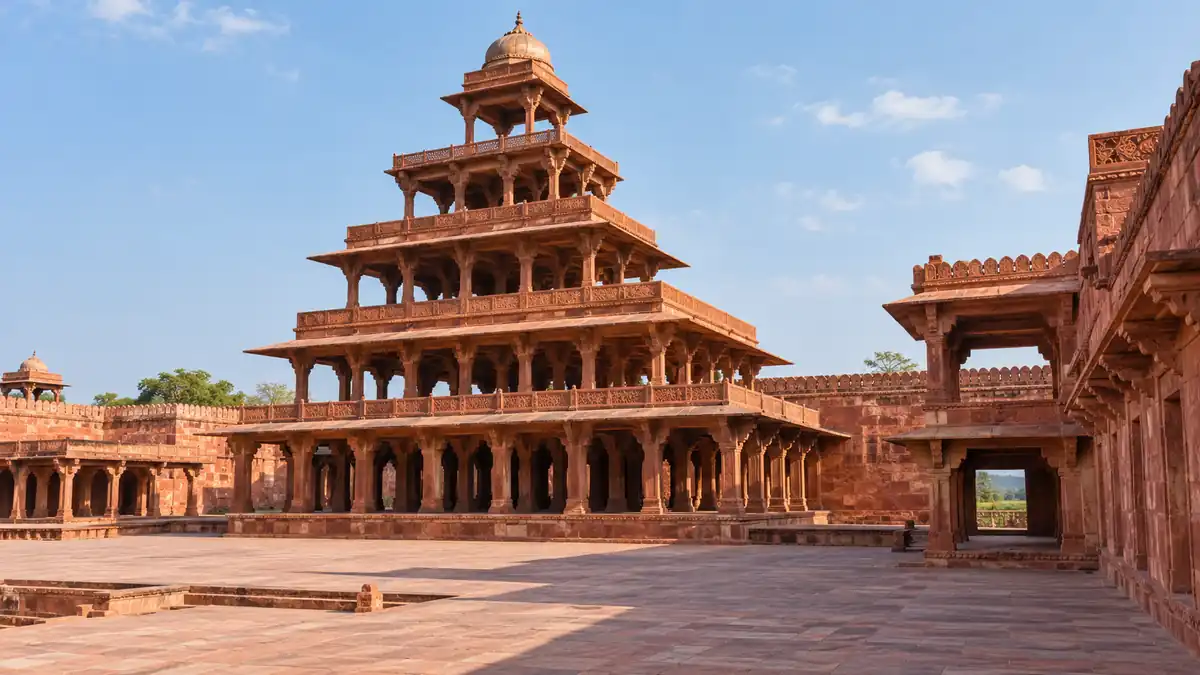
The Panch Mahal rises as a pyramidal open colonnade resting on 176 carved stone pillars across five receding levels. Originally screened with delicate stone lattice work, this breezy pavilion allowed royal women of the court to enjoy cool evening winds and observe celebrations in the Pachisi courtyard below.
Jodha Bai’s Palace and Birbal’s House
Jodha Bai’s Palace represents the largest residential palace inside the complex, showcasing distinct Rajput architectural elements including Gujarati floral brackets and Hindu temple motifs. Nearby, the double-story residence known as Birbal’s House displays ornate stone ceiling carvings that reflect the favored status of Akbar’s witty court advisor.
Tourists traveling along the Golden Triangle route routinely visit these imperial residences before exploring the royal forts and what to see in Jaipur.
Historical Context: Akbar’s Red Sandstone Mughal Capital
Fatehpur Sikri served as the nerve center of the Mughal Empire for only fourteen years before Akbar relocated his court to Lahore in 1585. Historians trace the city’s sudden abandonment to critical water shortages on the ridge and shifting military campaigns on the northwestern frontiers.
Because the site was largely untouched by later construction, it offers an exceptionally pure snapshot of classical 16th-century Mughal civil planning. The city layout integrates administrative pavilions, residential harems, mints, and stables into a single harmonious architectural scheme.
Travelers should note that this imperial city in Uttar Pradesh is geographically distinct from Fatehpur in Rajasthan’s Shekhawati region, which is famous for painted merchant havelis. Detailed transit logistics connecting these two states are recorded in Rajasthan travel itineraries.
How to Reach Fatehpur Sikri from Agra, Delhi, and Jaipur
Fatehpur Sikri sits along National Highway 21, approximately 37 kilometers west of central Agra, making it accessible as a half-day excursion. Most travelers hire private taxis or book guided day tours from Agra that combine the site with local heritage monuments.
Uttar Pradesh state transport buses leave continuously from the Idgah Bus Stand in Agra, completing the journey to Fatehpur Sikri bus depot in approximately 60 minutes. Fatehpur Sikri railway station also receives passenger trains connecting directly with Agra Fort railway station.
Tourists traveling along the Golden Triangle find this monument directly along the direct driving route connecting Agra with Bharatpur and Jaipur. Comprehensive transit resources are detailed in the Incredible India Fatehpur Sikri Monument Directory, pairing naturally with our guide to Agra Fort, Mehtab Bagh, and Itimad-ud-Daulah. Travelers continuing twenty-four kilometers west can explore the celebrated wetlands and cycle rickshaw trails covered in our Bharatpur bird sanctuary and Chambal safari guide.
| Travel Route | Distance | Driving Duration | Preferred Transit Mode |
|---|---|---|---|
| Agra City Center to Fatehpur Sikri | 37 km | 50 minutes | Private taxi or UP state bus via NH21 |
| Bharatpur Bird Sanctuary to Fatehpur Sikri | 24 km | 35 minutes | Highway cab or local bus |
| Jaipur to Fatehpur Sikri | 205 km | 4 hours | National Highway 21 express route |
| Delhi to Fatehpur Sikri | 240 km | 4.5 hours | Yamuna Expressway to Agra, then NH21 |
Frequently Asked Questions About Fatehpur Sikri
What are the operational visiting hours of Fatehpur Sikri?
Fatehpur Sikri monuments open daily from sunrise to sunset, generally operating from 6:00 AM to 6:30 PM. The complex remains open to tourists all seven days of the week, including Fridays when the palace section operates normally while the mosque hosts community prayers.
How much does it cost to enter Fatehpur Sikri?
Entry to the ASI Imperial Palace complex costs ₹50 for Indian citizens and ₹610 for foreign travelers, while children under 15 enter free. Access to the adjacent religious complex containing Buland Darwaza and the Salim Chishti Dargah is free for all visitors.
How far is Fatehpur Sikri from the city of Agra?
Fatehpur Sikri is located roughly 37 kilometers west of central Agra along National Highway 21. Driving between Agra and the monument takes approximately 50 to 60 minutes by private taxi or state transport bus.
Why was Fatehpur Sikri abandoned after only 14 years?
Emperor Akbar relocated the Mughal imperial court to Lahore in 1585 primarily due to severe water shortages on the arid sandstone ridge. Strategic military needs along the northern frontiers also required the emperor’s sustained presence closer to Punjab and Kabul.
Can a visit to Fatehpur Sikri be combined with Holi celebrations in Mathura?
Yes, Fatehpur Sikri is located just 65 kilometers south of Mathura. Travelers visiting during spring can easily combine Akbar’s red sandstone capital with the festive multi-day gatherings of Braj Ki Holi in Vrindavan and Mathura.