Shekhawati Havelis Guide: Mandawa, Nawalgarh & Fresco Mansions
Complete guide to Shekhawati painted havelis in Rajasthan: Mandawa, Nawalgarh, Fatehpur fresco walking tours, Poddar museum, itineraries, and heritage stays.
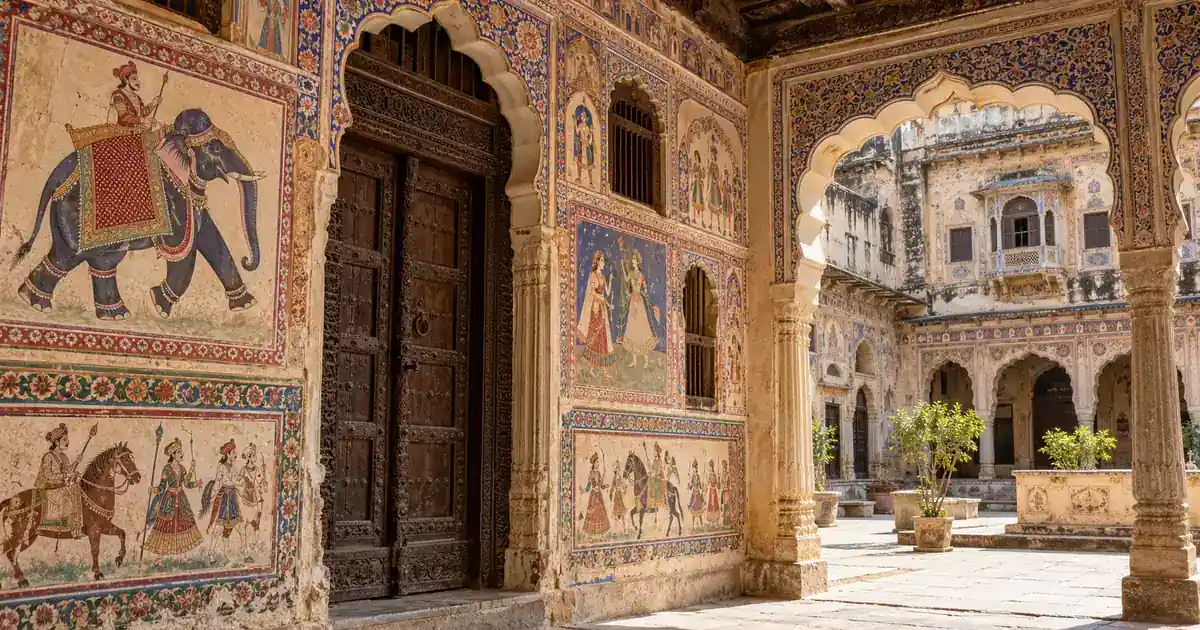
Spanning the arid plains of Jhunjhunu, Sikar, and Churu districts in northern Rajasthan, the historic region of Shekhawati is globally renowned as the world’s largest open-air art gallery. Between the early 18th and early 20th centuries, wealthy Marwari merchants constructed thousands of lavish multi-story mansions (havelis), water reservoirs (baoris), and cenotaphs (chhatris).
What sets Shekhawati apart from the great stone fortresses of Rajasthan is its dazzling surface art. Every square inch of plaster (from street-level outer walls and archways to secluded inner courtyards and bedroom ceilings) is adorned with intricate, hand-painted frescoes.
These murals illustrate a fascinating visual record of changing times. Traditional religious epics and Rajasthani folklore sit directly alongside whimsical depictions of British colonial technology, including steam locomotives, Wright Brothers biplanes, gramophones, and Victorian motorcars.
Shekhawati Region Travel Essentials
- Geographic Belt: Northern Rajasthan, covering Jhunjhunu and Sikar districts.
- Primary Hub Towns: Mandawa, Nawalgarh, Fatehpur, Ramgarh, and Dundlod.
- Architectural Marvel: Hundreds of 18th- to 20th-century painted merchant havelis.
- Fresco Technique: True fresco (fresco buono) using wet lime plaster and mineral pigments.
- Signature Sight: Poddar Haveli Museum in Nawalgarh and open haveli alleys in Mandawa.
- Transit Gateway: Jaipur International Airport (140 km) and direct express trains to Sikar and Jhunjhunu.
- Recommended Duration: Two to three days for an unhurried heritage tour.
For travelers seeking authentic heritage off the beaten path, Shekhawati provides a peaceful cultural escape free from modern metropolitan traffic. The table below outlines key towns, signature havelis, entry policies, and transit distances.
| Shekhawati Town | Geographic Location | Signature Painted Mansions | Key Travel Feature & Admission |
|---|---|---|---|
| Mandawa | Heart of Jhunjhunu district | Murmuria Haveli, Chokhani Double Haveli, Castle Mandawa | Walkable town center; open-air haveli street circuits |
| Nawalgarh | 25 km south of Mandawa | Dr. Ramnath A. Poddar Haveli Museum, Morarka Haveli | Over 200 painted havelis; finest restored museum collection (₹100 entry) |
| Fatehpur | 20 km northwest of Mandawa | Nadine Le Prince Cultural Centre, Jagannath Singhania Haveli | French-restored 1802 haveli; bold European and indigo murals (₹200 entry) |
| Dundlod | 7 km north of Nawalgarh | Dundlod Fort, Goenka Haveli, Satyanarayan Temple | Blend of Rajput military ramparts and Marwari merchant art |
| Ramgarh | 18 km north of Fatehpur | Seth Ramgopal Poddar Chhatri, Mohanka Havelis | Richly painted cenotaphs depicting scenes from the Ramayana |
What is Shekhawati: The World’s Largest Open-Air Art Gallery
The term Shekhawati translates to the “Garden of Shekha,” derived from Rao Shekha, a 15th-century Rajput chieftain of the Kachhwaha clan who established an independent principality independent of Amber (Jaipur). Situated strategically along the northern trade crossroads between the Arabian Sea ports of Gujarat and the imperial capital of Delhi, the region grew prosperous by taxing camel caravans carrying spices, silk, and opium.
During the 19th century, regional trade routes shifted toward British-controlled sea ports like Calcutta, Bombay, and Madras. Ambitious Marwari trading families, including the Birlas, Goenkas, Poddars, Piramals, and Mittals, migrated to these coastal metropolises, building financial empires in textiles, jute, and stockbroking.
Yet, despite amassing great fortunes in distant ports, their emotional and ancestral roots remained anchored in their desert homeland. To demonstrate their newfound wealth and social prestige to rival clans, merchants sent vast fortunes back home to build palatial painted havelis for their families.
Travelers organizing regional cultural journeys across northern India can compare these desert fresco circuits with the seasonal festivals outlined in our curated guide to the best places to visit in India.
The Marwari Merchant Boom: Opium, Silk & Cotton Caravans
The haveli-building boom reached its peak between 1860 and 1930. Wealthy merchants spared no expense in outdoing their neighbors. If one merchant built a haveli with two courtyards, his competitor constructed one with four courtyards and gilded timber ceilings.
Because Marwari merchants frequently traveled to British trading centers, they encountered modern Western inventions long before rural Rajasthan saw them. Merchants sent European photographs, lithographs, and magazine illustrations back to their home villages.
Local village artists (chiteras), many of whom had never seen an ocean liner, an airplane, or an Englishman, recreated these foreign wonders based purely on verbal descriptions and black-and-white etchings. The resulting murals are delightful blends of artistic imagination and cultural curiosity.
The Chemistry of Fresco Buono: Limestone Plaster and Natural Pigments
The enduring vibrancy of Shekhawati’s century-old murals is due to the mastery of the true fresco technique, locally known as fresco buono or aarash:
- Lime Plaster Preparation: Artisans applied several layers of fresh slaked lime plaster mixed with marble dust, river sand, and curd. The final layer was polished smooth with an agate stone until it gleamed like ivory.
- Wet Plaster Painting: While the plaster was still wet, artists applied mineral and vegetable pigments. The chemical reaction between lime and atmospheric carbon dioxide carbonated the plaster, permanently locking the pigments into the stone matrix.
- Natural Pigment Sources: Early 19th-century murals used exclusively natural mineral colors: yellow from raw ochre (peeli mitti), red from crushed cinnabar, green from copper carbonate (zangar), white from sea shells, and black from lamp soot.
- The Synthetic Revolution: By the late 19th century, merchants imported synthetic chemical dyes from Germany. These introduced vivid ultramarine blues, chrome yellows, and bright purples, transforming later havelis into dazzling multi-colored displays.
Mandawa Painted Havelis: Murmuria, Chokhani & Castle Mandawa
Located in the center of Jhunjhunu district, Mandawa is the most popular base for exploring Shekhawati. Founded in 1755 by Thakur Nawal Singh, the town is compact, flat, and easily explored on foot or by bicycle.
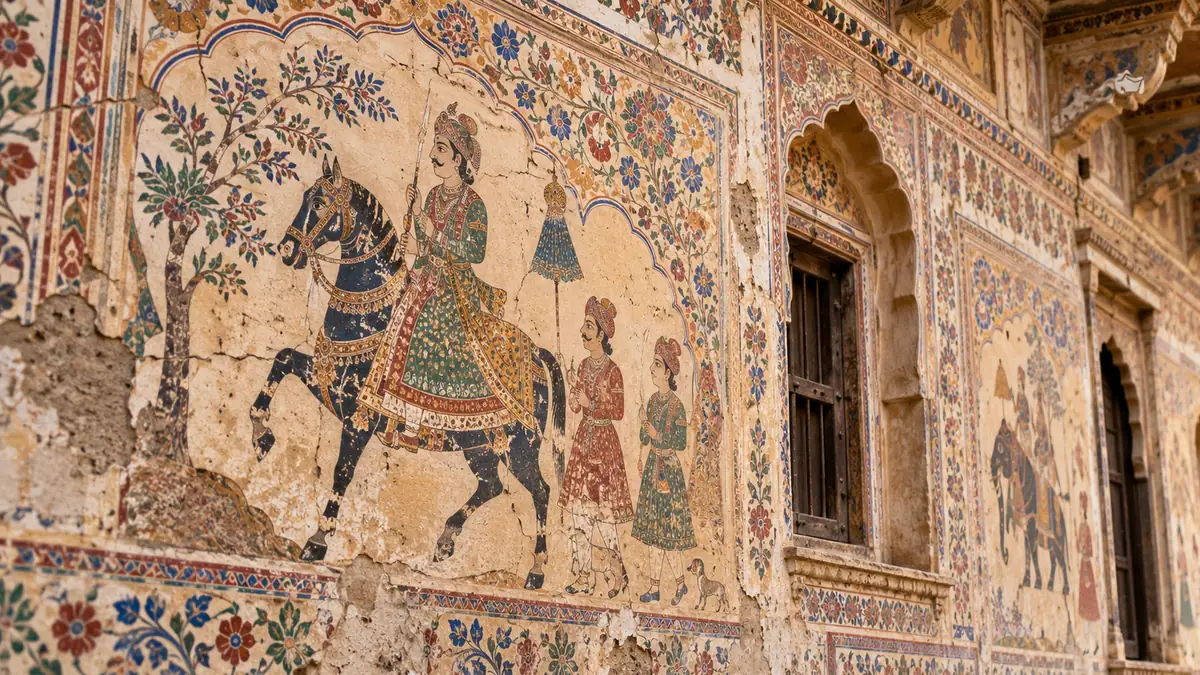
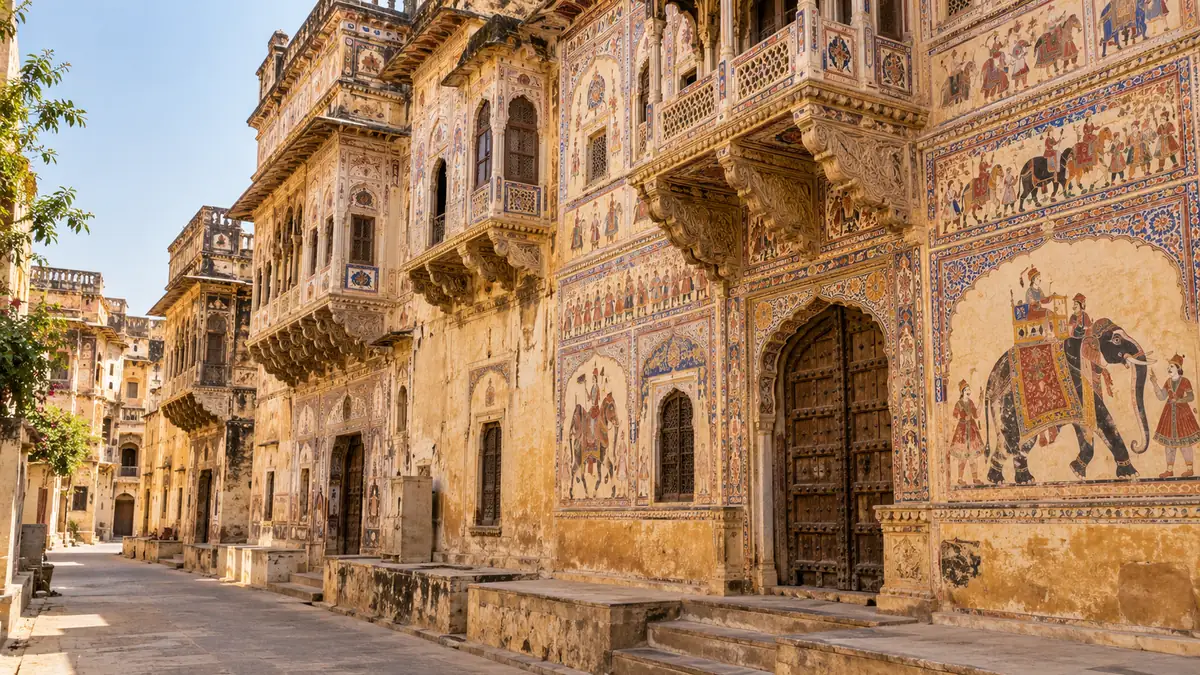
Historic conservation updates, accredited walking guide contacts, and official town maps can be referenced on the Rajasthan Tourism Mandawa Portal.
| Haveli / Landmark | Construction Period | Architectural Highlight | Notable Fresco Themes |
|---|---|---|---|
| Murmuria Haveli | Built 1930s | Italianate arched courtyard with roof terrace | Trains, Venice canals, Nehru on horseback, biplanes |
| Chokhani Double Haveli | Built 1890s | Twin symmetrical courtyards with carved wooden gates | British soldiers in red coats, Lord Krishna pastimes |
| Hanuman Prasad Goenka Haveli | Built late 19th century | Elaborate toran archway and upper jharokhas | Lord Shiva on Nandi, Indra on Airavata elephant |
| Castle Mandawa | Built 1755 (Now luxury hotel) | Medieval Rajput fortress with turreted battlements | Antique weaponry, royal portraits, courtyard gardens |
| Saraf Haveli | Built early 20th century | Deep verandas with decorative floral arches | Ornate mirror-work ceilings and English portraits |
Murmuria Haveli: Trains, Venice Canals & Wright Brothers Biplanes
Built in the 1930s by a wealthy Marwari trader, the Murmuria Haveli is one of the most eccentric painted mansions in Mandawa. The haveli displays a fascinating transition from classical mythological scenes to European colonial imagery.
On its southern exterior wall, visitors can admire a painted freight train complete with a steam locomotive puffing dark smoke as it chugs past telegraph poles. Nearby, a mural depicts a gondolier steering a boat through the canals of Venice, copied from an Italian postcard brought back by the owner.
Other whimsical murals on the upper courtyard walls include a depiction of the Wright Brothers flying their experimental canvas biplane, alongside a portrait of Indian nationalist leader Jawaharlal Nehru proudly carrying the national tricolour flag on horseback.
Chokhani Double Haveli and the Fresco Alleys of Mandawa Bazaar
Built in the 1890s for two merchant brothers, the Chokhani Double Haveli consists of two completely separate residential wings joined by a common central entrance arch.
The heavy teakwood doors are studded with iron spikes to ward off thieves. Above the doorframe, delicate paintings depict Ganesha, the remover of obstacles, flanked by his consorts Riddhi and Siddhi.
Walking through the narrow cobblestone alleys behind the Mandawa bazaar reveals dozens of smaller merchant mansions. Look upward at the underside of the overhanging balconies (chhajjas), where artists painted floral arabesques and decorative peacocks in brilliant shades of cobalt blue and saffron yellow.
Nawalgarh: The Golden City of Shekhawati & Poddar Haveli Museum
Situated 25 kilometers south of Mandawa, Nawalgarh is universally celebrated by art historians as the “Golden City of Shekhawati.” Home to over two hundred painted havelis, Nawalgarh features some of the finest, most meticulously preserved fresco art in India.
Official museum visiting hours, district heritage registration rules, and restoration archives can be consulted on the Rajasthan Tourism Nawalgarh Information Desk.
| Monument / Site | Operating Timings | Entry Fee | Distinctive Artistic Feature |
|---|---|---|---|
| Dr. Ramnath A. Poddar Haveli Museum | 08:30 AM to 06:30 PM | ₹100 (Indians) / ₹300 (Foreigners) | 750+ restored frescoes; galleries of regional textiles and wedding turbans |
| Morarka Haveli Museum | 09:00 AM to 06:00 PM | ₹100 per person | 1900 CE haveli; stunning Krishna Leela friezes and courtyard fountain |
| Aath Haveli Complex | Open during daylight | Free to view exteriors | Cluster of eight neighboring mansions showing architectural evolution |
| Bhagton Ki Chhoti Haveli | 09:00 AM to 05:30 PM | ₹50 tip to caretaker | Brilliant European motorcar and steamship paintings |
| Roop Niwas Kothi | Heritage Hotel | Open to dining guests | Sprawling colonial country palace set in manicured gardens |
Dr. Ramnath A. Poddar Haveli Museum: Restored Grandeur and Artifacts
If you visit only one painted mansion in all of Shekhawati, make it the Dr. Ramnath A. Poddar Haveli Museum in Nawalgarh. Constructed in 1902 by Anandilal Poddar and meticulously restored by the Anandilal Poddar Charitable Trust, the complex operates as a world-class living museum.
The haveli contains over 750 individual fresco panels restored using original organic mineral dyes. The murals cover five distinct thematic categories:
- Mythology & Religion: Detailed epics depicting the battle of Kurukshetra from the Mahabharata, the churning of the cosmic ocean, and Krishna playing his flute for the gopis.
- Historical Events: Royal Rajput durbars, camel cavalry marches, and the legendary love story of Dhola and Maru fleeing across the desert on a camel.
- Technological Wonders: English gentlemen riding penny-farthing bicycles, early telephone switchboards, and hot air balloons floating over European palaces.
- Folklore and Village Life: Women drawing water from village stepwells, farmers plowing fields, and musicians playing traditional folk instruments.
The museum also houses fascinating galleries exhibiting antique musical instruments, Rajasthani miniature paintings, and authentic wedding turbans (safas) representing dozens of royal clans.
Aath Haveli Complex, Morarka Haveli & Massive Baoris
Just a five-minute walk from the Poddar Museum lies the Aath Haveli Complex (The Complex of Eight Havelis). Built in the late 19th century by different branches of a wealthy merchant dynasty, these eight adjoining mansions allow visitors to observe how painting styles evolved over a fifty-year span.
Nearby, the Morarka Haveli Museum offers a peaceful courtyard experience, with fresco panels showing Lord Rama’s triumphant return to Ayodhya and lively circus acts with balancing acrobats.
On the outskirts of town, do not miss Nawalgarh’s historic stepwells (baoris). The multi-tiered stepwells feature steep stone stairs descending past carved arcades into deep groundwater pools, once serving as vital gathering spots for desert travelers.
Fatehpur, Ramgarh & Dundlod: Offbeat Haveli Enclaves
Beyond the primary hubs of Mandawa and Nawalgarh, several quieter Shekhawati towns reward adventurous heritage enthusiasts with rare artistic treasures.
Travelers looking to combine merchant haveli tours with sacred desert shrines can take a short drive westward to visit the miraculous Salasar Balaji Temple in Churu district, connecting two of northern Rajasthan’s cultural landmarks.
| Town / Enclave | Distance from Mandawa | Signature Sight | Cultural Highlights |
|---|---|---|---|
| Fatehpur | 20 km northwest | Nadine Le Prince Cultural Centre | 1802 haveli restored by French artist Nadine Le Prince; art residency |
| Ramgarh | 38 km north | Seth Ramgopal Poddar Chhatri | Cenotaph with 500+ miniature frescoes; over 100 heritage mansions |
| Dundlod | 30 km southeast | Dundlod Fort & Horse Stud | Rajput-European castle; world-famous Marwari horse breeding stables |
| Jhunjhunu | 28 km northeast | Khemi Sati Temple & Modi Haveli | Historic district capital with busy brass and textile bazaars |
| Alsisar | 25 km north | Alsisar Mahal | Restored 17th-century palace hotel with painted durbar hall |
Nadine Le Prince Cultural Centre in Fatehpur: French Restoration
Founded in 1445 by Muslim Nawab Fateh Khan, Fatehpur preserves some of the oldest surviving havelis in the region. The artistic highlight of the town is the Nadine Le Prince Cultural Centre, situated inside the historic Nand Lal Devra Haveli, built in 1802.
In 1999, French artist Nadine Le Prince fell in love with the decaying haveli, purchased the structure, and spent over a decade painstakingly restoring its delicate murals using traditional techniques and authentic mineral pigments.
Today, the mansion serves as an active cultural foundation and artist residency, displaying contemporary international artwork in dialogue with two-hundred-year-old Rajasthani frescoes.
Ramgarh Seth Ramgopal Poddar Chhatri & Dundlod Cavalry Fort
Known historically as the wealthiest town in Shekhawati, Ramgarh was established in 1791 by the Poddar family after a tax dispute with the Raja of Sikar. The town contains over one hundred mansions, but its greatest treasure is the Seth Ramgopal Poddar Chhatri.
This grand funerary cenotaph features four open stone pavilions topped by an enormous carved dome. The underside of the dome is painted with over five hundred miniature frescoes depicting scenes from the Ramayana, painted with such precision that magnifying glasses are provided to examine the details.
In Dundlod, the 1750 Dundlod Fort offers a fascinating blend of martial Rajput ramparts and delicate merchant fresco art. The fort houses prestigious private stables breeding the rare, indigenous Marwari horse, famous for its inward-curling lyre-shaped ears and stamina in desert terrain.
Curated 2-Day Shekhawati Road Trip Itinerary from Jaipur
A two-day road trip allows travelers to explore the primary towns of Shekhawati comfortably, enjoying leisurely haveli walks, sunset photography on castle terraces, and regional Marwari cuisine.
State transit guidelines, highway route advisories, and hotel listings can be confirmed on the Rajasthan Tourism Shekhawati Overview.
| Timing / Phase | Destination & Activity | Driving Distance | Highlights & Logistics Advice |
|---|---|---|---|
| Day 1: Morning (07:30 AM – 11:00 AM) | Jaipur to Nawalgarh drive | 140 km via NH52 | Scenic desert highway drive; breakfast stop at Chomu |
| Day 1: Midday (11:00 AM – 02:00 PM) | Poddar & Morarka Haveli Museums | Local in Nawalgarh | Guided museum audio tour; study 750+ restored fresco panels |
| Day 1: Afternoon (02:30 PM – 04:30 PM) | Dundlod Fort & Horse Stables | 7 km drive north | Tour historic ramparts and meet purebred Marwari horses |
| Day 1: Evening (05:00 PM – 08:30 PM) | Check into Mandawa Heritage Haveli | 25 km drive to Mandawa | Rooftop dinner with live Rajasthani folk music and sunset views |
| Day 2: Morning (08:30 AM – 12:00 PM) | Mandawa Haveli Walking Circuit | Old city alleys | Explore Murmuria, Chokhani, and Saraf havelis with local guide |
| Day 2: Midday (12:30 PM – 03:00 PM) | Excursion to Fatehpur Frescoes | 20 km drive northwest | Tour Nadine Le Prince Cultural Centre and Jagannath Singhania Haveli |
| Day 2: Afternoon (03:30 PM – 07:30 PM) | Return Highway Drive to Jaipur | 165 km via NH52 | Smooth return drive arriving in Jaipur for dinner |
Day 1: Jaipur to Nawalgarh and Dundlod Heritage Circuit
Depart Jaipur early at 07:30 AM via National Highway 52, heading northward through Ringas toward Sikar. The smooth four-lane highway crosses undulating scrublands where khejri trees dot the horizon.
Arrive in Nawalgarh by 11:00 AM and head directly to the Dr. Ramnath A. Poddar Haveli Museum. Spend two hours exploring the courtyard galleries and learning about the fresco buono process from local resident caretakers.
After a traditional Marwari lunch of Dal Baati Churma and Ker Sangri at a local restaurant, take the short 15-minute drive to Dundlod. Explore the painted arches of Dundlod Fort and visit the royal stables to admire Marwari horses.
By late afternoon, drive north to Mandawa and check into a restored heritage haveli hotel. Enjoy sunset chai from the rooftop terrace as the call to prayer and temple bells echo across the desert rooftops.
Day 2: Mandawa Walking Tour, Fatehpur Frescoes & Return
Begin your morning with an unhurried two-hour walking tour of Mandawa’s old quarters. The soft morning light is ideal for photographing the murals on the exterior walls of Murmuria and Chokhani havelis before the sun creates harsh shadows.
Stroll through the colorful local bazaar to shop for regional handicrafts, hand-block printed cotton bedspreads, carved wooden door hardware, and antique brass bells.
At noon, drive twenty minutes northwest to Fatehpur. Tour the French-restored Nadine Le Prince Cultural Centre and marvel at the bold cobalt-blue frescoes of the Singhania mansions.
Begin your return drive toward Jaipur by 03:30 PM, arriving in the Pink City by early evening for onward travel connections.
How to Reach Shekhawati by Road, Train, and Heritage Stays
Shekhawati enjoys dependable highway and rail connectivity, positioned conveniently between the state capital of Jaipur and the national capital of New Delhi.
Travelers planning an extensive golden triangle or desert tour can easily coordinate this excursion using our comprehensive guide to top attractions in Jaipur.
| Origin City | Travel Mode | Route / Distance | Travel Duration | Practical Booking Advice |
|---|---|---|---|---|
| Jaipur | Private Taxi / Rental Car | NH52 via Ringas & Sikar (140 km) | 2.5 to 3 hours | Most convenient option; allows flexible stops across multiple haveli towns |
| Jaipur | Express Train to Sikar | Daily Intercity / Passenger trains | 2 hours | Trains depart Jaipur Junction daily; hire local cabs from Sikar |
| New Delhi | Highway Drive via NH48 & NH334B | Delhi–Rewari–Narnaul–Jhunjhunu (240 km) | 5 to 6 hours | Smooth multi-lane highway; ideal weekend road trip from NCR |
| New Delhi | Delhi Sarai Rohilla Express | Direct train to Sikar Junction | 5 hours 30 mins | Departs Sarai Rohilla; connects directly to central Shekhawati |
| Bikaner | National Highway 11 | Bikaner to Fatehpur (180 km) | 3.5 hours | Excellent connecting highway for travelers traveling from the Thar Desert |
Driving National Highway 52 from Jaipur and Express Trains via Sikar
The four-lane National Highway 52 connects Jaipur directly with the southern gateway of Shekhawati at Sikar. The toll road is smooth, well-signposted, and handles both private passenger vehicles and state transport buses.
Hiring a private air-conditioned taxi for a two-day return journey from Jaipur covering Mandawa, Nawalgarh, and Fatehpur typically costs ₹6,000 to ₹8,500, including toll taxes and driver allowances.
Travelers preferring rail transit can board daily superfast trains from Delhi Sarai Rohilla or Jaipur Junction to Sikar Junction (station code: SIKR) or Jhunjhunu (station code: JJN). Both stations connect smoothly with nearby haveli towns via affordable shared taxis and auto-rickshaws.
Staying in Restored Heritage Haveli Hotels and Merchant Castles
One of the greatest highlights of visiting Shekhawati is staying inside a restored heritage mansion:
- Castle Mandawa: A 260-year-old fortress palace offering antique-filled royal suites, sweeping courtyard gardens, and rooftop candlelit dining.
- Vivaana Culture Hotel (Churi Ajitgarh): A twin-mansion heritage property featuring museum-quality 19th-century frescoes, hand-carved stone balconies, and an outdoor courtyard swimming pool.
- Roop Niwas Kothi (Nawalgarh): A grand heritage country home blending Rajput and European architecture, surrounded by fruit orchards and stables offering horseback riding excursions.
- Budget Haveli Homestays: Towns like Mandawa and Nawalgarh offer dozens of intimate family-run guesthouses (such as Mandawa Haveli or Radhika Haveli) with room rates ranging from ₹1,500 to ₹3,500 per night, including home-cooked vegetarian meals.
Frequently Asked Questions About Shekhawati Havelis
Why is Shekhawati called the open-air art gallery of Rajasthan?
Shekhawati is called the open-air art gallery because it contains hundreds of historic mansions, palaces, stepwells, and cenotaphs completely covered inside and out with intricate fresco paintings. Unlike traditional museums where art is kept behind glass, the artwork in Shekhawati is painted directly on public town walls and building facades.
Which towns in Shekhawati have the best painted havelis?
Nawalgarh and Mandawa are the two best towns to visit. Nawalgarh has the highest density of havelis and the finest restored museums (such as the Poddar Haveli Museum), while Mandawa offers a charming, walkable old town filled with easily accessible fresco circuits and heritage hotels.
What are the entry fees for visiting Shekhawati havelis?
Many havelis in town bazaars are private homes where caretakers permit visitors to view courtyards for a small voluntary tip of ₹50 to ₹100. Formal museums (such as the Dr. Ramnath A. Poddar Haveli Museum in Nawalgarh and the Nadine Le Prince Cultural Centre in Fatehpur) charge formal admission tickets of ₹100 to ₹200 per adult.
What is the best time of year to visit Shekhawati?
The best time to visit Shekhawati is between October and March. During these winter months, the weather is sunny and dry, with daytime temperatures ranging from 18°C to 28°C, making walking tours through town alleys pleasant. Avoid summer months (April to June) when desert temperatures regularly exceed 42°C.
How many days are needed to explore Shekhawati?
Two full days (a weekend trip) are ideal to explore Shekhawati. This allows sufficient time to tour the Poddar Haveli Museum in Nawalgarh, walk the painted alleys of Mandawa, visit the French-restored mansion in Fatehpur, and relax in a heritage haveli hotel.
Can a trip to Shekhawati be paired with desert festival destinations?
Yes, travelers often combine the painted mansions of Shekhawati with seasonal fairs across central and western Rajasthan; check our comprehensive Pushkar Camel Fair guide for full moon snan dates, desert camps, and camel trading events just three hours to the south.