Pushkar Camel Fair: Dates, Brahma Temple, Ghats & Mela Guide
Complete guide to Pushkar Camel Fair in Rajasthan: Kartik Purnima snan dates, Brahma temple darshan, 52 lake ghats, camel trade competitions, and desert camps.
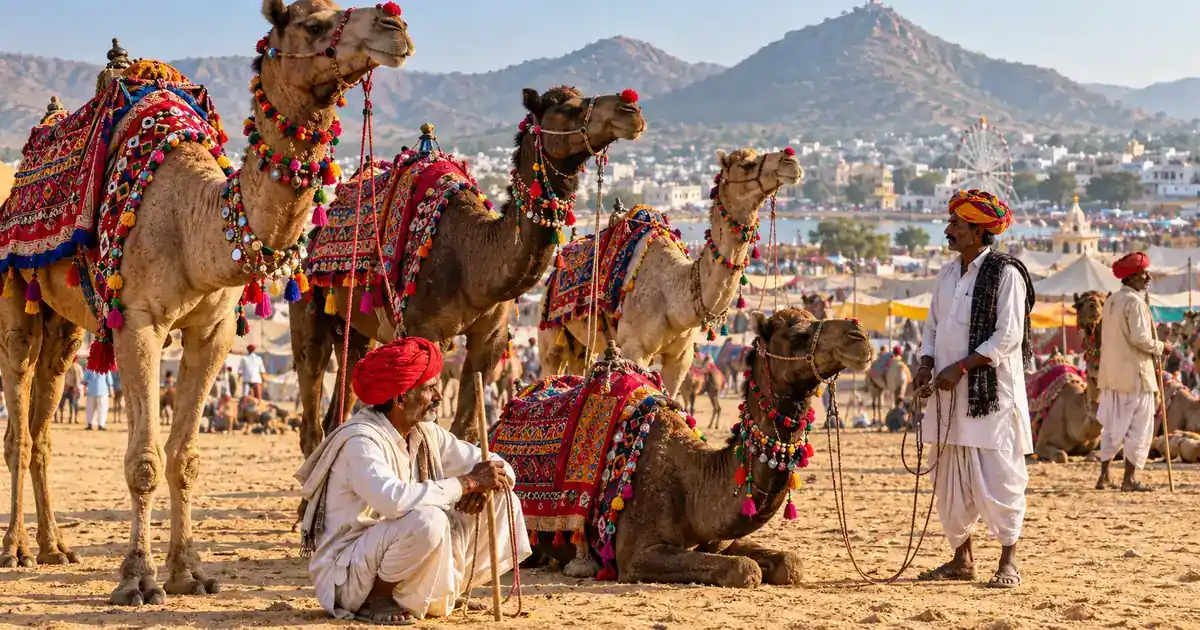
Every autumn in the Hindu month of Kartik, the tranquil oasis town of Pushkar on the edge of the Thar Desert transforms into one of the most hypnotic spectacles on the planet. Over 200,000 pastoralists, pilgrims, traders, and international travelers gather across rolling sand dunes for the legendary Pushkar Camel Fair (locally known as the Pushkar Mela).
What began centuries ago as a practical livestock trading exchange for nomadic Raika camel herders has evolved into an extraordinary convergence of sacred devotion and desert folklore. More than 25,000 camels, horses, and cattle are groomed, decorated, and bartered across the golden sands under the shadow of the sacred Nag Pahar hills.
Pushkar Camel Fair Quick Overview
- Primary Location: Pushkar town, situated 14 kilometers northwest of Ajmer in Rajasthan.
- Fair Duration: Eight to nine days ending on the holy night of Kartik Purnima (full moon).
- Livestock Scale: 25,000+ camels, Marwari horses, and indigenous cattle traded on the dunes.
- Spiritual Hub: Pushkar Lake with its 52 sacred stone ghats and the world-renowned 14th-century Jagatpita Brahma Temple.
- Key Highlights: Camel beauty contests, moustache competitions, hot air ballooning over dunes, and nightly Maha Aarti ceremonies.
- Transit Gateway: Ajmer Junction railway station (14 km) and Jaipur International Airport (145 km).
Simultaneously, tens of thousands of devout Hindu pilgrims descend upon the holy waters of Pushkar Lake to take ritual cleansing baths (snan). Worshippers believe that taking a dip during Kartik Purnima washes away a lifetime of spiritual transgressions, honoring Lord Brahma who created the sacred lake according to ancient scriptures.
| Fair Component / Event | Operating Schedule / Timing | Cultural & Logistical Importance |
|---|---|---|
| Cattle Trading Phase | First 4 to 5 days of Mela | Prime window for documentary photography as pastoralists negotiate livestock sales |
| Cultural Festival Phase | Last 4 days leading to Purnima | State tourism sports events, folk dances, music concerts, and handicrafts markets |
| Kartik Purnima Holy Bath | Final full moon day (All day) | Peak religious gathering; hundreds of thousands bathe at the 52 lake ghats |
| Brahma Temple Darshan | 06:00 AM to 01:30 PM, 03:00 PM to 09:00 PM | Ancient red-spire sanctum housing the four-faced icon of Creator Brahma |
| Maha Aarti at Varaha Ghat | Daily at 07:00 PM (Sunset) | Sacred lamp offering with chanting, brass bells, and floating clay lamps on the lake |
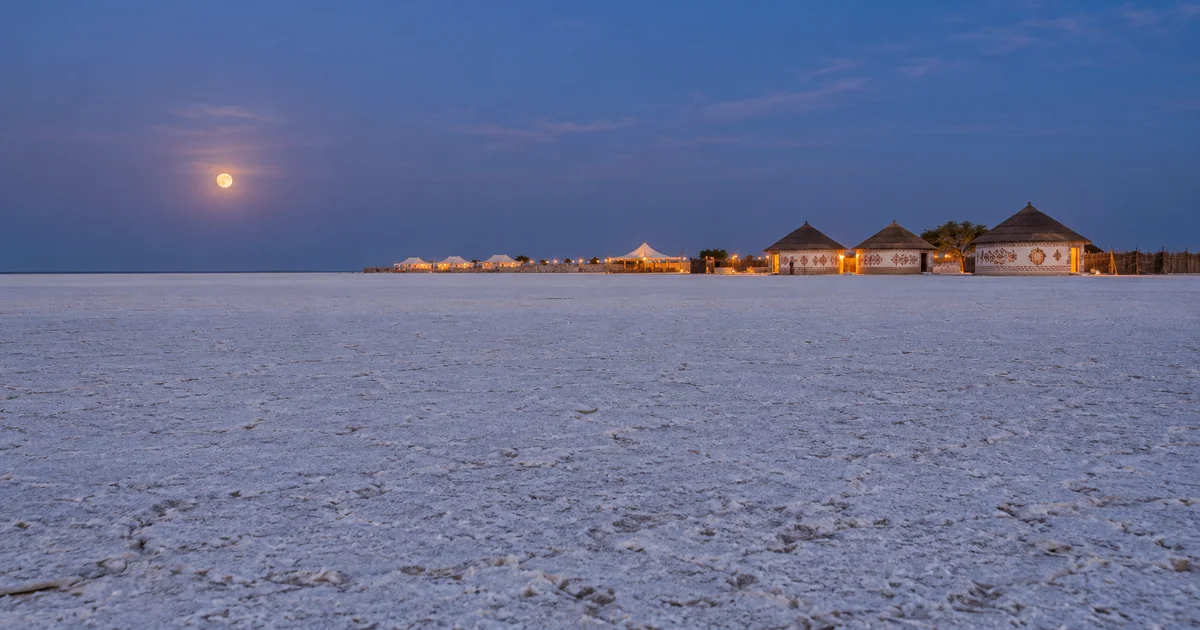
| Desert Camp Experience | November through February | Luxury Swiss tent townships offering Rajasthani cuisine and folk music under the stars |
What is Pushkar Camel Fair: History, Camel Trading & Kartik Purnima
The roots of the Pushkar Fair stretch back centuries into the pastoral folklore of Rajasthan. For the Raika (or Rebari) community, the traditional camel breeding pastoralists of the Thar Desert, the gathering represented an essential economic appointment. Herders would trek for weeks across arid scrublands from Jaisalmer, Barmer, and Bikaner to trade male working camels for grain, textiles, and household silver.
Over time, this livestock market merged with the ancient Kartik Purnima pilgrimage, creating a multi-layered festival that combines desert commerce with deep Vedic reverence. Today, the fair is jointly organized by the local administration and Rajasthan Tourism, providing formal infrastructure, sanitation, and safety while preserving authentic rural traditions.
Travelers mapping extensive regional cultural tours across northern and western India can consult our curated directory of best places to visit in India for seasonal flight routes and packing advice.
The Two Distinct Phases: Cattle Trading Week vs Cultural Fiesta
A common misconception among first-time travelers is that the Pushkar Fair is a single static event. In reality, the fair is divided into two distinctly different chronological phases:
- The Livestock Trading Phase (Days 1 to 5): This is the most authentic, raw period of the fair. Herders arrive several days before the official opening ceremony, setting up makeshift canvas shelters on the sand dunes. Campfires glow in the crisp evening air, hookahs are passed among elders, and lively negotiations take place in quiet murmurs. If you are a documentary photographer or cultural enthusiast, visiting during this initial window gives you unfiltered access to authentic desert life without commercial crowds.
- The Cultural & Religious Phase (Days 6 to 9): As livestock deals conclude and many herders begin their long homeward trek, the Rajasthan Tourism Development Corporation (RTDC) launches the public festival program at the central Mela Ground stadium. This phase features formal dance competitions, carnival rides, hot air balloon ascents, and high-energy cricket matches between local townspeople and international travelers.
The Sacred Legend: Lord Brahma’s Lotus and the Creation of Pushkar Lake
According to the Padma Purana, the demon Vajranabha was terrorizing the earth and slaying children. Lord Brahma, the cosmic Creator in the Hindu Trinity, descended from heaven and struck the demon with his divine weapon: a sacred blue lotus (pushpa).
The impact killed the demon, but three petals slipped from Brahma’s hand (kar) and drifted down to earth, striking the soil in three distinct spots. Water immediately sprang forth from each crater, forming three sacred lakes: Jyeshtha Pushkar (Senior Pushkar), Madhyama Pushkar (Middle Pushkar), and Kanishtha Pushkar (Junior Pushkar).
Because the holy water burst forth from Brahma’s hand, the sanctuary was named Pushkar. Lord Brahma then decided to perform an elaborate Vedic yajna (fire sacrifice) on the shores of the lake to purify the earth and secure the welfare of all beings.
Pushkar Fair Dates, Schedule & Major Fairground Events
Because the fair’s timing is governed by the traditional Hindu lunar calendar, the Gregorian dates shift each year, generally falling between late October and late November. The grand climax always coincides with the full moon day of Kartik (Kartik Purnima).
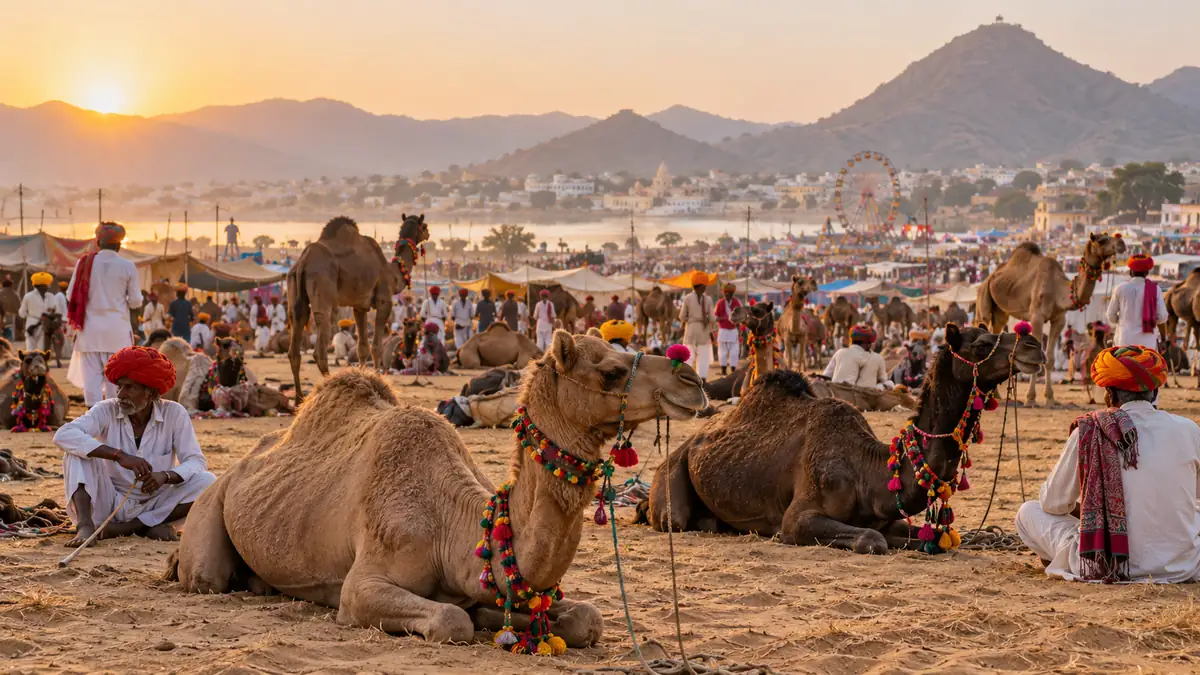
Official festival schedules, cultural program calendars, and verified government tourist tent tariffs are published on the Rajasthan Tourism Fairs and Festivals Portal.
| Upcoming Fair Edition | Official Festival Dates | Prime Livestock Trading Dates | Kartik Purnima (Peak Bathing Day) |
|---|---|---|---|
| Pushkar Fair 2026 | November 13 to November 21, 2026 | November 11 to November 15, 2026 | November 21, 2026 |
| Pushkar Fair 2027 | November 02 to November 10, 2027 | October 31 to November 04, 2027 | November 10, 2027 |
| Pushkar Fair 2028 | November 21 to November 29, 2028 | November 19 to November 23, 2028 | November 29, 2028 |
| Pushkar Fair 2029 | November 10 to November 18, 2029 | November 08 to November 12, 2029 | November 18, 2029 |
Camel Decoration Competitions, Gorbandh & Camel Dance
One of the most photogenic fairground spectacles is the Camel Decoration Contest. Owners spend weeks grooming their camels, clipping their thick coats into intricate geometric and floral patterns reminiscent of Rajasthani block prints.
The animals are draped in Gorbandh, elaborate handcrafted necklaces made of colorful wool pom-poms, brass cowrie shells, and glass beads. Silver anklets (payal) are tied around their shins, jingling musically with every stride.
During the camel dance competition, trained camels step, trot, and kneel in time to the frantic rhythm of the nagada drum, earning cheers from thousands of spectators packed onto the stadium bleachers.
The Matka Race, Longest Moustache Contest & Harmony Turban Tying
Beyond animal displays, the Mela Ground hosts quirky traditional sports that celebrate Rajasthani desert culture:
- The Longest Moustache Competition: Marwari and Shekhawati men proudly display curled moustaches measuring over six to ten feet in length, oiled with mustard extract and coiled into intricate facial ornaments.
- The Matka Race: Local Rajasthani women dressed in mirror-worked ghagra cholis sprint across the fairgrounds while balancing multiple earthenware water pots (matkas) atop their heads without spilling a drop.
- Turban Tying Contest: Visitors are invited onto the stadium turf to learn the art of winding nine meters of brightly dyed cotton cloth (safas) into traditional Rajput headgear within ninety seconds.
- Langa & Kalbelia Folk Performances: As night falls, fire dancers, Kalbelia snake charmers, and Manganiyar musicians perform beneath the stadium floodlights, accompanied by the soulful whine of the kamaicha and the rhythm of the dholak.
Jagatpita Brahma Temple: Architecture, Legend & Darshan Timings
While India has hundreds of thousands of temples dedicated to Lord Shiva and Lord Vishnu, temples dedicated to Lord Brahma are extraordinarily rare. The Jagatpita Brahma Temple in Pushkar is universally recognized as the most prominent and holiest of them all.
Travelers touring regional sacred circuits across Rajasthan can pair this pilgrimage with the renowned miracle shrine of Salasar Balaji Temple in Churu district, connecting two of northern Rajasthan’s most revered shrines.
| Temple Metric / Parameter | Value / Operational Detail | Visitor Significance |
|---|---|---|
| Architectural Era | Present structure 14th century (Origins 8th century) | Built on an elevated stone plinth reached by broad marble steps |
| Presiding Deity | Four-faced Lord Brahma (Chaturmukha Brahma) | Carved from rare black stone and seated in cross-legged padmasana |
| Spire Architecture | Brilliant crimson-red Shikhara spire | Visible from across the town and topped by a sacred goose (Hamsa) symbol |
| Morning Darshan Hours | 06:00 AM to 01:30 PM | Morning aarti at 06:30 AM; holy offering of rose petals and sugar candy |
| Evening Darshan Hours | 03:00 PM to 09:00 PM | Sandhya Aarti at 07:00 PM, followed by Shayan Aarti at 08:30 PM |
| Entry Fee | Free for all devotees | Special prasad packets cost ₹50 to ₹100 at registered counter |
Why Pushkar Has the Only Prominent Brahma Temple in the World
According to Hindu mythology, when Lord Brahma prepared to perform the universal yajna at Pushkar, his consort, Goddess Saraswati (Savitri), was late in arriving for the ceremony. Because Vedic rites require the presence of the priest’s wife to be valid, and the auspicious celestial moment was passing, Brahma married a local Gurjar maiden named Gayatri to complete the sacrifice on time.
When Goddess Savitri finally arrived and saw another woman sitting in her place by the sacred fire, she was overwhelmed with fury. She uttered a solemn curse: because Brahma had disrespected her sacred bond, he would never be worshipped anywhere on Earth except in the holy valley of Pushkar.
Savitri then climbed to the peak of Ratnagiri Hill southwest of the lake, where her independent temple stands today. A modern passenger ropeway now whisks visitors up the 750-foot hill to Savitri Temple for sweeping views of the entire desert basin.
Temple Rules, Photography Restrictions & Sacred Offerings
Devotees visiting the Brahma Temple should keep the following guidelines in mind:
- Strict Electronic Device Ban: Mobile phones, cameras, smartwatches, and leather goods (belts and wallets) are strictly forbidden inside the temple complex. Safe deposit lockers are available outside the main gate for ₹20 to ₹50.
- Modest Dress Code: Sleeveless shirts, shorts, and skirts above the knee are not permitted. Both men and women should wear clothing that covers shoulders and legs.
- Pushkar Rose Offerings: Pushkar is known as the “Rose Garden of Rajasthan,” cultivating thousands of acres of aromatic pink Damask roses. Devotees purchase traditional bamboo baskets filled with fresh pink rose petals and crystallized sugar (batasha) to offer at Brahma’s feet.
The 52 Sacred Ghats of Pushkar Lake: Maha Aarti & Holy Snan
Pushkar Lake is an enclosed crescent-shaped water body ringed by 52 historic stone bathing ghats and more than 400 white temples. Built over centuries by royal Rajput families, Maratha kings, and wealthy merchant guilds, these stepped embankments allow pilgrims safe access to the holy water.
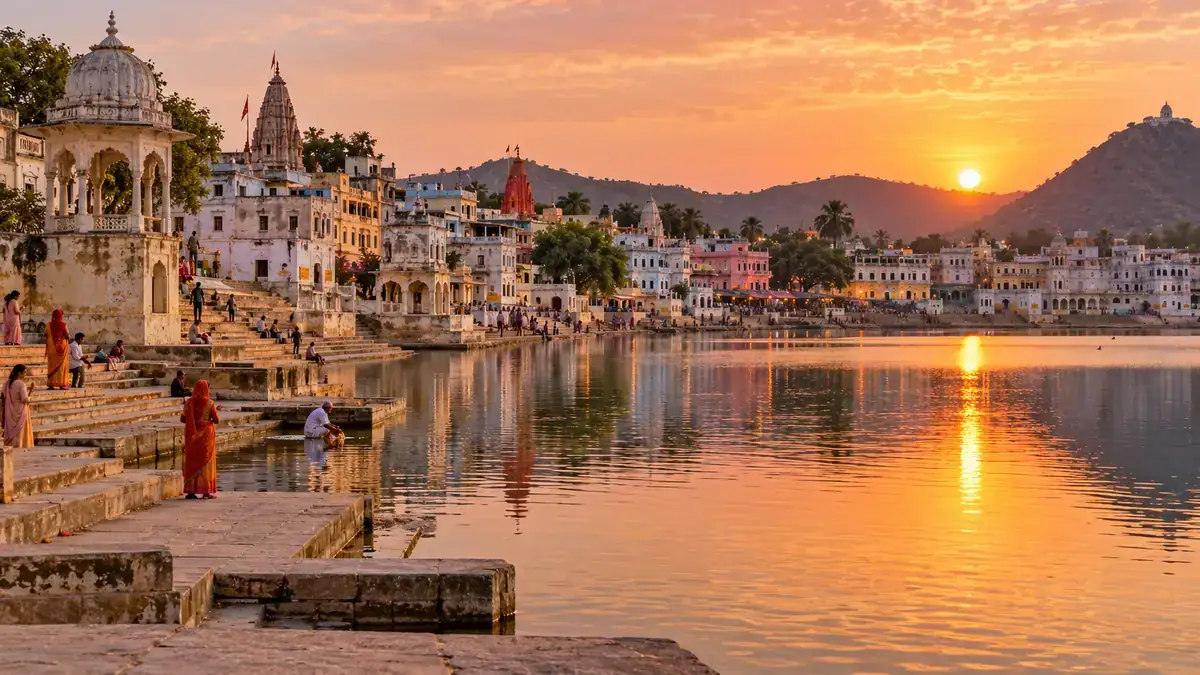
Historical architectural documentation, state heritage preservation orders, and town walking maps can be explored on the official Rajasthan Tourism Pushkar Guide.
| Major Sacred Ghat | Royal Builder / Patron | Religious Significance & Recommended Activity |
|---|---|---|
| Brahma Ghat | Royal House of Amber (Jaipur) | Primary pilgrimage ghat where Lord Brahma performed his cosmic fire sacrifice |
| Varaha Ghat | King Anaji Chauhan of Ajmer | Site where Lord Vishnu appeared as Varaha (the Boar); host of daily sunset Maha Aarti |
| Gau Ghat (Gandhi Ghat) | Maratha Rulers of Gwalior | Sacred ghat for ancestor worship (pinda daan); Mahatma Gandhi’s ashes immersed here |
| Badri Ghat | Maharaja of Jodhpur | Peaceful central ghat famous for morning meditation and sunrise photography |
| Kot Tirth Ghat | Bikaner Royal Family | Known for deep purifying waters and historical Sanskrit inscriptions |
Varaha Ghat, Brahma Ghat & Gau Ghat Sacred Rituals
The spiritual rhythm of Pushkar revolves around its ghats from dawn to dusk:
- Sunrise Holy Dips (05:30 AM to 07:30 AM): Long before the desert sun warms the air, pilgrims descend the stone steps in white and saffron robes. Chanting Sanskrit mantras, they take three cleansing dips in the placid water while offering libations of water (arghya) to Surya, the sun god.
- Sunset Maha Aarti at Varaha Ghat (07:00 PM): As twilight envelopes the lake, hundreds of worshippers assemble on the broad steps of Varaha Ghat. Temple priests dressed in golden silks lift multi-tiered brass oil lamps, swinging them in rhythmic arcs while bells toll, conch shells blow, and hymns echo across the water.
- Deepdan Floating Lamps: Devotees place small clay lamps (diyas) placed inside leaf boats filled with marigold and rose petals, lighting the wick and sending them floating across the calm dark surface of the lake.
Beware of the ‘Pushkar Priest’ Scams & Fake Red Thread Blessings
While Pushkar is a sacred sanctuary, independent travelers (particularly foreign visitors and first-time domestic tourists) must be aware of aggressive pushy touts commonly called “fake priests”:
- The Red Thread (Pushkar Passport) Tactic: Touts posing as traditional priests will approach you on the ghats, offering free rose petals and encouraging you to perform a quick “blessing” for your family. They will recite a few verses, tie a red and yellow sacred thread (mauli) around your wrist, and then aggressively demand exorbitant donations of ₹2,000 to ₹10,000.
- How to Avoid the Scam: Firmly and politely decline any rose petals or flowers handed to you near the lake. If you genuinely wish to perform a puja, approach the official temple offices or hire a verified priest through your heritage hotel with a mutually agreed fee (typically ₹100 to ₹250).
Desert Experiences: Hot Air Ballooning, Dune Camps & Sunset Points
Beyond its sacred core, the Thar Desert surrounding Pushkar offers world-class outdoor adventures. The rolling sand dunes west of the town provide an ideal setting for desert camping and aerial sightseeing.
Travelers seeking to combine desert adventures with majestic fortress architecture can continue southwest to explore the blue-painted old town and towering citadels covered in our guide to places to visit in Jodhpur.
| Desert Activity | Operating Hours | Approximate Cost | Experience Highlights |
|---|---|---|---|
| Sky Waltz Hot Air Balloon | 06:00 AM (Sunrise flight) | ₹12,000 to ₹15,000 / passenger | 60-minute flight lifting 1,000 feet over the fairgrounds and camel camps |
| Camel Safari on Dunes | 06:00 AM & 04:30 PM | ₹500 to ₹1,000 / camel (2 hrs) | Ride through acacia scrublands to desert sunset viewpoints |
| Quad Biking (ATV Rides) | 08:00 AM to 06:00 PM | ₹800 to ₹1,500 / 15-min ride | Thrilling self-drive ride across sand ridges outside the fair perimeter |
| Luxury Swiss Desert Camp | Overnight stays | ₹6,500 to ₹14,000 / tent / night | Air-conditioned luxury tent with private bath, Rajasthani buffet, and folk shows |
| Savitri Temple Ropeway | 07:00 AM to 07:00 PM | ₹160 per passenger (Return) | 6-minute cable car ascent up Ratnagiri Hill for panoramic sunset vistas |
Sky Waltz Hot Air Balloon Rides Over the Fairgrounds
For an unforgettable perspective, the authorized commercial operator Sky Waltz runs licensed hot air balloon flights during the festival days.
Lifting off from designated launch pads outside town just as the morning sun crests the Aravalli peaks, the balloon drifts silently over thousands of campfires, grazing camel herds, and the white temples of Pushkar Lake. The flight lasts roughly 45 to 60 minutes and includes champagne breakfast on landing and flight certificates. Because slots are limited to small groups, advance booking two to three months ahead is essential.
Luxury Swiss Tents vs Heritage Haveli Stays in Pushkar Town
Accommodations in Pushkar cater to every style of traveler:
- Luxury Tented Townships: Operators such as the Pushkar Desert Camp and Royal Rajasthan Camp set up temporary luxury Swiss tent villages on the perimeter sand dunes. These units feature wooden flooring, plush double beds, attached bathrooms with hot running water, and private verandas. Evenings feature open-air barbecues, Rajasthani folk dances, and stargazing.
- Heritage Havelis in Town: Travelers who prefer staying within walking distance of the 52 ghats and Brahma Temple can choose restored haveli hotels inside the bazaar (such as Pushkar Palace or Hotel Jagat Singh Palace). These properties offer courtyard fountains, hand-painted fresco ceilings, and private rooftop balconies overlooking the holy lake.
How to Reach Pushkar from Ajmer, Jaipur, and Delhi: Road & Train Routes
Situated in a scenic valley between the rugged Nag Pahar (Snake Mountain) hills, Pushkar is easily accessible via road and rail networks across central Rajasthan.
Detailed district transportation advisories, highway maps, and train schedules can be cross-referenced on the Incredible India Ajmer Destination Portal.
| Transit Segment | Travel Mode | Distance / Duration | Cost Estimate | Practical Travel Advice |
|---|---|---|---|---|
| Ajmer to Pushkar | Private Taxi / Cab | 14 km (30 minutes) | ₹500 to ₹800 | Scenic drive over the winding Nag Pahar mountain pass |
| Ajmer to Pushkar | RSRTC Public Bus | 14 km (45 minutes) | ₹25 to ₹40 per seat | Buses depart every 20 minutes from Ajmer Bus Stand |
| Jaipur to Pushkar | Private Taxi via NH48 | 145 km (3 hours) | ₹2,800 to ₹3,800 | Smooth multi-lane toll expressway via Kishangarh |
| Delhi to Ajmer | Vande Bharat Express | 440 km (5 hours 15 mins) | ₹1,250 (CC) / ₹2,270 (EC) | Departs Delhi Cantt at 06:10 AM; arrives Ajmer 11:25 AM |
| Delhi to Ajmer | Ajmer Shatabdi Express | 440 km (6 hours 30 mins) | ₹950 (Chair Car) | Departs New Delhi Railway Station daily at 06:10 AM |
Driving over Snake Mountain (Nag Pahar) from Ajmer Junction
The historic rail hub of Ajmer Junction (station code: AII) is the nearest primary railhead to Pushkar, located just 14 kilometers to the southeast. Ajmer connects directly with New Delhi, Mumbai, Ahmedabad, Kolkata, and Jammu through daily superfast trains.
The road from Ajmer to Pushkar winds upward through the Nag Pahar (Snake Mountain) hills along State Highway 58. The pass offers panoramic views over Ana Sagar Lake in Ajmer before dropping down into the peaceful rose-growing valley of Pushkar.
During the peak days of the Camel Fair, traffic over the pass can be heavy. Consider hiring an auto-rickshaw or taxi early in the morning to avoid gridlock. Travelers routing through Ajmer frequently spend a morning visiting the Sufi shrine and hilltop citadel covered in our Ajmer Sharif Dargah and Taragarh Fort guide before crossing Nag Pahar.
Connecting by Superfast Trains & Jaipur Airport Logistics
For travelers arriving by air, Jaipur International Airport (airport code: JAI) is the closest commercial airport, situated 145 kilometers northeast of Pushkar. Jaipur handles dozens of daily domestic flights connecting New Delhi, Mumbai, Bengaluru, Hyderabad, Chennai, and Kolkata, as well as direct flights to Dubai, Muscat, and Sharjah.
From Jaipur Airport, you can hire a private pre-paid cab directly to Pushkar (a pleasant 3-hour journey along the multi-lane National Highway 48) or take a 30-minute cab ride to Jaipur Junction to board the Vande Bharat or Shatabdi Express to Ajmer.
Frequently Asked Questions About Pushkar Camel Fair
When does the Pushkar Camel Fair take place each year?
The Pushkar Camel Fair is held annually in the Hindu month of Kartik, typically falling between late October and late November. The festival lasts for eight to nine days and culminates on the auspicious night of Kartik Purnima (full moon).
Do I need to buy tickets to enter the Pushkar Fairgrounds?
No, general entry to the Pushkar Fairgrounds, the camel trading dunes, the Brahma Temple, and the 52 ghats is completely free. Paid tickets are only required for special commercial activities such as hot air balloon rides, camel safaris, and VIP grandstand seating for specific state evening concerts.
How many days are ideal for visiting the Pushkar Camel Fair?
Three to four days are ideal for experiencing the fair. This allows you to explore the livestock trading dunes at sunrise, attend the quirky sports contests at the Mela Ground, visit the Brahma and Savitri temples, witness the evening Maha Aarti at Varaha Ghat, and take a desert camel safari.
Is alcohol or non-vegetarian food available in Pushkar?
Because Pushkar is one of the holiest pilgrim towns in Hinduism, the sale and consumption of alcohol, meat, fish, and eggs are strictly prohibited within the municipal town limits. All restaurants and cafes serve 100% vegetarian food, including falafel, wood-fired pizzas, and traditional Rajasthani thalis.
Can tourists participate in the fair competitions?
Yes, international and domestic tourists are warmly encouraged to take part in fairground contests such as the Turban Tying Competition, the Matka Race, and friendly cricket matches against local teams at the central stadium.
Can a trip to Pushkar be combined with the Golden Triangle and royal palaces?
Yes, Pushkar is located just three hours from the Pink City; you can easily extend your journey to explore the majestic Amber Fort and City Palace using our detailed guide to places to visit in Jaipur.