Places to Visit in Mount Abu: Dilwara, Nakki Lake & Guru Shikhar
Complete guide to places to visit in Mount Abu: Dilwara Jain temples marble carving, Nakki Lake boating, Guru Shikhar peak, Toad Rock, itineraries, and transit.
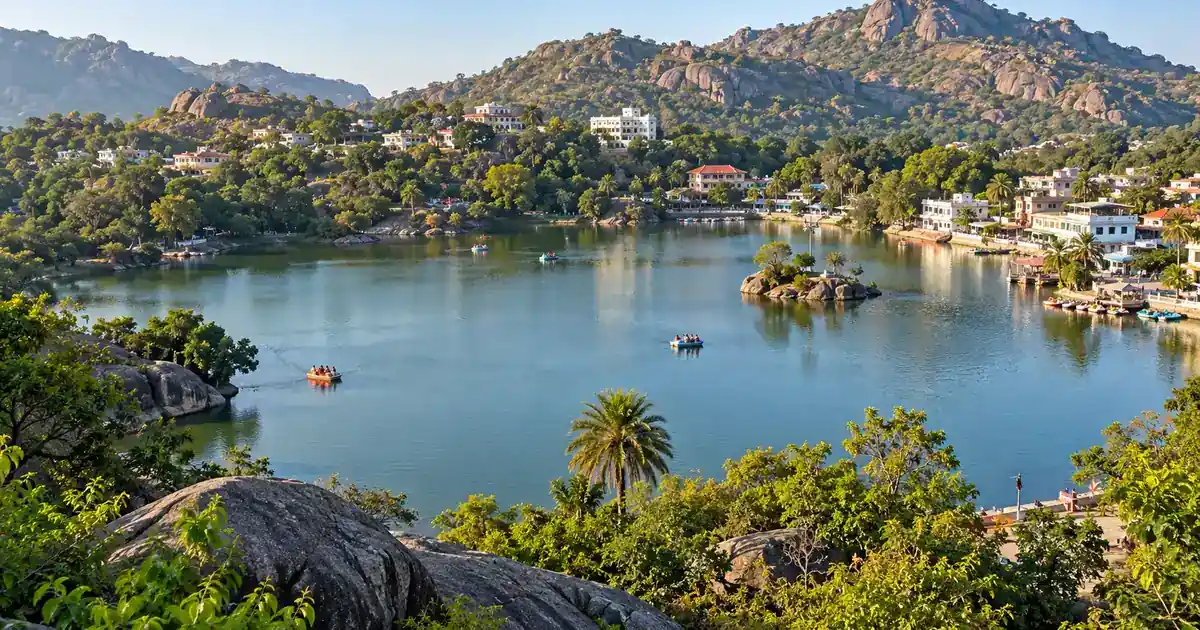
Perched at an elevation of 1,220 meters (4,003 feet) atop a rocky granite plateau in Sirohi district, Mount Abu stands as Rajasthan’s sole hill station. While the rest of the desert state endures scorching summer temperatures, Mount Abu offers cool mountain air, forested ravines, and natural freshwater springs.
Encircled by the southern ridges of the ancient Aravalli Range, the town is renowned for two contrasting wonders. In nature, it features panoramic cliff lookouts and the calm waters of Nakki Lake. In art, it houses the world-famous Dilwara Jain Temples, an 11th-century architectural marvel where pure white marble was sculpted into gossamer-thin, translucent stone filigree.
Mount Abu Sightseeing Essentials
- Geographic Setting: Sirohi district, southwestern Rajasthan, bordering Gujarat.
- Plateau Elevation: 1,220 meters, with Guru Shikhar rising to 1,722 meters (5,650 feet).
- Primary Architectural Treasure: Dilwara Jain Temple complex (11th to 13th centuries CE).
- Signature Water Body: Nakki Lake, India’s first artificially excavated high-altitude mountain lake.
- Wildlife Sanctuary: 288 sq km reserve protecting leopards, sloth bears, and sambar deer.
- Transit Gateway: Abu Road Railway Station (28 km) and Maharana Pratap Airport Udaipur (185 km).
- Recommended Duration: Two to three days for an unhurried hill circuit.
For travelers seeking respite from city heat, Mount Abu blends spiritual pilgrimage with outdoor leisure. The table below outlines key sightseeing landmarks, visiting hours, admission rates, and recommended durations.
| Sightseeing Attraction | Elevation & Location | Visiting Hours | Admission Fee | Recommended Duration |
|---|---|---|---|---|
| Dilwara Jain Temples | 2.5 km north of town center | 12:00 PM to 05:00 PM (Tourists) | Free admission; mandatory dress code | 2 to 2.5 hours |
| Nakki Lake & Toad Rock | Center of Mount Abu | 08:00 AM to 08:00 PM (Boating) | ₹100 (Pedal boat) / ₹250 (Shikara) | 1.5 to 2 hours |
| Guru Shikhar Peak | 15 km northeast of town | 08:00 AM to 06:30 PM daily | Free entry; temple bell ritual | 1.5 to 2 hours |
| Achalgarh Fort & Temple | 11 km north of town center | 06:00 AM to 07:00 PM | Free entry; steep hill climb | 1 to 1.5 hours |
| Trevor’s Tank Wildlife Park | 5 km northeast of town | 09:00 AM to 05:00 PM | ₹50 per person + ₹100 for vehicle | 1.5 hours |
| Sunset Point & Honeymoon Point | 2 km southwest of Nakki Lake | 04:30 PM to 07:00 PM | Free access; pony rides available | 1 to 1.5 hours |
What is Mount Abu: Rajasthan’s Only Hill Station Oasis
Surrounded by arid plains, Mount Abu forms a dramatic 22-kilometer-long granite plateau standing isolated from the surrounding lowlands. Geologically, the Aravalli Range is one of the oldest fold mountain systems in the world, predating the Himalayas by hundreds of millions of years.
Because of its high elevation, Mount Abu experiences a distinct sub-tropical highland microclimate. Coniferous pine trees, bamboo groves, date palms, and blooming wild orchids thrive alongside rocky granite outcrops, earning the town its historic moniker: the “Shimla of Rajasthan.”
Travelers organizing broader cross-state journeys can consult our curated directory of best places to visit in India for seasonal flight routes and packing advice.
Granite Plateau Geography and Cool Microclimate of the Southern Aravallis
The geography of Mount Abu creates a welcome cooling refuge:
- Summer Escape (April to June): While temperatures across the plains of Rajasthan and northern Gujarat regularly touch 45°C, Mount Abu enjoys pleasant daytime temperatures between 28°C and 34°C, accompanied by cool mountain breezes.
- Monsoon Cloudbursts (July to September): Mount Abu receives the highest rainfall in Rajasthan, recording over 1,500 millimeters annually. Heavy rain transforms the granite cliffs into cascading seasonal waterfalls, with thick mountain mists blanketing the forests.
- Crisp Winter Days (October to March): Clear sunny skies and daytime temperatures around 18°C make winter the most popular season. Nighttime temperatures occasionally dip to 2°C, coating lakeside meadows with delicate frost.
Mythological Origins: The Serpent Arbuda and Sage Vashistha’s Ashram
According to ancient Puranic scriptures, Mount Abu was originally known as Arbudanchal. Legend recounts that Lord Shiva’s sacred bull, Nandi, fell into a deep mountain chasm.
To rescue Nandi, Shiva requested the great mountain serpent Arbuda to carry a colossal rock on his back and fill the abyss. Out of gratitude, the sage Vashistha named the mountain Arbuda, which eventually corrupted into Abu.
Mount Abu is also celebrated as the sacred site of the Vedic Agni Kunda (fire altar). Scriptures state that Sage Vashistha performed a grand fire sacrifice atop the plateau to purify the earth, from which four legendary Rajput warrior clans (the Chauhans, Parmars, Pratiharas, and Solankis) emerged into history.
Dilwara Jain Temples: Marble Carving, Vimal Vasahi & Luna Vasahi
Situated among a quiet grove of mango trees two kilometers north of Mount Abu, the Dilwara Jain Temples are regarded by art historians as the crowning achievement of Indian marble craftsmanship.
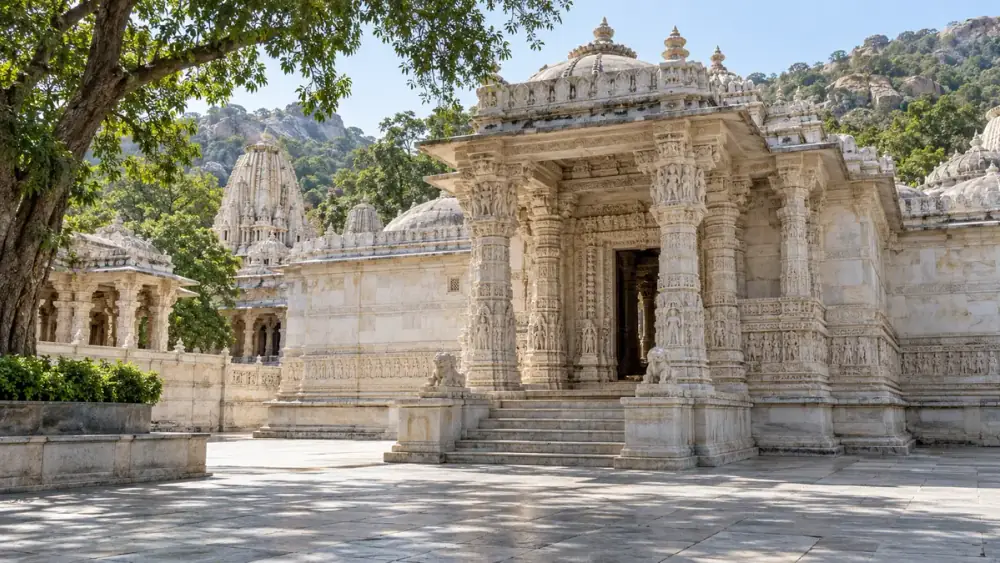
Constructed between the 11th and 13th centuries CE by wealthy Jain ministers, the five shrines appear plain and unassuming from the outside to protect them from invading medieval armies. However, stepping inside reveals a world of pure white marble carved with unbelievable delicacy.
Official monument maintenance notices, temple trusts, and prayer schedules are maintained on the Rajasthan Tourism Mount Abu Portal.
| Temple Shrine | Dedication / Era | Patron / Architect | Artistic Masterpiece |
|---|---|---|---|
| Vimal Vasahi | Lord Adinath (1031 CE) | Vimal Shah, Minister of Gujarat | Central dome with layered concentric rings and 16 Vidyadevis |
| Luna Vasahi | Lord Neminath (1230 CE) | Vastupal and Tejpal, Jain Ministers | Central marble pendant carved like an unfolding lotus flower |
| Pittalhar Temple | Lord Rishabhdev (14th Century) | Built by Bhima Shah | Houses a colossal five-metal (panchdhatu) idol weighing 4.3 tons |
| Parshvanatha (Khartar Vasahi) | Lord Parshvanatha (1459 CE) | Built by Sanghana Mandavika | Three-story temple crowned by a tall granite tower with gray carvings |
| Mahavir Swami Temple | Lord Mahavira (1582 CE) | Dedicated to 24th Tirthankara | Intricate ceiling frescoes painted with red and blue mineral pigments |
Vimal Vasahi and Luna Vasahi: Translucent Ceilings and Lotus Pendants
The artistic grandeur of Dilwara centers on two shrines:
- Vimal Vasahi (Adinath Temple): Built in 1031 CE by Vimal Shah, this temple is surrounded by a pillared cloister containing 52 individual secondary shrines. The central mandapa features sixteen marble statues of the Vidyadevis (goddesses of knowledge), each holding sacred manuscripts and musical instruments. The marble has been carved so thin that light passes through the stone, making the sculptures appear weightless.
- Luna Vasahi (Neminath Temple): Erected in 1230 CE by the brothers Vastupal and Tejpal, this temple honors their late brother Luna. Its central dome features a hanging marble pendant so delicately sculpted that it resembles an inverted lotus blossom carved from crystal rather than stone. Artisans scraped the marble with fine steel tools rather than chisels, reportedly receiving payment in pure gold equal to the weight of marble dust they carved away.
Temple Visiting Rules, Photography Prohibitions & Free Entry
Because Dilwara remains an active, revered center of Jain spiritual pilgrimage, visitors must respect strict rules:
- Restricted Tourist Hours: To allow Jain devotees uninterrupted morning worship, tourists are admitted only between 12:00 PM and 05:00 PM. Entry is completely free of charge.
- Strict Photography Ban: Mobile phones, digital cameras, smartwatches, and video equipment are strictly prohibited inside the complex. Free lockers are provided outside the entrance gate to deposit electronic devices safely.
- Dress Code and Leather Articles: All shoes and socks must be removed before entering. Clothing must cover shoulders and knees. In accordance with Jain vows of non-violence, leather items (belts, wallets, and leather watchstraps) must be left in lockers.
Nakki Lake, Toad Rock & Sunset Point: Waterfalls & Cliff Trails
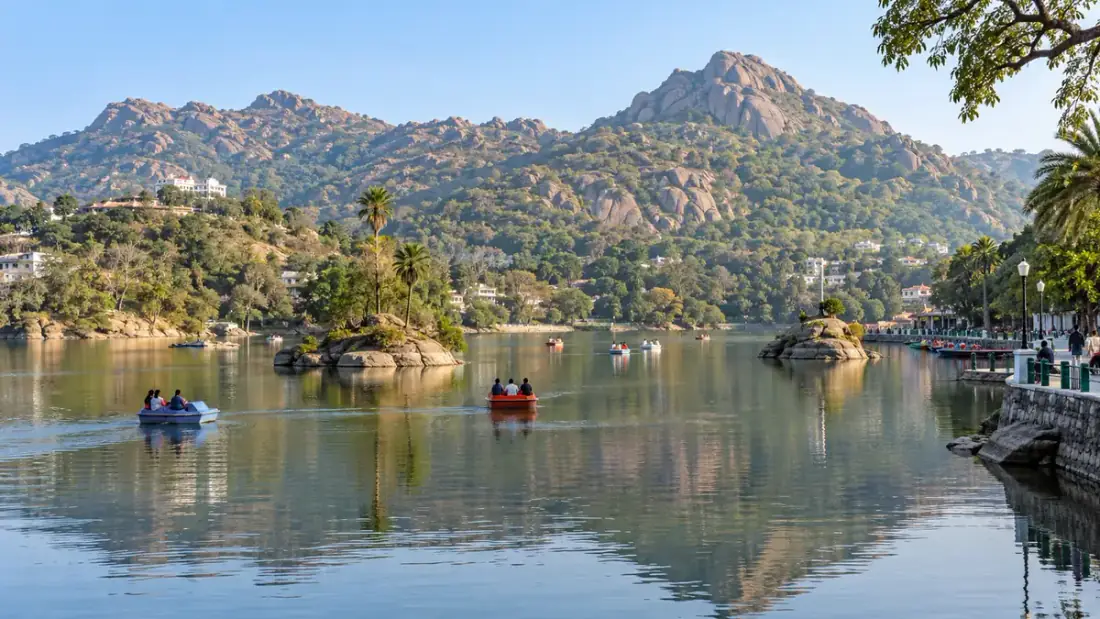
Located at the center of Mount Abu town, Nakki Lake is the leisure heartbeat of the hill station. Surrounded by rocky granite hills, landscaped gardens, and broad walking promenades, the lake offers outdoor recreation for family vacationers and couples.
State park conservation guidelines, municipal boating fees, and town maps are documented on the Incredible India Mount Abu Profile.
| Leisure Spot | Distance from Lake | Key Activity | Best Visiting Window |
|---|---|---|---|
| Nakki Lake Boating | Town Center | 2-seater and 4-seater pedal boats, Kashmiri shikaras | 09:00 AM to 07:00 PM (Late afternoon light) |
| Toad Rock Climb | 1 km hike above lake | 250 stone steps; iconic rock formation shaped like a toad | Early morning or late afternoon for lake panoramas |
| Sunset Point | 2 km southwest | Paved hilltop walkway overlooking the distant desert plains | 05:00 PM to 06:45 PM (Sunset golden hour) |
| Honeymoon Point | 2.5 km northwest | Secluded cliff edge with dramatic views of the gorge below | Sunset; quiet alternative to busy Sunset Point |
| Nakki Bazaar | Adjacent to lake promenade | Shopping for Rajasthani quilts, Kota doria sarees, wooden toys | 06:00 PM to 10:00 PM (Evening street food) |
Pedal Boating on Sacred Nakki Lake and Evening Promenade Bazaars
Local mythology holds that Nakki Lake was dug out by the gods using their fingernails (nakh) to protect themselves against the demon Bashkali, earning the body of water its sacred name. Mahatma Gandhi’s ashes were immersed in the lake in 1948, commemorated by the Gandhi Ghat on the eastern shore.
Travelers can rent brightly painted pedal boats (₹100 to ₹150 for 30 minutes) or hire a covered four-passenger shikara (₹250 to ₹350) to cruise past tiny granite islets and weeping willows.
As dusk falls, the lakeside promenade lights up with food stalls serving piping-hot roasted sweet corn (bhutta), spicy pav bhaji, mulberry ice cream, and Rajasthani kachoris.
Climbing Toad Rock and Golden Hour Views at Honeymoon & Sunset Points
Hovering on a rocky cliff directly above the lake stands Toad Rock, a natural granite boulder sculpted by millions of years of wind erosion into the uncanny shape of a giant toad about to leap into the water.
A 15-minute climb up 250 paved stone steps leads to the base of the rock. Scrambling to the upper viewpoint provides a bird’s-eye panorama of Nakki Lake, the town’s colonial roofs, and the surrounding green hills.
Two kilometers to the southwest lies Sunset Point. Every evening, thousands of travelers gather on the stone amphitheater terraces to watch the sun sink into the distant horizon. The sky shifts through shades of orange, magenta, and purple over the valley below.
Guru Shikhar, Achalgarh Fort & Trevor’s Tank Wildlife Sanctuary
Beyond the town center, the northern reaches of Mount Abu offer rugged peaks, ancient medieval fortresses, and secluded wildlife habitats.
Travelers pairing hill station tranquility with royal lake palaces can connect this journey with the heritage circuits described in our complete guide to Udaipur travel highlights.
| Landmark / Site | Elevation / Distance | Historical & Ecological Importance | Practical Visitor Advice |
|---|---|---|---|
| Guru Shikhar | 1,722 m; 15 km northeast | Highest mountain summit in the Aravalli Range | 300 steps to summit; panoramic 360-degree views |
| Dattatreya Temple | Peak of Guru Shikhar | Sacred cave temple dedicated to Trinity incarnation | Massive brass bell rung by pilgrims for good fortune |
| Achalgarh Fort | 11 km north of town | 15th-century fortress built by Maharana Kumbha | Steep walk; double-walled battlements and ancient granaries |
| Achaleshwar Mahadev | Base of Achalgarh | Natural toe impression of Lord Shiva worshipped in pit | Huge 4-ton bronze Nandi bull statue |
| Trevor’s Tank | 5 km northeast | Artificial lake built by British engineer in 1897 | Protected wetland for birdwatchers and marsh crocodiles |
Standing at 1,722 Meters: Dattatreya Temple on the Highest Aravalli Peak
Rising to 1,722 meters (5,650 feet) above sea level, Guru Shikhar is the highest mountain peak in Rajasthan and the entire Aravalli system.
A scenic 15-kilometer drive winds through high-altitude scrub forests to the base of the peak. From the vehicle parking area, visitors climb roughly 300 stone steps past souvenir stalls to reach the summit.
At the highest point stands a cave shrine dedicated to Lord Dattatreya, an incarnation of the holy trinity (Brahma, Vishnu, and Shiva). Outside the sanctum hangs an enormous brass bell inscribed with ancient Sanskrit verses. Pilgrims ring the bell upon reaching the top, sending deep musical chimes echoing across the mountain valleys.
Adjacent to the temple sits the Mount Abu Infrared Observatory, operated by the Physical Research Laboratory to study celestial objects through clear high-altitude skies.
Achaleshwar Mahadev Shivalinga, Nandi Bull & Crocodile Spotting at Trevor’s Tank
Eleven kilometers north of town lies the historic settlement of Achalgarh:
- Achaleshwar Mahadev Temple: Built in the 9th century by the Paramara rulers, this unique shrine is the only Shiva temple in India where worshippers revere the divine “big toe” of Lord Shiva rather than a lingam. In the courtyard stands a massive 4-ton brass statue of the Nandi bull, composed of five sacred metals.
- Achalgarh Fort: Commissioned by Maharana Kumbha in 1452 CE, the fortress crowns a steep hill above the temple. Travelers can explore the monumental Hanuman Pol gate and two large rock-cut water tanks known as the Sawan-Bhadon lakes.
Five kilometers northeast of town lies Trevor’s Tank, a protected wildlife depression engineered in 1897 by British engineer Col. G.H. Trevor. Ringed by rocky hills and thick jungle, the reservoir is home to breeding colonies of mugger crocodiles (marsh crocodiles) that bask on the muddy banks at midday. The park is a paradise for birdwatchers, sheltering black drongos, emerald green bee-eaters, and crested serpent eagles.
Curated 2-Day Mount Abu Itinerary from Ahmedabad & Udaipur
A 2-day itinerary provides sufficient time to experience Mount Abu’s key attractions without feeling rushed, balancing world-class stone carving with leisurely lake walks and mountain summits.
Regional weather updates, road safety guidelines, and seasonal holiday packages can be verified on the Incredible India Udaipur Regional Desk.
| Timing / Phase | Sightseeing Destination & Activity | Location / Distance | Helpful Travel Tips |
|---|---|---|---|
| Day 1: Morning (09:00 AM – 11:30 AM) | Scenic drive up the Abu Road hill pass | 28 km uphill climb | Enjoy scenic valley viewpoints; check into hotel |
| Day 1: Midday (12:00 PM – 02:30 PM) | Dilwara Jain Temples guided tour | 2.5 km north of town | Arrive at noon; explore Vimal Vasahi and Luna Vasahi |
| Day 1: Afternoon (03:30 PM – 05:00 PM) | Climb Toad Rock & walk Nakki promenade | Town center | Climb 250 steps for panoramic lake photos |
| Day 1: Evening (05:30 PM – 07:30 PM) | Sunset Point golden hour & street food | 2 km southwest | Watch the desert sunset; sample hot bhutta and pav bhaji |
| Day 2: Morning (07:30 AM – 10:30 AM) | Guru Shikhar Peak summit ascent | 15 km northeast | Early morning climb to Dattatreya Temple; ring brass bell |
| Day 2: Midday (11:00 AM – 01:30 PM) | Achalgarh Fort & Achaleshwar Temple | 11 km north of town | Admire Shiva’s toe shrine and the massive 4-ton brass Nandi |
| Day 2: Afternoon (02:30 PM – 04:30 PM) | Trevor’s Tank wildlife nature walk | 5 km northeast | Walk shaded forest trails to view marsh crocodiles |
| Day 2: Late Afternoon (05:00 PM onward) | Pedal boating on Nakki Lake & departure | Town center | Evening boat ride before descending the hill road |
Day 1: Dilwara Marble Wonders, Nakki Lake Boating & Sunset Point
Begin your first day by arriving in Mount Abu by mid-morning via the winding ghat road from Abu Road station. Check into your hotel and head directly to the Dilwara Jain Temples by 12:00 PM, when the doors open to general tourists. Spend two unhurried hours admiring the translucent ceiling carvings of Vimal Vasahi and Luna Vasahi.
After a vegetarian Gujarati thali lunch in town, walk down to Nakki Lake. Climb the stone steps to Toad Rock to capture panoramic photos across the water basin.
By 05:00 PM, walk or take a shared pony cart along the paved two-kilometer pathway to Sunset Point. Join the crowds to watch the sun drop behind the distant horizon, then spend your evening browsing the lively stalls of Nakki Bazaar.
Day 2: Guru Shikhar Summit Sunrise, Achalgarh Fort & Market Shopping
Rise early on your second morning for the 30-minute drive northeast to Guru Shikhar. Climb the 300 stone steps in the cool morning air to reach the Dattatreya Temple at 1,722 meters, savoring 360-degree views across the green Aravalli ridges.
On your return drive, stop at Achalgarh to tour the ancient Achaleshwar Mahadev Temple and explore the rugged stone battlements of Maharana Kumbha’s fort.
In the afternoon, take a quiet nature walk through Trevor’s Tank to spot marsh crocodiles and migratory water birds. Conclude your trip with a peaceful sunset pedal boat cruise on Nakki Lake before beginning your onward journey.
How to Reach Mount Abu by Train, Road, and Flight Logistics
Mount Abu is well connected by rail and highway networks linking southern Rajasthan with northern Gujarat.
Travelers planning an extended royal fort and palace vacation can coordinate their onward road trip with the monumental stone ramparts covered in our Kumbhalgarh Fort and Ranakpur guide.
| Transit Mode | Connecting Terminal Hub | Distance / Duration | Practical Transit Logistics |
|---|---|---|---|
| Express Train | Abu Road Railway Station (ABR) | 28 km (45 mins taxi ride) | Major railhead on Delhi–Ahmedabad Western Railway line |
| Air Travel (Udaipur) | Maharana Pratap Airport (UDR) | 185 km (3.5 hours drive) | Convenient for travelers flying from Delhi, Mumbai, or Jaipur |
| Air Travel (Ahmedabad) | Sardar Vallabhbhai Patel Airport (AMD) | 220 km (4.5 hours drive) | Excellent international connectivity; smooth toll expressway |
| Private Taxi (Udaipur) | Udaipur City to Mount Abu | 165 km via NH27 (3 hours) | Smooth multi-lane toll road via Pindwara; ₹3,500 to ₹4,500 cab fare |
| Private Taxi (Ahmedabad) | Ahmedabad to Mount Abu | 225 km via NH27 (4.5 hours) | Popular weekend getaway route; ₹4,000 to ₹5,500 cab fare |
Abu Road Railway Station (ABR) Transit and Winding Hill Road Drive
The primary rail gateway for Mount Abu is Abu Road Railway Station (station code: ABR), located at the base of the mountain 28 kilometers to the southeast.
Abu Road is a major stop on the busy Delhi–Jaipur–Ahmedabad–Mumbai broad-gauge line. Daily superfast express trains like the Swarna Jayanti Rajdhani, Ashram Express, and Vande Bharat Express connect Abu Road directly to New Delhi (10 hours), Jaipur (6 hours), and Mumbai (9 hours).
From Abu Road station, travelers can reach Mount Abu through two convenient transport modes:
- Private Tourist Cabs: Pre-paid and private taxis wait outside the station exit gates, charging fixed rates between ₹700 and ₹1,000 for a private sedan ride up the mountain.
- RSRTC Public State Buses: State transport buses operate every thirty minutes from the bus stand opposite the railway station, taking approximately one hour to climb the hill for a budget fare of ₹50 to ₹70 per seat.
The 28-kilometer mountain road climbs over 900 vertical meters through dense deciduous forests, offering sweeping views over the surrounding plains.
Connecting via Udaipur Airport or Ahmedabad Highway Corridors
For visitors arriving by air, Maharana Pratap Airport in Udaipur (airport code: UDR) is the closest domestic airport, situated 185 kilometers to the east. Hired cabs travel along the smooth four-lane National Highway 27, passing through Pindwara before reaching Abu Road.
Alternatively, travelers flying internationally can land at Sardar Vallabhbhai Patel International Airport in Ahmedabad (airport code: AMD), located 220 kilometers to the south. The six-lane highway corridor through Mehsana and Palanpur makes the drive pleasant and fast, taking approximately 4.5 hours.
Frequently Asked Questions About Visiting Mount Abu
What are the top places to visit in Mount Abu?
The top attractions in Mount Abu include the Dilwara Jain Temples, Nakki Lake, Toad Rock, Guru Shikhar (the highest peak in Rajasthan), Achalgarh Fort, Sunset Point, and Trevor’s Tank Wildlife Sanctuary.
Why are the Dilwara Jain Temples in Mount Abu famous?
The Dilwara Jain Temples are globally renowned for their extraordinary marble stone carving. Built between the 11th and 13th centuries, the temples feature translucent marble ceilings, intricate lotus pendants, and carved pillars of remarkable artistic delicacy.
What are the visiting hours for tourists at the Dilwara Temples?
Tourists are permitted to visit the Dilwara Jain Temples daily between 12:00 PM and 05:00 PM. Morning hours (06:00 AM to 12:00 PM) are reserved exclusively for Jain pilgrims for prayers. Entry is completely free of charge.
How much does boating cost at Nakki Lake?
Pedal boats at Nakki Lake cost between ₹100 and ₹150 for a 30-minute ride, while traditional four-seater shikara boat rides cost approximately ₹250 to ₹350 per boat.
How far is Mount Abu from Udaipur and Ahmedabad?
Mount Abu is located approximately 165 kilometers west of Udaipur (3 to 3.5 hours drive via NH27) and 225 kilometers north of Ahmedabad (4 to 4.5 hours drive via NH27).
Can a trip to Mount Abu be combined with royal fortress destinations?
Yes, travelers frequently combine the cool mountain atmosphere of Mount Abu with the medieval ramparts of Marwar; check our complete travel guide to top attractions in Jodhpur for Mehrangarh Fort audio tours and Blue City walks just four hours to the north.