Places to Visit in Hampi: 3-Day Ruins, Temples & Coracle Guide
Comprehensive guide to places to visit in Hampi: Vijaya Vittala stone chariot, Virupaksha Temple, royal enclosures, sunset boulder hills, and coracle rides.
The ruins of Hampi spread across more than 4,100 hectares of rugged granite hills along the banks of the Tungabhadra River in northern Karnataka. Founded in the fourteenth century, Hampi served as the imperial capital of the Vijayanagara Empire. At its peak during the sixteenth century, Portuguese merchants and Persian ambassadors described it as one of the largest and most prosperous metropolises on Earth.
Hampi Travel Essentials
- Geographic Zone: Tungabhadra River Basin, Vijayanagara District, Karnataka.
- Heritage Designation: UNESCO World Heritage Site inscribed in 1986.
- Primary Architectural Wonders: Vijaya Vittala Stone Chariot, Virupaksha Temple, Lotus Mahal, Elephant Stables.
- Best Season to Visit: October to March for cool weather and clear skies.
- Ideal Trip Duration: 3 full days to cover the Sacred Center, Royal Center, and Anegundi.
- Nearest Transit Hub: Hosapete Junction (HPT) railway station, located 14 kilometers away.
Today, this UNESCO World Heritage landscape functions as an expansive open-air museum where monumental Dravidian granite shrines stand amidst ancient markets and royal courtyards. Travelers planning pan-Indian cultural journeys often rank the historic city alongside the top places to visit in India.
Official historical surveys published on the Ballari District official tourism portal document more than 1,600 surviving monuments across the rocky plain. These structures range from fortresses, royal baths, and pillared pavilions to active sanctums that have maintained unbroken religious worship for over a thousand years.
| Archaeological Zone | Primary Monument Highlights | Architectural Style |
|---|---|---|
| Sacred Center | Virupaksha Temple, Hemakuta Hill, Hampi Bazaar | Classical Dravidian and pre-Vijayanagara granite |
| Vittala Complex | Monolithic Stone Chariot, 56 Musical Pillars | Peak Vijayanagara imperial stone masonry |
| Royal Center | Lotus Mahal, Elephant Stables, Mahanavami Dibba | Indo-Islamic vaulted arches and tiered stone bas-reliefs |
| Anegundi Bank | Anjanadri Hill, Sanapur Lake, Chintamani Temple | Prehistoric boulder formations and mythological riverfronts |
The Sacred Center: Virupaksha Temple, Hemakuta Hill & Hampi Bazaar
The Sacred Center clusters along the southern bank of the Tungabhadra River, serving as the spiritual heart of the Vijayanagara capital. This district survived the catastrophic sack of the city in 1565 because its shrines were dedicated to regional guardian deities rather than imperial treasuries.
For an extensive architectural breakdown and spiritual history, consult our dedicated Virupaksha Temple Hampi guide before beginning your morning walking tour.
Virupaksha Temple and Inverted Shadow Pinhole Camera
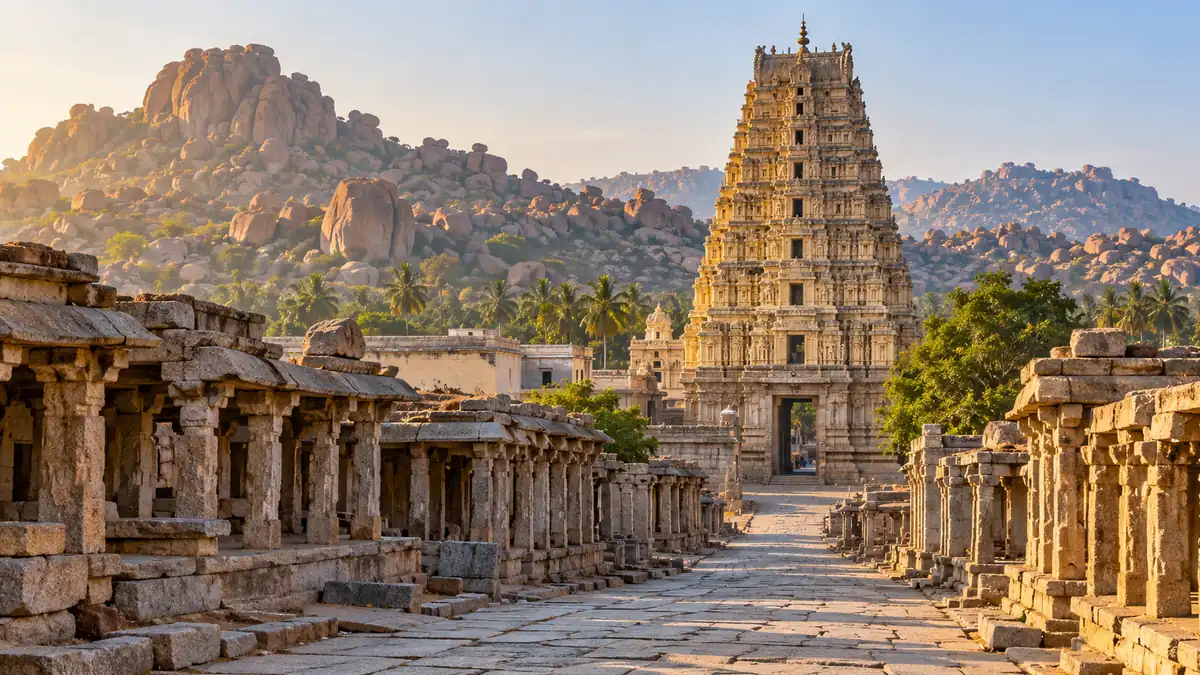
Virupaksha Temple remains the oldest functioning temple complex in Hampi, with core shrines dating back to the seventh century. The temple complex is dominated by an imposing 50-meter-tall eastern entrance tower (gopuram) with nine stepped tiers rising above Hampi Bazaar.
Inside the pillared sanctum, pilgrims worship Lord Virupaksha, a sacred manifestation of Lord Shiva, alongside his divine consort Pampa Devi. A fascinating engineering feature rests inside a dark rear stone chamber: a small aperture in the exterior masonry acts as a medieval camera obscura, casting an inverted shadow of the towering eastern gateway onto the white wall inside.
Hemakuta Hill Monolithic Shrines and Sunset Vistas
Hemakuta Hill rises directly south of Virupaksha Temple. The gentle sloping granite outcrop is studded with more than thirty compact stone shrines constructed in the pre-Vijayanagara Kadamba and early Chalukya idioms with pyramid-stepped stone roofs.
According to regional folklore, Lord Shiva agreed to marry Pampa on this hill, prompting golden rain (hema) to shower down from the heavens. Hemakuta offers smooth stone terraces where travelers gather during late afternoon to watch the sun drop behind the distant Tungabhadra palm groves.
Sasivekalu and Kadalekalu Ganesha Colossal Sculptures
At the southern base of Hemakuta Hill stand two colossal monolithic statues of Lord Ganesha, each carved directly out of massive freestanding granite boulders:
- Sasivekalu Ganesha: Carved in 1506 by local grain merchants, this 2.4-meter-tall statue features a snake tied around Ganesha’s stomach to keep it from bursting after consuming too much sweet pudding. The name sasivekalu refers to its mustard-seed resemblance.
- Kadalekalu Ganesha: Standing 4.5 meters high inside a tall pillared stone hall, this monumental sculpture resembles a Bengal gram (kadalekalu) seed. Its polished belly and broad stone torso illustrate the scale of Vijayanagara stone sculpting.
Vijaya Vittala Temple Complex: The Iconic Stone Chariot & Musical Pillars
The Vijaya Vittala temple complex stands as the pinnacle of Vijayanagara artistic and architectural achievement. Commissioned during the fifteenth century under King Devaraya II and significantly expanded by King Krishnadevaraya, the sanctuary honors Lord Vittala, an aspect of Lord Krishna.
To compare the intricate stone craftsmanship here with the grand granite temples of Tamil Nadu, read our companion Brihadisvara Temple Thanjavur guide.
The Monolithic Stone Chariot Dedicated to Garuda
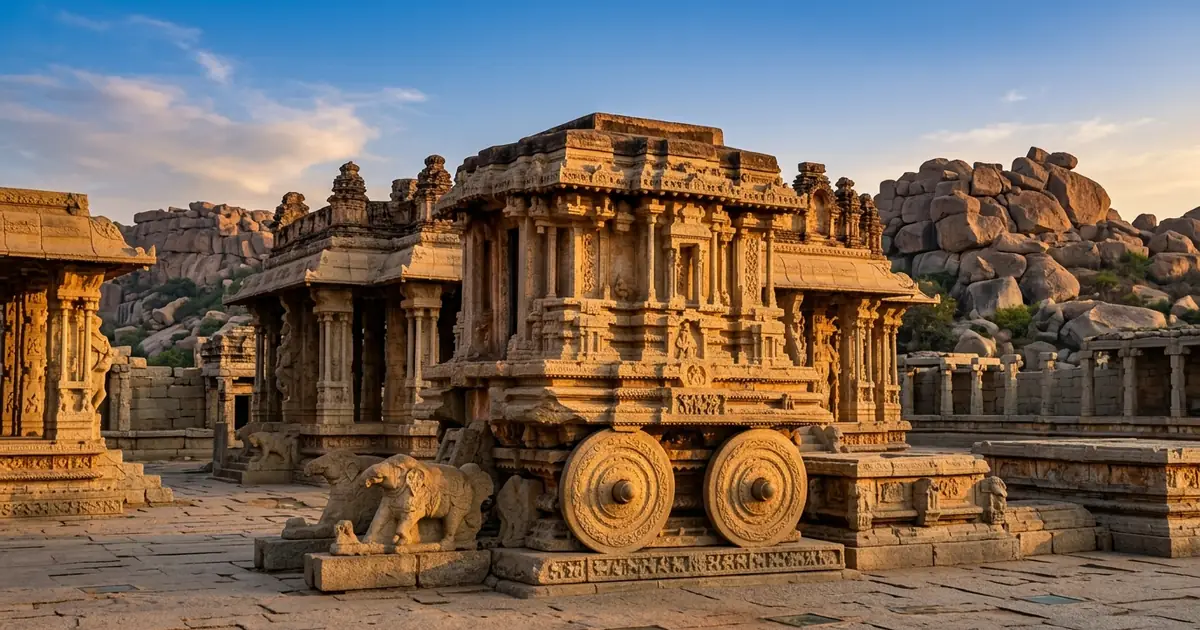
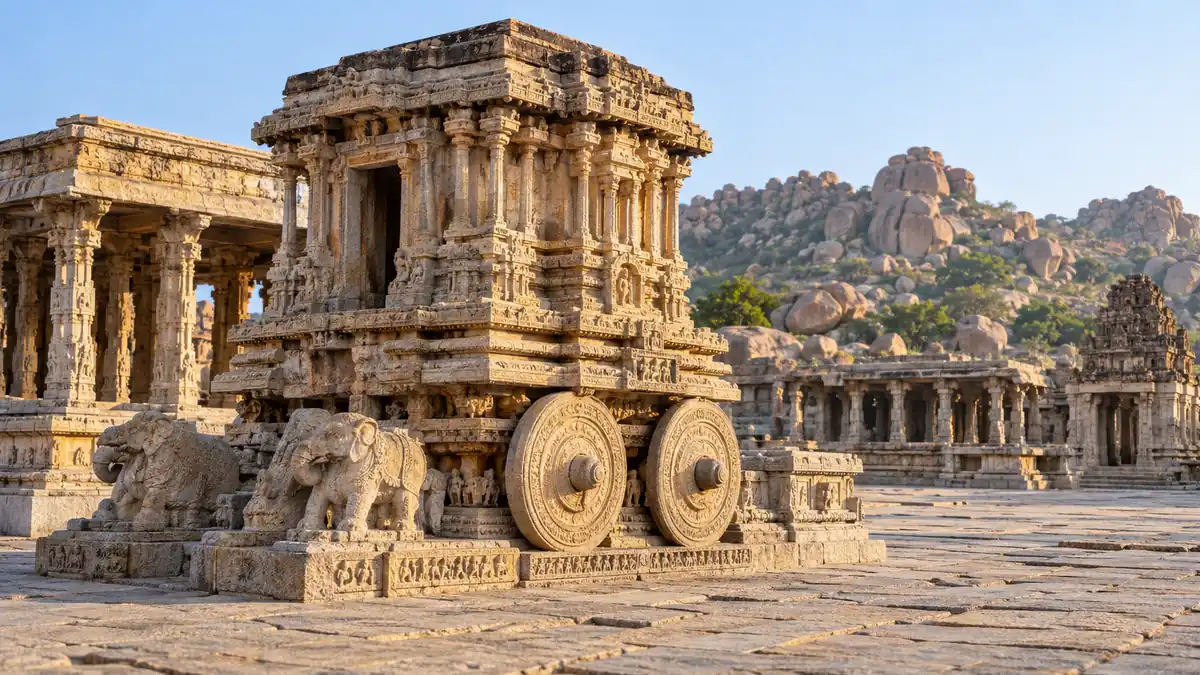
The world-famous Stone Chariot (Ratha) stands inside the inner courtyard facing the main sanctum. Although it appears to be carved from a single boulder, the chariot is an assembly of carved granite slabs fitted together with hidden mortise and tenon joints.
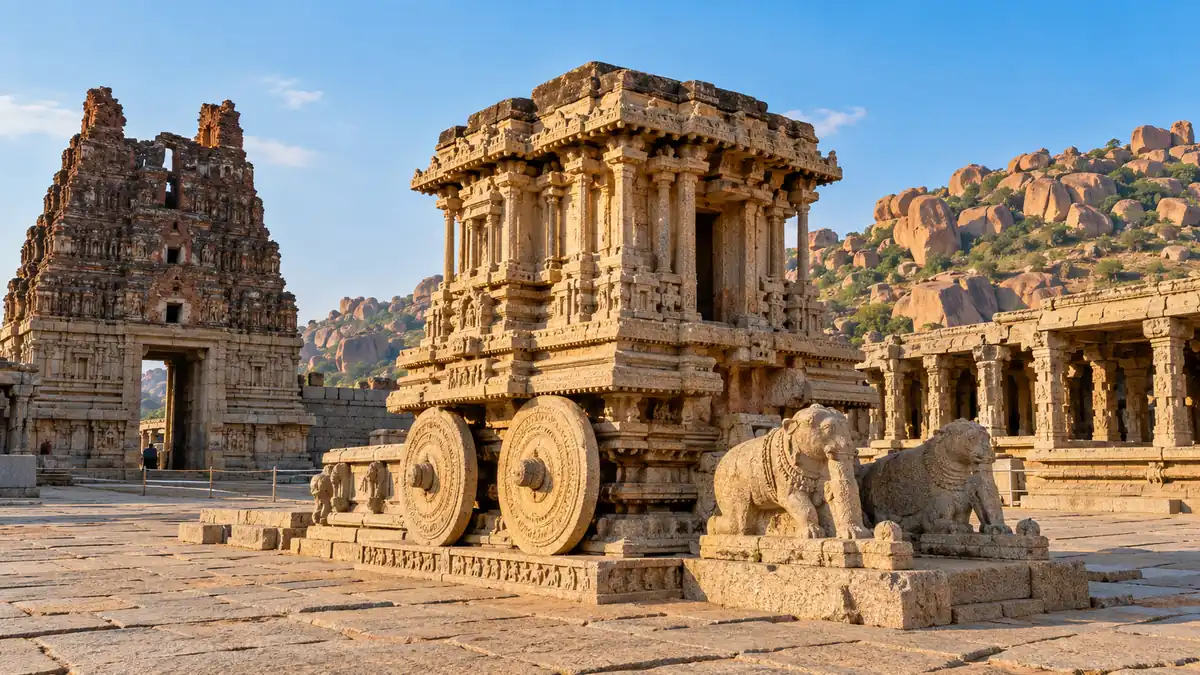
Dedicated to Garuda, the mythical eagle mount of Lord Vishnu, the chariot features stone wheels carved with delicate floral spokes. In historic times, these wheels could be rotated on their granite axles before modern conservators secured them in place to prevent structural wear.
Ranga Mandapa 56 Resonant Musical Pillars
The large open hall (Ranga Mandapa) fronting the sanctum contains 56 monolithic granite pillars celebrated for their acoustic properties. Each central support pillar is surrounded by a cluster of slender stone colonnettes carved from single blocks of rock.
When lightly tapped with fingertips, these stone shafts produce distinct musical tones representing classical Indian percussion and stringed instruments. While direct physical tapping is now restricted by the Archaeological Survey of India to protect the stone matrix, government naturalists explain the geological density variations that produce these tones.
King’s Balance (Thulabhara) and Riverfront Monolithic Carvings
A stone footpath leads west from the Vittala temple along the rocky riverbank toward the King’s Balance (Thulabhara). This 5-meter-high granite archway features two vertical columns supporting an intricately carved horizontal beam with stone suspension loops.
During annual coronation anniversaries and solar eclipses, Vijayanagara kings sat on one scale pan while court treasurers loaded the opposite pan with gold, pearls, silver, and precious gems before distributing the treasure among priests and common citizens.
The Royal Center: Lotus Mahal, Elephant Stables & Stepped Tank
Located approximately two kilometers south of the Sacred Center, the Royal Center housed the administrative, military, and private residential quarters of the imperial family. Unlike the purely religious stone sanctums, many royal buildings exhibit a synthesis of Hindu and Islamic architectural traditions featured across our Karnataka travel guide.
Comprehensive regional itineraries can be reviewed on the Vijayanagara District Tourism Guide to plan efficient transit across these widespread archaeological zones.
Indo-Islamic Architecture of Lotus Mahal and Elephant Stables
The Zenana Enclosure features the Lotus Mahal, a two-story secular pleasure pavilion designed for royal women:
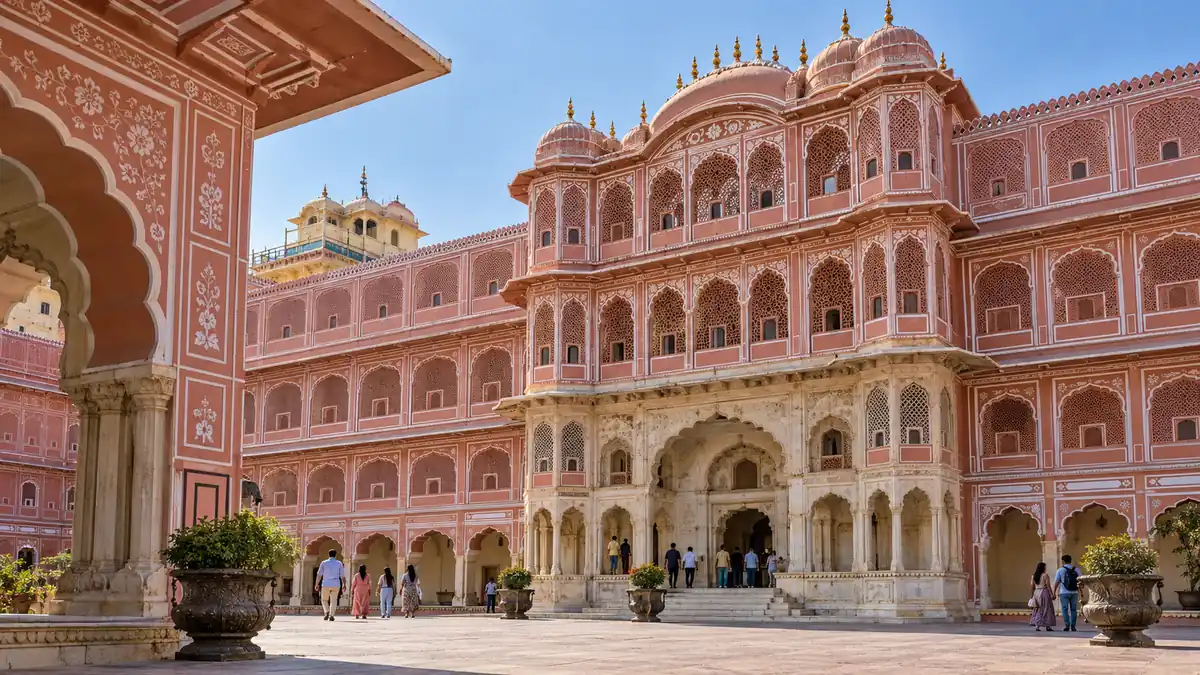
- Structural Grace: The building features multi-foliated Islamic cusped arches resting on 24 ornate stone pillars, topped by nine stepped pyramidal spires resembling opening lotus petals.
- Air Cooling System: Deep air ducts and terracotta water pipes built inside the stone walls once circulated cool water during scorching summer months, demonstrating advanced medieval climate control.
Directly behind the enclosure stand the monumental Elephant Stables. This long building features eleven spacious domed chambers where imperial war elephants were housed, displaying symmetrical domes inspired by Deccan Sultanate architecture.
Mahanavami Dibba Royal Throne and Carved Bas-Reliefs
The Mahanavami Dibba is a massive three-tiered square stone platform rising twelve meters above the royal plains. Consecrated by King Krishnadevaraya after his military conquest of Udayagiri in 1513, the structure served as the royal stage for the annual ten-day Navratri and Mahanavami festivals.
From this elevated platform, kings reviewed cavalry parades, royal dancers, and wrestling contests. The exterior granite tiers are carved with detailed bas-relief friezes depicting Portuguese traders in European doublets, Chinese porcelain merchants, royal hunts, and dancing maidens.
Pushkarini Stepped Tank and Ancient Stone Aqueducts
Beside the Mahanavami Dibba rests the perfectly symmetrical Stepped Tank (Pushkarini), excavated by archaeologists in the mid-1980s. Constructed from dressed black schist stone, the tank descends through five stepped tiers of geometric pyramidal steps.
A network of shallow stone aqueducts runs across the ground, originally bringing fresh water from canals miles away to keep the tank filled for ceremonial ablutions. The precision stone fitting remains watertight after five centuries.
Sunset Viewpoints & Boulder Landscapes: Matanga Hill and Malyavanta
Hampi’s topography is formed of massive volcanic granite boulders that have weather-cracked over millions of years into precarious piles and balanced stone hills. Climbing these elevated viewpoints provides expansive perspectives across the river plain.
National heritage preservation projects coordinated on the Ministry of Tourism Incredible India portal highlight how these rocky hilltops shaped the empire’s defensive military strategy.
Matanga Hill 360-Degree Dawn Panorama
Matanga Hill is the highest geographic elevation in central Hampi, making it the favored vantage point for witnessing sunrise. The ascent follows rough stone stairs cut into the granite rock face, taking roughly 25 to 30 minutes from the eastern end of Hampi Bazaar.
From the rooftop of the Veerabhadra temple crowning the peak, travelers enjoy an uninterrupted 360-degree view. As the sun rises, the golden light bathes the winding Tungabhadra River, the distant towers of Virupaksha, and the endless boulder valleys stretching toward the horizon.
Malyavanta Raghunatha Temple on Granite Rocks
Malyavanta Hill lies east of the royal center, crowned by the Malyavanta Raghunatha Temple. Built atop a colossal rounded granite whaleback rock, the temple honors Lord Rama and Lakshmana during their search for Sita.
The courtyard is tranquil, shaded by fragrant frangipani trees and frequented by local monkeys. A continuous chant of the Ramcharitmanas by resident priests has echoed through the stone prayer halls without interruption for decades, providing a deeply atmospheric experience away from tourist crowds.
Across the Tungabhadra: Anegundi, Sanapur Lake & Coracle Rides
Crossing to the northern bank of the Tungabhadra River takes travelers into Anegundi, a settlement far older than Hampi itself. Anegundi is widely identified with Kishkindha, the mythological monkey kingdom described in the Ramayana epic. Travelers tracing the earlier roots of northern Karnataka rock-cut architecture often extend their road trip northward into Bagalkot district via the Badami Aihole Pattadakal circuit.
The atmosphere on this side shifts from solemn archaeological stone monuments to green emerald paddy fields, coconut plantations, and quiet rural hamlets.
Traditional Round Coracle River Crossings
A classic experience in Hampi is crossing the Tungabhadra in a traditional round coracle boat (teppa). These circular watercraft are fashioned from woven bamboo frames, plastic sheeting, and waterproof tree tar:
- River Ghats: Coracles operate primarily from the river ghats behind Virupaksha Temple and near the Vittala Temple path.
- Water Stability: Despite their bowl-like shape, coracles are remarkably buoyant and easily carry five passengers with luggage.
- Scenic Whirls: Experienced boatmen often spin the coracle in a gentle 360-degree circle in the middle of the river, providing panoramic perspectives of rocky riverside cliffs.
Sanapur Lake Bouldering and Cliff Formations
Located five kilometers northwest of Anegundi, Sanapur Lake is a freshwater reservoir fed by the Tungabhadra canal network. The lake is surrounded by colossal rust-colored granite boulders, making it a popular hub for international bouldering enthusiasts.
Travelers can hire coracles for peaceful 30-minute floats across the calm deep water or relax along rocky granite ledges. Swimming in the lake is strictly cautioned against due to underwater currents and submerged rocks.
Anjanadri Hill: The Mythological Birthplace of Lord Hanuman
Anjanadri Hill is revered across India as the sacred birthplace of Lord Hanuman. The hill is easily identified by a small white temple complex perched high atop its rugged granite peak.
Reaching the summit requires climbing exactly 575 whitewashed stone steps winding through shady rock crevices. The climb takes 30 to 45 minutes, with friendly troops of langur monkeys greeting pilgrims along the path. The panoramic sunset view from the summit across the Tungabhadra basin is unmatched.
Visitor Logistics: Entry Tickets, Guided Tours & Hospet Connectivity
Planning a smooth exploration of Hampi requires an understanding of ticket rules, transport corridors, and weather dynamics. Because the ruins span dozens of square kilometers, smart logistical planning prevents physical fatigue under the Deccan sun.
Travelers visiting during winter can coordinate their journey with the statewide cultural festival outlined in our Hampi Utsav guide.
| Practical Category | Key Traveler Information | Actionable Advice |
|---|---|---|
| Combined ASI Entry Ticket | ₹40 for Indians, ₹600 for foreigners | Single digital ticket covers Vittala Temple, Lotus Mahal & Museum on the same date |
| Nearest Railway Hub | Hosapete Junction (HPT, 14 km) | Direct overnight trains from Bengaluru, Goa, Hyderabad, and Mumbai |
| On-Site Local Transport | Auto-rickshaws, rental scooters, bicycles | ₹1,000 to ₹1,400 per day for full-day chartered auto-rickshaws |
| Vittala Buggy Transfer | ₹20 per passenger return | Electric cart shuttle between the parking depot and Vittala Temple gates |
| Cellular Network Signal | Jio, Airtel, BSNL reliable | Connectivity drops in rocky valleys around Sanapur and Malyavanta |
ASI Monument Entry Tickets and Electric Buggy Shuttles
Most ruins across Hampi (including Virupaksha Temple, Hemakuta Hill, and the Royal Enclosure) are open to the public without admission fees. However, the Archaeological Survey of India (ASI) charges an entry ticket for two enclosed premium zones:
- Vittala Temple Complex (including the Stone Chariot)
- Zenana Enclosure (Lotus Mahal and Elephant Stables)
A single entry ticket purchased online via the official ASI portal remains valid for both monuments throughout that calendar day. To protect fragile stone structures from vehicle emissions, road vehicles must park at the Gejjala Mandapa parking area. Environmentally friendly battery-operated buggies shuttle visitors the remaining one kilometer to the Vittala gates for ₹20 per person.
Hospet Junction Railway Connections and Local Cabs
Hosapete Junction (station code HPT) serves as the primary railway link for travelers arriving from across India. Express trains connect Hosapete with major metropolitan hubs:
- From Bengaluru: The Hampi Express departs Bangalore City Station nightly, arriving at Hospet early the next morning after an eight-hour journey.
- From Goa: The Amravati Express connects Vasco da Gama and Madgaon to Hospet across the Western Ghats in seven hours.
- Local Auto Transfers: Prepaid auto-rickshaw booths and private taxis operate directly outside Hospet station, reaching Hampi Bazaar in 25 minutes for ₹250 to ₹350.
Best Season and Weather for Bouldering Exploration
Hampi experiences a tropical semi-arid climate. Planning your trip within the proper weather window is vital:
- Winter (October to March): Ideal season. Daytime temperatures hover comfortably between 22°C and 30°C, with cool morning and evening breezes perfect for walking across open stone terrain.
- Summer (April to June): Scorching heat exceeding 40°C. Bare granite rocks absorb extreme heat, making open walking exhausting after 10:00 AM.
- Monsoon (July to September): Intermittent rains transform the surrounding paddy fields into brilliant shades of green. However, wet granite boulders become slippery and dangerous for hiking.
Curated 3-Day Hampi Travel Itinerary
This unhurried 3-day itinerary organizes monuments by geographic proximity to minimize transit time and maximize photography lighting.
Day 1: Sacred Center, Virupaksha, Hemakuta & Riverside Boulders
- 06:30 AM: Begin your morning with a quiet darshan at Virupaksha Temple before tourist crowds arrive.
- 08:30 AM: Walk down the colonnaded Hampi Bazaar and explore the Kadalekalu and Sasivekalu monolithic Ganeshas.
- 10:30 AM: Ascend Hemakuta Hill to examine the pre-Vijayanagara triple-shrine stone temples.
- 12:30 PM: Enjoy a relaxed south Indian thali meal at a shaded cafe in Hampi Bazaar.
- 03:00 PM: Take a guided walk along the ancient riverside path connecting Hampi Bazaar to the Sugriva Cave.
- 05:30 PM: Climb the smooth stone slopes of Hemakuta Hill to watch the golden sunset over the Tungabhadra valley.
Day 2: Royal Center, Lotus Mahal, Elephant Stables & Vittala Complex
- 08:00 AM: Arrive at the Zenana Enclosure to admire the Indo-Islamic arches of the Lotus Mahal and Elephant Stables.
- 10:00 AM: Explore the tiered relief carvings of the Mahanavami Dibba and the Stepped Tank (Pushkarini).
- 12:30 PM: Retreat to Kamalapur for a cool beverage and visit the Archaeological Museum.
- 02:30 PM: Board the battery buggy to the Vijaya Vittala temple complex.
- 03:30 PM: Spend two hours marveling at the Stone Chariot, musical pillars, and King’s Balance.
- 05:45 PM: Photograph the glowing granite pillars of Vittala Temple during late afternoon golden hour.
Day 3: Anegundi, Anjanadri Hanuman Hill & Sanapur Lake
- 07:00 AM: Cross the Tungabhadra River on a traditional round coracle boat to Anegundi.
- 08:30 AM: Hire a rental scooter to tour Kishkindha landscapes, Chintamani Temple, and rural village lanes.
- 11:00 AM: Relax beside the clear blue waters and giant boulder formations of Sanapur Lake.
- 01:00 PM: Savor authentic north Karnataka Jolada Rotti meals served on banana leaves at a countryside eatery.
- 04:30 PM: Climb the 575 steps of Anjanadri Hill to visit the Hanuman temple.
- 06:00 PM: Watch the sunset sweep across the entire boulder-strewn expanse of the Vijayanagara plains.
Frequently Asked Questions About Visiting Hampi
How many days are needed to explore Hampi properly?
A minimum of three full days is recommended to explore Hampi thoroughly without rushing. This schedule allows one full day for the Sacred Center and riverfront ruins, one day for the Royal Enclosure and Vittala complex, and one day to explore Anegundi, Sanapur Lake, and Anjanadri Hill across the river.
What is the dress code enforced at temples in Hampi?
At active religious temples like Virupaksha Temple, visitors must dress modestly with shoulders and knees covered. Footwear must be removed and stored at token stands before stepping inside inner sanctums. For general archaeological ruins, comfortable cotton clothing and supportive walking shoes are recommended.
Are coracle rides safe in Hampi?
Yes, coracle boat rides are generally safe when operated along designated river ghats by licensed boatmen. Avoid riding in overloaded craft during heavy monsoon river surges. Life jackets are maintained by government operators at primary crossing points.
Is alcohol permitted in Hampi?
Hampi Sacred Center is a holy pilgrimage site where the sale and public consumption of alcohol and non-vegetarian food are strictly prohibited. Travelers seeking relaxed dining and beer options can cross the river to the northern bank around Anegundi and Sanapur or stay in the city of Hospet.
What should travelers pack for a trip to Hampi?
Essential gear includes sturdy, broken-in walking shoes or hiking sandals with good grip for climbing granite boulders. Carry a wide-brim hat, high-SPF sunscreen, polarized sunglasses, a reusable water bottle, and a compact headlamp for early morning or sunset walks. Keep sufficient Indian currency notes on hand, as rural card payment terminals frequently suffer network delays.