Bandhavgarh Safari Guide: Zones, Timings & Tiger Bookings
Plan your Bandhavgarh tiger safari: Tala, Magdhi, and Khitauli zone booking, MPOnline permit fees, morning vs afternoon timings, and travel routes.
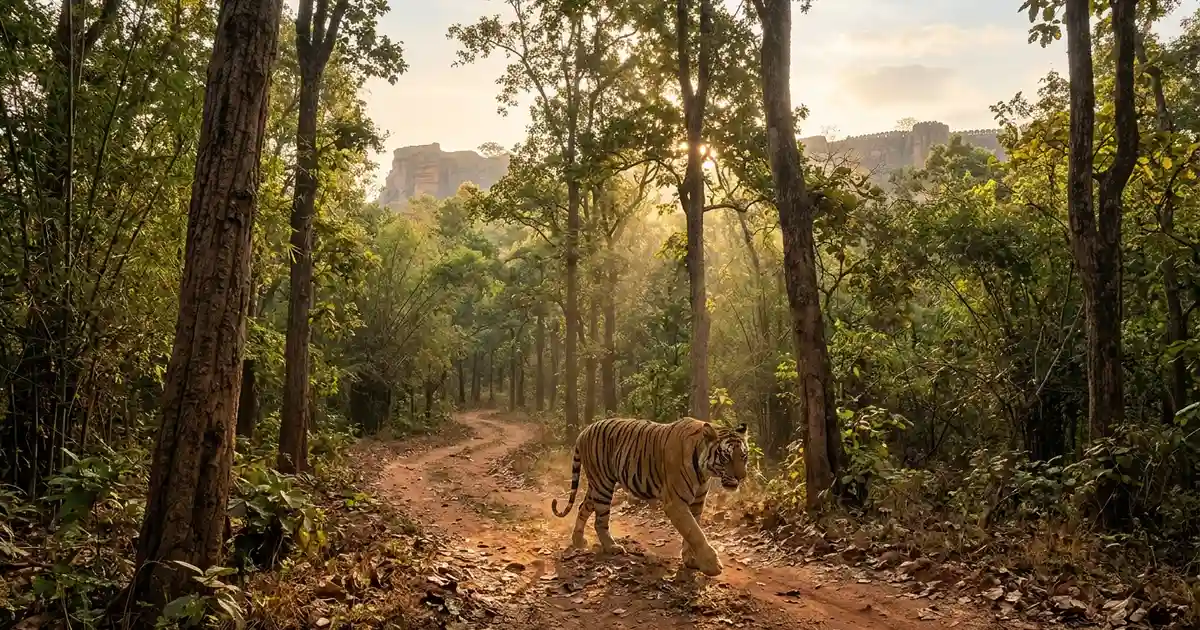
Spanning 1,536 square kilometers across the Vindhya Hills of Umaria district in eastern Madhya Pradesh, Bandhavgarh National Park protects the highest recorded density of Royal Bengal tigers anywhere on the globe. With an estimated population of over 120 adult tigers roaming across its protected core and buffer zones, the sanctuary offers unmatched wilderness encounters for wildlife photographers, conservationists, and nature enthusiasts.
Unlike sprawling reserves where predator tracking requires days of patient navigation, Bandhavgarh features a compact 105-square-kilometer tourism core. It combines moist-deciduous sal valleys, sheer sandstone cliffs, and open marshy grasslands. This varied terrain channels predator movements along predictable vehicle tracks.
Safari & Permit Essentials
- Location: Umaria district, Madhya Pradesh (32 km from Umaria railway junction, 165 km northeast of Jabalpur Airport).
- Core Safari Zones: Tala (Zone 1), Magdhi (Zone 2), and Khitauli (Zone 3).
- Official Authority Details: Full administrative notices and local contact directories are cataloged on the District Administration Umaria Tourism Directory.
- Permit Booking: Book online via the official portal managed by the state, documented in the Madhya Pradesh Tourism Bandhavgarh Guide, opening 120 days in advance at 08:00 AM IST.
- Gypsy Vehicle Cost: Core permit fee ₹2,400 to ₹3,000 per full vehicle (up to 6 passengers) plus mandatory gypsy hire (₹3,000 to ₹3,500) and forest department guide fee (₹600) paid at the gate.
- Park Timings: Morning safaris depart 06:00 AM to 10:00 AM; afternoon safaris run 02:30 PM to 06:00 PM (seasonal variations apply; park core closed Wednesday afternoons).
Core Zones of Bandhavgarh: Tala, Magdhi, and Khitauli Dynamics
Bandhavgarh divides its primary tourism territory into three distinct core zones and three interconnected buffer zones. Because vehicle entry permits are issued strictly zone-wise with no inter-zone roaming permitted, selecting the appropriate gate during reservation defines your safari experience, much like zone selection in our Ranthambore Safari Booking safari zones and timings.
| Safari Zone | Zone Category | Terrain & Forest Character | Signature Highlights & Wildlife |
|---|---|---|---|
| Tala (Zone 1) | Core | Dense sal forest, 32 sandstone hills, perennial streams | 10th-century Shesh Shaiya statue, historic tiger lineages, Charanganga river |
| Magdhi (Zone 2) | Core | Open savannah grasslands, mixed forest, waterholes | Sukhi Patiha grasslands, high daytime tiger sightings around watering holes |
| Khitauli (Zone 3) | Core | Dry deciduous woodland, rocky outcrops, scrub thickets | Indian leopards, sloth bears, chousingha, resident wild elephant herds |
| Dhamokhar | Buffer | Rolling hills, mixed bamboo brakes, rural borders | Young dispersing tigers, evening birdwatching, night safari trials |
| Johila | Buffer | Johila river valley, rocky waterfalls, scrub forest | River walks, scenic viewpoints, open year-round including monsoons |
| Panpatha | Buffer | Northern corridor forest, mixed scrub | Nilgai, chital herds, wild boars, four-horned antelopes |
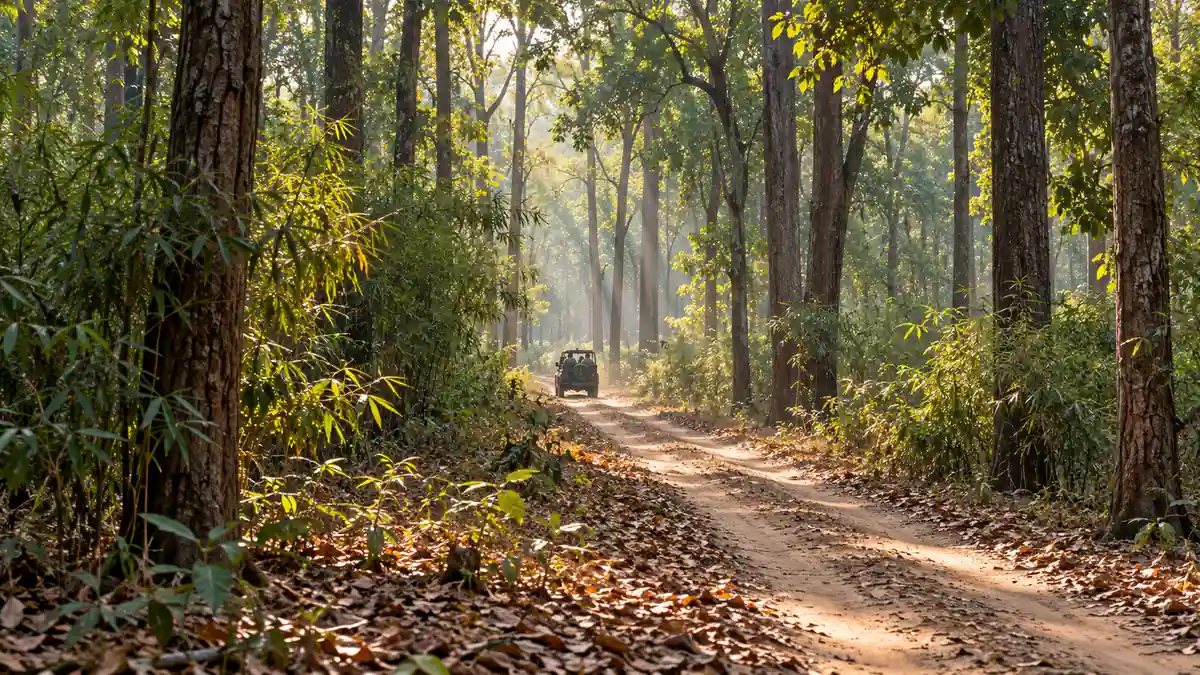
Tala (Zone 1): The Legendary Core & Shesh Shaiya Statue
Tala represents the premium historic heart of Bandhavgarh and was the exclusive private hunting reserve of the Maharajas of Rewa. Bounded by 32 sandstone hills, Tala features dense riverine sal forests, bamboo brakes, and expansive meadows.
The signature highlight within Tala is the 10th-century Shesh Shaiya, an 11-meter reclining stone sculpture of Lord Vishnu carved directly out of a sheer sandstone cliff face. The mythical serpent Sheshanaga spreads its hoods over Vishnu’s head, while a natural perennial spring originates at his feet, forming the sacred Charanganga River that irrigates the surrounding forest.
Tala carries high demand among visiting wildlife photographers because legendary tiger dynasties established their home ranges across its waterways. Today, dominant male tigers and resident breeding tigresses maintain territories across the Chakradhara, Mirchahani, and Bhadhadhor grasslands.
Magdhi (Zone 2): Open Grasslands & Waterhole Sighting Hub
Situated directly east of Tala, Magdhi features broader horizons, gentler topography, and extensive savannah grasslands bordered by mixed deciduous woodlands. Because tree cover is less dense than Tala, spotting big cats moving across open fields is clear during morning golden hours.
Magdhi contains several artificial waterholes and natural seepages including Sukhi Patiha, Dabhadhole, and Churnaha. During hot pre-monsoon months from March through June, resident tigers spend hours submerged in these pools to regulate their body temperature, creating predictable sighting locations along designated game tracks.
Magdhi also supports dense populations of spotted deer, sambar, wild boar, and Asiatic jackals, making it an active hunting ground for sub-adult tigers learning territory defense.
Khitauli (Zone 3): Dry Deciduous Forest & Leopard Corridors
Khitauli occupies the western sector of the national park, characterized by dry deciduous forests, rocky ridges, and scrub woodlands. Khitauli offers superior opportunities for viewing the Indian leopard and sloth bear, both of which thrive among the broken rocky terrain and termite mounds.
Khitauli also hosts migrating herds of wild Asian elephants that entered Bandhavgarh from neighboring Chhattisgarh and established permanent residence in the park. Birdwatchers favor Khitauli for its raptor populations, including crested serpent eagles, changeable hawk-eagles, and white-eyed buzzards.
Buffer Zones: Dhamokhar, Johila, and Panpatha
To alleviate visitor pressure on the core ecosystem and expand wildlife habitat, the state government operationalized three connected buffer zones: Dhamokhar, Johila, and Panpatha.
Dhamokhar adjoins the Tala and Magdhi perimeter, featuring undulating hills and dense bamboo clumps where young adult tigers frequently disperse. Johila is traversed by the scenic Johila River, offering rocky gorges, river crossings, and excellent birding walks. Panpatha extends north, providing crucial refuge for blue bulls and four-horned antelopes.
Buffer zones remain open year-round, including during the July-to-September monsoon season when the core zones close for breeding cycles and road maintenance.
Wildlife and Biodiversity: Apex Predators and Forest Habitats
Bandhavgarh’s microclimate supports 37 mammal species, over 250 bird varieties, and 80 butterfly species. The protected basin provides an abundant prey base that sustains apex carnivores at densities twice the national average for Project Tiger reserves, surpassing the predator density of northern sub-Himalayan reserves.
| Mammal Species | Typical Forest Habitat | Peak Activity Window | Relative Sighting Frequency |
|---|---|---|---|
| Royal Bengal Tiger | Perennial streams, bamboo thickets, grassland edges | Dawn (06:00-08:00 AM) & Dusk (04:30-06:00 PM) | Very High (highest in India) |
| Indian Leopard | Rocky ledges, tree canopies, scrub forest | Early morning & late dusk | Moderate (higher in Khitauli) |
| Sloth Bear | Termite mounds, mahua groves, dry ravines | Early dawn & cloudy afternoons | Moderate (March-April mahua drop) |
| Dhole (Asiatic Wild Dog) | Open woodlands, meadow borders | Mid-morning pack patrol | Low to Moderate |
| Spotted Deer (Chital) | Grassy clearings, sal forest fringes | Throughout daytime hours | Abundant across all zones |
| Sambar Deer | Deep forest valleys, waterhole banks | Dawn and late evening | Common |
| Indian Gaur (Bison) | Bamboo groves, elevated ridges | Morning grazing hours | Reintroduced population, growing |
Royal Bengal Tiger Lineages & Density Statistics
According to regional administrative wildlife summaries verified on the Umaria District Bandhavgarh National Park Portal, the sanctuary maintains an average of one adult tiger for every 5 to 7 square kilometers in its core habitat. This high density produces frequent territorial overlaps between mature males and dispersing sub-adults, distinct from the open scrub landscape seen in Gir National Park lion habitats.
Visitors should listen attentively for acoustic alarm calls: the sharp, metallic bark of the barking deer (muntjac), the piercing whistle of the spotted deer, and the booming warning cough of the grey langur perched high in the sal canopy. Trained local nature guides read these sensory cues to anticipate tiger movement across the tracks.
Avian Diversity Across Sal Forests and Bamboo Brakes
Birders exploring Bandhavgarh record diverse forest and wetland avi-fauna across different canopy tiers.
Canopy predators include the crested hawk-eagle, brown fish owl, changeable hawk-eagle, mottled wood owl, and Oriental honey buzzard. Forest specialists encompass the Malabar pied hornbill, Indian grey hornbill, sirkeer malkoha, Tickell’s blue flycatcher, and white-bellied drongo.
Wetland and meadow residents thrive around the Charanganga marshlands, featuring woolly-necked storks, black-necked storks, sarus cranes, painted snipes, and pied kingfishers.
How to Book Bandhavgarh Safaris: MP Forest Department Portal
Securing entry permits for Bandhavgarh requires planning well ahead of your travel dates. All core safari permits are regulated electronically by the Madhya Pradesh government to prevent commercial touting and vehicle overcrowding.
Advance Online Booking via MPOnline Portal
Official safari permits must be booked through the state forest department reservation system. Core permits become available online 120 days prior to your desired safari date at exactly 08:00 AM IST.
Tala permits (Zone 1) typically exhaust within 3 to 5 minutes of opening for peak holiday weekends in November, December, and March. Magdhi and Khitauli permits generally remain available for several additional days.
Every passenger must provide valid, government-issued photo identification during booking (Passport for foreign citizens; Aadhaar, Voter ID, or Driving License for Indian nationals). Names and ID numbers entered during online reservation cannot be changed later.
Single-Seat Booking vs. Full Gypsy Vehicle Permits
Travelers can choose between two permit structures depending on budget and travel party size.
A full vehicle permit books the entire 6-seater Maruti Suzuki Gypsy for your private party. This option provides complete freedom for wildlife photography, lens positioning, and pacing stops without accommodating strangers.
A single-seat permit allows solo travelers and couples to purchase individual seats, sharing the vehicle with other travelers. While more economical, all passengers must agree on stopping times and viewing priorities during the drive.
Tatkal Quota and Waiting List Policies
If regular advance permits are sold out, the state forest department opens an online Tatkal Safari Quota.
Tatkal permits open online exactly at 05:00 PM on the day prior to the safari date. Tatkal core permits carry a premium government fee (₹1,500 higher than standard permits).
Tatkal slots are limited to 2 to 4 vehicles per core zone and require high-speed internet to secure before seats fill.
Visitor Information: Safari Timings, Entry Fees & Vehicle Tariffs
Bandhavgarh maintains two safari shifts daily: a 4-hour morning game drive and a 3-hour afternoon drive. Park gates open slightly earlier in summer to allow visitors to capture early daylight before temperatures climb.
| Season & Month | Morning Safari Shift | Afternoon Safari Shift | Gate Closure Notice |
|---|---|---|---|
| October to February (Winter) | 06:00 AM – 10:00 AM | 02:30 PM – 05:30 PM | Wednesday afternoon core closed |
| March to June (Summer) | 05:30 AM – 09:30 AM | 03:30 PM – 06:30 PM | Wednesday afternoon core closed |
| July to September (Monsoon) | Core zones closed | Core zones closed | Buffer zones remain open daily |
Important
Wednesday Afternoon Rule: All core zones (Tala, Magdhi, and Khitauli) are strictly closed for tourism every Wednesday afternoon throughout the operating season. Buffer zones (Dhamokhar, Johila, and Panpatha) remain fully open on Wednesday afternoons.
Comprehensive Safari Cost Breakdown
To budget accurately for your Bandhavgarh expedition, factor in all three required cost components for each safari drive.
The government entry permit for a full gypsy (up to 6 passengers) costs ₹2,400 to ₹3,000 for core zones. The registered 4x4 Gypsy rental fee paid at the gate ranges between ₹3,000 and ₹3,500 per drive. The mandatory eco-development guide fee is ₹600 per vehicle.
Consequently, the total expenditure per private vehicle per safari drive comes to ₹6,000 to ₹7,100. Standard handheld DSLR and mirrorless cameras with telephoto lenses incur zero additional camera charges for tourists.
Historical Heritage: Bandhavgarh Fort and Ancient Caves
Bandhavgarh is unique among Indian national parks because its wilderness is intertwined with two millennia of human history. The name Bandhavgarh translates as “Brother’s Fort” (Bandhav = brother, Garh = fort), originating from the Hindu epic Ramayana, in which Lord Rama is said to have gifted the 811-meter cliff fortress to his brother Lakshmana to watch over Lanka.
The Hilltop Fortress Complex
Perched on the summit of Bandhavgarh Hill inside the Tala zone, the fort was ruled consecutively by the Magha dynasty in the 2nd century CE, the Vakatakas, the Kalachuris of Chedi, and finally the Baghel Rajputs of Rewa until their capital shifted in 1617.
Key historical monuments within the reserve include the Shesh Shaiya Vishnu carving, the 10th-century Bari Gufa monastic assembly hall bearing ancient Brahmi inscriptions, and deep stone-cut reservoirs that held rainwater during historic sieges.
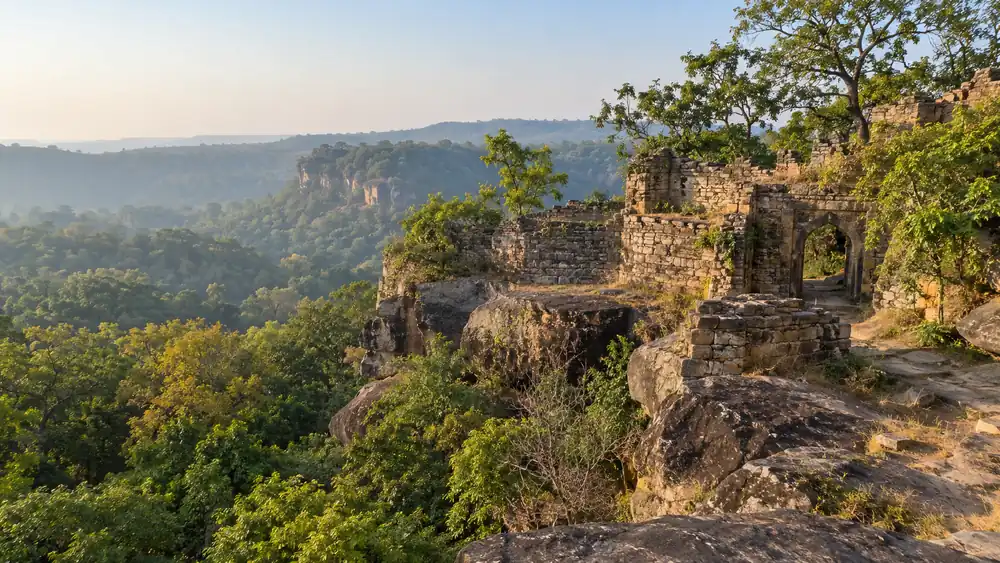
While general tourist safari vehicles cannot climb to the fort plateau due to ongoing forest conservation rules, the monumental Shesh Shaiya shrine remains accessible along the primary Tala zone safari track.
Best Time to Visit Bandhavgarh & Weather Seasons
Planning your expedition depends on whether your priority is comfortable weather or maximum tiger sighting probability. Wildlife enthusiasts mapping multi-park circuits across central India can reference our comprehensive Madhya Pradesh travel guide.
Winter days from October to February are crisp and invigorating. Morning safari starts can drop to 4°C to 8°C in December and January, requiring heavy thermal layers, windproof jackets, wool beanies, and gloves during early open-gypsy drives. Afternoon temperatures climb to a pleasant 22°C to 25°C under clear blue skies.
Summer from March to June is the prime tiger sighting window. As temperatures rise from 32°C in March to over 42°C in May and June, the dense undergrowth and tall grasses dry out completely. Natural watering holes shrink to isolated pools, compelling tigers to visit designated water bodies multiple times daily.
How to Reach Bandhavgarh: Umaria, Katni & Jabalpur Transit
Bandhavgarh is well connected by air, rail, and road to major Indian metropolitan hubs.
Jabalpur Airport (JLR) is located 165 kilometers southwest of Tala gate (approximately 3.5 to 4 hours driving time). Jabalpur connects via daily scheduled flights from New Delhi, Mumbai, Hyderabad, and Bengaluru on major domestic carriers.
Khajuraho Airport (HJR) is located 250 kilometers northwest of Tala gate (5.5 hours drive). Travelers can pair a safari with exploring ancient UNESCO monuments featured in our detailed Khajuraho temples guide.
Umaria Railway Station (UMR) is just 32 kilometers from Tala gate (40 minutes by taxi), serviced by overnight express trains from Delhi, Bhopal, Jabalpur, and Bilaspur. Katni Junction (KTE / KMZ) is located 95 kilometers west of Tala (2 hours drive), offering nationwide express train connectivity from Mumbai, Kolkata, Varanasi, and Bengaluru.
Curated 3-Day Bandhavgarh Safari Itinerary
To maximize your opportunity to encounter tigers and explore distinct ecosystems, schedule at least four to five safari drives across multiple zones.
Day 1 begins with arrival and afternoon orientation, checking in at a jungle lodge near Tala village before setting out on Safari 1 in Magdhi Zone to view open grasslands and waterholes.
Day 2 focuses on core zone tracking and heritage, departing at 05:45 AM for Safari 2 in Tala Zone to view Shesh Shaiya and the Chakradhara meadow, followed by afternoon Safari 3 in Khitauli Zone to search for leopards and wild elephants.
Day 3 provides deep forest tracking with Safari 4 in Tala or Magdhi Zone to monitor morning alarm calls, before checking out for onward transfer toward Jabalpur or continuing southwest into Maharashtra to experience a Tadoba National Park tiger safari.
Frequently Asked Questions About Bandhavgarh Safari
How many safari drives are recommended to see a tiger at Bandhavgarh?
Taking four to five safari drives across a minimum of two core zones gives travelers an 80 to 90 percent chance of spotting a wild tiger. Booking multiple drives allows your naturalist guide to track alarm calls across both morning and afternoon shifts.
Which zone is best for tiger sightings in Bandhavgarh?
Tala (Zone 1) and Magdhi (Zone 2) offer the highest consistency of tiger sightings due to perennial water springs and open meadows. Khitauli (Zone 3) provides superior sightings for leopards, sloth bears, and wild elephants.
Can I book a Bandhavgarh safari on the spot upon arrival?
On-the-spot core safari booking is rarely possible because core vehicle permits sell out online weeks in advance on the MPOnline portal. Travelers arriving without advance reservations must rely on the 05:00 PM daily Tatkal online quota or book buffer zone entries at the gate.
Are cell phones and cameras permitted inside Bandhavgarh National Park?
Cellular phones and handheld digital cameras are permitted inside tourist safari vehicles, but phones must be switched to silent mode to avoid disturbing wildlife. Flying drones, playing loud music, and stepping outside your vehicle are strictly prohibited under national park regulations.
What should I wear on a morning winter safari in Bandhavgarh?
Wear heavy layered clothing including a thermal base layer, fleece jacket, windproof coat, gloves, and a woolen beanie during December and January morning drives. Choose earth-toned colors like olive green, khaki, brown, and beige to blend into the forest landscape.