Chapchar Kut Festival Aizawl: Cheraw Dance & Rituals Guide
Experience the vibrant Chapchar Kut spring festival in Aizawl with our cultural guide covering Cheraw bamboo dance rituals, traditional attire, and dates.
Chapchar Kut stands as the primary cultural and agrarian festival of Mizoram, celebrating the arrival of spring with colorful community dances, rhythmic music, and traditional highland feasts. Held annually in the state capital of Aizawl, this joyful occasion unites indigenous Mizo communities across diverse clans, transforming the central stadium into an energetic spectacle of woven textiles and synchronized bamboo choreography.
Travelers planning to witness the chapchar kut festival mizoram will experience one of the most remarkable tribal celebrations in Northeast India. From the spectacular footwork of the Cheraw bamboo dance and melodic folk ballads to the display of historic warrior attire and authentic Mizo cuisine, this comprehensive guide details festival dates, ceremonial rituals, venue logistics, and cultural etiquette.
Festival & Cultural Essentials
- Agrarian Significance: Celebrated after the completion of Jhum (slash-and-burn) jungle clearing, giving farming communities a well-deserved period of leisure before spring sowing.
- Main Festival Grounds: The central state-level celebration unfolds at the historic Assam Rifles Ground, known locally as Lammual, in the heart of Aizawl.
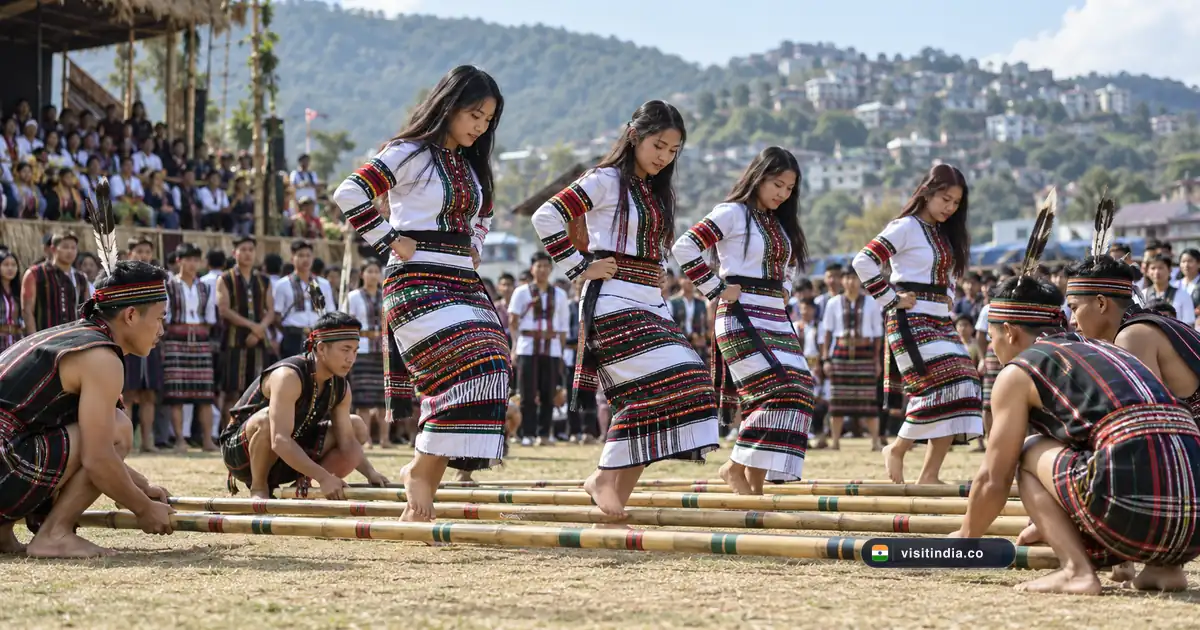
- Iconic Cultural Dance: Highlights the world-renowned Cheraw bamboo dance, where male performers rhythmically clash horizontal bamboo poles while female dancers skip gracefully between them.
- Traditional Dress Code: Attendees dress in exquisite handloom attire, notably the colorful woven Puanchei skirt for women and woven cotton shawls with feathered headgear for men.
- Visitor Access: Free admission to public gallery stands, with special seating arrangements and press badges coordinated through the Department of Tourism.
Origins and Cultural Significance of Chapchar Kut
Chapchar Kut traces its ancestry back to ancient agrarian customs, originally conceived as a thanksgiving celebration following the arduous clearing of mountainous jungle plots.
In traditional Mizo society, life revolved around shifting agricultural cultivation known as Jhum. During the dry winter months of January and February, villagers worked tirelessly cutting down thick forest bamboo and dense brushwood across steep mountain slopes.
Once cut timber was left to dry under the late winter sun awaiting spring burning, the community enjoyed a brief interlude of rest before monsoon planting. Complete regional planning is detailed in our Mizoram travel guide.
To mark this transition, ancestral village chiefs declared a multi-day feast. The word Chapchar refers to the cut and dried trees awaiting fire, while Kut signifies a harvest festival. The festival served to reaffirm communal harmony, resolve village disputes, and honor ancestral spirits through shared meals, athletic competitions, and night-long choral singing around village campfires.
Modern Revival and State-Level Celebrations
While early celebrations were localized to independent village chiefdoms, modern Chapchar Kut has transformed into a unified state-wide festival celebrating shared Mizo identity.
The Government of Mizoram and the central Young Mizo Association (YMA) coordinate the festivities. The celebration focuses on preserving indigenous art forms, encouraging youth participation in traditional weaving, and promoting cultural tourism as officially highlighted by the Mizoram Tourism Fairs and Festivals Record.
The festival opens with solemn prayers and an official address by the state governor, followed by a thunderous roll of indigenous drums and brass gongs that inaugurates hours of folk performances. The event concludes with communal dances where spectators in the stadium join performers in a massive display of highland unity.
The Iconic Cheraw: The World-Famous Mizo Bamboo Dance
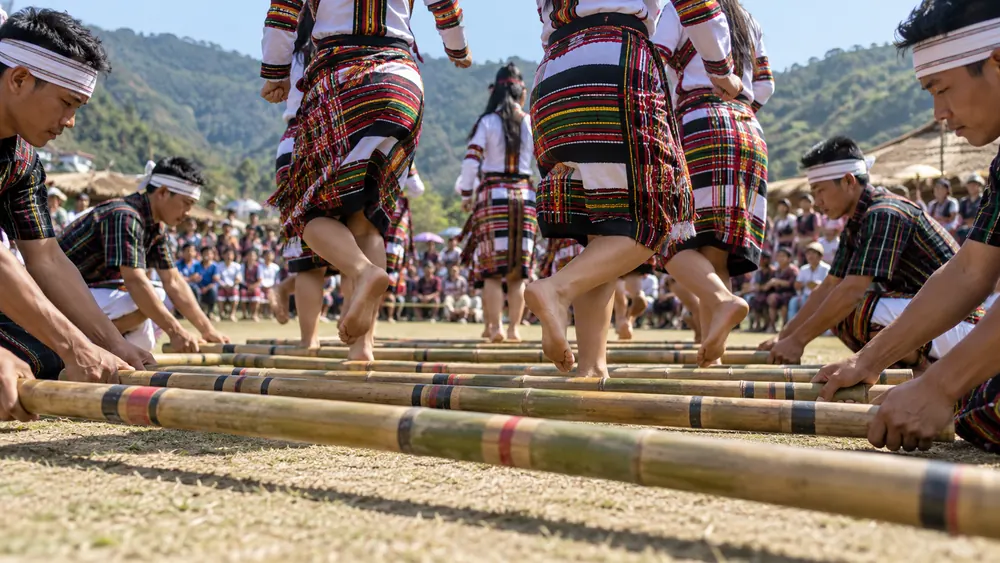
The crowning jewel of Chapchar Kut is the Cheraw dance, an extraordinary performing art that demands flawless rhythm, agile coordination, and athletic grace.
Recognized globally for its complex visual patterns, Cheraw originated as an ancient ritual performed to provide solace to the grieving spirit of a mother who died during childbirth. Over centuries, the ritual evolved into a celebratory art form performed at major festivals and national ceremonies. Hikers planning mountain trips between dance performances can refer to our Reiek Tlang and Phawngpui trekking guide.
Mechanics and Rhythm of the Dance
The choreography of Cheraw relies on pairs of male performers who kneel on the ground holding the ends of long bamboo poles laid horizontally across parallel support timbers.
As musicians strike bronze gongs and hollow wooden drums, the pole handlers clap the bamboo poles together and beat them against the ground in rapid, syncopated 4/4 time signatures. Female dancers, dressed in traditional ceremonial attire, step gracefully in and out of the shifting geometric grids formed by the moving poles. Their footwork must be exact: a split-second delay could result in feet being caught between clashing timbers.
As the tempo accelerates, dancers execute intricate rotational turns, leaping effortlessly across crisscrossing grids while maintaining delicate arm movements and calm smiles.
Other Traditional Mizo Folk Dances Featured at the Festival
While Cheraw takes center stage, Chapchar Kut features a diverse repertoire of ancestral Mizo dances, each representing distinct historical narratives:
- Khuallam: Known as the dance of the guests, performed by men draped in traditional Puandum striped shawls who sway rhythmically to drumbeats to welcome visiting dignitaries.
- Chheihlam: A joyous, celebratory community dance where performers sit in a circle clapping and singing improvised lyrics while solo dancers take turns stepping into the center.
- Chai Dance: A slow, communal circle dance where men and women alternate holding hands and resting arms across shoulders, singing traditional folk verses celebrating agricultural fertility.
- Sarlamkai: An ancient warrior dance historically performed to celebrate military victory, featuring rapid footwork and the brandishing of ceremonial wooden swords and buffalo-hide shields.
| Traditional Dance | Origin & Theme | Primary Performers | Accompanying Instruments |
|---|---|---|---|
| Cheraw | Ancient ritual evolved to celebratory dance | Male pole handlers & female dancers | Clashing bamboo poles, bronze gongs, drums |
| Khuallam | Welcome dance for guests & village visitors | Troupe of male dancers | Traditional Mizo drums (Khuang) and gongs |
| Chheihlam | Festive evening community celebration | Men and women in circle formation | Hand-clapping, drumbeats, bamboo tube percussion |
| Chai | Traditional spring harvest circle dance | Alternating lines of men and women | Sung verses (Chai Hla), deep gongs, horn pipes |
| Sarlamkai | Historic victory dance of warrior clans | Male performers with shields & swords | Resonant bronze cymbals, war drums |
Traditional Attire and Woven Regalia
Chapchar Kut serves as a stunning exhibition of indigenous Mizo textile craftsmanship, with nearly every attendee donning authentic hand-loomed regalia.
Mizo weaving holds deep cultural significance, with distinct color combinations, geometric banding, and diamond motifs indicating clan lineage, social prestige, and ceremonial roles. Visitors can shop for these textiles in Thenzawl or Bara Bazar, as detailed in our guide to places to visit in Aizawl and Vantawng Falls.
Women’s Traditional Festival Costume
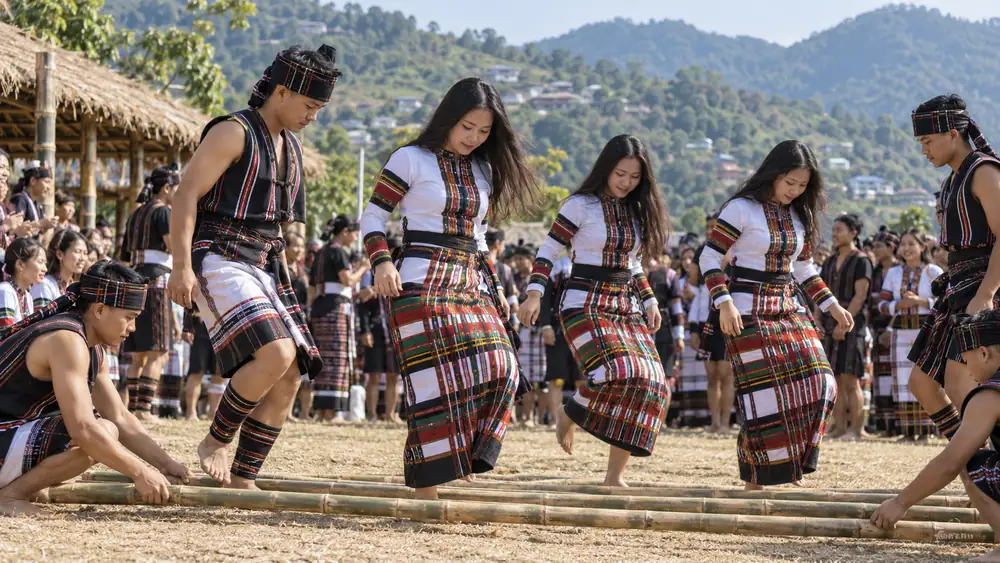
Mizo women attending the festival wear exquisite three-piece ceremonial ensembles that reflect centuries of weaving refinement:
- Puanchei: The most celebrated hand-woven skirt in Mizoram, featuring bold horizontal bands of crimson red, white, and black, intricately embroidered with colorful geometric checks.
- Kawrchei: A matching hand-loomed white blouse featuring embroidered necklines and sleeve borders that harmonize with the patterns of the Puanchei.
- Vakiria: An ornate ceremonial headdress worn by dancers, constructed from a bamboo ring decorated with colorful parrot and pheasant feathers, beetle wings, and dangling strands of brass beads.
Men’s Traditional Attire and War Regalia
Men participating in festival dances dress in traditional woven cotton shawls and historic warrior accents:
- Ngotekherh: A striking black-and-white wrap draped across the shoulders, featuring broad horizontal stripes woven on back-strap looms.
- Chawnduh: A ceremonial feather plume worn in the hair by distinguished elders and clan leaders.
- Accessories: Dancers carry traditional bamboo smoking pipes, brass-tipped hunting spears, and wooden walking staves adorned with hand-carved tribal motifs.
Food, Music, and Handloom Exhibitions
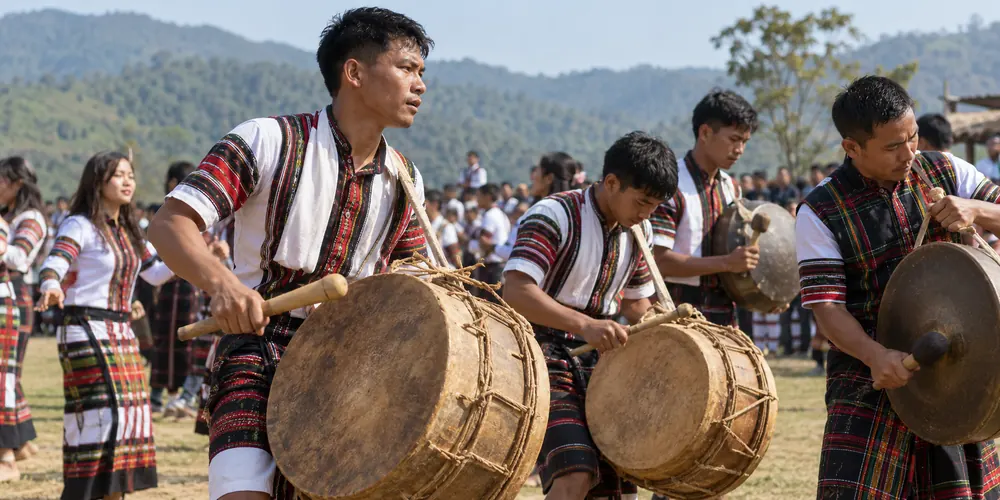
Beyond dance performances, Chapchar Kut transforms Aizawl into a lively cultural carnival filled with artisanal food stalls, acoustic music stages, and craft pavilions.
Surrounding the central stadium grounds, open-air food courts operated by local women’s associations serve authentic Mizo delicacies prepared using time-honored highland recipes. Cultural observers can compare these tribal festivities with classical dances during the Manipur Sangai Festival.
Traditional Culinary Delights at Festival Stalls
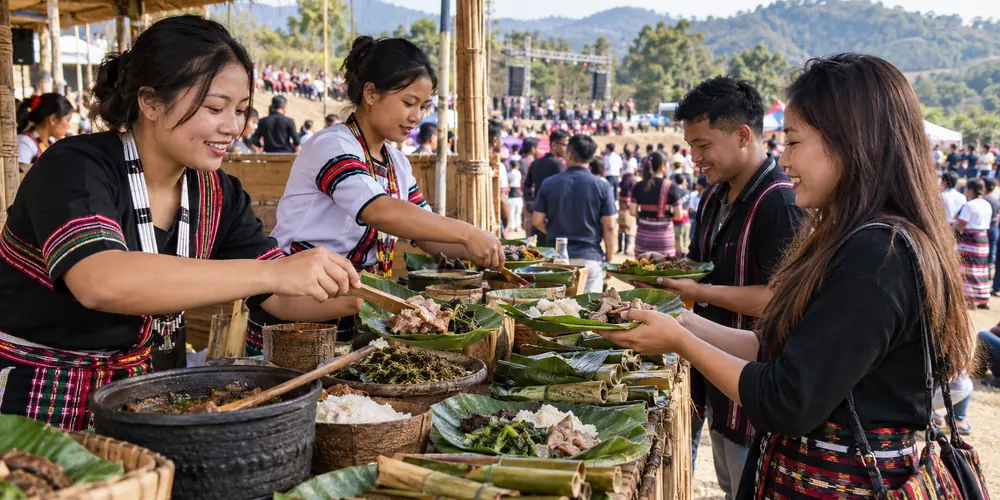
Visitors can sample an array of authentic, wholesome dishes that are rarely found in standard commercial restaurants:
- Sawhchiar: A hearty, comforting rice porridge simmered with chicken or smoked pork broth, fresh ginger root, and cracked black peppercorns.
- Vawksa Rep Chhum: Fragrant smoked pork braised with wild seasonal greens, mustard leaves, and fermented bamboo shoots.
- Chhangban: Sweet, chewy steamed rice cakes wrapped in fresh banana leaves, made from locally harvested glutinous mountain rice.
- Fresh Fruit and Beverages: Stalls offer chilled tender coconut water, wild passion fruit juice, and local herbal infusions brewed from mountain ginger and lemongrass.
Handloom and Bamboo Craft Pavilions
Artisans from rural districts across Mizoram gather at festival exhibition booths to display their finest craftwork, cataloged across tourist databases on the Aizawl District Administration Portal.
Visitors can purchase authentic hand-woven Puan textiles directly from master weavers, ensuring fair compensation for artisan cooperatives. Other popular craft items include finely woven cane baskets, bamboo walking sticks, traditional musical instruments, and contemporary bamboo jewelry designed by local artisans.
Visitor Logistics: Dates, Venues, and Travel Advice
Attending Chapchar Kut requires planning ahead, as hotels in Aizawl fill quickly with domestic visitors, cultural researchers, and Mizo diaspora returning home for the celebrations.
The festival takes place annually on the first Friday of March, though cultural exhibitions, rock concerts, and sporting events often span the surrounding Thursday and Saturday. Travelers interested in broader tribal cultures can also plan winter excursions to the Hornbill Festival in Nagaland.
Festival Venue and Seating Arrangements
The main festival events unfold at the Assam Rifles Ground, known locally as Lammual, located near Treasury Square in central Aizawl.
- Admission: Entry to the public spectator stands is entirely free of charge, with gates opening around 8:00 AM. Seating operates on a first-come, first-served basis.
- VIP and Media Passes: Travel writers and photographers can request special media enclosures through the Department of Tourism office located at McDonald Hill.
- Timing: Main stage ceremonies commence at 9:30 AM and conclude around 3:30 PM, followed by evening music concerts at local auditoriums and open-air amphitheaters.
Tips for Travelers Attending Chapchar Kut
To ensure a comfortable and respectful experience at the festival, keep the following guidelines in mind:
- Arrive Early: Stadium seats fill rapidly by 9:00 AM; arriving early guarantees prime elevated viewpoints for photographing the Cheraw bamboo dance.
- Dress Code: While casual clothing is acceptable for tourists, wearing a touch of traditional Mizo handloom (such as a woven scarf or shawl) is appreciated by local residents.
- Footwear: Wear comfortable flat walking shoes, as navigating stadium steps and steep hill approaches requires good traction.
- Permit Formalities: Remember to complete your permit application prior to arrival through the Mizoram Tourism Entry Formalities portal.
Frequently Asked Questions About Chapchar Kut Festival
When is the Chapchar Kut festival celebrated in Mizoram?
Chapchar Kut is celebrated annually on the first Friday of March in Aizawl, Mizoram. The date aligns with the completion of the winter forest clearing phase before the arrival of spring agricultural sowing.
Where does the main Chapchar Kut festival take place?
The primary state-level celebration takes place at the Assam Rifles Ground, locally referred to as Lammual, in central Aizawl. Additional community celebrations are held in village grounds across every district of Mizoram.
Is an entry ticket required to attend Chapchar Kut?
No, public admission to the festival at the Assam Rifles Ground is completely free of charge for both local residents and visiting tourists. Special designated badges are issued by the state tourism department for official media and invited delegates.
What is the Cheraw dance and why is it significant?
Cheraw is the traditional bamboo dance of Mizoram, where male performers rhythmically clap horizontal bamboo poles while female dancers step gracefully in and out of the shifting grids. It is the central cultural performance of Chapchar Kut, symbolizing highland agility, communal harmony, and celebration.
Can tourists participate in the dancing at Chapchar Kut?
While the main Cheraw performances are executed by trained traditional dance troupes, the festival frequently concludes with inclusive community circle dances where spectators and visiting tourists are warmly invited to join local participants on the field.
What traditional attire do women wear during Chapchar Kut?
Women wear the traditional three-piece ensemble consisting of the hand-woven Puanchei skirt with red, black, and white bands, the embroidered Kawrchei blouse, and the Vakiria feather headdress.
How do I reach Aizawl for the festival?
You can fly directly to Lengpui Airport (AJL) near Aizawl on daily flights operating from Kolkata and Guwahati. From the airport, shared taxis and private cabs transport travelers 32 kilometers into central Aizawl in approximately ninety minutes.