Haji Ali Dargah & Mount Mary Church Mumbai: Timings & Guide
Visit Haji Ali Dargah and Mount Mary Church Mumbai with tide-table causeway timings, Bandra Mass schedules, dress codes, and Coastal Road transit routes.
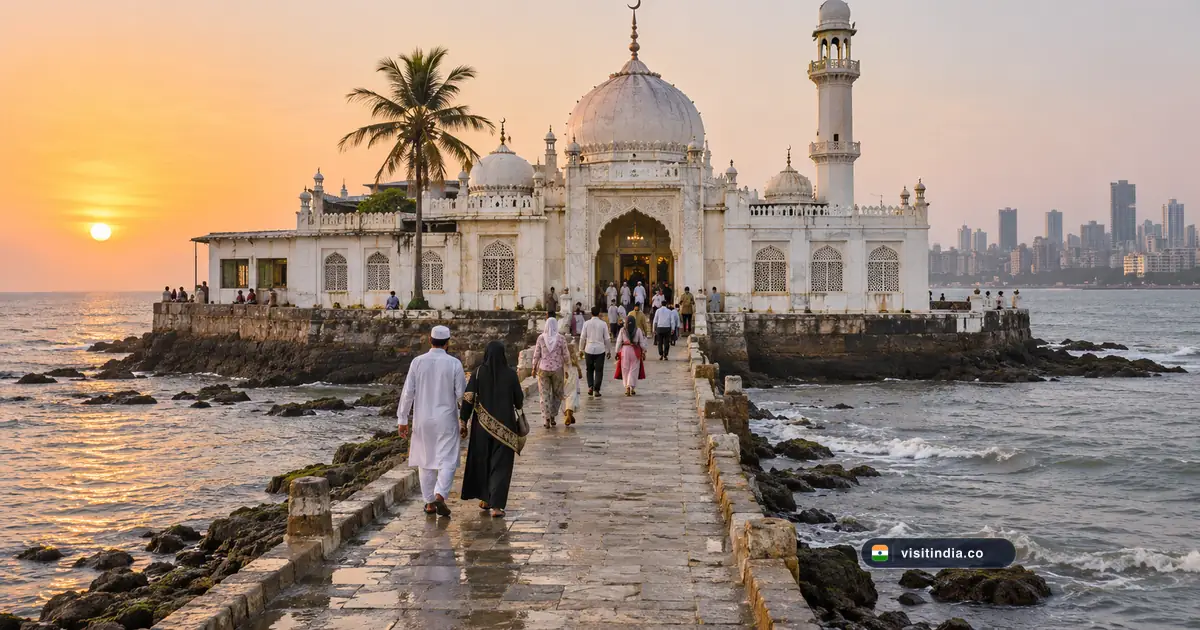
Along Mumbai’s western Arabian Sea coastline, Haji Ali Dargah and Mount Mary Church stand as two landmark interfaith sanctuaries separated by Mahim Bay. One rises from a basalt islet off Worli connected by a tidal walkway, while the other crowns a sea-facing hillock in Bandra West.
Planning a single-day visit requires coordinating Haji Ali Dargah timings with high tide cycles in Mumbai alongside early-morning Mass schedules at Mount Mary Basilica. Travelers who check tide charts before setting out move cleanly between Worli, Mahalaxmi, and Bandra via the Mumbai Coastal Road and Bandra-Worli Sea Link.
Visitor & Tide Essentials
- Location: Haji Ali Dargah sits off Lala Lajpatrai Marg in Worli (Mumbai 400026), and Mount Mary Basilica sits atop Mount Mary Road in Bandra West (Mumbai 400050).
- Haji Ali Timings & Tides: Open daily 5:30 AM to 10:00 PM, but the 700-yard unrailed causeway submerges at high tide and is walkable only during low tide.
- Mount Mary Mass Schedule: Weekday morning Masses run at 6:30 AM and 7:30 AM (Monday to Saturday) and Sunday Masses at 6:30 AM, 7:30 AM, 8:30 AM, and 9:30 AM, with no regular evening Mass.
- Entry Fee & Attire: Entry is free at both shrines; modest clothing covering shoulders and knees is mandatory, and women must cover their heads inside Haji Ali Dargah.
- Transit Access: Mahalaxmi Station (1.8 km) serves Haji Ali by taxi or walk, while Bandra Station (2.5 km) connects to Mount Mary via auto-rickshaw or BEST bus 211 and 214.
What to Expect at Haji Ali Dargah and Mount Mary Church Mumbai
Haji Ali Dargah and Mount Mary Church anchor Mumbai’s coastal pilgrimage tourism across Maharashtra, welcoming devotees and travelers of every faith without barriers. Built in 1431 on a Worli sea rock and rebuilt in 1904 atop Bandra Hill, both landmarks pair centuries-old devotion with distinct Indo-Islamic and Neo-Gothic coastal stonework.
Visitors experience contrasting atmospheres across the two sites on the same day. Worli’s sea-level courtyard fills with ocean spray, Thursday evening qawwali, and brass incense holders, whereas Bandra’s elevated stone basilica stays quiet outside morning liturgy and the September fair week.
Pir Haji Ali Shah Bukhari and the 1431 Islet Shrine
Constructed in 1431 CE roughly 500 yards off Lala Lajpatrai Marg, Haji Ali Dargah enshrines the tomb of Sayed Peer Haji Ali Shah Bukhari, a wealthy fifteenth-century merchant and Sufi saint from Bukhara in modern Uzbekistan. Legally administered since 1916 by the Haji Ali Dargah Trust, the islet houses a mausoleum, masjid, and pilgrim sanatorium.
Historical accounts maintained by the Mumbai City Collectorate Haji Ali heritage profile explain that the saint renounced his commercial fortune after settling in western India. According to local tradition, he instructed followers to cast his shroud into the sea rather than bury him on land, and his casket came to rest upon this rocky outcrop.
Basilica of Our Lady of the Mount: 1570 Origins to 1904 Stonework
Jesuit fathers erected a simple mud oratory on Bandra’s Land’s End hillock in 1570 to shelter a wooden statue of Virgin Mary holding the Child Jesus brought from Portugal. After raids and three structural rebuilds, architect S. N. Chandabhoy completed the fourth stone church in 1904, and Pope Pius XII granted Minor Basilica status in December 1954.
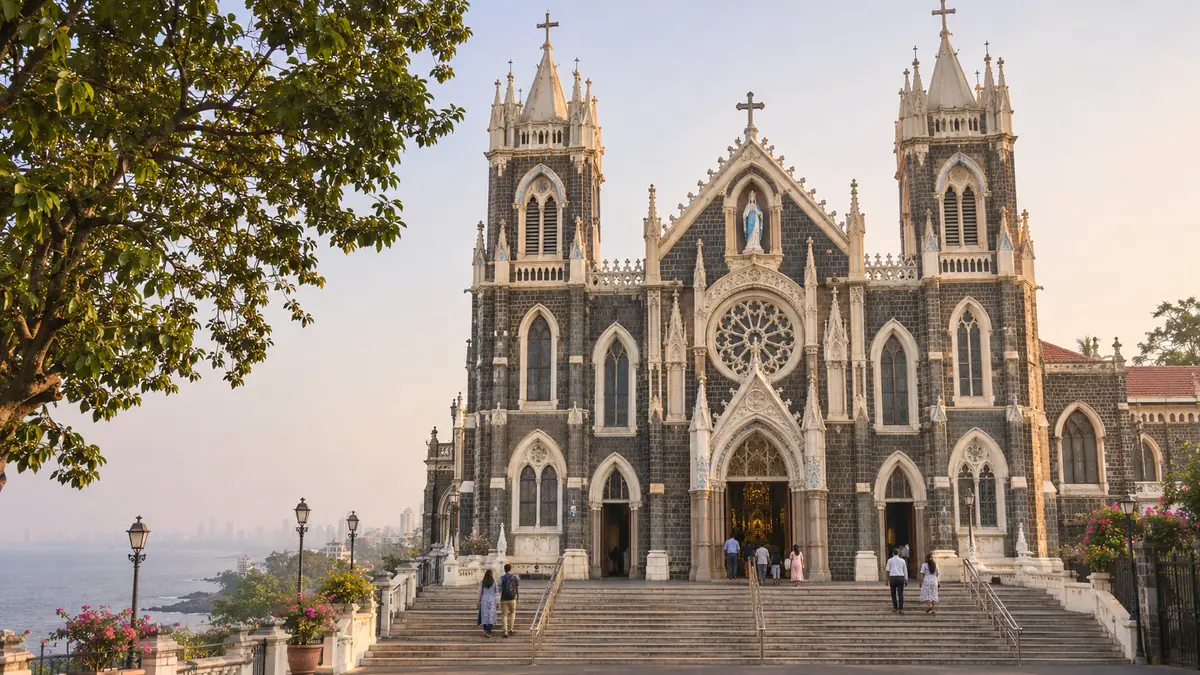
During the 1700 pirate attack, raiders damaged the original statue’s right forearm, prompting temporary transfer of an image from nearby St. Andrew’s Church until restoration in 1761. Travelers interested in Portuguese-era Catholic sanctuaries along India’s western coast often compare Bandra’s Minor Basilica with Goa’s UNESCO-listed Basilica of Bom Jesus in Old Goa.
Architectural Contrast: Indo-Islamic Marble and Bandra Neo-Gothic
Haji Ali Dargah presents a whitewashed Indo-Islamic profile anchored directly onto dark coastal basalt boulders, crowned by onion-shaped domes and an 85-foot masjid minaret. Inside the south-hall tomb chamber, intricate mirror inlay ceilings display the ninety-nine names of Allah and Prophet Muhammad above the red-and-green brocade-draped cenotaph.
Across Mahim Bay, Mount Mary Basilica rises behind a 67.5-foot-wide symmetrical semi-Gothic facade framed by twin 98-foot pyramidal spires made from grey Malad stone and Porbandar stone slabs. Inside the teak-roofed nave, marble plaques depict the Last Supper alongside a relic of St. Pope John Paul II gifted after his 1986 papal visit to Mumbai.
| Architectural Feature | Haji Ali Dargah (Worli) | Mount Mary Basilica (Bandra West) |
|---|---|---|
| Founding & Present Structure | Founded 1431 CE; trust formed 1916; causeway built 1944 | First oratory 1570; current church inaugurated 1904; Minor Basilica 1954 |
| Primary Design Style | Whitewashed Indo-Islamic mosque and Sufi tomb complex | Semi-Gothic stone church designed by S. N. Chandabhoy |
| Building Materials | Concrete and lime-plastered masonry over coastal basalt | Dark grey Malad stone, Porbandar stone spires, teak-wood nave ceiling |
| Signature Vertical Element | 85-foot white minaret adjacent to the northern masjid | Twin 98-foot square stone towers with octagonal steeples |
| Distinguishing Setting | Sea-level islet 500 yards off Hornby Vellard (Worli) | Hillock overlooking Land’s End and Bandstand Promenade |
Haji Ali Dargah Timings, High Tide Causeway Rules, and Mount Mary Mass Schedule
Haji Ali Dargah remains open daily from 5:30 AM to 10:00 PM, yet physical entry across its 700-yard concrete causeway stops entirely whenever Arabian Sea high tides submerge the deck. Mount Mary Church holds weekday morning Masses at 6:30 AM and 7:30 AM and four Sunday morning Masses ending at 9:30 AM.
Checking local Mumbai tide predictions before leaving your hotel prevents wasted cab rides to a closed sea gate. While Mount Mary Basilica stays accessible on dry hilltop ground throughout daytime prayer hours, Haji Ali operates strictly on the rhythm of coastal lunar tides.
Checking Mumbai High Tide Tables Before Walking the 700-Yard Causeway
Built in 1944 from trust funds and elevated by several feet during the 1980s, the narrow 700-yard walkway connecting Lala Lajpatrai Marg to the main gate lacks protective side railings. As documented on the Haji Ali Dargah Trust official pathway portal, high tide swells wash directly across the causeway surface, prompting security staff to close the shoreline barrier until water recedes.
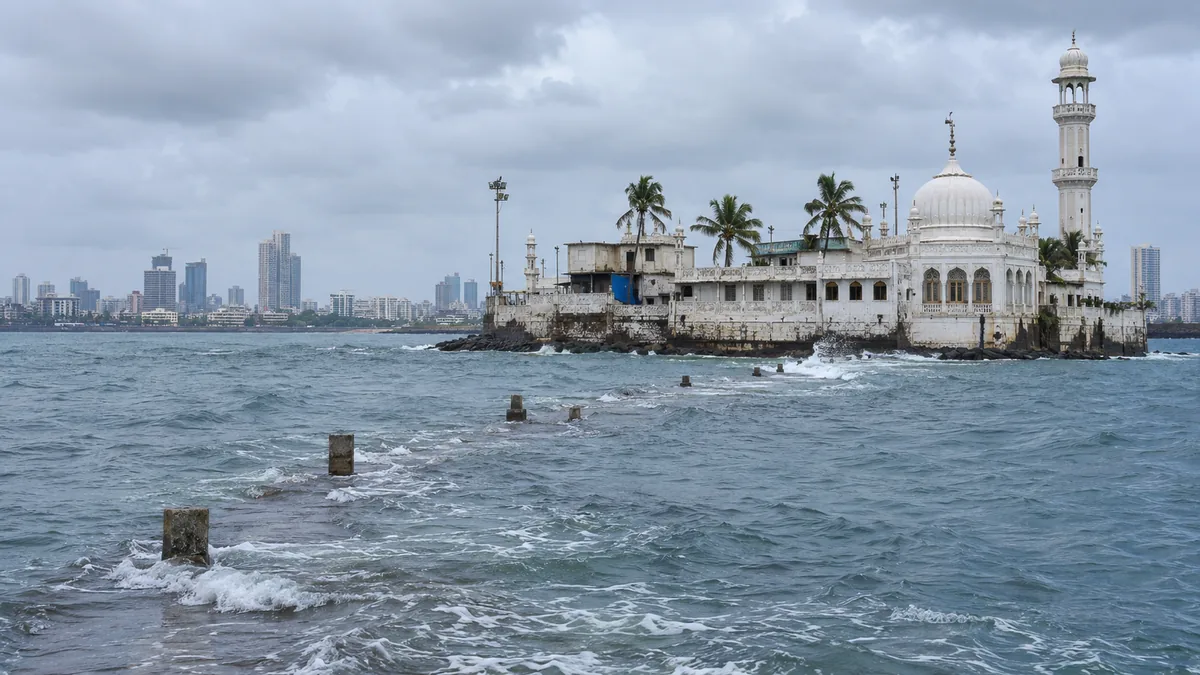
Always schedule your walk during low tide or arrive at least two to three hours before the day’s high-tide peak so you have safe passage back. During spring tides around full moon and new moon dates, high-water submergence can block pedestrian crossings for three to four hours at a stretch.
Important
Tidal Causeway Closure Warning: Never attempt to wade across the Haji Ali causeway when waves breach the deck or security guards blow whistles to clear the path. Verify daily Mumbai tide timings on a marine weather chart each morning before heading to Worli.
Thursday and Friday Qawwali Nights and Peak Crowd Windows
Live Sufi devotional music takes place inside the open-air Qawwal Khana at the south-west corner of the Haji Ali courtyard, drawing intense crowds every Thursday and Friday evening after sunset. Friday afternoon Jummah congregational prayers at the northern masjid also pack the narrow causeway with thousands of worshippers.
Travelers seeking unobstructed views of the tomb hall mirror work and quiet sea breezes should arrive on Tuesday or Wednesday mornings between 7:00 AM and 10:30 AM when low tide coincides with opening hours. Sunset crossings offer warm coastal light across Worli Bay, provided high tide does not overlap the dusk window.
Mount Mary Church Daily Mass Schedule and Private Prayer Hours
According to the official service schedule published by the Basilica of Our Lady of the Mount Bandra portal, weekday Masses from Monday through Saturday take place at 6:30 AM and 7:30 AM, while Sunday Masses run hourly at 6:30 AM, 7:30 AM, 8:30 AM, and 9:30 AM. The Basilica does not hold a regular evening Mass on ordinary days.
Outside morning Mass blocks, the nave remains open for silent prayer, candle lighting, and visits to the adjacent Fatima Oratory and the Pranam Maria Exhibition Centre, which opened in May 2024. Travellers scheduling multiple Mumbai devotions can also plan morning darshan at Prabhadevi using our Siddhivinayak Temple Mumbai timings guide.
| Sanctuary & Activity | Schedule / Timings | Crowd Level | Planning Note |
|---|---|---|---|
| Haji Ali Dargah Complex | Daily 5:30 AM to 10:00 PM | Moderate (Mon-Wed); Heavy (Thu-Sun) | Walkable only during low tide along the 700-yard causeway |
| Haji Ali Qawwal Khana | Dusk and evening hours; peak Thu & Fri nights | Very High | Arrive 90 minutes before sunset if low tide permits |
| Mount Mary Weekday Mass | Monday to Saturday: 6:30 AM, 7:30 AM | Quiet to Moderate | No regular evening Mass on weekdays or Sundays |
| Mount Mary Sunday Mass | Sundays: 6:30 AM, 7:30 AM, 8:30 AM, 9:30 AM | High | Best visited before 10:30 AM or late afternoon |
Entry Fees, Dress Code, and Shrine Etiquette Guidelines
Admission is completely free at both Haji Ali Dargah and Mount Mary Church, with zero ticket counters, entry charges, or official paid VIP darshan passes. Visitors must dress modestly with shoulders and knees covered, remove shoes before entering inner prayer halls, and refrain from photography inside active sanctums.
Following local shrine rules keeps courtyard queues moving smoothly and avoids confrontation with volunteer stewards. Both sites sit within residential and coastal security zones where modest behavior and luggage discipline are strictly expected.
Free Entry Policy and Avoiding Unofficial Intermediaries
Neither shrine levies any ticket price for general entry, museum rooms, or prayer hall access. The Haji Ali Dargah Trust explicitly cautions travelers against street touts and fraudulent websites posing as authorized representatives to solicit cash donations or paid fast-track entry.
Devotees wishing to contribute financially should use only locked donation boxes inside the respective shrines or verified official portals. Flower petals, chadars, or wax candles purchased outside remain strictly optional and cost roughly ₹20 to ₹500 depending on size.
Mandatory Dress Code, Head Coverings, and Footwear Counters
Both Haji Ali Dargah and Mount Mary Basilica enforce conservative attire covering upper arms, shoulders, midriffs, and knees, meaning shorts, mini-skirts, and sleeveless tank tops are turned away at inner gates. At Haji Ali Dargah, women must cover their heads with a scarf, stole, or dupatta before stepping into the marble mausoleum.
Footwear must be removed prior to entering the Haji Ali inner sanctum courtyard, where supervised shoe racks charge a nominal ₹5 to ₹10 caretaking fee or accept free placement along designated shelves. Wear washable slip-on sandals rather than laced sneakers, because salt spray and wet puddles often coat the causeway stones.
Pro Tip
Pack a Lightweight Scarf and Small Bag: Keep a cotton scarf or shawl in your daypack for mandatory head covering inside Haji Ali Dargah, along with a small drawstring pouch for holding slip-on shoes if outer racks fill up on busy Thursday evenings.
Wax Candle Figurines, Chadar Offerings, and Photography Rules
At Mount Mary Hill, stalls lining the approach steps sell molded paraffin wax candles shaped as houses, cars, babies, eyes, hands, and legs. Pilgrims offer these wax effigies as symbolic mannat petitions or thanksgiving tokens for health, home ownership, or family milestones inside the candle-lighting pavilion beside the Basilica.
Photography is welcomed along the open Haji Ali causeway and on Mount Mary’s outdoor stone plaza, though tripods and drone cameras are prohibited without municipal police permission. Inside Haji Ali’s mirrored tomb room and during Holy Mass inside Mount Mary Basilica, mobile phones must stay silent and cameras remain holstered; similar security discipline applies at large city celebrations covered in our Lalbaugcha Raja darshan guide.
| Policy Category | Haji Ali Dargah Rules | Mount Mary Church Rules |
|---|---|---|
| Admission Ticket | Free (zero entry fee or paid VIP passes) | Free (zero entry fee; open to all faiths) |
| Attire & Head Cover | Covered shoulders and knees; headscarf mandatory for women | Modest clothing covering shoulders and knees; hats removed indoors |
| Footwear Policy | Removed before sanctum courtyard; racks outside main hall | Footwear permitted inside the nave; keep noise minimal |
| Offerings & Customs | Optional chadar, rose petals, and sweets from licensed stalls | Optional wax candles and molded wax figurines at lighting stands |
| Photography & Bags | Permitted on causeway; banned inside inner tomb chamber | Exterior plaza allowed; restricted during live Mass liturgy |
Step-by-Step Coastal Circuit: Mahalaxmi Temple, Haji Ali, and Mount Mary Hill
A chronological half-day Mumbai circuit pairs Shree Mahalakshmi Temple and Haji Ali Dargah in South-Central Mumbai during morning low tide before crossing the Bandra-Worli Sea Link to Mount Mary Church before sunset. Setting aside four to five hours allows unhurried shrine visits, coastal driving, and Bandstand waterfront views.
Starting in Worli and moving northward follows natural coastal road flow while avoiding rush-hour southbound bottlenecks. Checking the morning tide clock determines whether Mahalaxmi Temple comes first or second on the Worli leg.
South-Central Leg: Mahalaxmi Temple to the Haji Ali Causeway
Begin along Bhulabhai Desai Road at Shree Mahalakshmi Temple, built in the eighteenth century along the rocky shore to enshrine Goddesses Mahalakshmi, Mahakali, and Mahasaraswati. Daily darshan schedule updates and festival advisories are maintained on the Shree Mahalaxmi Temple Trust official portal.
After morning darshan, walk 1.2 kilometers north-west past the sea-facing promenade toward Haji Ali Circle in 15 minutes. Cross the pedestrian subway beneath the busy coastal intersection to reach the starting bollard of the 700-yard Haji Ali causeway, allowing 60 to 75 minutes for the round-trip walk and tomb visit.
Crossing Mahim Bay via the Coastal Road and Bandra-Worli Sea Link
Once back on Lala Lajpatrai Marg, hail a black-and-yellow taxi or app cab northbound onto the Mumbai Coastal Road near Lotus Junction, which channels traffic straight onto the Worli approach of the 5.6-kilometer cable-stayed Bandra-Worli Sea Link. Crossing Mahim Bay via this elevated marine link bypasses congested surface roads through Worli Naka and Mahim Causeway.
Total driving distance from Haji Ali Dargah to Mount Mary Church measures roughly 14 to 16 kilometers depending on Bandra exit loops. Under regular daytime traffic, the coastal crossing takes 25 to 40 minutes, dropping passengers near Bandra Reclamation or Bandstand.
Bandra Hillock Walk: Mount Mary Steps, Pranam Maria, and Bandstand
From the Bandra seafront, climb either the winding approach road or the historic 136 stone steps rising from St. John the Baptist Road up to the Mount Mary Basilica plaza. Spend 45 to 60 minutes touring the semi-Gothic nave, the Oratory of Our Lady of Fatima opposite the main doors, and the Pranam Maria Exhibition Centre.
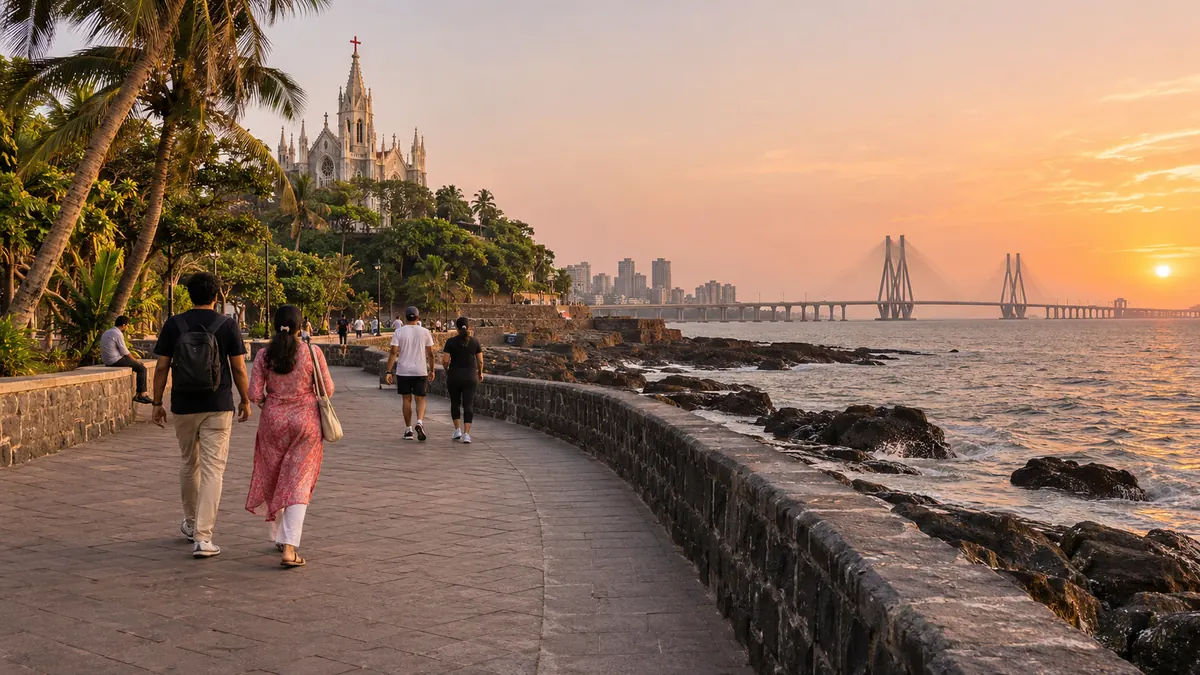
Finish the route with a ten-minute downhill stroll to Bandstand Promenade and the seventeenth-century Portuguese watchtower ruins at Castella de Aguada, checking wider municipal sightseeing updates on the Maharashtra Tourism Mumbai destination portal. Travelers spending multiple days on the harbour coast can pair this afternoon circuit with a morning boat departure from Apollo Bunder covered in our planning a visit to Elephanta Caves Mumbai Ferry.
| Circuit Stage | Route & Distance | Recommended Duration | Key Highlights |
|---|---|---|---|
| 1. Shree Mahalakshmi Temple | Bhulabhai Desai Road start | 30 to 40 minutes | Three coastal goddess idols, floral lanes, Arabian Sea terrace |
| 2. Haji Ali Dargah | 1.2 km walk north-west + 700-yard causeway | 60 to 75 minutes | 1431 tomb hall, mirror calligraphy, 85-foot minaret, Qawwal Khana |
| 3. Coastal Road & Sea Link | 14 to 16 km northbound across Mahim Bay | 25 to 40 minutes | Direct marine transit bypassing central Mahim traffic |
| 4. Mount Mary Basilica & Bandstand | 136 steps or Kane Road climb + promenade | 60 to 75 minutes | 1904 stone spires, wax candle pavilion, Castella de Aguada sunset |
Best Time to Visit, Monsoon Advisories, and the September Bandra Fair
October through March brings the safest low-tide walking conditions at Haji Ali Dargah and dry evening breezes at Mount Mary Hill, with temperatures averaging 18°C to 30°C. September hosts the annual Bandra Fair, whereas heavy monsoon swells from June to August frequently close the unrailed causeway. Travelers extending their itinerary along this spiritual corridor can review Ajmer Sharif Dargah & Taragarh Fort darshan and timings for queue hours, dress code, and entry rules. If your route includes additional pilgrimage stops in the region, check Girnar Ropeway, Mount Girnar & Uparkot Fort Junagadh darshan and timings before finalizing morning darshan slots.
Coastal humidity and sea spray alter comfort levels noticeably across Mumbai’s three seasons. Matching your travel dates to calm sea states protects both safety and architectural photography clarity.
Winter Comfort Window (October to March)
Between October and March, retreating moisture leaves crisp visibility across Worli Bay and Bandra Land’s End, keeping afternoon heat manageable along the unshaded Haji Ali walkway. Morning temperatures sit near 18°C to 22°C before warming to 28°C to 30°C by early afternoon.
Winter weekends bring pleasant walking weather around Bandstand Promenade and clean golden-hour light against Mount Mary’s dark grey Malad stone towers. Boat operators, coastal promenades, and nearby evening food markets all operate at full seasonal rhythm without rain disruptions.
Monsoon Tide Closures and Slippery Stone Precautions (June to September)
Mumbai receives torrential southwest monsoon rainfall from June through September, driving high Arabian Sea waves directly over the Haji Ali pathway during storm surges and spring high tides. Police and Trust wardens shut the shoreline gates whenever sea spray threatens pedestrian balance on the unrailed concrete slabs.
Carry a compact umbrella rather than bulky ponchos, wear non-slip rubber-soled sandals, and keep cameras inside waterproof dry pouches when visiting during the rainy season. Mount Mary Basilica stays dry and open indoors throughout the monsoon, though steep approach lanes around Mount Mary Road become slick during afternoon squalls.
Experiencing the Bandra Fair and Haji Ali Urs Gatherings
Every September, the week-long Bandra Fair begins on the Sunday falling on or immediately after September 8, celebrating the Feast of the Nativity of the Blessed Virgin Mary. Hundreds of thousands of visitors climb Bandra Hill while stalls along Kane Road sell sweet khaja, kadio bodios sugar sticks, and handmade wax offerings.
During fair week, municipal police enforce one-way pedestrian routing where the 136 eastern Mount Mary Steps serve strictly as a downhill exit path. Meanwhile, Haji Ali Dargah observes its annual Urs honoring Pir Haji Ali Shah Bukhari on the 16th of Safar with extended qawwali sessions.
Visitors exploring Bandra and South Mumbai after evening prayers can stop at regional snack counters detailed in our Mumbai Street Food tasting route.
| Season | Months | Temperature Range | Causeway & Sea Conditions | Visitor Highlights |
|---|---|---|---|---|
| Winter Peak | October to March | 18°C to 30°C | Calm seas; reliable daily low-tide access | Clear Sea Link views, dry walking, peak winter comfort |
| Summer Heat | April to May | 26°C to 35°C | High humidity; unshaded causeway hot midday | Visit before 9:30 AM or after 5:00 PM to avoid glare |
| Southwest Monsoon | June to September | 24°C to 29°C | Rough swells; frequent high-tide closures | Dramatic waves; September 8 Bandra Fair week |
How to Reach Haji Ali Dargah and Mount Mary Church by Train, Metro, Road, and Air
Mahalaxmi Railway Station and the underground Aqua Line 3 Metro station sit 1.8 kilometers east of Haji Ali Dargah, while Bandra Station sits 2.5 kilometers east of Mount Mary Basilica. Crucially, Mumbai bars auto-rickshaws south of Mahim and Sion, making black-and-yellow taxis and BEST buses essential in Worli.
Knowing Mumbai’s zonal transport split saves newcomers confusion at suburban station exits. Both rail corridors run frequent trains from dawn past midnight, pairing smoothly with short metered cab or bus hops.
Western Railway, Aqua Line 3 Metro, and BEST Bus Connectivity
From Churchgate Station in South Mumbai, take a slow Western Railway suburban train 12 minutes north to Mahalaxmi Station, or ride the underground Mumbai Metro Aqua Line 3 to Mahalaxmi Metro Station. From Mahalaxmi, walk 20 minutes west via Keshavrao Khadye Marg or take a three-minute metered cab to Haji Ali Circle.
To reach Mount Mary Basilica by rail, disembark at Bandra Station on the Western or Harbour Line, roughly 2.5 kilometers east of the hillock. Outside Bandra Station West, board BEST bus route 211 to Land’s End (followed by a short uphill walk on Kane Road) or BEST bus route 214 directly to the Mount Mary Steps stop.
Mumbai Taxi vs Suburban Auto-Rickshaw Zonal Boundaries
Under Mumbai’s regional transport regulations, three-wheeled auto-rickshaws operate strictly in the suburbs north of Mahim Creek and Sion and cannot enter South or Central Mumbai. Travelers arriving at Haji Ali from Mohammed Ali Road, Crawford Market, or Churchgate must ride metered black-and-yellow kaali-peeli taxis or BEST buses.
Once you cross the Bandra-Worli Sea Link north into Bandra West, three-wheeled auto-rickshaws become widely available and offer the quickest last-mile climb up Hill Road and Mount Mary Road. Keep small ₹50 and ₹100 currency notes handy for metered short hops outside station forecourts.
Transfers from Chhatrapati Shivaji Maharaj International Airport
Chhatrapati Shivaji Maharaj International Airport (BOM) lies approximately 12 kilometers north of Mount Mary Basilica and 18 to 20 kilometers north of Haji Ali Dargah. Prepaid airport taxis and app-based cabs reach Bandra West in 30 to 40 minutes via the Western Express Highway, or continue across the Bandra-Worli Sea Link to reach Worli in 45 to 60 minutes.
Visitors extending their Mumbai stay across western India’s hill stations, rock-cut caves, and coastal forts can coordinate rail and highway gateways using our Maharashtra travel guide. Always confirm Sea Link toll inclusion before starting metered cab trips between the airport and South Mumbai.
| Starting Hub | Destination Shrine | Distance | Best Transit Mode | Approximate Travel Time |
|---|---|---|---|---|
| Mahalaxmi Station (Rail / Metro 3) | Haji Ali Dargah | 1.8 km | Black-and-yellow taxi or 20-min walk | 5 to 20 minutes |
| Churchgate Station | Haji Ali Dargah | 6.5 km | Western Railway to Mahalaxmi, or direct taxi | 15 to 25 minutes |
| Mohammed Ali Road | Haji Ali Dargah | 5.5 km | Metered black-and-yellow taxi or BEST bus | 15 to 25 minutes |
| Bandra Station (West) | Mount Mary Church | 2.5 km | Auto-rickshaw or BEST Bus 211 / 214 | 10 to 15 minutes |
| Mumbai Airport (BOM) | Mount Mary / Haji Ali | 12 km / 19 km | Prepaid taxi via WEH and Bandra-Worli Sea Link | 30 to 55 minutes |
Frequently Asked Questions About Haji Ali Dargah and Mount Mary Church
Is Haji Ali Dargah open today and accessible during high tide?
Haji Ali Dargah is open every day of the year from 5:30 AM to 10:00 PM for visitors of all faiths. However, the 700-yard concrete causeway submerges during high tide, so pedestrians can cross safely only during low-tide hours.
How to reach Haji Ali Dargah from Churchgate?
From Churchgate Station, board a Western Railway local train four stops north to Mahalaxmi Station in 12 minutes and walk or take a short cab 1.8 kilometers west to the causeway entrance. Alternatively, hire a direct metered black-and-yellow taxi 6.5 kilometers north via Marine Drive and Pedder Road.
How to reach Haji Ali Dargah from Mohammed Ali Road?
Travelers starting near Mohammed Ali Road or Crawford Market can hire a metered black-and-yellow taxi 5.5 kilometers north via the J.J. Flyover and Lala Lajpatrai Marg in 15 to 25 minutes. Auto-rickshaws are prohibited in South Mumbai, though regular BEST buses also connect Nagpada and Byculla to Haji Ali Circle.
What to wear in Haji Ali Dargah and Mount Mary Church?
Both Haji Ali Dargah and Mount Mary Church require modest clothing that covers shoulders and knees, avoiding shorts, sleeveless tops, and mini-skirts. Women entering the inner sanctum of Haji Ali Dargah must additionally cover their heads with a scarf or dupatta and leave footwear at outer racks.
What are the daily Mass timings at Mount Mary Church Bandra?
Mount Mary Basilica holds weekday Masses from Monday through Saturday at 6:30 AM and 7:30 AM, and Sunday Masses at 6:30 AM, 7:30 AM, 8:30 AM, and 9:30 AM. There is no regular evening Mass at Mount Mary Church outside special novena and feast days.
What is the distance between Haji Ali Dargah and Mount Mary Church?
Haji Ali Dargah and Mount Mary Church are separated by roughly 14 to 16 kilometers across Mahim Bay. Taxis using the northbound Mumbai Coastal Road and the 5.6-kilometer Bandra-Worli Sea Link cover the distance between both shrines in 25 to 40 minutes.
When does the Bandra Fair take place at Mount Mary Basilica?
The annual week-long Bandra Fair starts on the Sunday falling on or immediately after September 8, celebrating the Feast of the Nativity of the Blessed Virgin Mary. During fair week, the 136 eastern Mount Mary Steps operate strictly as a downhill exit while stalls line Kane Road.