Kambala Festival Karnataka: Races, History & Season
Experience the thrilling Kambala buffalo race festival in coastal Karnataka with traditional racing categories, history, winter dates, and travel tips.
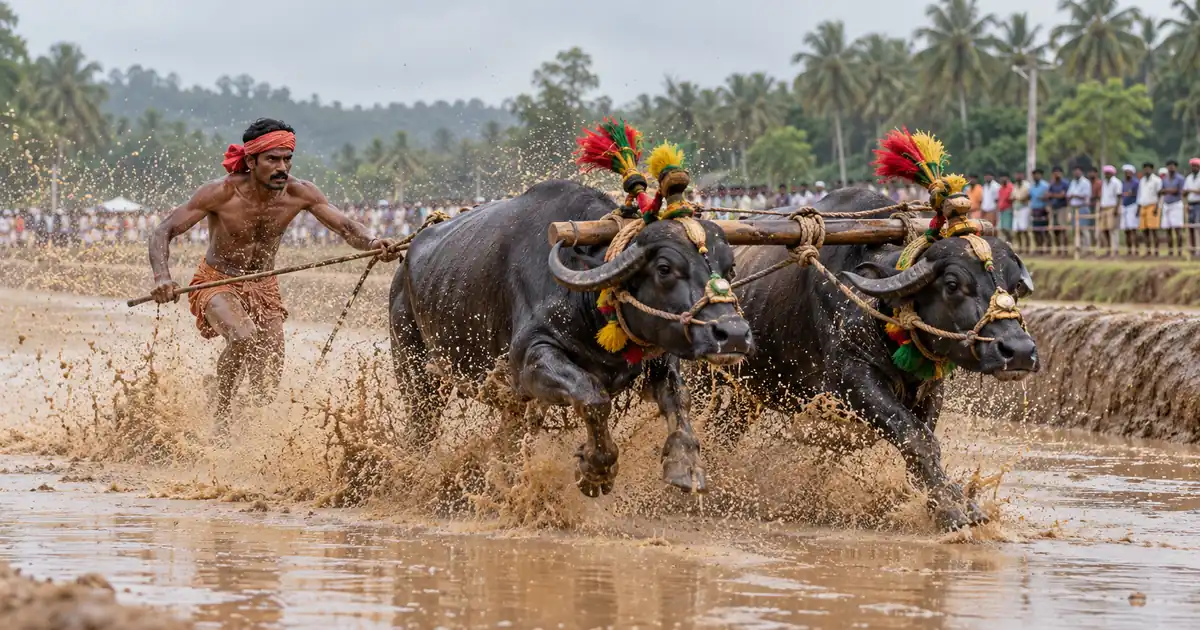
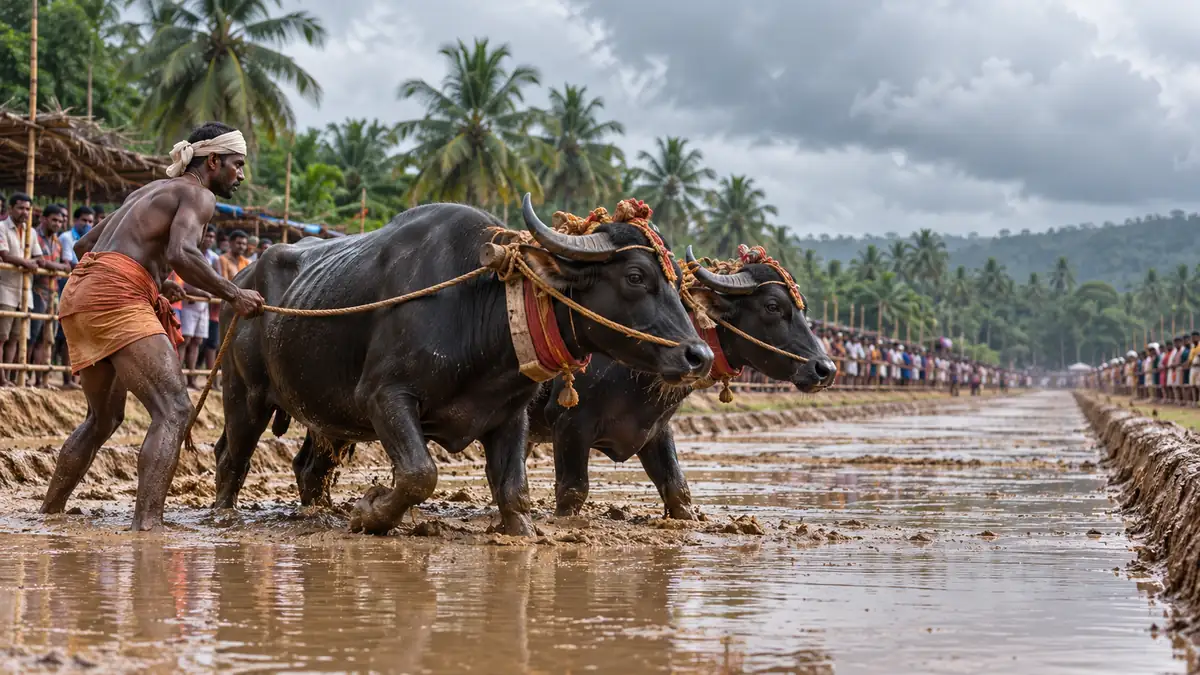
Kambala Festival is an ancient agrarian folk sport celebrated across the coastal districts of Dakshina Kannada and Udupi in Karnataka. Centered on high-speed sprint races between pairs of specially trained water buffaloes, the festival takes place in waterlogged mud tracks known locally as the bakimar.
The annual competition honors local agricultural deities and marks the conclusion of the winter paddy harvest. It celebrates the enduring bond between rural farming families and their livestock.
Festival Essentials
- Kambala Festival is a historic annual pair-buffalo sprint held in slushy paddy tracks across Dakshina Kannada and Udupi districts of coastal Karnataka.
- The competitive racing season runs annually from November through April, featuring over 20 sanctioned weekend events.
- Races feature four traditional categories: Kane Halage (water-spurting wooden plank), Hagga (rope racing), Negilu (plough racing), and Adda Halage.
- Spectator attendance is free, with overnight floodlit sprint heats beginning on Saturday afternoon and concluding on Sunday morning.
Traditional Racing Categories and Competitive Rules
Kambala Festival features four primary competitive racing categories that test speed, jockey endurance, and synchronized control over charging buffaloes. Every race pits two pairs of bulls against each other down parallel 130 to 145-meter slush tracks called the Manjotti.
Laser timing sensors, digital photo-finish cameras, and electronic display boards are now standard at all major coastal events to resolve close sprint finishes down to fractions of a second.
| Racing Category | Traditional Equipment | Track Condition | Victory & Judging Criteria |
|---|---|---|---|
| Kane Halage | Round wooden plank with two holes | Flooded deep slush (water level 8–10 inches) | Water spray height measured against overhead white cloth banner |
| Hagga (Senior & Junior) | Thick coir ropes tied to nose rings | Wet muddy slurry track | Pure sprint speed across the finish line held by bare ropes |
| Negilu (Senior & Junior) | Lightweight wooden farming plough | Standard slush paddy track | Fastest sprint time while holding the wooden plough bar |
| Adda Halage | Flat horizontal wooden plank | Level muddy track | Pure sprint speed with the jockey standing flat upon the board |
Official tournament regulations published on the Udupi District Administration Tourism Directory highlight the prestige associated with Kane Halage. In this demanding event, jockeys balance on a perforated wooden disk while buffaloes charge at full gallop. The winning pair must force water jets through the plank holes to drench an overhead fabric banner suspended seven to eight meters high.
Origins, Royal Patronage, and Agricultural Significance
Kambala Festival traces its cultural origins back over a thousand years to the ruling Alupa dynasty of coastal Tulunadu. Feudal chieftains and kings patronized these events as royal celebrations known as Arasu Kambala, rewarding victorious farming households with gold coins, silk turbans, and brass trophies. This royal sponsorship of agrarian spectacles parallels the state patronage of the Mysuru Dasara Jumbo Savari elephant processions celebrated by the Wodeyar kings in southern Karnataka.
Legend also connects the sport with the sacred Kadri Manjunatha Temple in Mangalore, earning traditional non-competitive events the title of Devara Kambala.
Historical records preserved on the Incredible India Coastal Karnataka Cultural Guide explain how local Tulu farmers established the races to seek the blessings of Lord Shiva for fertile soil, timely monsoon rains, and protection against cattle epidemics.
Following the harvest of the Enel paddy crop in late autumn, farm owners lead their bull pairs to local temple ponds for ritual bathing before entering the competition tracks.
The Annual Winter Race Circuit and Key Coastal Venues
The Kambala Festival circuit comprises more than twenty sanctioned weekend tournaments organized across coastal towns between November and April. Each tournament is hosted by a traditional agricultural village committee or prominent local family trust.
Spectators flock from regional cities and highland plantations, including coffee country visitors planning weekend getaways from places to visit in Coorg. Coastal Mangalore sits only 140 kilometers west of Madikeri via National Highway 275.
| Prominent Kambala Event | Typical Month | Venue Location | Unique Festival Tradition |
|---|---|---|---|
| Moodubidire Kambala | Late November / Early December | Moodubidire, Dakshina Kannada | One of the oldest royal tracks, attracting over 140 bull pairs |
| Mulki Arasu Kambala | Late December | Mulki, Mangalore Taluk | Traditional palace grounds race preserving ancient feudal ceremonies |
| Miyaru Kambala | Early January | Miyaru, Karkala Taluk | Modern dual track featuring high-speed electronic timing setups |
| Puttur Koti-Chennaya Kambala | Late January | Mahalingeshwara Temple, Puttur | Dedicated to historic Tulu twin warrior heroes Koti and Chennaya |
| Aikala Bava Kambala | Early February | Aikala, Kinnigoli | High-profile cash prize tournament with live global broadcasts |
| Uppinangadi Kambala | Late March | Confluence of Kumaradhara & Nethravathi | Historic riverbank setting drawing massive rural crowds |
Each competition begins on Saturday morning with ceremonial poojas and track blessing rituals. Knockout sprint heats continue without pause through Saturday night under high-powered stadium floodlights, concluding with championship finals on Sunday afternoon.
Buffalo Care, Grooming Traditions, and Animal Welfare Rules
Raising a championship pair of racing buffaloes represents a matter of family honor in rural coastal Karnataka. Owners spend up to ₹3,000 to ₹5,000 per day on specialized nutrition, providing bulls with cooked horse gram, black lentils, tender coconut water, wheat bran, and mineral supplements.
Trainers take the animals on daily swimming sessions in village rivers to develop muscular stamina and joint flexibility.
Devotees of regional Indian folk customs can compare these animal heritage traditions with the masked dances and sacred festivals documented in our overview of the festivals of Sikkim.
In recent years, the District Kambala Committee has introduced stringent animal welfare guidelines following Supreme Court directives. Whips, sticks, and spiked ropes are strictly prohibited, and veterinary doctors inspect every participating bull before and after each race heat to prevent physical exhaustion or injury.
Spectator Guidelines, Trackside Culture, and Photography Tips
Attending a Kambala Festival offers a sensory introduction to coastal Tulu culture. Spectators sit on raised dirt embankments bordering the mud tracks, cheering their favorite village teams while commentators deliver energetic play-by-play commentary in Tulu and Kannada over loudspeakers.
Travelers looking to experience varied winter celebrations along the Arabian Sea can also read our guide to the Goa Carnival to enjoy street parades along the adjacent Konkan coast.
Photographers should arrive early on Saturday afternoon to secure vantage points near the starting line or the finish ropes. High shutter speeds of at least 1/2000th of a second are essential to freeze flying mud droplets, churning water, and charging buffalo muscles.
Visitors should wear casual clothing that can withstand occasional mud splatters, and waterproof protective covers are strongly recommended for camera bodies and lenses.
How to Reach Kambala Race Venues in Coastal Karnataka
Mangalore serves as the primary transport gateway for reaching Kambala race venues across Dakshina Kannada and Udupi. Mangalore International Airport operates daily scheduled direct flights from Mumbai, Bengaluru, Chennai, Hyderabad, and major Middle Eastern airports.
The airport lies within an hour’s drive of major racing hubs like Moodubidire, Mulki, and Kinnigoli.
The Karnataka Tourism Destinations Directory provides regional road maps and transit options for visitors traveling through Mangalore. Mangalore Central and Mangalore Junction railway stations connect the coast to the Konkan Railway network, offering superfast train services from Mumbai, Kochi, and Goa.
Travelers concluding their coastal sports tour can drive inland to explore the forested cascades of Abbey Falls Coorg for a relaxing highland excursion.
Frequently Asked Questions About Kambala Festival
When is the best time to watch Kambala races in Karnataka?
The Kambala racing season runs from late November through late March, with weekend tournaments held almost every Saturday and Sunday across coastal Karnataka. Visiting between December and February guarantees large tournament fields with over one hundred participating buffalo pairs.
Is entry free for spectators at Kambala events?
Yes, spectator entry to all traditional village Kambala tournaments is completely free of charge. Visitors can walk freely along the raised earthen spectator galleries and open food stalls surrounding the mud track.
Where are the most famous Kambala races held?
The most renowned tournaments take place at Moodubidire, Puttur, Miyaru in Karkala, Aikala, and Mulki in Dakshina Kannada and Udupi districts. The Kadri Kambala in Mangalore also holds deep historic and religious significance.
How fast do buffaloes run during a Kambala sprint?
Championship buffalo pairs can cover the 140-meter slush track in under 12 to 13 seconds, reaching speeds of up to 40 kilometers per hour. Jockeys sprint barefoot alongside or behind the animals while holding steering ropes or balancing on wooden planks.
Are whips or cruelty allowed during Kambala races?
No, the Kambala Committee enforces strict animal welfare regulations that completely ban the use of whips, sticks, and harsh physical force. Government-appointed veterinary teams inspect every animal at trackside checkpoints before and after races.
What other major cultural festivals should travelers attend in Karnataka?
In addition to coastal buffalo races, travelers should experience Hampi Utsav among the illuminated UNESCO World Heritage ruins of the Vijayanagara Empire in northern Karnataka during the winter season.