Delhi UNESCO Monuments: Red Fort, Qutub Minar & Humayun Tomb
Explore Delhi's three UNESCO World Heritage Sites: Red Fort, Qutub Minar, and Humayun's Tomb with historical details, ticket booking, and transit tips.
Delhi UNESCO Monuments Essentials
- Inscribed Sites: Delhi preserves three distinct UNESCO World Heritage Sites: Qutub Minar and its Monuments (1993), Humayun’s Tomb (1993), and the Red Fort Complex (2007).
- Management Authority: All three complexes fall under the direct stewardship of the Archaeological Survey of India (ASI), requiring digital QR entry passes to bypass ticketing lines.
- Architectural Progression: The three complexes chronicle successive eras of medieval Islamic architecture: 12th-century Delhi Sultanate beginnings, 16th-century early Mughal garden tombs, and 17th-century imperial sandstone palaces.
- Transit Connectivity: Delhi Metro Yellow and Violet lines directly connect all three monuments, allowing visitors to travel between them without encountering surface traffic.
Delhi stands among the few global metropolises preserving three distinct UNESCO World Heritage Sites within municipal borders. Each complex represents a defining phase of imperial sovereignty, showcasing evolutionary shifts in engineering, material selection, and aesthetic philosophy across five centuries.
From the towering fluted sandstone minarets of the 12th-century Mamluk Sultanate to the symmetric Persian charbagh water gardens of the early Mughals and the imposing red ramparts of Shahjahanabad, exploring these monuments reveals how dynastic rulers stamped their authority upon the Yamuna river plains.
Architectural Comparison Matrix: Delhi’s Three UNESCO Sites
How do Delhi’s three UNESCO World Heritage Sites compare across historical eras, architectural styles, and transit points? The three monuments span five centuries of engineering development, progressing from corbelled Sultanate stone towers to geometric Mughal garden mausoleums and palatial royal citadels.
The comparison matrix below highlights the foundational specifications, royal patrons, and logistics for each World Heritage property.
| Monument Entity | Historical Epoch | Primary Patron | Architectural Style | Nearest Metro Station | Average Visit Duration |
|---|---|---|---|---|---|
| Qutub Minar Complex | Inscribed 1993 (Built 1192–1368 CE) | Qutb-ud-din Aibak & Iltutmish | Early Indo-Islamic Sultanate | Qutab Minar (Yellow Line) | 2 to 2.5 hours |
| Humayun’s Tomb | Inscribed 1993 (Built 1565–1572 CE) | Empress Bega Begum | Classical Mughal Charbagh | JLN Stadium (Violet Line) | 2 to 2.5 hours |
| Red Fort (Lal Qila) | Inscribed 2007 (Built 1638–1648 CE) | Emperor Shah Jahan | High Mughal Sandstone Palace | Lal Qila (Violet Line) | 2.5 to 3 hours |
Qutub Minar Complex: Sultanate Towers, Mosque Ruins & Iron Pillar
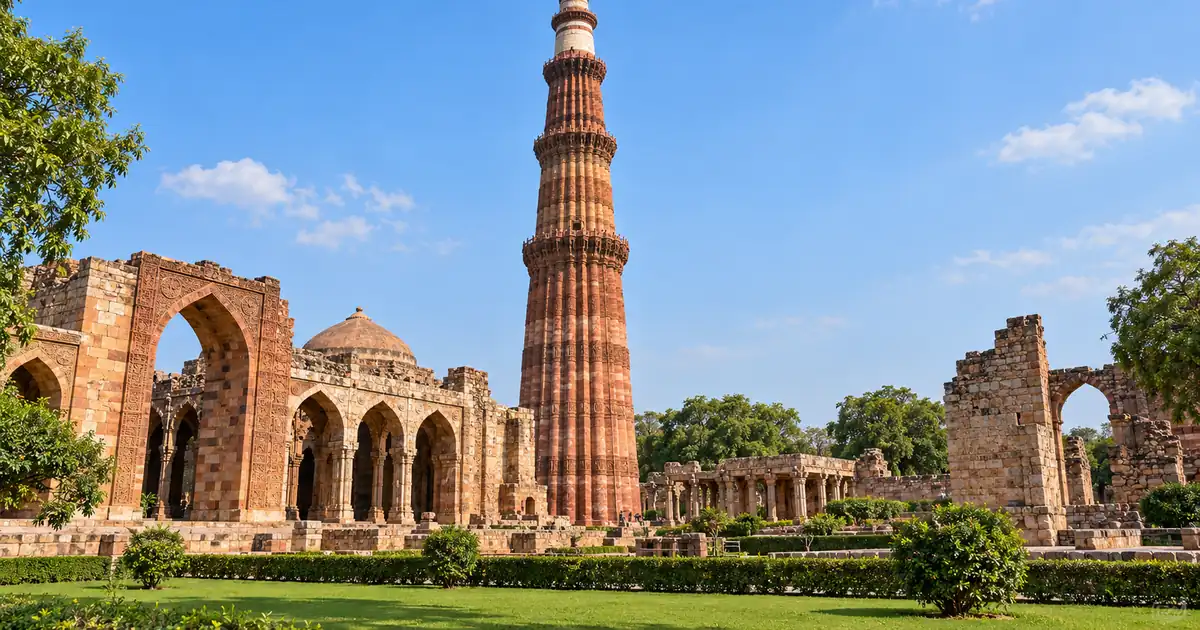
What architectural monuments make up the Qutub archaeological area in Mehrauli? The Qutub complex contains the 72.5-meter Qutub Minar, the Quwwat-ul-Islam congregational mosque, the rust-resistant 4th-century Gupta iron pillar, the tomb of Iltutmish, and the monumental 1311 CE Alai Darwaza gateway.
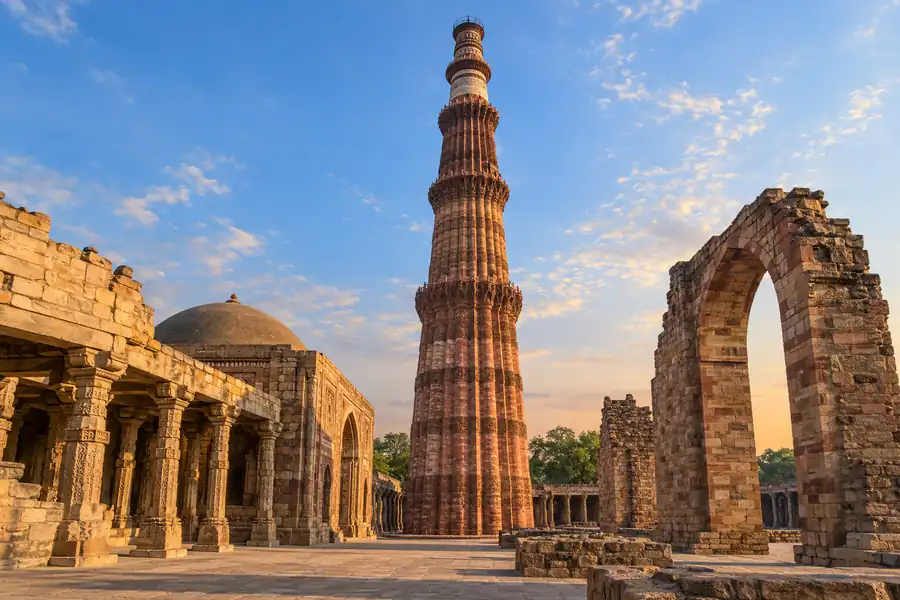
Commissioned by Qutb-ud-din Aibak in 1192 CE, the tower marked the establishment of the Delhi Sultanate. Successive rulers Shams-ud-din Iltutmish and Firoz Shah Tughlaq enlarged and repaired the upper storeys. Rising across five tapering sections, the minaret features alternating angular flutings in red sandstone carved with Quranic inscriptions. Detailed conservation histories are maintained through the Archaeological Survey of India Qutb Complex Portal.
Within the adjoining courtyard of Quwwat-ul-Islam mosque stands the famed 4th-century Iron Pillar of Chandragupta II. Weighing over six tons, this metallurgic marvel has resisted atmospheric corrosion for sixteen centuries due to a protective layer of amorphous iron hydrogen phosphate. Visitors combining their visit with broader capital exploration can review regional routes in our Delhi visitor overview for optimal day planning.
Humayun’s Tomb: The Garden Mausoleum That Inspired the Taj Mahal
Why is Humayun’s Tomb considered a defining milestone in Mughal architecture? Humayun’s Tomb introduced the geometric four-part charbagh garden layout, the monumental bulbous white marble double dome, and high central archways (pishtaqs) that subsequently defined imperial Mughal tomb architecture.
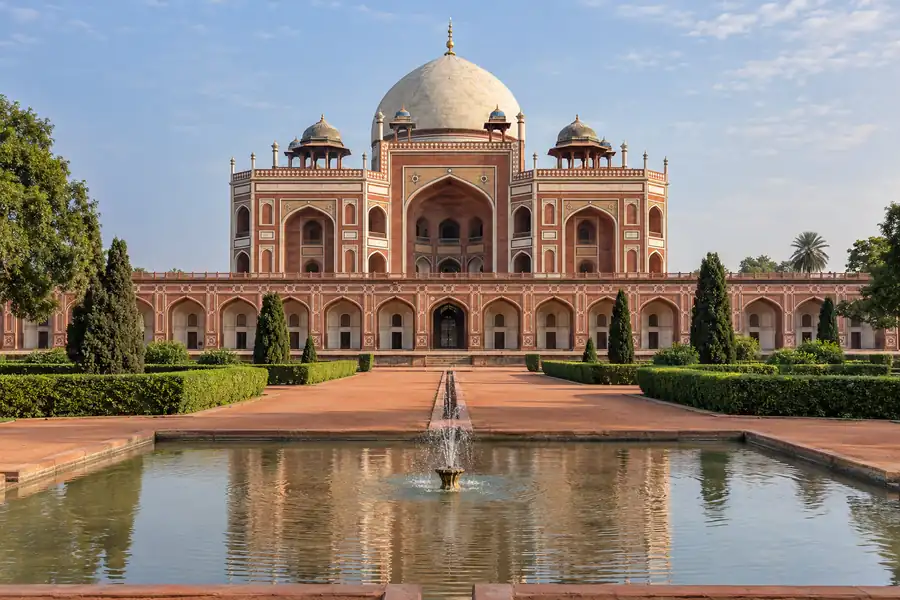
Commissioned in 1565 CE by Humayun’s senior consort, Empress Bega Begum, and designed by Persian architect Mirak Mirza Ghiyas, the monument occupies an elevated stone plinth overlooking symmetrical sunken gardens. Channels of flowing water symbolize the four rivers of paradise described in Quranic texts, dividing the enclosure into four large squares further divided into thirty-six smaller plots.
The double-dome design served both aesthetic and structural functions. The outer white marble dome rises to a soaring height visible across the skyline, while the lower interior dome maintains comfortable proportions for visitors inside the octagonal memorial chamber. Complete structural preservation records are published on the Archaeological Survey of India Humayun’s Tomb Portal.
Adjacent to the main tomb, travelers can stroll into Sunder Nursery. This restored 90-acre heritage ecological park preserves sixteen additional Sultanate and Mughal monuments surrounded by micro-habitats, botanical collections, and marble water fountains.
Red Fort (Lal Qila): Imperial Seat of the Mughal Emperors
What royal structures define the historic fortress complex of the Red Fort? The Red Fort houses the massive red sandstone Lahori Gate, the covered vaulted market of Chhatta Chowk, the public audience hall of Diwan-i-Aam, and the private marble pavilions of the Diwan-i-Khas.
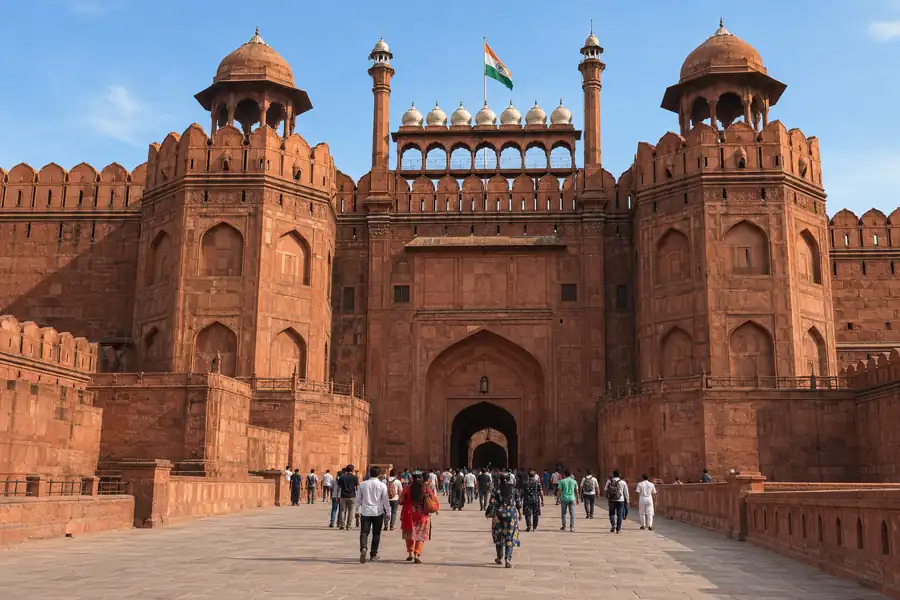
Emperor Shah Jahan commissioned the fortress in 1638 CE upon deciding to relocate the imperial court from Agra to his newly designed capital city of Shahjahanabad. Enclosed by two kilometers of octagonal ramparts rising up to 33 meters, the palace citadel accommodated royal apartments, administrative bureaus, and the imperial treasury along the western bank of the Yamuna River.
Entering through the Lahori Gate leads visitors into Chhatta Chowk, an arcade where royal merchants historically sold silk, jewels, and carpets to the imperial court. Further inside, the Diwan-i-Khas once housed Shah Jahan’s legendary jewel-encrusted Peacock Throne before its plunder by Persian invader Nadir Shah in 1739. Archaeological collections are documented on the Archaeological Survey of India Red Fort Portal.
After concluding your walking tour through the imperial halls, exit into the surrounding streets to experience authentic Mughal culinary heritage using our Old Delhi food guide for kebabs and historic sweets.
Ticketing, Online Booking & Entry Protocol
How do travelers book tickets and complete entry security at Delhi’s UNESCO sites? Travelers book tickets online via the Archaeological Survey of India digital portal or by scanning on-site QR codes, presenting digital confirmation alongside official government identification at the turnstile gates.
Booking tickets online in advance is strongly recommended to avoid queues at ticket windows. Online tickets provide a nominal discount compared to physical cash purchases and include entry to the main monument grounds.
| Visitor Category | Online Booking Fee | On-Site Physical Counter Fee | Included Access |
|---|---|---|---|
| Indian Citizens & SAARC Visitors | ₹35 per person (Red Fort ₹50) | ₹40 per person (Red Fort ₹50) | Entry to gardens, courtyards, and primary monuments |
| Foreign Nationals | ₹550 per person (Red Fort ₹600) | ₹600 per person (Red Fort ₹650) | High-value entry queue and monument compound access |
| Children (Under 15 Years) | Free entry | Free entry | Valid age proof required at security turnstiles |
Security checks at all three properties are rigorous. Prohibited items include large backpacks, tripods without commercial filming permits, cigarettes, lighters, and external food items.
Small day bags and cameras for personal photography are permitted without extra charges. For travelers organizing visits to other major spiritual complexes, our Akshardham Temple Delhi darshan and timings outlines distinct electronic storage rules and camera restrictions.
One-Day Delhi UNESCO Heritage Circuit Route
Can you tour all three Delhi UNESCO World Heritage monuments in a single day? You can visit all three sites in one day by starting at Qutub Minar at sunrise, traveling by metro to Humayun’s Tomb by mid-morning, and finishing at the Red Fort by mid-afternoon.
This itinerary forms the core cultural foundation of the broader complete Golden Triangle India Itinerary overview before travelers continue their onward road trip toward Agra.
| Schedule Window | Activity & Location | Recommended Metro Transit Link | Practical Touring Tip |
|---|---|---|---|
| 07:30 AM to 10:00 AM | Qutub Minar complex and Quwwat-ul-Islam ruins | Board Yellow Line at Qutab Minar station; change at Central Secretariat to Violet Line | Arrive early to photograph the iron pillar before morning tour groups arrive |
| 10:45 AM to 01:15 PM | Humayun’s Tomb and Sunder Nursery heritage park | De-board at JLN Stadium station; 10-minute auto-rickshaw to the gate | Walk through Sunder Nursery gardens for lunch at the artisan garden cafe |
| 02:00 PM to 04:30 PM | Red Fort ramparts, Diwan-i-Aam, and Diwan-i-Khas | Board Violet Line from JLN Stadium to Lal Qila station | Enter through Lahori Gate and allocate at least two hours for inner halls |
Frequently Asked Questions About Delhi UNESCO Monuments
Can visitors go inside the tower of Qutub Minar?
Public entry inside the spiral staircase of Qutub Minar has been closed since 1981 for visitor safety and structural preservation. Travelers can walk freely throughout the surrounding archaeological courtyard to inspect the fluted stone carvings, ancient arches, and the Gupta iron pillar.
Is the Red Fort open on Mondays?
The Red Fort remains closed to visitors every Monday for routine maintenance and restoration work. Both Qutub Minar and Humayun’s Tomb remain open seven days a week from sunrise to sunset.
How do travelers reach Humayun’s Tomb by Delhi Metro?
The nearest metro stop is Jawaharlal Nehru Stadium Station on the Violet Line, situated approximately two kilometers west of the monument. From the station exit, travelers can take a short five-minute electric rickshaw ride directly to the main ticket gate.
Are tripods and commercial video equipment permitted inside Delhi monuments?
Handheld still cameras and mobile phones for personal photography are permitted without supplementary fees at all three sites. Professional photography setups involving tripods, drone systems, or lighting reflectors require prior written authorization and payment of filming fees to the Archaeological Survey of India.
Which monument is best for late afternoon and sunset photography?
Humayun’s Tomb provides exceptional late afternoon light as the setting sun illuminates the red sandstone plinths and white marble dome. The open charbagh water channels create striking mirrored reflections as evening shadows stretch across the garden terraces.