Baidyanath Dham Deoghar Guide: Shravani Mela, VIP Pass & Darshan
Plan your pilgrimage to Baba Baidyanath Temple in Deoghar. Complete guide to Shravani Mela Kanwar Yatra, VIP darshan pass, timings, rituals, and hotels.
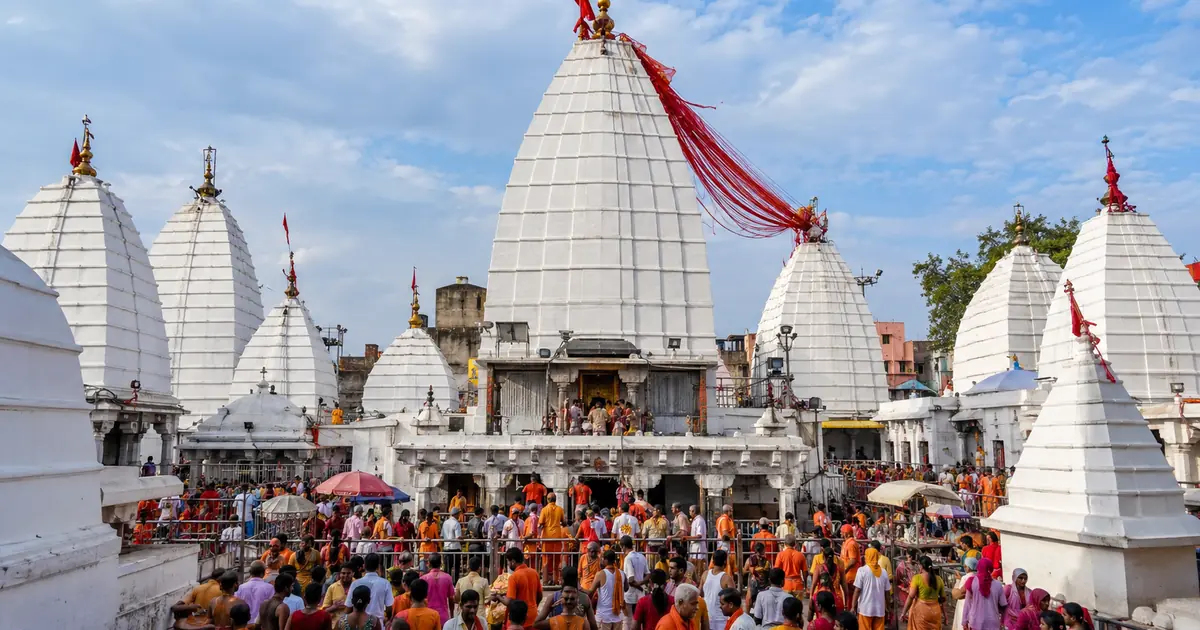
Baba Baidyanath Dham, located in the sacred town of Deoghar in the Santhal Parganas division of Jharkhand, stands as one of the most revered spiritual centers in India. Revered simultaneously as one of the twelve sacred Jyotirlingas of Lord Shiva and one of the 51 Shakti Peethas of Goddess Sati, this holy sanctuary occupies an extraordinary position in Hindu spiritual geography.
Known affectionately among devotees as Baba Dham and Chitabhoomi, the temple complex features 22 distinct shrines centered on the ancient stone pyramidal shikhara of Lord Baidyanath. The shrine becomes the focal point of the month-long Shravani Mela, widely celebrated as the longest unorganized religious fair in the world, where millions of saffron-clad pilgrims journey barefoot to pour holy Ganga water over the lingam.
Baidyanath Dham Pilgrim Advisory
- Primary Sanctum Deity: Lord Baidyanath (Vaidyanatha), the divine healer aspect of Lord Shiva.
- Dual Spiritual Status: One of the 12 Jyotirlingas and the revered Hridaya Peetha (heart shrine) among the 51 Shakti Peethas.
- Shravani Mela Pilgrimage: Annual month-long pilgrimage (July to August) involving a 105-kilometer barefoot trek from Sultanganj in Bihar.
- VIP Darshan (Sheeghra Darshanam): Special queue passes available at ₹500 per person at official administrative counters.
- Key Connectivity: Deoghar Airport (DGH) sits 8 km southwest; Jasidih Junction (JSME) railway station lies 7 km northwest.
Mythological Legends: Ravana’s Penance and Kamna Linga
According to the Shiva Purana and regional Sthala Mahatmyas, the demon king of Lanka, Ravana, performed intense penance in the high Himalayas to propitiate Lord Shiva. Seeking invincible protection for his island kingdom, Ravana cut off nine of his ten heads as an offering to the deity.
Moved by his extreme austerity, Lord Shiva descended, acted as a divine physician (Vaidya) to reattach Ravana’s severed heads, and granted his request in the form of a sacred Atmalinga. Shiva placed one strict condition: if Ravana set the lingam down upon the earth anywhere on his return journey, it would become permanently rooted to that spot.
As Ravana journeyed south through the forested plateau of Jharkhand, the celestial devas grew anxious and invoked Lord Varuna to induce an urgent physical need within the demon king. Lord Vishnu then descended in the guise of a humble cowherd named Baiju.
Ravana handed the heavy lingam to Baiju while he relieved himself at a nearby pond. Finding the weight immense, Baiju set the sacred stone upon the earth, where it became irrevocably rooted as the Kamna Linga.
Devotees seeking to understand the sacred geography of all twelve manifestations can consult our comprehensive guide to the 12 Jyotirlingas of India. Further historical and administrative details are published on the Deoghar District Administration portal.
The Hridaya Peetha: Sati’s Heart and Dual Sanctum
Baidyanath Dham holds a unique theological position because it is celebrated as both a Shiva Jyotirlinga and a Shakta Mahapitha. Classical Puranic literature records that following Goddess Sati’s self-immolation at Daksha’s sacrificial fire, Lord Shiva carried her lifeless body in deep grief across the universe.
To preserve cosmic equilibrium, Lord Vishnu released his Sudarshana Chakra, dismembering Sati’s mortal remains into 51 sacred fragments. The divine heart (Hridaya) of Sati fell at this very spot in Deoghar, making it the supreme Hridaya Peetha. The resident goddess is worshiped as Jai Durga, whose shrine stands directly opposite the main Baidyanath temple.
Pilgrims exploring primary Shakta pilgrimage centers in eastern India can contrast this shrine with the yoni peetha detailed in our Kamakhya Temple Guwahati guide.
Sanctum Architecture, Gathbandhan & the Panchashula
The main temple of Baba Baidyanath rises 72 feet high, presenting a lotus-shaped stone tower that tapers upward in distinct pyramidal horizontal tiers. Built upon a raised granite foundation, the walls feature thick carved stone blocks that have endured centuries of monsoonal weather.
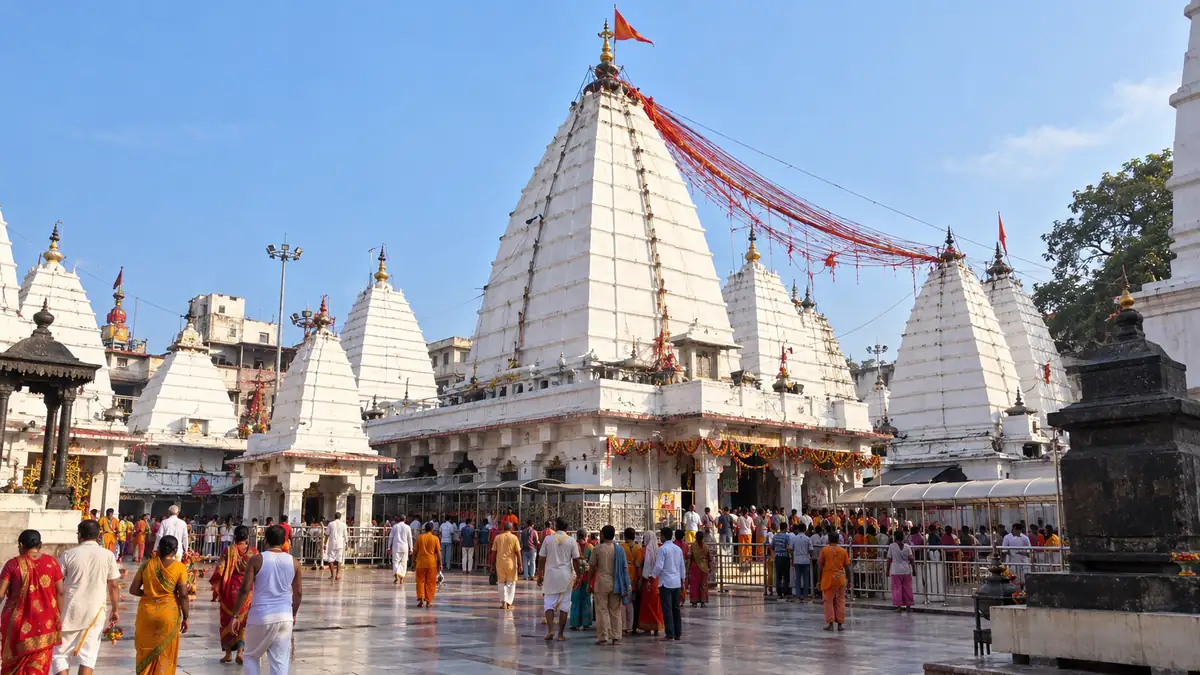
The Sacred Panchashula (Five-Pronged Trident)
Unlike most North Indian Shiva temples crowned by a standard three-pronged Trishula, the pinnacle of Baba Baidyanath Temple and all adjacent shrines are crowned with an extraordinary Panchashula (five-pronged trident).
According to Tantric traditions, this five-spoke copper device acts as a cosmic antenna, shielding the temple complex from celestial disturbances and negative energies. Devotees revere the Panchashula during the annual Maha Shivaratri festival, when the device is lowered, ritually bathed with panchamrit, and re-hoisted atop the dome.
The Gathbandhan Ritual: Uniting Shiva and Shakti
One of the most visually striking sights within the temple courtyard is the Gathbandhan (holy tying). Huge swathes of unstitched crimson and saffron cloth, measuring up to 100 meters in length, are secured to the Panchashula of the Baidyanath Temple and extended across the open air to bind with the pinnacle of the Maa Parvati Temple.
Daring local temple sevayats climb the slick exterior stone carvings without safety harnesses to tie these red ribbons. Devotees sponsor this ritual to pray for marital longevity, family harmony, and the resolution of marital discord.
Shravani Mela: The Legendary 105 km Kanwar Yatra
During the Hindu lunar month of Shravan (July to August), Deoghar hosts the historic Shravani Mela, attracting more than five million pilgrims from every state of India and neighboring Nepal.
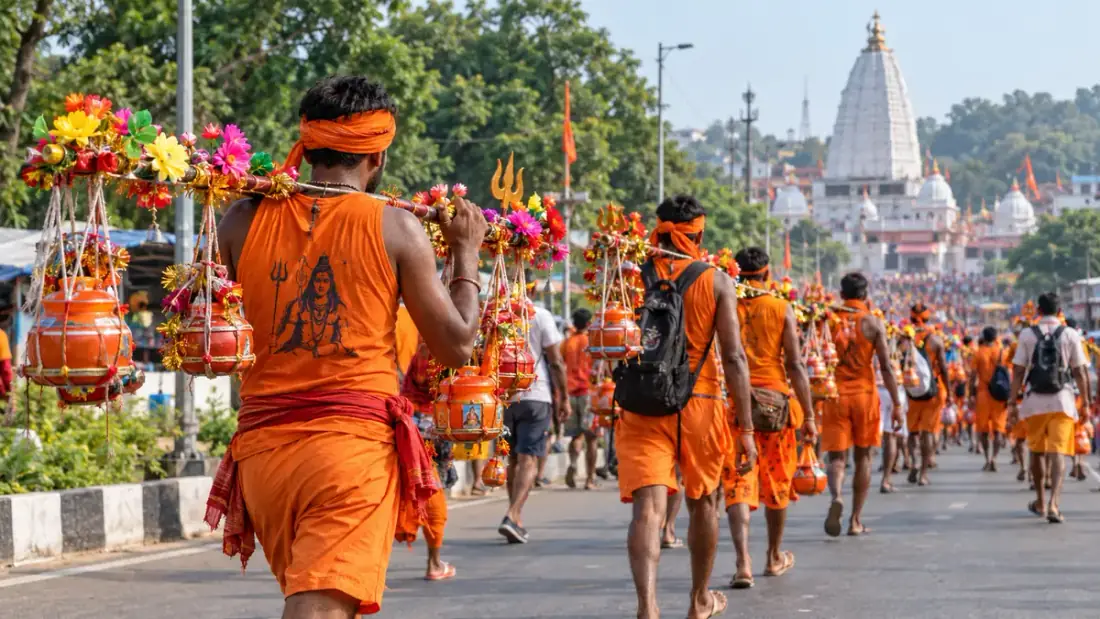
Pilgrims, known as Kanwariyas, dress in traditional saffron cotton garments and gather at Sultanganj in the Bhagalpur district of Bihar. Here, the holy Ganga River uniquely curves northward (Uttarvahini Ganga). Pilgrims perform morning purification rituals, fill two brass or glass containers with sacred water, and suspend them on a balanced bamboo shoulder pole termed a Kanwar.
| Kanwar Category | Pilgrim Discipline | Journey Logistics |
|---|---|---|
| Samanya Kanwariya | Standard walking pilgrimage | Takes 3 to 4 days, resting at roadside community shelters (Dharmashalas) |
| Dak Kanwariya | Continuous non-stop relay run | Must complete the entire 105 km within 24 hours without setting the Kanwar down |
| Khari Kanwariya | Standing ascetic vow | Never places the pole on the earth; companions hold the load while the pilgrim rests |
Throughout the 105-kilometer walking corridor, state authorities and voluntary charitable societies provide free medical clinics, drinking water stations, covered resting pavilions, and food rations.
Daily Darshan Timings, Aarti & Seva Schedule
The temple follows an orderly daily ritual cycle conducted by the local Maithil Brahmin priest community (Panda Samaj).
| Time Window | Daily Ritual | Devotee Guidelines |
|---|---|---|
| 4:00 AM – 5:30 AM | Kacha Jal & Sarkari Pooja | Temple doors open; head priest performs confidential dawn purification |
| 5:30 AM – 3:30 PM | Public Darshan & Sparsha Darshan | General queues and VIP pass lines proceed for abhishekham and touch darshan |
| 3:30 PM – 6:00 PM | Sanctum Intermission | Sanctum doors closed for deity rest, cleaning, and dry flower clearance |
| 6:00 PM – 9:00 PM | Shringaar Aarti & Sandhya Darshan | Deity adorned with sandalwood paste and silver ornaments; no water offerings |
| 9:00 PM | Concluding Shayan Aarti & Gate Closure | Sanctum locked for the night |
Devotees can contrast these eastern riverine rituals with the evening riverfront ceremonies detailed in our Kashi Vishwanath Varanasi guide.
VIP Pass (Sheeghra Darshanam) Booking Process
During peak pilgrimage months, festivals, and Mondays, general queue waiting times can extend between 4 and 8 hours. The temple management operates a structured Sheeghra Darshanam (VIP fast-track) system to assist elderly visitors, families with young children, and time-constrained travelers.
- Token Cost: ₹500 per person on regular weekdays; tariffs may increase to ₹1,000 on auspicious festival dates such as Shravan Mondays.
- Purchase Location: Available strictly at official biometric ticket kiosks near the Mansarovar administrative complex. Avoid unauthorized local middlemen.
- Access Route: VIP ticket holders enter through a dedicated elevated footbridge and separate queue corridor, reaching the inner sanctum within 30 to 60 minutes.
- Official Identity: A valid government photo ID card (Aadhaar, Voter ID, or Passport) is required to issue the electronic biometric wristband.
Sacred Shivaganga Pond Bathing Etiquette
Positioned roughly 200 meters west of the main temple complex is the holy Shivaganga Pond, an ancient stepped water body excavated in the bedrock.
Tradition requires pilgrims to perform a ritual bath in the Shivaganga waters to wash away physical impurities before carrying offerings into the sanctum sanctorum. Paved masonry ghats, safety chains, and separate changing facilities are provided for both men and women. During the monsoon rush, local police personnel enforce strict perimeter barriers to prevent pilgrims from venturing into deep water zones.
How to Reach Baidyanath Dham Deoghar
Deoghar features modern transport connections linking Jharkhand to major metropolitan hubs across India.
| Mode of Travel | Hub / Gateway | Transit Route to Temple Complex |
|---|---|---|
| By Air | Deoghar Airport (DGH) | Located 8 km from the temple. Indigo operates direct scheduled commercial flights to Delhi, Kolkata, Bengaluru, and Patna. Pre-paid taxis reach the temple gates in 20 minutes. |
| By Train | Jasidih Junction (JSME) | Primary railway station on the Howrah-Delhi main trunk line, 7 km from town. Major trains like the Howrah Rajdhani, Vande Bharat Express, and Poorva Express pause here. Auto-rickshaws and app cabs ply continuously. |
| By Road | Deoghar Bus Depot | Positioned 2 km from the shrine. Frequent state transport and deluxe private AC coaches link directly to Ranchi (250 km), Patna (255 km), and Kolkata (320 km). |
Train travelers can verify rail connections alongside regional pilgrim facilities on the Deoghar district tourism portal. Those arriving via Ranchi frequently combine their pilgrimage drive with the Ranchi waterfalls circuit across the Chota Nagpur Plateau.
Prominent Excursions Around Deoghar
Travelers spending an extended weekend in Deoghar can explore several notable cultural and scenic destinations located nearby:
Naulakha Temple (Jugal Mandir)
Situated 2 km from the main temple, this graceful 146-foot-tall stone shrine is dedicated to Radha and Krishna. Commissioned by Rani Charushila of Pathuria Ghat in Bengal, the structure earned its popular name because its intricate construction cost nine lakh rupees in 1948.
Trikuta Parvat (Trikut Pahar)
Located 15 km east of Deoghar along the Dumka road, Trikuta Parvat features three prominent granite hill peaks rising to 2,470 feet. The site features an aerial ropeway cable car, natural rock caves where sage Bamdev performed austerities, and the Mayurakshi River spring.
Pilgrims mapping wider spiritual journeys across Eastern India can also undertake the sacred mountain walk detailed in our Sammed Shikharji Parasnath trek guide or explore coastal shrines in our Puri Jagannath Temple guide. State travel programs can be explored via the Incredible India Jharkhand portal.
Accommodation & Where to Stay in Deoghar
Deoghar provides a broad spectrum of lodging options catering to solo ascetics, family groups, and luxury travelers:
- State Tourism Guest Houses: Jharkhand Tourism operates clean, economical properties including Natraj Vihar and Baidyanath Vihar within walking distance of the sanctum.
- Private Hotels: Modern air-conditioned family hotels with parking facilities cluster along the Court Road and near the Clock Tower, with room rates ranging from ₹1,500 to ₹4,500 per night.
- Dharmashalas: Hundreds of community trusts run affordable dharmashalas offering basic dormitory beds and private rooms for ₹200 to ₹600 per day.
For comprehensive nationwide travel planning and pilgrimage scheduling, review our complete directory of the best places to visit in India.
Frequently Asked Questions About Baidyanath Dham
Is Baba Baidyanath Temple one of the 12 Jyotirlingas?
Yes. Baidyanath Jyotirlinga is celebrated as the eighth among the twelve sacred Jyotirlingas of Lord Shiva in Adi Shankaracharya’s Dvadasa Jyotirlinga Stotram.
How long is the walking route of the Kanwar Yatra?
The traditional walking route of the Kanwar Yatra extends 105 kilometers, starting at the river ghats of Sultanganj in Bihar and concluding at the sanctum of Baba Baidyanath in Deoghar.
What is the fee for VIP Sheeghra Darshanam pass?
The regular fee for the Sheeghra Darshanam token is ₹500 per person on normal days. Tokens must be purchased directly from the official temple administrative counters.
Can devotees touch the Shiva Lingam during darshan?
Yes. Devotees are permitted to perform Sparsha Darshan (touching the sacred lingam with hands) during public darshan hours, offering water, bel patra, and flowers. During peak Shravani Mela rush, authorities occasionally switch to external Argha pipe systems to ensure safety.
What is the closest railway station to Deoghar?
Jasidih Junction (JSME) is the main railway hub, situated 7 km from the temple complex. It offers frequent direct superfast and express train connections to Kolkata, Delhi, Patna, and Varanasi.