Kamakhya Temple Guwahati: VIP Pass, Timings & Ambubachi Mela
Complete Kamakhya Temple guide covering 2026 darshan timings, ₹501 VIP pass booking, Ambubachi Mela rituals, Garbhagriha cave rules, and Nilachal Hill route.
Darshan Essentials
- Operating Hours: The temple gates open daily at 5:30 AM for morning snan and nitya puja. Public darshan runs from 8:00 AM to 1:00 PM, closes for afternoon bhog from 1:00 PM to 2:30 PM, and reopens from 2:30 PM until sunset prayer (~5:30 PM).
- VIP Pass Booking: General queue darshan is completely free with waiting times ranging from 4 to 8 hours. Special entry VIP passes costing ₹501 per devotee can be acquired at designated Devalaya counters, reducing waiting times to approximately 1.5 to 2.5 hours.
- Subterranean Sanctum: The Garbhagriha contains no stone idol or statue. Devotees descend steep stone stairs into a dark, candlelit subterranean bedrock cave to touch the sacred Matra Yoni, kept moist by a natural underground perennial spring.
- Ambubachi Mela: Observed annually in mid-June during the monsoon season, the festival celebrates the earth’s fertility. The temple remains sealed for three consecutive days before reopening on the fourth day with the distribution of consecrated red cloth (Raktavastra).
- Sacred Shakti Hierarchy: Perched atop Nilachal Hill overlooking the Brahmaputra River in Guwahati, Kamakhya stands as the primary Mahapitha among India’s 51 Shakti Peethas.
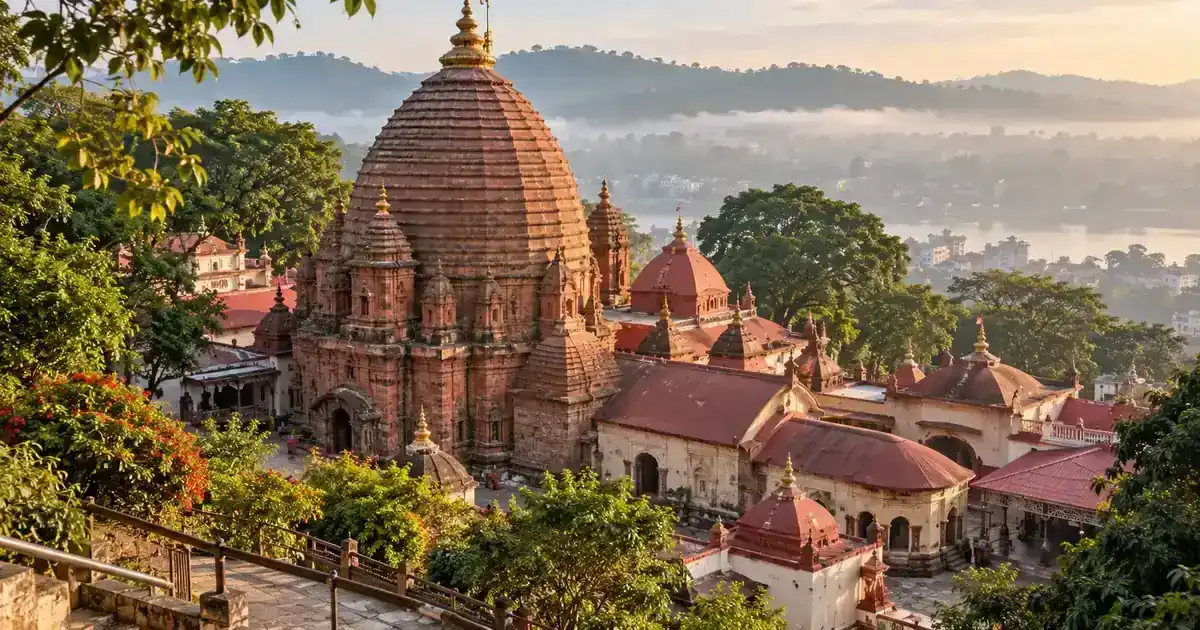
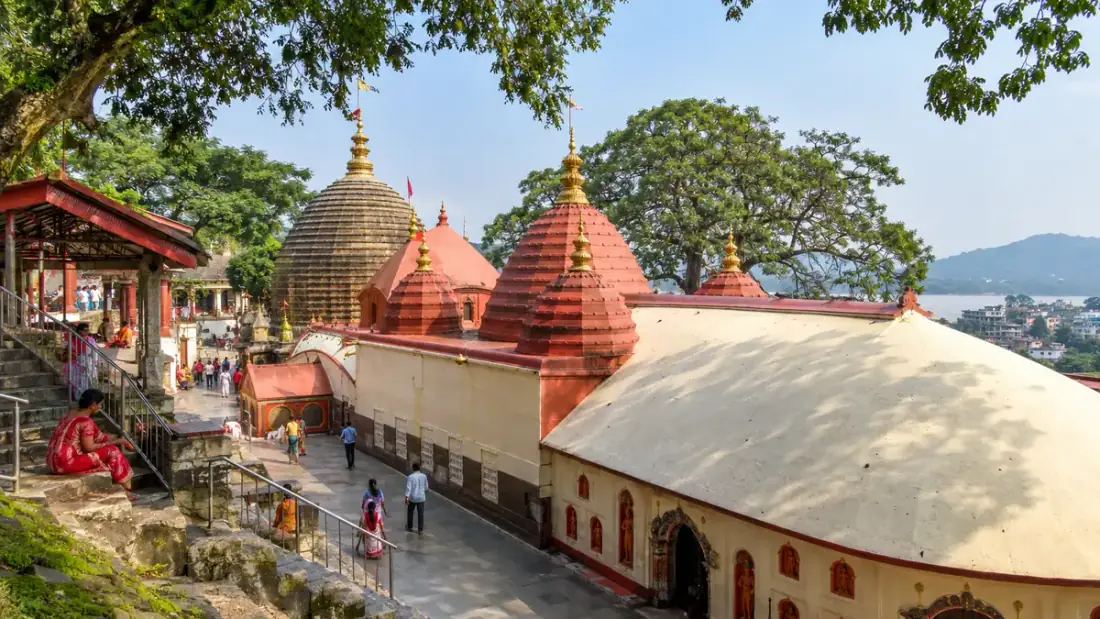
Maa Kamakhya Temple crowns the forested crest of Nilachal Hill in Guwahati, Assam, commanding wide views of the Brahmaputra River basin. Revered as the foremost among the 51 sacred Shakti Peethas of the subcontinent, this ancient sanctuary represents the supreme center of Tantric Shakta worship in India.
Unlike conventional Hindu temples centered on carved anthropomorphic statues, Kamakhya celebrates the primordial feminine creative energy (Shakti). The shrine attracts thousands of spiritual seekers, sadhus, and families each day, reaching tens of thousands during auspicious lunar festivals.
Because rituals inside the subterranean cave follow strict Tantric customs, planning your arrival hour, understanding pass quotas, and preparing for cave descent rules ensures a respectful pilgrimage.
Travelers exploring classical divine mother shrines across the subcontinent can connect this eastern seat with the Bhadrakali Shaktipeeth in Kurukshetra to understand regional variations in sacred geography.
Understanding Maa Kamakhya Devalaya: Foremost of 51 Shakti Peethas on Nilachal Hill
The theological significance of Kamakhya is deeply grounded in the Puranic legend of Goddess Sati and Lord Shiva. According to Hindu sacred history, following Sati’s self-immolation at Daksha’s sacrificial fire, a grief-stricken Shiva carried her corpse across the heavens in a cosmic dance of destruction (Tandava).
To restore cosmic equilibrium, Lord Vishnu released his Sudarshana Chakra to divide Sati’s physical form into 51 pieces. The reproductive organ and creative womb (Yoni) of the goddess fell upon Nilachal Hill (the Blue Mountain).
Consequently, the hill was recognized as the sacred Kamakhya Mahapitha, where the divine mother manifests as the creative matrix of all universal existence. The surrounding hill is believed to represent the body of Lord Shiva himself, turned blue with divine absorption.
The architectural profile of Kamakhya features a distinctive regional structural design known as the Nilachal architectural style. Originally built during the 8th to 9th centuries under the Kamarupa kingdom, the complex suffered destruction during medieval invasions before being rebuilt in 1565 CE by King Chilarai and King Naranarayana of the Koch dynasty.
The monument is distinguished by its beehive-shaped curvilinear dome (Shikhara) constructed from dense red sandstone blocks resting on a sculpted octagonal base. The exterior walls are decorated with relief sculptures depicting Hindu deities, dancing celestial maidens, and historical Koch royal patrons. Pilgrims timing their journeys across the Brahmaputra Valley during April or January can also partake in the cultural pageantry and folk dance celebrations of the Bihu Festival in Assam, which unites communities across the state.
Historical records, district preservation data, and conservation documentation can be consulted on the Kamrup Metropolitan District Administration Portal.
Inside the Subterranean Garbhagriha: Natural Spring and Yoni Pitha Darshan
The inner sanctum (Garbhagriha) of Kamakhya offers one of the most distinctive devotional encounters in the Hindu world. Located deep below the ground level of the assembly mandapa, the sanctum takes the form of a natural subterranean bedrock cave.
Devotees step off the main hall floor and descend down a steep, narrow flight of approximately twenty stone stairs into near-total darkness. The chamber is lit exclusively by flickering earthen oil lamps and glowing brass butter diyas tended by hereditary servitors.
In place of an idol, the focal point of the sanctum is the Matra Yoni. This is a smooth, natural cleft in the bedrock slab measuring roughly ten inches across, sloping gently downward into the earth.
A natural underground perennial spring continuously feeds water into this sacred stone fissure, keeping the rock perpetually cool, wet, and glistening. The water that flows from this subterranean spring is revered as Angodak (holy body nectar) and is believed by devotees to carry extraordinary purifying properties.
During the darshan procedure, pilgrims crouch low inside the stone chamber to touch the cool spring water flowing across the rock surface. Devotees offer fresh red hibiscus flowers, vermilion powder (sindoor), incense, and silk shawls directly upon the spring fissure before ascending back into daylight.
Because the subterranean cave is compact and oxygen levels are limited, temple priests maintain steady movement through the chamber, allowing each visitor several sacred moments before the spring.
Daily Darshan Schedule and Aarti Timings on Nilachal Hill
Kamakhya Temple follows an unbending daily liturgy that coordinates public darshan windows around morning cleansing and afternoon meal offerings.
| Daily Liturgical Milestone | Scheduled Timing | Primary Location | Visitor Access and Pilgrimage Significance |
|---|---|---|---|
| Snan and Nitya Puja | 5:30 AM to 6:30 AM | Subterranean Cave | Priests open inner doors; morning holy spring cleansing |
| Morning Darshan Window | 8:00 AM to 1:00 PM | Main Sanctum | General queue and VIP pass holders enter for cave darshan |
| Madhyanha Bhog (Afternoon Closure) | 1:00 PM to 2:30 PM | Inner Sanctum | Sanctum sealed; royal vegetarian meal offered to the Goddess |
| Afternoon Darshan Window | 2:30 PM to Sunset (~5:30 PM) | Main Sanctum | Darshan resumes until evening twilight |
| Sandhya Aarti | Sunset (~5:30 PM to 6:30 PM) | Assembly Mandapa | Grand evening lamp ceremony with drums and conch shells |
| Temple Gate Closure | 8:00 PM | Outer Complex | Compound gates locked for the night |
The temple doors remain strictly closed between 1:00 PM and 2:30 PM every afternoon while the Goddess receives her midday meal (Bhog). Visitors inside the queue complex during this period must wait patiently in the covered waiting corridors until the doors reopen.
Devotees who wish to attend the morning darshan should plan to arrive on Nilachal Hill before 6:30 AM to join the queue line. Travelers interested in southern Shakti Peetha traditions can explore our guide to the Bhramaramba Shakti Peetha at Srisailam.
Kamakhya Temple VIP Pass Booking: Rates, General Queue vs. Special Tickets
Because Kamakhya Temple welcomes thousands of devotees daily, navigating the entrance lines requires understanding the ticket tiers established by the Maa Kamakhya Devalaya Management Committee.
| Queue Category | Access Requirements | Typical Waiting Time | Devotee Guidance |
|---|---|---|---|
| General Free Line | Open to all pilgrims | 4 to 8 hours | Carry water and snacks; arrive before 6:30 AM |
| Defense / Police Line | Valid military or police ID card | 2 to 3 hours | Dedicated gate near office building |
| Special VIP Pass | ₹501 token at counter | 1.5 to 2.5 hours | Recommended for seniors and tight schedules |
1. The General Free Darshan Queue
General admission into Kamakhya Temple is completely free of charge. Devotees enter through broad iron-fenced waiting sheds equipped with ceiling fans, drinking water dispensers, and stone seating benches.
On standard weekdays, clearing the general queue to reach the subterranean cave takes between four and six hours. On Sundays, Tuesdays, and auspicious full-moon dates, the waiting time frequently extends up to eight hours or more.
Pilgrims utilizing the free line should carry snacks, water bottles, and essential medication to handle the extended waiting period comfortably.
2. The Special VIP Pass (₹501 Token System)
To provide a structured fast-track alternative for elderly pilgrims, travelers on tight flight connections, and out-of-state visitors, the temple administration issues a limited daily quota of Special Darshan Passes.
- Token Fee: The VIP pass fee is fixed at ₹501 per devotee, payable directly at the designated administrative ticket windows located near the temple office on the hill.
- Queue Experience: VIP ticket holders enter through a dedicated queue gate that bypasses the long public holding sheds, merging closer to the entrance of the subterranean descent.
- Average Waiting Time: VIP pass holders typically complete their cave darshan within 1.5 to 2.5 hours, representing a substantial time savings during busy periods.
Visitors should beware of unauthorized touts around the parking areas promising instant five-minute entry for inflated fees. All official passes must be obtained directly from authorized Devalaya counters displaying official receipts.
The Ten Tantric Wisdom Shrines: Exploring the Dasa Mahavidya Temples
While the central Kamakhya shrine commands the primary focus of visitors, Nilachal Hill is considered a complete sacred mandala containing the temples of the Dasa Mahavidyas (the Ten Great Wisdom Goddesses).
According to Shakta Tantric philosophy, these ten divine aspects represent the multifaceted expressions of cosmic feminine consciousness:
| Wisdom Divinity | Temple Location on Nilachal | Primary Spiritual Attribute |
|---|---|---|
| Maa Kali | Northeast ridge | Destroyer of time, ego, and mortal limitations |
| Maa Tara | East of main shrine | Bestower of compassion and spiritual salvation |
| Maa Shodashi (Tripura Sundari) | Inside central complex | Embodiment of supreme transcendent beauty |
| Maa Bhuvaneshwari | Highest hill crest | Sovereign ruler of the physical cosmos |
| Maa Bhairavi | Southern hillside | Victorious energy dispelling fear and darkness |
| Maa Chhinnamasta | Western rocky spur | Self-sacrificing supreme divine wisdom |
| Maa Dhumavati | Isolated forest grove | Ancient smoke goddess representing void and neutrality |
| Maa Bagalamukhi | North entrance path | Paralyzer of negative forces and deceit |
| Maa Matangi | Near Saraswati pond | Patron of arts, speech, music, and wisdom |
| Maa Kamala | Southern lake ridge | Manifestation of material and spiritual prosperity |
A complete circumambulation of Nilachal Hill takes pilgrims along shaded stone stairways connecting these ten peaceful subsidiary shrines.
Visiting the hilltop temple of Maa Bhuvaneshwari at the highest elevation of the hill offers sweeping panoramic viewpoints overlooking the sweeping horseshoe bend of the Brahmaputra River, particularly during the late afternoon.
The Sacred Ambubachi Mela: Monsoon Cycle, Raktavastra Cloth and Ritual Closures
The most famous annual celebration at Kamakhya is the Ambubachi Mela, celebrated during the Assamese month of Ahar (coinciding with the third week of June).
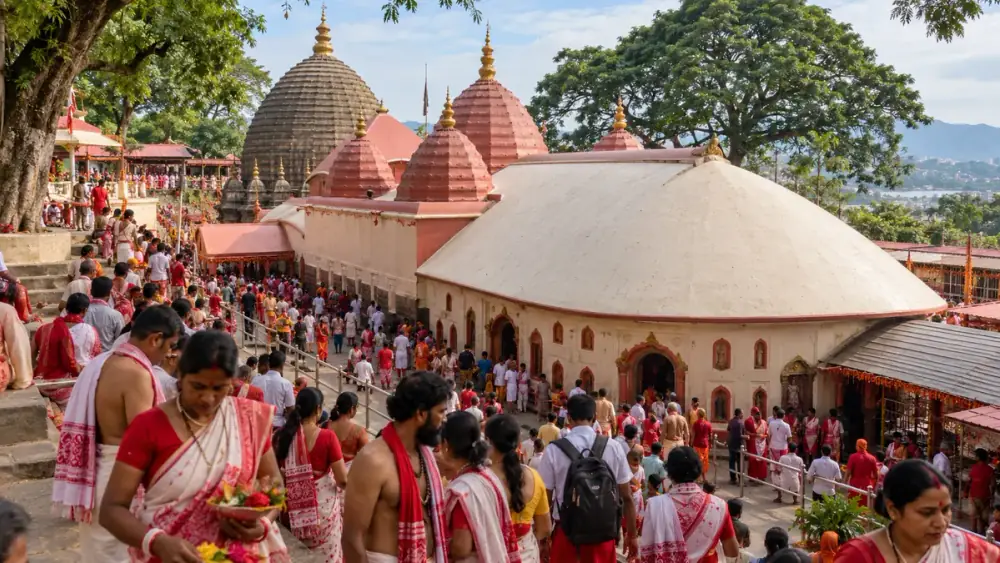
The festival marks the annual menstruation cycle of Mother Earth, synchronized with the arrival of heavy monsoon rains that replenish regional agriculture across the Brahmaputra valley.
The Four-Day Festival Cycle
The mechanics of Ambubachi Mela follow an ancient four-day schedule:
- Day 1 to Day 3 (Pravritti - Sacred Seclusion): The main temple doors are locked and sealed. The Goddess is believed to undergo her annual menstrual rest. During these three days, all temple worship, scripture reading, and agricultural plowing across the surrounding countryside are paused.
- Day 4 (Nivritti - Reopening & Purification): At dawn on the fourth morning, temple priests perform lavish purification ceremonies, bathing the subterranean spring rock with sacred waters and fresh herbs. The temple doors are unlocked amid jubilant conch blowing and celebration.
Distribution of the Consecrated Raktavastra Cloth
Before the doors are locked on the first day, priests drape a large white silk cloth across the subterranean stone fissure. When the sanctum is unlocked on the fourth day, the cloth is found soaked in a rich crimson hue, attributed to the divine red waters of the subterranean spring.
This sacred red fabric is cut into tiny individual strips known as Raktavastra (or Angabastra). Receiving a piece of this consecrated red cloth is considered immensely auspicious by pilgrims, who tie it around their right wrists or place it in their home prayer shrines as an emblem of divine protection and good fortune.
During Ambubachi Mela, over 400,000 pilgrims, Tantric practitioners, Naga sadhus, and Baul singers from across India pitch tents across the Nilachal hillside. For exact Pravritti door-closure dates, camp zones, and shuttle logistics, read our dedicated Ambubachi Mela guide. Those planning to attend should prepare for high humidity, muddy walking paths, and intense crowd congestion. Those interested in Eastern Himalayan religious celebrations can compare these monsoon rites with the monastic mask ceremonies featured in our guide to the festivals of Sikkim.
Visitor Etiquette, Dress Code and Sacrificial Viewing Protocols
Visiting Kamakhya Temple requires adherence to specific behavioral protocols to respect both the sacred environment and local traditions.
1. Mandatory Traditional Clothing
All pilgrims must wear modest Indian attire to clear the entrance security gates:
- Men: Dhotis or cotton pyjamas paired with kurtas. Formal full-length trousers with plain shirts are acceptable. Bermudas, cargo shorts, and sleeveless gym shirts are strictly barred.
- Women: Traditional sarees, salwar kameez with dupattas covering shoulders and chest, or modest ankle-length ethnic skirts. Western short dresses and ripped denim pants are turned away.
2. Electronic Devices and Footwear Rules
Footwear must be removed and stored at the authorized shoe counters situated at the base of the paved temple plaza.
While smartphones and cameras are permitted within the open outer plazas, photography and video recording are strictly prohibited inside the inner assembly halls and the subterranean Garbhagriha. Using mobile phones inside the cave carries immediate expulsion by temple security.
3. Understanding Sacrificial Protocols (Boli Shala)
In accordance with ancient Shakta traditions, ceremonial animal sacrifices (principally goats and pigeons) are performed at Kamakhya by dedicated servitors.
- The sacrificial area, known as the Boli Shala, is located in a separate walled courtyard positioned to the side of the main complex.
- These rites are conducted away from the main public darshan lines. Visitors who prefer not to witness animal rituals can easily bypass this courtyard entirely without any impact on their temple visit.
- Devotees who wish to offer vegetarian symbolic offerings can present ash gourds, sugarcane stalks, or sweet fruits at the central mandap.
Travelers interested in comparing western Indian temple traditions can examine our guide to the ancient Shakti Peetha of Mahalaxmi Temple in Kolhapur.
How to Reach Kamakhya Temple: Flights to GAU, Express Trains & Hill Road Transit
Guwahati functions as the principal transportation gateway to Northeast India, providing robust multimodal connectivity.
Reaching Kamakhya by Air
The nearest commercial airport is Lokpriya Gopinath Bordoloi International Airport (IATA Code: GAU), situated approximately 20 kilometers west of Nilachal Hill in Borjhar.
Guwahati Airport handles frequent non-stop domestic flights connecting directly to New Delhi, Kolkata, Mumbai, Bengaluru, Chennai, and Hyderabad. Direct international flights also connect Guwahati with regional destinations.
From Guwahati Airport, travelers can hire government-authorized prepaid taxis or app-based cabs directly to Nilachal Hill. The drive takes approximately 45 to 60 minutes along National Highway 17. Expect taxi fares between ₹600 and ₹900 for an air-conditioned hatchback or sedan.
Reaching Kamakhya by Train
Guwahati is served by two major railway hubs on the Northeast Frontier Railway network:
- Kamakhya Junction (Station Code: KYQ): Situated just three kilometers from the base of Nilachal Hill. Many major express trains terminate or stop here, making it the most convenient railhead for arriving pilgrims.
- Guwahati Railway Station (Station Code: GHY): The central terminal located seven kilometers east of the temple, offering direct train connectivity to every major Indian metropolis.
Prominent express rail services connecting to Guwahati include:
- New Delhi to Guwahati Vande Bharat Express / Rajdhani Express: Fast long-distance express connections linking the national capital with Assam.
- Saraighat Express (Train No. 12345 / 12346): Legendary daily express connecting Howrah (Kolkata) with Guwahati in 17 hours. Many pilgrims explore Bengal’s riverside temples featured in our Dakshineswar Kali Temple and Belur Math guide before boarding trains to Assam.
- Northeast Express: Daily service linking Anand Vihar Terminal in Delhi directly to Kamakhya Junction.
Train tickets can be booked through the official IRCTC portal. Pre-paid auto-rickshaws and taxis wait outside both railway stations.
Ascending Nilachal Hill Road
From the base of Nilachal Hill along the main highway, a well-engineered four-kilometer paved ghat road winds smoothly up to the temple plaza.
Travelers can ascend the hill using shared auto-rickshaws, city app cabs, or state-run ASTC minibuses that depart every 10 minutes from the hill base. Energetic pilgrims can also ascend the historic stone staircase (Mekhela Ujowa Path), climbing approximately 800 stone steps constructed by medieval Koch kings.
Travelers exploring broader national circuits can examine our directory of the best places to visit across India, or continue south from Guwahati into the pine-covered highlands with our 5-day places to visit in Meghalaya itinerary. Those planning a comprehensive state journey can consult our complete key details for Assam or journey northwest to track golden langurs via our Manas National Park safari guide.
For updated state tourism circuits, destination maps, and cultural schedules, consult the official Incredible India Guwahati Portal.
Frequently Asked Questions About Kamakhya Temple
What are the daily darshan timings at Kamakhya Temple?
The temple gates open at 5:30 AM for morning snan, with public darshan running from 8:00 AM to 1:00 PM and 2:30 PM until sunset prayer (~5:30 PM). The temple is completely closed between 1:00 PM and 2:30 PM for afternoon bhog offerings.
How much does the VIP pass cost at Kamakhya Temple?
The Special VIP Darshan Pass costs ₹501 per devotee and can be purchased at authorized Devalaya ticket counters on the hill. The VIP pass provides access through a separate queue that reduces waiting times from up to eight hours down to roughly two hours.
What is enshrined inside the inner sanctum of Kamakhya Temple?
The subterranean sanctum contains no carved idol or statue. Instead, it enshrines the sacred Matra Yoni, a natural stone fissure in the bedrock kept continuously moist by an underground perennial spring.
When does the Ambubachi Mela take place?
Ambubachi Mela takes place annually in mid-June during the monsoon season. The temple remains completely closed for three days during the Goddess’s seclusion before reopening on the fourth morning with the distribution of sacred Raktavastra cloth.
What clothing is required to enter Kamakhya Temple?
Visitors must wear modest Indian traditional clothing such as dhotis or pyjamas with kurtas for men, and sarees or salwar suits for women. Western shorts, sleeveless shirts, and mini-skirts are strictly prohibited.
Which other Eastern India Shakti Peetha pairs with Kamakhya?
Pilgrims touring sacred Shakta shrines in Eastern India frequently pair Kamakhya with the Hridaya Peetha (heart shrine) of Sati at Baba Baidyanath Dham in Jharkhand, detailed in our visiting Baidyanath Dham Deoghar.