Tirumala Brahmotsavam: Dates, Garuda Seva & Gallery Rules
Complete guide to Tirumala Brahmotsavam and Garuda Seva covering nine-day vahana schedules, Mada Street gallery entry, ghat road bans, and TTD darshan rules.
Perched high among the sacred Seven Hills of the Seshachalam range in southern Andhra Pradesh, the temple town of Tirumala hosts one of the greatest devotional spectacles on earth. Every autumn, millions of pilgrims climb the sacred mountain to observe tirumala brahmotsavam dates garuda seva rules, participating in nine continuous days of celestial pageantry.
The festival honors Lord Venkateswara through elaborate morning and evening processions across the Four Mada Streets. On the fifth evening, the sacred Garuda Seva gathers over four hundred thousand devotees in a continuous chorus of holy chants.
Managing this immense pilgrimage requires careful logistical planning around ghat road curfews, two-wheeler bans, and gallery entry rules. With TTD suspending all privileged darshans during the festival, this guide details everything needed for a smooth pilgrimage.
Key Festival Highlights at a Glance
- Sacred Sanctuary: Sri Venkateswara Swamy Temple atop Tirumala Hills, Andhra Pradesh.
- Festival Scope: Nine full days of dual-session vahana processions around the Four Mada Streets.
- Peak Event: Garuda Seva on the fifth evening, running from 7:00 PM until midnight.
- Universal Access: Completely free gallery seating; all paid and VIP tickets are suspended.
- Ghat Road Curfew: Mandatory 24-hour ban on two-wheelers during Garuda Seva operations.
What to Expect at Srivari Brahmotsavam in Tirumala
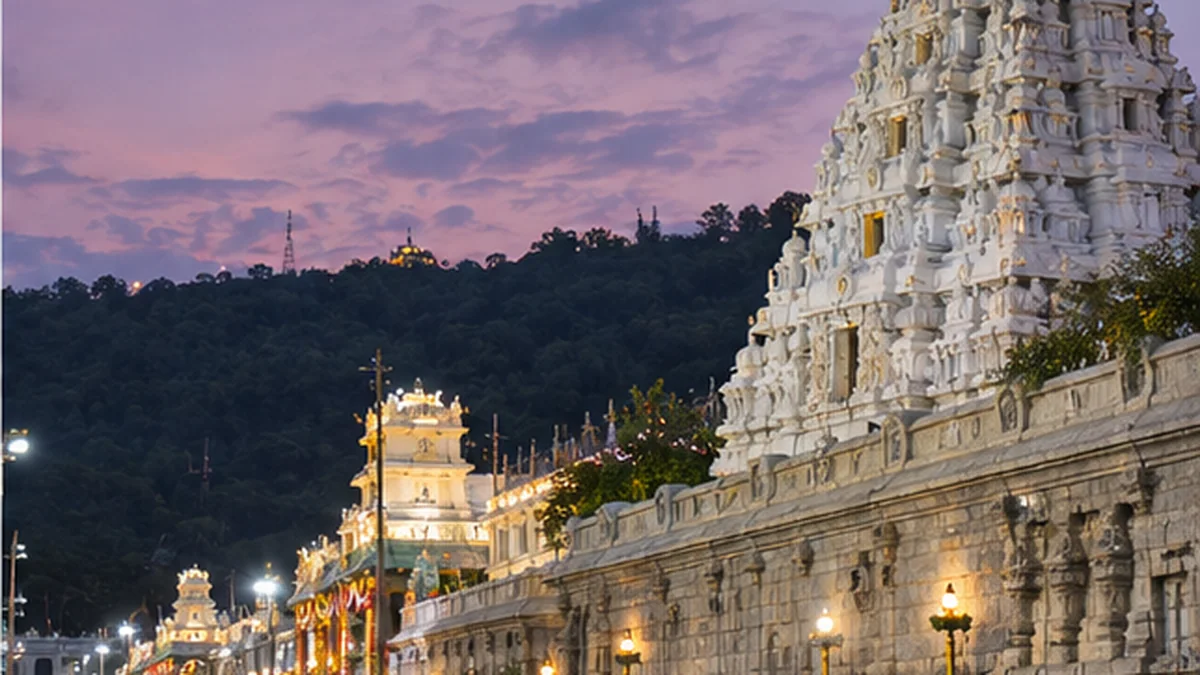
Srivari Brahmotsavam is the grandest nine-day annual celebration at the Sri Venkateswara Temple in Tirumala. The processional deity Malayappa Swamy rides ornate divine carriers (vahanams) twice daily around the four Mada Streets, bestowing direct public darshan upon millions of assembled pilgrims.
The festival converts the hilltop township into a center of continuous religious worship. The streets surrounding the gold-plated Ananda Nilayam sanctum echo with Vedic chanting, Nadaswaram music, and temple drum rhythms.
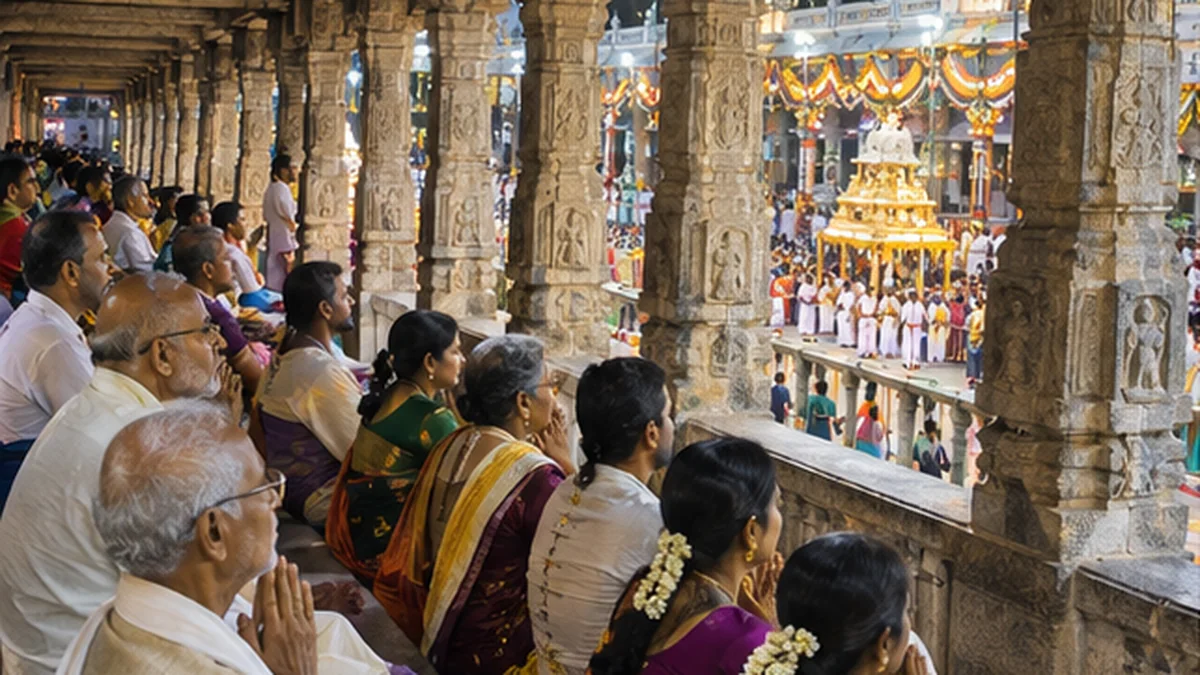
Unlike standard temple visits where pilgrims spend hours moving through indoor queue complexes for a brief second before the deity, Brahmotsavam brings God outside to the people. Devotees seated along the wide stone galleries can view the Lord in open daylight and under illuminated evening skies.
Celestial Origins: Lord Brahma’s Inaugural Nine-Day Festival
According to the Brahma Purana, Lord Brahma first conducted this nine-day festival to thank Lord Srinivasa for protecting mankind in the Kali Yuga, naming the celebration Brahmotsavam in honor of its cosmic creator.
Scriptures record that Brahma descended to the Venkatadri hills to conduct the inaugural ceremony under the auspicious Shravana star. The festival acts as a terrestrial recreation of that primeval cosmic worship.
Every year, temple priests place an empty chariot at the head of the processions, symbolizing the invisible presence of Lord Brahma leading the celebrations. To understand the wider religious context of this hilltop shrine, explore our comprehensive Tirumala Tirupati Balaji Temple guide.
Salakatla vs Navaratri Brahmotsavam: Twin Annual Cycles
Salakatla Brahmotsavam is the standard annual festival held in September. During an Adhika Masa (intercalary lunar leap month occurring every three years), TTD conducts a second nine-day festival called Navaratri Brahmotsavam in October.
The regular Salakatla Brahmotsavam features the traditional chariot procession (Rathotsavam) on day eight and opens with formal flag hoisting (Dwajarohanam). It remains the primary festival celebrated every single year.
When an intercalary month occurs in the Hindu lunar calendar, the Navaratri Brahmotsavam follows one month later without Dwajarohanam, utilizing the golden chariot (Swarna Rathotsavam) instead. Both festivals draw colossal crowds from across southern India.
Tirumala Brahmotsavam Dates, Vahana Schedule & Garuda Seva
The nine-day festival features daily morning processions from 8:00 AM to 10:00 AM and evening processions from 7:00 PM to 9:00 PM. Sacred highlights include Dwajarohanam on day one, Garuda Seva on night five, Rathotsavam on day eight, and Chakrasnanam on day nine.
Each carrier represents a distinct spiritual attribute or celestial vehicle mentioned in Vaishnavite scriptures. The morning carriers generally symbolize solar vitality and divine wisdom, while evening vahanams emphasize royal majesty and cosmic protection.
Pilgrims who plan to attend multiple days should study the carrier schedule closely. Knowing which deity carrier appears on each date helps families choose which morning or evening sessions to attend.
| Festival Day | Morning Procession (8:00 AM – 10:00 AM) | Evening Procession (7:00 PM – 9:00 PM) | Scriptural Significance |
|---|---|---|---|
| Day 1 | Dwajarohanam (Flag Hoisting ritual) | Pedda Sesha Vahanam (Seven-headed Serpent) | Cosmic serpent Adisesha serving the Lord |
| Day 2 | Chinna Sesha Vahanam (Five-headed Serpent) | Hamsa Vahanam (Celestial White Swan) | Embodiment of pure knowledge and discernment |
| Day 3 | Simha Vahanam (Divine Lion Carrier) | Muthyapu Pandiri (Canopy of Pure Pearls) | Royal courage and calming pearl radiance |
| Day 4 | Kalpavriksha Vahanam (Wish-Fulfilling Tree) | Sarvabhoopala Vahanam (Universal Kings) | Lord fulfilling desires and ruling creation |
| Day 5 | Mohini Avataram (Cosmic Illusion Form) | Garuda Seva (Golden Eagle, 7 PM – 12 AM) | Supreme climax of Brahmotsavam pageantry |
| Day 6 | Hanumantha Vahanam (Devoted Servant) | Gaja Vahanam (Grand Celestial Elephant) | Supreme devotion and royal wealth |
| Day 7 | Surya Prabha Vahanam (Radiant Sun Disc) | Chandra Prabha Vahanam (Cool Moon Disc) | Solar energy balance and peaceful lunar rest |
| Day 8 | Rathotsavam / Swarna Ratham (Wooden Chariot) | Aswa Vahanam (Majestic War Steed) | World cycle turnover and Kalki anticipation |
| Day 9 | Chakrasnanam (Holy Lake Immersion) | Dwajavarohanam (Flag Lowering Ceremony) | Sins purified in Swami Pushkarini; festival concludes |
Morning and Evening Vahana Processions Across Nine Days
Malayappa Swamy processes on majestic carriers including Pedda Sesha, Chinna Sesha, Hamsa, Simha, Muthyapu Pandiri, Kalpavriksha, Sarvabhoopala, Surya Prabha, and Chandra Prabha, each symbolizing a cosmological realm.
Each morning, the carrier is decorated with fragrant flowers, jasmine garlands, and gold ornaments inside the temple complex. Priests lift the palanquin onto the shoulders of dozens of trained temple carriers who march in step.
The evening sessions feature grand illuminations, with decorative electric arches lighting the entire perimeter of the Mada Streets. To plan broader travel routes connecting historical sites across the region, read our complete Andhra Pradesh state travel guide.
Flag Hoisting (Dwajarohanam) and Sacred Bath (Chakrasnanam)
The festival opens with Dwajarohanam, raising the Garuda flag atop the golden mast to invite thirty-three crore devatas. It concludes on day nine with Chakrasnanam, when the Sudarshana Chakra is bathed in Swami Pushkarini lake.
During Dwajarohanam on the first evening, high priests chant Vedic mantras to summon celestial beings to witness the festivities. The consecrated cloth bearing the image of Garuda is hoisted to the top of the Dwajasthambam.
On the final morning, the processional idol of Sudarshana Chakra undergoes sacred holy bathing in the Swami Pushkarini lake. Thousands of pilgrims dive into the holy waters simultaneously, believing the sacred dip cleanses lifetimes of sins.
The Fifth Night: Golden Garuda Vahanam Procession Protocols
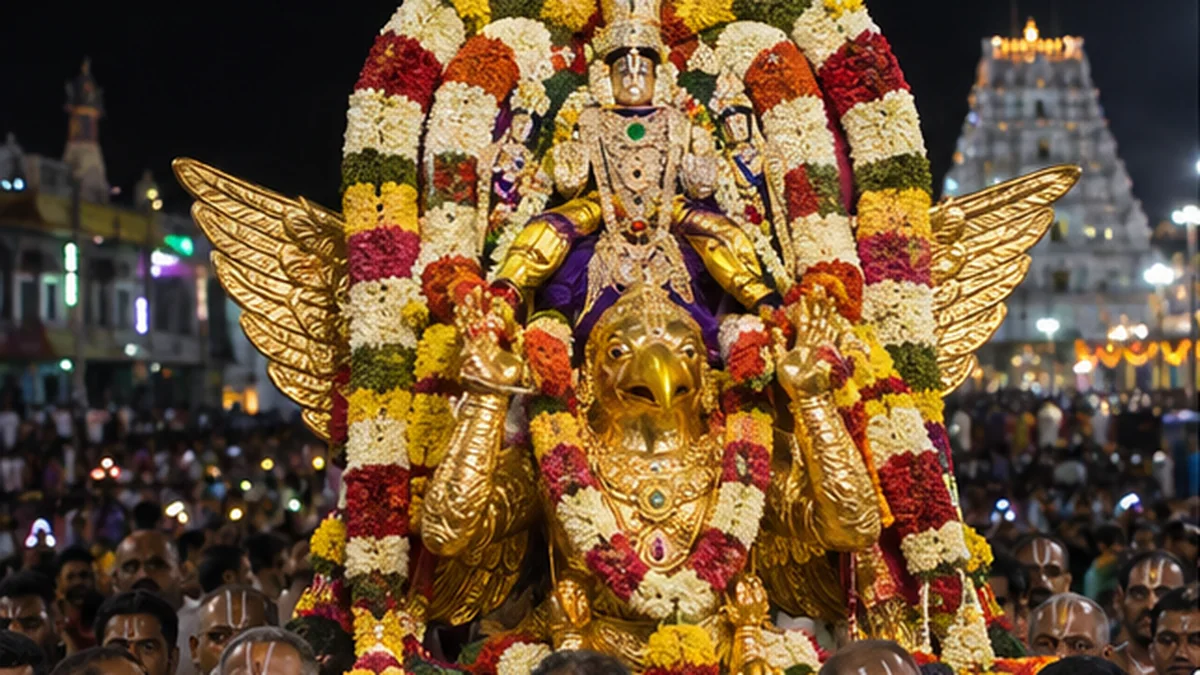
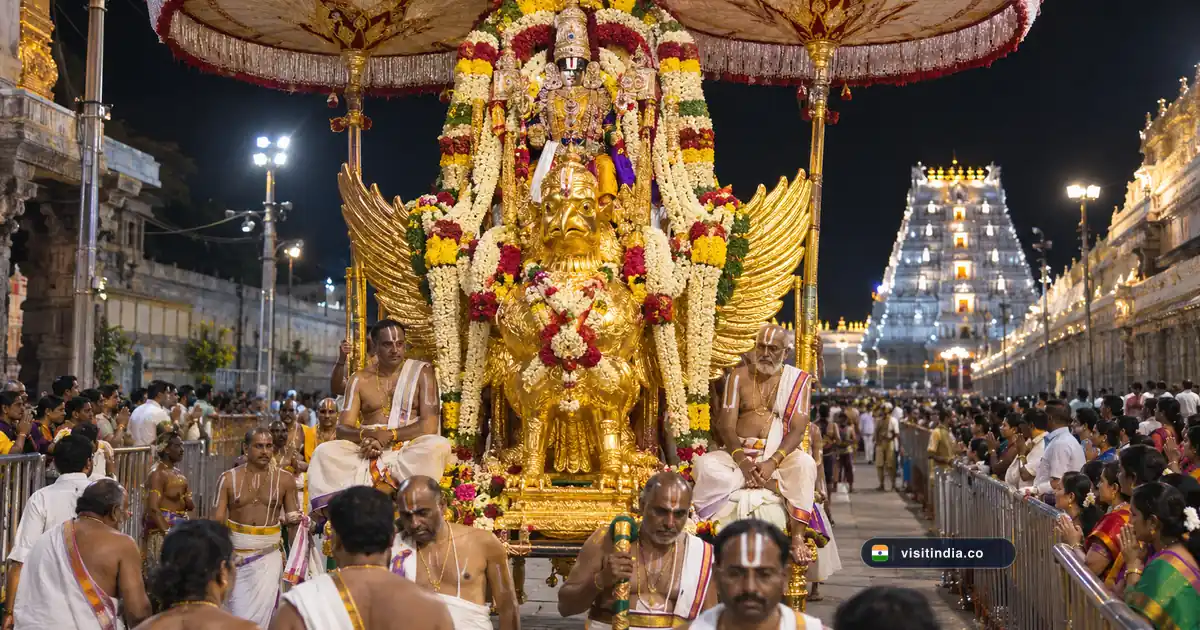
Garuda Seva on the fifth night represents the spiritual climax of Brahmotsavam. Lord Malayappa Swamy rides his favorite celestial eagle carrier (Garuda), adorned with ancient sacred jewels including the Makarakanti necklace and the Lakshmi Kasula Haram, circling the Mada Streets until midnight.
Garuda is revered as the foremost devotee and celestial mount of Lord Vishnu. Seeing the Lord mounted on the golden shoulders of Garuda is believed to grant salvation and freedom from worldly rebirth.
Over four hundred thousand pilgrims gather inside the Mada Street galleries to witness this single procession. The energy reaches a peak when the procession emerges from the temple tower into open view.
Note
On Garuda Seva night, the procession moves at an intentionally measured pace for five full hours (7:00 PM to 12:00 AM midnight), giving every spectator in the Four Mada Street galleries an uninterrupted darshan.
Divine Adornments: Makarakanti, Sahasranama Haram & Lakshmi Kasula Haram
Exclusively on Garuda Seva night, the deity wears the priceless diamond Makarakanti necklace and the thousand-coin Lakshmi Kasula Haram brought from the inner sanctum. These ancient heirlooms reflect dazzling light across the night procession.
The Makarakanti is an antique gold collar set with uncut Burmese rubies, emeralds, and diamonds. It is kept locked in the temple treasury under armed guard throughout the remainder of the year.
The processional deity is also adorned with the massive Lakshmi Kasula Haram, a heavy gold necklace containing over one thousand gold coins embossed with Goddess Lakshmi. If combining your visit with southern Shiva shrines, consult our Srikalahasti Temple Rahu Ketu guide.
Midnight Procession Timeline and Govinda Chants Across the Mada Streets
Beginning at 7:00 PM at the main temple gopuram, the massive golden carrier glides slowly along the four Mada Streets for five hours. Hundreds of thousands of devotees chant Govinda Govinda in unison, creating an electric devotional atmosphere.
The procession pauses at each corner of the Mada Streets to allow priests to offer Harati lamps and read sacred hymns. The chanting of Govinda rolls across the mountain like thunder.
Devotees wave camphor lamps and fold their hands in prayer as the deity passes. By the time Malayappa Swamy returns to the main temple gate at midnight, the entire hillside has shared in an unforgettable spiritual vigil.
Four Mada Streets Gallery Access, Free Entry & Seating Rules
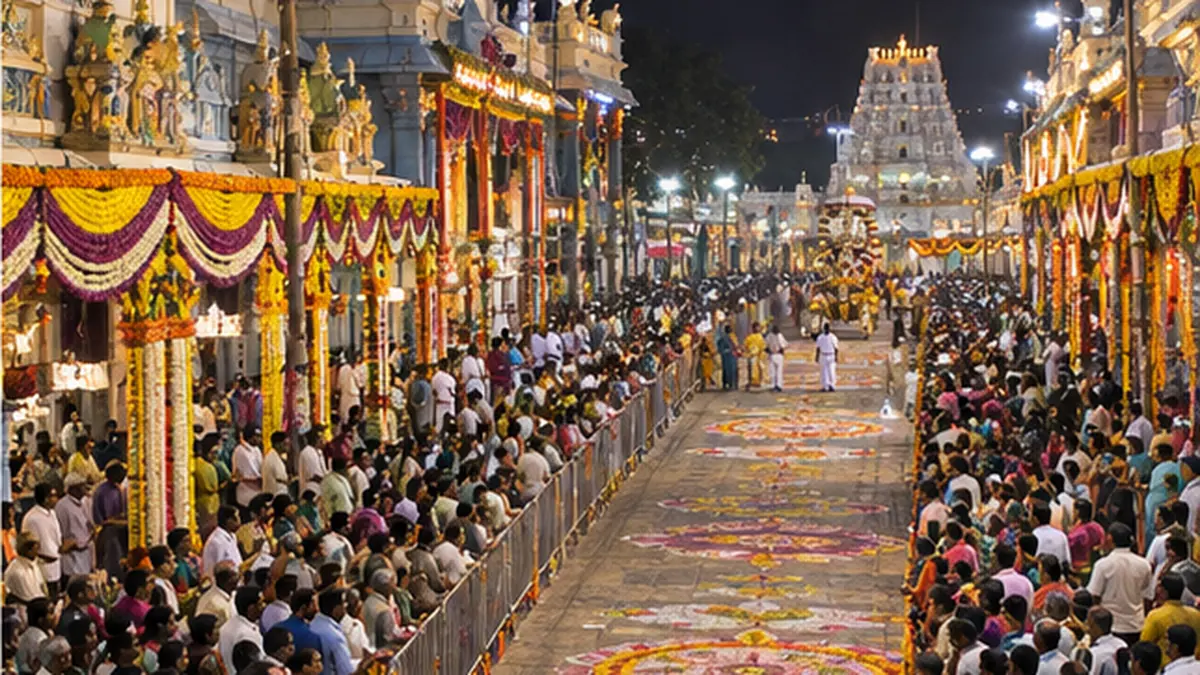
The Four Mada Streets feature tiered steel galleries accommodating over 200,000 spectators completely free of charge. Entry begins through designated security gates from early morning, with galleries filling completely by 2:00 PM, five hours before the procession starts.
TTD constructed these modern galleries to provide safe, comfortable viewing for immense crowds without the risk of stampedes. The galleries are divided into secure fenced sectors with dedicated entry and exit turnstiles.
Entry into the galleries is entirely free and open to all pilgrims without any reservation tickets. However, securing a seated spot on Garuda Seva day requires arriving early in the morning.
| Mada Street Sector | Seating Capacity | Primary Gate Access Points | Best Viewing Angle |
|---|---|---|---|
| North Mada Street | ~55,000 seats | Gates 1 to 4 near Varahaswamy Temple | Direct frontal view as carrier turns corner |
| South Mada Street | ~60,000 seats | Gates 5 to 8 near Old Annaprasadam | Wide panoramic view of illuminated galleries |
| East Mada Street | ~45,000 seats | Gates 9 to 11 near Main Temple Tower | Departure & return point of procession |
| West Mada Street | ~50,000 seats | Gates 12 to 14 near Akhilandam | Close-up vantage as carriers pause for Harati |
Gallery Capacity, Gate Numbers, and Lock-in Protocols
Galleries on the North, South, East, and West Mada Streets have dedicated entry turnstiles. Once seated, gates are locked for crowd safety, meaning pilgrims must remain inside their assigned sector until the procession passes.
Security personnel count incoming devotees through automated turnstiles. Once a sector reaches capacity, its gates are closed and arriving pilgrims are directed to subsequent sectors.
Because the gates lock once full, devotees cannot leave and return to their seats. Restroom complexes and drinking water taps are built directly inside each gallery sector to accommodate extended stays. For travelers exploring major spiritual circuits across South India, review our Pancha Bhuta Sthalams circuit guide.
Continuous Distribution of Annaprasadam, Milk, and Drinking Water
To sustain seated devotees through ten-hour waits, thousands of TTD Srivari Sevak volunteers distribute hot sambar rice, sweet pongal, buttermilk, baby milk, and water packets directly down each gallery row throughout the day.
Volunteers walk down the aisles every twenty minutes carrying stainless steel buckets of wholesome food. Devotees receive warm meals served directly into their hands on biodegradable leaf plates.
Medical first-aid teams walk through the aisles equipped with oral rehydration salts, glucose packets, and basic medications. This continuous care allows elderly pilgrims and families with young children to wait comfortably.
Ghat Road Curfews, Two-Wheeler Bans & Transit Logistics
To prevent catastrophic traffic bottlenecks and mountain accidents, TTD enforces a strict 24-hour two-wheeler ban on both Tirumala Ghat Roads starting from noon on the eve of Garuda Seva. All pilgrims must travel exclusively via APSRTC public buses or four-wheeled taxis.
The two engineered mountain ghat roads handle extraordinary traffic volumes during the festival week. Allowing thousands of motorcycles to weave between heavy buses on steep curves creates severe hazards.
Pedestrian walking paths along Alipiri Mettu and Srivari Mettu remain open around the clock for walkers. Walking the steps is one of the most reliable ways to ascend the mountain when vehicular traffic slows.
| Transit Parameter | Official TTD Regulation | Practical Advice for Travelers |
|---|---|---|
| Two-Wheeler Ghat Ban | Completely barred from 12:00 PM Day 4 to 12:00 PM Day 6 | Park two-wheelers at Alipiri foothill parking lots |
| Four-Wheeler Access | Permitted with strict 28-min uphill speed limit | Heavy delays likely; prefer public APSRTC buses |
| APSRTC Ghat Bus Fleet | Over 500 electric/diesel buses running every 30 seconds | Board at Tirupati Railway Station or Central Bus Stand |
| Alipiri Footpath | Open 24 hours continuously during Brahmotsavam | 9 km trek (3.5 to 4.5 hours); free luggage transport |
| Srivari Mettu Footpath | Open 6:00 AM to 6:00 PM daily | 2.1 km trek (1.5 to 2.5 hours); faster stone stairs |
Complete Two-Wheeler Ghat Road Ban on Garuda Seva Day
Motorcycles and scooters are prohibited from ascending or descending the ghat roads from 12:00 PM on the 4th day until 12:00 PM on the 6th day. Security personnel enforce mandatory vehicle parking at Alipiri foothill lots.
Extensive paid parking lots are set up at the foot of the hill in Alipiri. Riders can park their two-wheelers in secure monitored bays before boarding an APSRTC bus up the mountain.
Traffic police turn away any two-wheeler attempting to enter the toll booths. For official district transport alerts and tourist services, refer to the Tirupati District Administration Tourism Directory.
APSRTC Electric Bus Fleet Operations from Tirupati Station
APSRTC operates a continuous fleet of over 500 electric and diesel buses departing every thirty seconds from Tirupati Railway Station and central bus stand, transporting over 300,000 passengers uphill in round-the-clock rotations.
The bus corporation establishes special barricaded passenger boarding lanes outside Tirupati Main Railway Station. Buses fill up and depart without waiting, maintaining an uninterrupted chain of transport up the mountain.
Round-trip tickets can be booked directly at the bus counters or online through the APSRTC Online Ghat Bus Reservation Portal. If planning onward high-speed rail connections across Andhra Pradesh, review our guide to Vande Bharat Express tourist routes.
Darshan Realities: VIP Privilege Suspensions and Sarva Darshan
TTD completely suspends all privileged darshan channels, including ₹300 Seeghra Darshan, infant privileges, senior citizen quotas, and donor break darshans during Brahmotsavam. The sanctum remains exclusively dedicated to general Sarva Darshan free queues.
This egalitarian policy ensures that the limited hours available for sanctum entry are given entirely to common pilgrims who have waited in long lines. No special recommendation letters or paid tickets are entertained by temple authorities.
Waiting times for sanctum darshan in the Vaikuntham Queue Complex can range between twenty-four and thirty-six hours during peak days. Many visitors choose to focus entirely on watching the outdoor vahana sevas rather than enduring the grueling indoor sanctum line.
Pro Tip
Do not attempt to secure indoor sanctum darshan on Garuda Seva day unless you are prepared for a 30-hour queue wait. Watching the Lord process around the Mada Streets offers an equally auspicious darshan with far greater comfort.
Complete Cancellation of Privileged & Paid Darshan Slots
To maximize sanctum access for ordinary pilgrims who travel across the subcontinent, no paid tickets are sold. Waiting times in the Vaikuntham Queue Complex frequently exceed 24 to 36 hours during the nine-day window.
TTD issues clear public notifications weeks in advance announcing the total cancellation of VIP break darshan and online quotas. Donors, politicians, and temple officials must all follow standard protocol.
The entire queue system is operated on a first-come, first-served basis. Devotees receive free food, milk, and medical checks inside the waiting compartments of the Vaikuntham Queue Complex.
Crowd Survival Tips: Footwear, Cash, and Mobile Lockers
Leave mobile phones and luggage in foothill lockers at Tirupati town before taking the ghat bus. Wear simple traditional attire, carry minimal cash, and keep emergency medicines on your person inside the crowded galleries.
Mobile phones and electronic items are strictly prohibited inside the inner temple complex. While free locker counters exist in Tirumala, retrieving devices from lockers after Garuda Seva can take several hours due to massive return lines.
Dress in modest traditional cotton clothing: dhotis or kurtas for men, and sarees or salwar kameez for women. For official state tourism information, check the Incredible India Tirupati Travel Portal.
Frequently Asked Questions About Tirumala Brahmotsavam
Direct answers to common questions regarding Tirumala Brahmotsavam dates, Garuda Seva timings, ghat road bans, and tickets.
When does the annual Srivari Brahmotsavam take place at Tirumala?
Srivari Brahmotsavam takes place annually for nine days during September or October, aligning with the Hindu lunar months of Bhadrapada or Ashwayuja. Exact dates are officially confirmed by Tirumala Tirupati Devasthanams (TTD) several months in advance.
Can tourists book VIP or ₹300 Seeghra Darshan tickets during Brahmotsavam?
No, TTD strictly suspends all paid ₹300 Seeghra Darshan tickets, VIP break privileges, and senior citizen quotas throughout the nine days. The sanctum remains exclusively open to pilgrims in the general free Sarva Darshan queue.
Do I need a ticket to watch the Garuda Seva procession in the Mada Streets?
No, viewing the Garuda Seva procession from the Four Mada Street galleries is completely free and open to all pilgrims without tickets. However, visitors must arrive at the gallery gates early in the morning as seats fill completely by early afternoon.
Are two-wheelers allowed on Tirumala Ghat Road during Garuda Seva?
No, TTD enforces a mandatory 24-hour ban on motorcycles and scooters on both ghat roads surrounding the day of Garuda Seva. All travelers must use official APSRTC buses, authorized four-wheelers, or walk the pedestrian footpaths.
What time does the Garuda Seva procession start and finish?
The sacred Garuda Seva begins at 7:00 PM on the fifth evening as the processional deity exits the main temple tower. The procession glides along the Four Mada Streets for five hours, concluding around 12:00 AM midnight.
What facilities are provided to pilgrims waiting in the Mada Street galleries?
TTD Srivari Sevak volunteers provide continuous free distribution of hot Annaprasadam meals, drinking water packets, buttermilk, and baby milk directly to seated pilgrims. Medical first-aid stations and clean sanitation facilities operate inside each gallery sector.