Triveni Sangam Prayagraj: Timings, Boat Fares & Holy Snan
Explore Triveni Sangam in Prayagraj, the sacred meeting point of the Ganga, Yamuna, and Saraswati. Find boat fares, snan rituals, timings, and temples.
Triveni Sangam in Prayagraj is revered across the Indian subcontinent as Tirtharaj Prayag, the monarch of all sacred pilgrimage destinations. Situated at the southeastern edge of the ancient city, this holy delta marks the geographical confluence of three venerated rivers: the Ganga, the Yamuna, and the subterranean Saraswati. For millennia, Hindu scriptures have celebrated this junction as the supreme location for ceremonial purification and liberation.
Every winter, millions of pilgrims, ascetics, and spiritual seekers gather along the expansive sandbanks of the Sangam. The vast floodplains serve as the traditional arena for the cyclic Maha Kumbh Mela congregation and the annual month-long Magh Mela. Visiting the confluence provides an immediate encounter with India’s living Vedic ritual heritage.
Key Confluence Highlights
- The Confluence: Meeting of the sacred Ganga, Yamuna, and invisible Saraswati rivers.
- Primary Pilgrimage Activity: Mid-river purification bath (Sangam Snan) conducted from wooden platforms.
- Access and Admission: Open 24 hours daily with free public entry to all riverbank ghats.
- Key Nearby Shrines: Bade Hanuman Mandir, Patalpuri Temple, and the sacred Akshaya Vat banyan tree.
- Official Heritage Guide: Published by the Uttar Pradesh Tourism Triveni Sangam Destination Guide.
- Administrative Authority: Monitored through the District Administration Prayagraj Sangam Heritage Overview.
Hydrography and Spiritual Symbolism of the Three Rivers
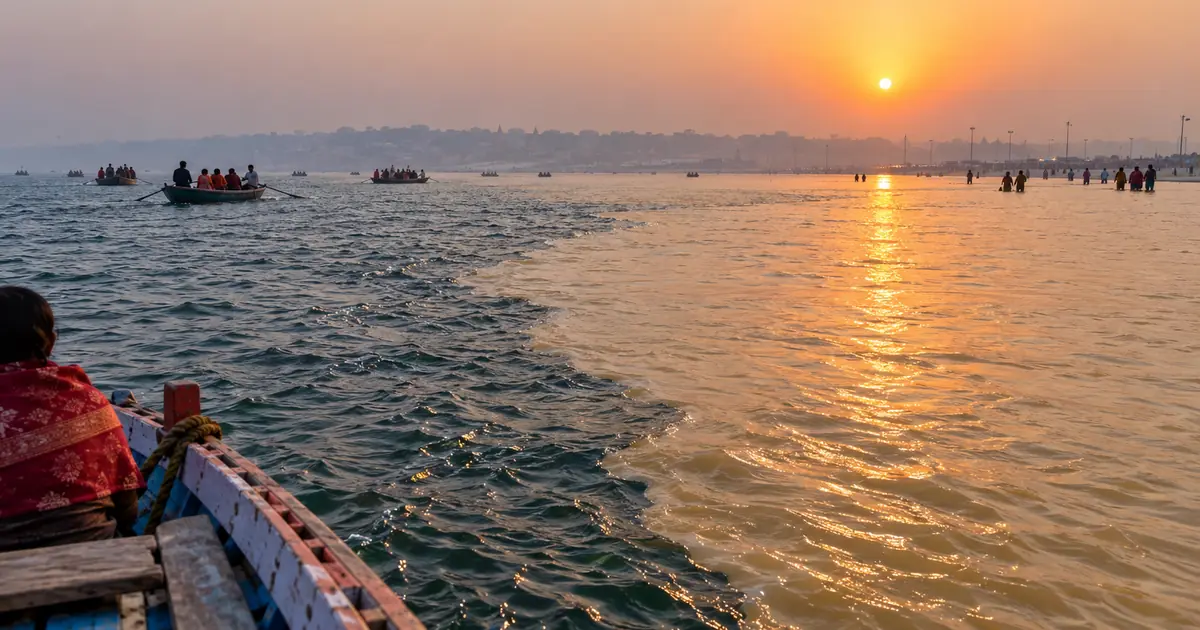
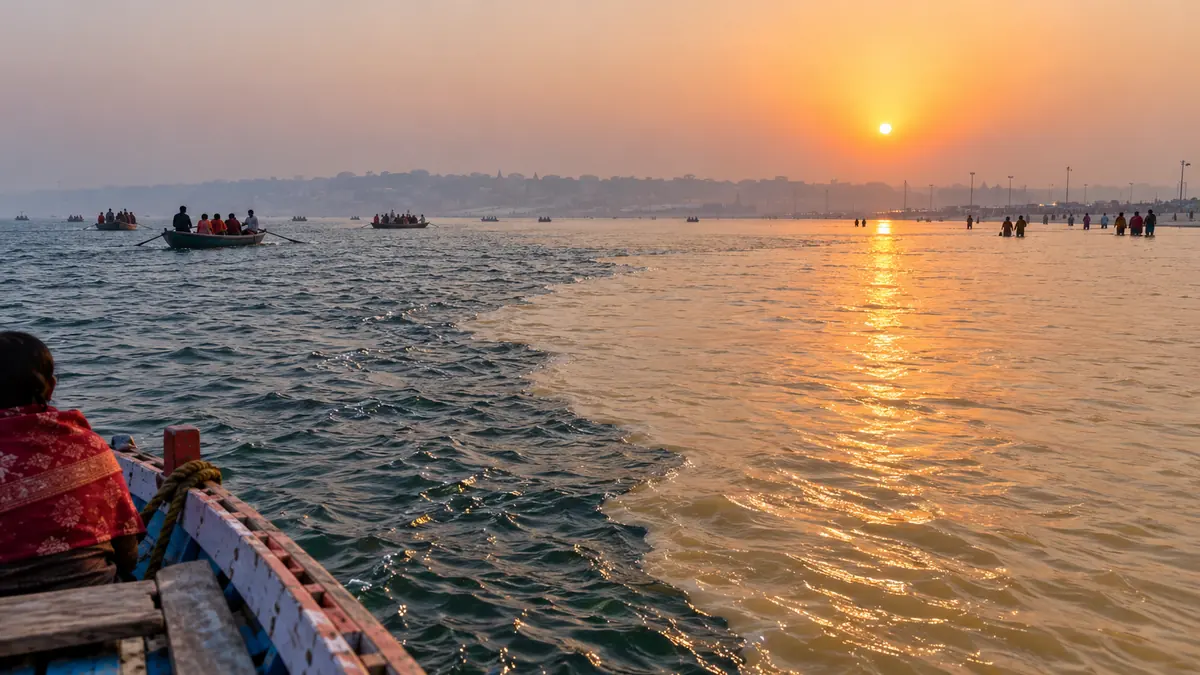
The physical phenomenon of the confluence presents a remarkable visual contrast that is clearly discernible from passing boats. The Ganga flows with rapid current, carrying light silt and pale brownish-ochre waters originating from high Himalayan glaciers. In contrast, the deeper Yamuna moves with a gentler pace, displaying distinctive greenish-blue waters born in the Yamunotri heights.
The third river, the mythical Saraswati, is held to flow underground before surfacing invisibly at this exact junction. Rigvedic hymns describe the Saraswati as the goddess of wisdom, learning, and eloquence. The union of the three waterways symbolizes the synthesis of action (Karma), devotion (Bhakti), and knowledge (Jnana).
Where the waters merge midstream, a distinct rippling boundary line remains visible throughout the year. Taking a bath directly along this line is believed to purify ancestral sins and grant spiritual liberation from rebirth.
Sacred Rituals: Holy Dip, Pinda Daan, and Veni Daan
Pilgrims visit the Sangam to perform ancient personal and family rituals guided by traditional local priests known as Prayagwal pandas. The central ritual is the holy snan, wherein devotees submerge themselves completely three times while chanting Vedic mantras and facing the rising sun. Specially anchored wooden platforms with safety railings allow bathers to enter the water securely mid-river.
Families regularly conduct pinda daan and tarpan ceremonies on the dry sandbanks to offer food and prayers for the peace of departed ancestors. Another unique regional tradition is Veni Daan, a rite performed by married couples where the wife offers a small braid of her hair to the river goddess to pray for her husband’s long life and marital prosperity.
Devotees often conclude their prayers by releasing small earthen leaf boats filled with marigold flowers and burning ghee lamps onto the river. These rituals provide a reflective counterpart to the grand choral ceremonies witnessed during Ganga Aarti in Varanasi downriver.
Boat Ride Logistics: Routes, Authorized Fares, and Safety Protocols
Because the actual confluence point sits several hundred meters away from the dry riverbank, reaching the sacred bathing line requires taking a boat. Hundreds of traditional wooden rowboats operate from major boarding points, including Qila Ghat, Saraswati Ghat, and Nehru Ghat. Most vessels are operated by generations of local Nishad community boatmen.
The Prayagraj district administration establishes regulated fare benchmarks each season to protect visitors from arbitrary overcharging. Boatmen row passengers to the midstream wooden platforms, wait twenty to thirty minutes for bathers to complete their rituals, and return them safely to shore.
| Boat Type | Passenger Capacity | Typical Duration | Approximate Fare Range (INR) | Best For |
|---|---|---|---|---|
| Shared Rowboat | 10 to 15 passengers | 1 to 1.5 hours | ₹100 to ₹200 per seat | Solo travelers, budget pilgrims |
| Private Small Rowboat | 2 to 4 passengers | 1.5 hours | ₹800 to ₹1,500 total | Couples, small families |
| Private Large Rowboat | 6 to 10 passengers | 1.5 to 2 hours | ₹1,500 to ₹2,500 total | Joint family groups |
| Motorized Launch | 15 to 25 passengers | 1 hour | ₹2,500 to ₹4,000 total | Elderly groups seeking faster transit |
All passengers must wear life vests before departing from the ghat. Visitors should negotiate and fix the exact total waiting time and round-trip price firmly before stepping into any private boat. During winter mornings, thousands of Siberian migratory seagulls hover around boats, creating iconic photographic scenes as passengers feed them gram grains, much like sunrise river cruises detailed in our Assi Ghat Varanasi morning aarti and boat guide.
Nearby Sacred Monuments and Underground Fort Temples
A visit to Triveni Sangam is incomplete without touring the historic sacred complexes located immediately adjacent to the riverbanks. Just above the western bank rises the monumental Allahabad Fort, constructed in 1583 by Mughal emperor Akbar out of red sandstone blocks. While most of the fort remains under military administration, key underground religious monuments remain open to the public.
Within the fort ramparts lies the ancient Patalpuri Temple, a subterranean stone hall housing idols of diverse Hindu deities. Deep inside this subterranean sanctum stands the Akshaya Vat, the immortal banyan tree celebrated in the Ramayana as an indestructible celestial tree visited by Lord Rama during his forest exile.
At the foot of the fort walls sits the celebrated Bade Hanuman Mandir, also known as the Lete Hanuman Ji Temple. This unique shrine houses a massive nine-foot vermilion-coated stone idol of Lord Hanuman in a reclining posture. Every monsoon season, the rising floodwaters of the Ganges submerge the temple sanctum, an event locally hailed as the holy river touching the deity’s feet before receding.
Seasonal Festival Cycles: Magh Mela and Kumbh Mela
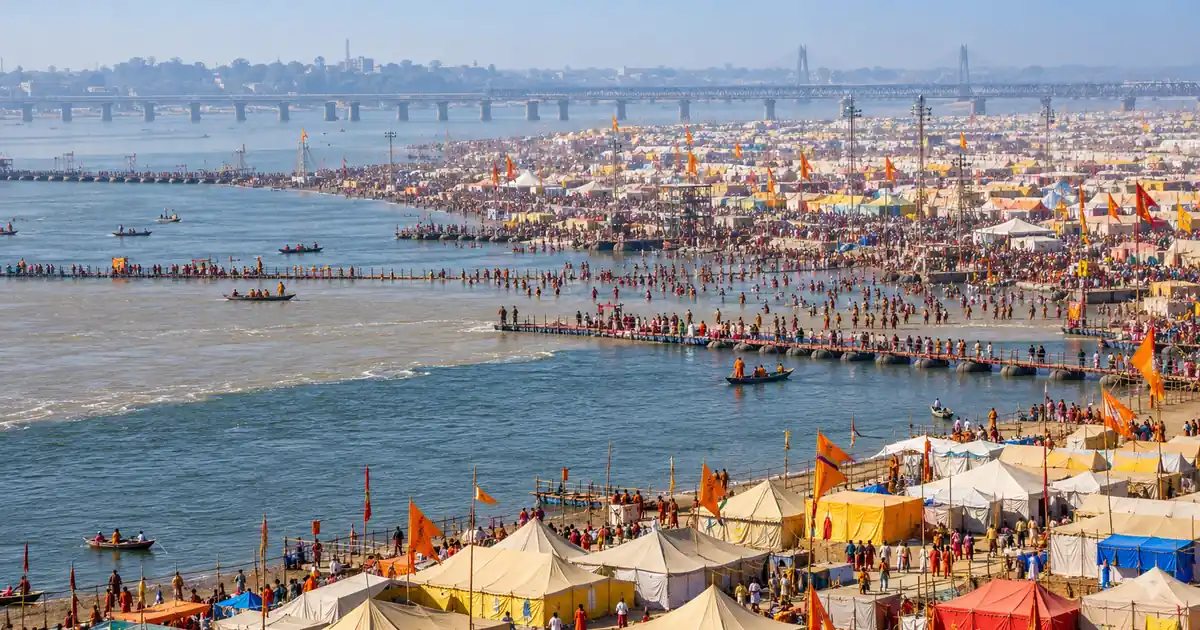
While Triveni Sangam welcomes pilgrims year-round, the religious atmosphere intensifies dramatically during the winter festival cycles. The peak pilgrimage window occurs from mid-January to late February during the annual Magh Mela. Thousands of ascetic devotees, known as Kalpvasis, establish tent colonies on the sandy riverbeds to observe a month of rigorous austerity, prayer, and dawn baths.
The greatest congregation on earth occurs during the cyclical Kumbh Mela, documented on the Official Uttar Pradesh Kumbh Mela Documentation. Millions of pilgrims gather on auspicious royal bathing dates to plunge into the holy waters. In contrast to the compact stone steps of the 84 Ghats of Varanasi, Prayagraj features temporary pontoon bridges, vast tent encampments, and wide sandy avenues.
How to Reach Triveni Sangam and Transit Connections
Prayagraj is a central transit crossroad in Uttar Pradesh, connected by broad railway networks, express highways, and regional air corridors. The city forms an easy cultural circuit when combined with nearby top attractions in Varanasi situated just 120 kilometers to the east.
Travelers can arrive via multiple direct routes before taking local battery e-rickshaws or auto-rickshaws directly down to the Sangam riverbed.
| Departure Point | Travel Mode | Road Distance | Approximate Travel Time |
|---|---|---|---|
| Prayagraj Junction (PRYJ) | Auto-rickshaw or Taxi | 8 kilometers | 20 to 25 minutes |
| Prayagraj Airport (IXD) | Airport Taxi | 17 kilometers | 40 to 45 minutes |
| Varanasi City Center | National Highway 19 | 120 kilometers | 2.5 to 3 hours |
| Ayodhya Ram Mandir | State Highway & Train | 165 kilometers | 3.5 to 4 hours |
| Lucknow Charbagh | Express Highway | 200 kilometers | 4 to 4.5 hours |
Eastern Uttar Pradesh Sacred Pilgrimage Circuits
Most pilgrims structure their spiritual journeys across eastern Uttar Pradesh by linking the holy confluence of Prayagraj with the sacred shrines of Kashi and Ayodhya. After completing their holy bath at Triveni Sangam, devotees typically travel east along National Highway 19 to pay homage at the golden spires of the Kashi Vishwanath Temple corridor.
This combined pilgrimage, traditionally known as the Triveni-Kashi Yatra, allows travelers to complete ancestral rituals at Sangam before offering holy river water to the Jyotirlinga in Varanasi. Winter months from October to March offer the most temperate climate for road travel across the Gangetic plains.
Frequently Asked Questions
Is there an admission fee to visit Triveni Sangam in Prayagraj?
Access to the riverbanks, ghats, and confluence areas of Triveni Sangam is free of charge for all visitors. Travelers only pay boatmen if they choose to hire a wooden boat to reach the midstream confluence bathing platforms.
How do you identify the three rivers at Triveni Sangam?
The confluence is distinguished by a visible color boundary where the pale brownish-ochre silt waters of the rapid Ganga merge with the deep greenish-blue flow of the Yamuna. The third river, the sacred Saraswati, is understood in Hindu tradition to flow invisibly underground into the union.
How much does a boat ride cost to reach the Sangam bathing point?
Shared wooden rowboats typically cost between ₹100 and ₹200 per passenger for a round trip to the confluence platforms. Private wooden rowboats range between ₹800 and ₹1,500 total, depending on passenger count and negotiation before departure.
Can tourists visit the Akshaya Vat tree inside Allahabad Fort?
Yes, pilgrims can visit the sacred Akshaya Vat banyan tree through designated pedestrian corridors managed by the authorities inside Allahabad Fort. The adjacent subterranean Patalpuri Temple is also accessible during regular daytime temple visiting hours.
What is the best time of year to take a holy dip at Triveni Sangam?
The ideal period to visit Triveni Sangam runs from October through March when pleasant winter temperatures make daytime river excursions comfortable. The sacred month of Magh between January and February offers the most spiritually charged festival atmosphere.
What is the annual winter gathering held at Triveni Sangam?
Every winter from January to February, the confluence hosts the 45-day Magh Mela Prayagraj celebration details, where thousands of Kalpwasis live in riverside tent encampments and observe sacred bathing vows.