Ghats of Varanasi: Complete List with Names, Types, Timings & Details
Explore the 84 Ghats of Varanasi along the sacred Ganges riverfront. Discover their types, historical significance, ritual timings, and boat ride details.
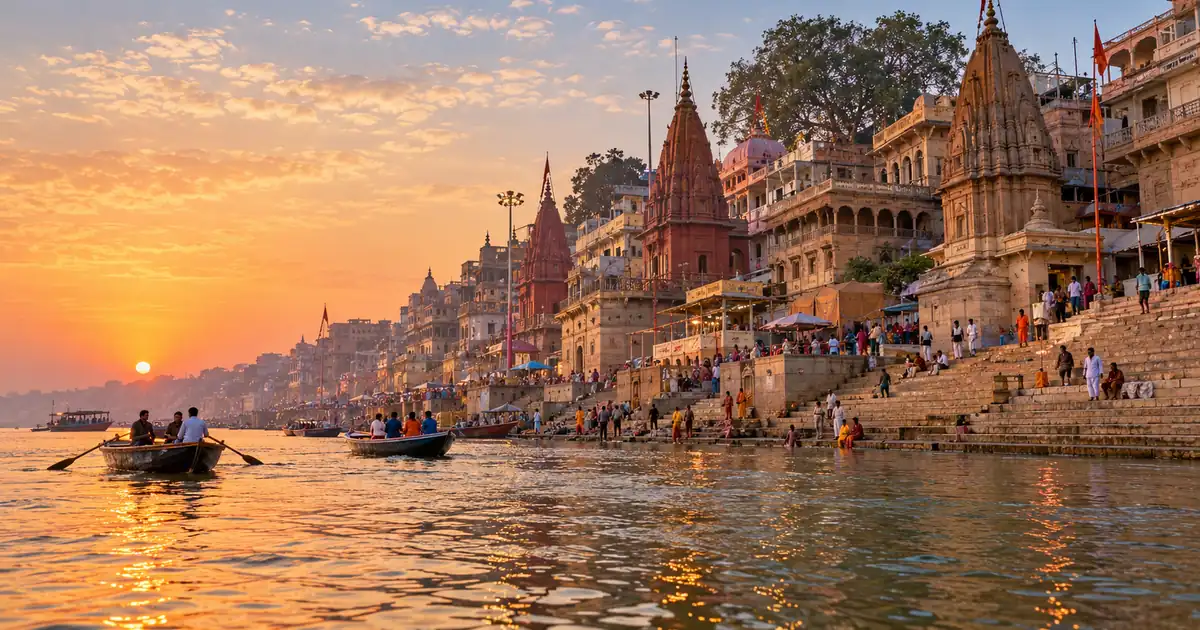
The riverfront of Varanasi forms a crescent-shaped expanse along the west bank of the Ganges. Stretching across nearly seven kilometers, 84 stone ghats connect the ancient sacred city with the river. Each landing carries distinct historical associations, architectural styles, and ritual traditions.
Pilgrims arrive at these stone steps throughout the day to perform ancestral rites, morning baths, and meditative prayers. The riverfront also functions as a living communal space where priests, scholars, boatmen, and travelers meet. Navigating these ghats reveals the spiritual heart of Kashi.
Key Riverfront Highlights
- Total Number of Ghats: 84 traditional stone ghats running south to north between the Assi and Varuna river confluences.
- Primary Ceremonial Hub: Dashashwamedh Ghat Varanasi temple overview, hosting the grand evening Ganga Aarti daily.
- Primary Cremation Grounds: Manikarnika Ghat and Harishchandra Ghat, operational day and night.
- Southern Anchor: Assi Ghat, home to sunrise Vedic recitations and Subah-e-Banaras cultural sessions.
- Corridor Gateway: Lalita Ghat, providing direct access to the transformed Kashi Vishwanath Temple corridor.
- Official Heritage Record: Documented in the UNESCO Riverfront Heritage Dossier and the Uttar Pradesh Tourism Ghats Directory.
Classification and Functional Types of Varanasi Ghats
The riverfront ghats divide into three functional categories based on their ritual and social usage. Most ghats serve as bathing landings where pilgrims perform ritual ablutions. Others function as sacred cremation sites or dynamic venues for performing arts.
Bathing ghats witness steady activity from dawn until midday. Devotees recite morning mantras, dip into the holy stream, and offer water to the rising sun. Many of these landings feature shrines dedicated to regional deities and riverside pavilions constructed by princely kingdoms.
Cremation ghats hold profound spiritual weight in Hindu philosophy. Followers believe dying or undergoing cremation along this stretch of the Ganges liberates the soul from the cycle of rebirth. These grounds maintain continuous funeral pyres supervised by traditional dom funeral caretakers.
Cultural ghats support music concerts, Sanskrit recitations, festival stages, and boat departures. They accommodate large public assemblies during seasonal celebrations and rank among the most rewarding planning a sightseeing trip to Varanasi.
| Ghat Category | Primary Purpose | Key Representative Ghats | Notable Features |
|---|---|---|---|
| Bathing Ghats (Snan) | Daily ablutions, sun worship, Vedic chanting | Assi, Kedar, Ahilyabai, Panchganga | Stone platforms, temple shrines, changing rooms |
| Cremation Ghats (Moksha) | Funeral rites, ash immersion, salvation | Manikarnika, Harishchandra | Perpetual sacred fires, wood yards, quiet observation |
| Ceremonial & Cultural | Public aarti, festivals, music programs | Dashashwamedh, Rajendra Prasad, Namo | Wide amphitheatres, boat docks, evening lighting |
Top 10 Prominent Ghats and Their Living Heritage
While all 84 landings possess individual stories, ten ghats stand out for their historical architecture, ritual prominence, and cultural role. Travelers exploring the riverfront usually center their walking tours around these landmark locations.
1. Dashashwamedh Ghat
Dashashwamedh Ghat remains the central nerve center of riverfront Varanasi. Mythological tradition relates that Lord Brahma performed ten simultaneous horse sacrifices here to welcome Lord Shiva back to Kashi. Maratha queen Ahilyabai Holkar rebuilt the stone embankment in 1774.
The landing features tiered stone terraces where thousands gather each dusk. Saffron-robed priests lift heavy multi-tiered brass oil lamps in synchronized devotion during dusk prayers. Hand-rowed wooden boats anchor closely along the riverbank to give spectators an unobstructed water view.
2. Assi Ghat
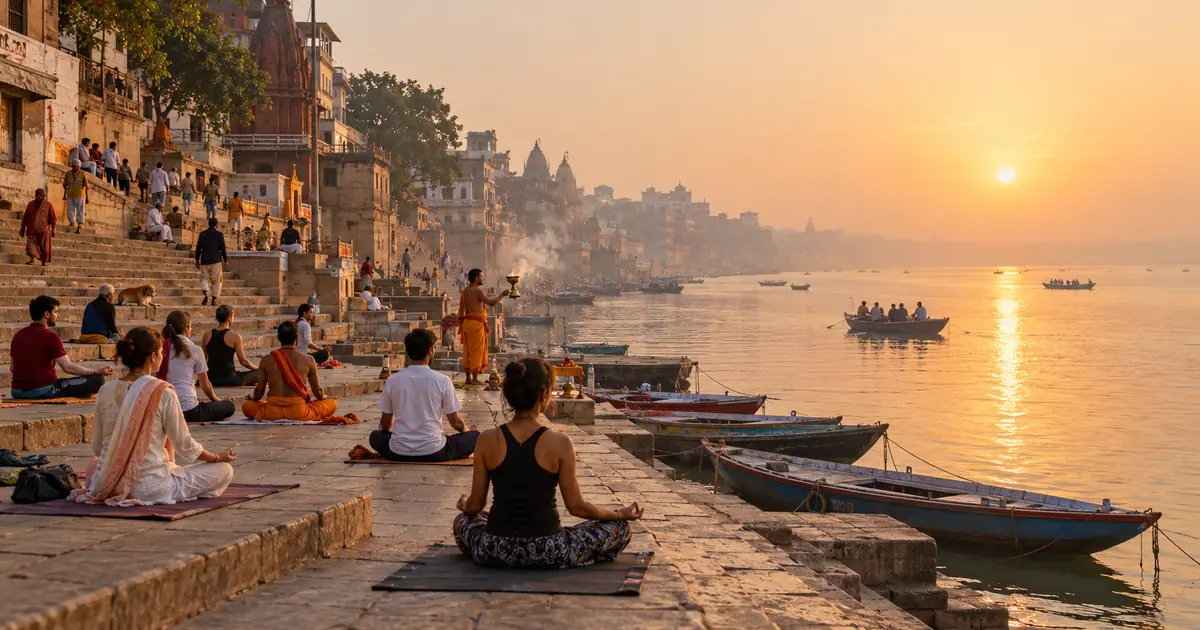
Assi Ghat anchors the southern end of the primary riverfront at the confluence of the Ganges and the seasonal Assi stream. Ancient texts link this site to Goddess Durga resting after slaying demons Shumbha and Nishumbha. Poet-saint Goswami Tulsidas also spent his final years writing near these steps.
Early mornings bring travelers together for Subah-e-Banaras, an initiative featuring classical vocal music, Vedic yajna, and sunrise yoga sessions. Many pilgrims begin their walking journeys northward along the riverbank from these stone steps.
3. Manikarnika Ghat
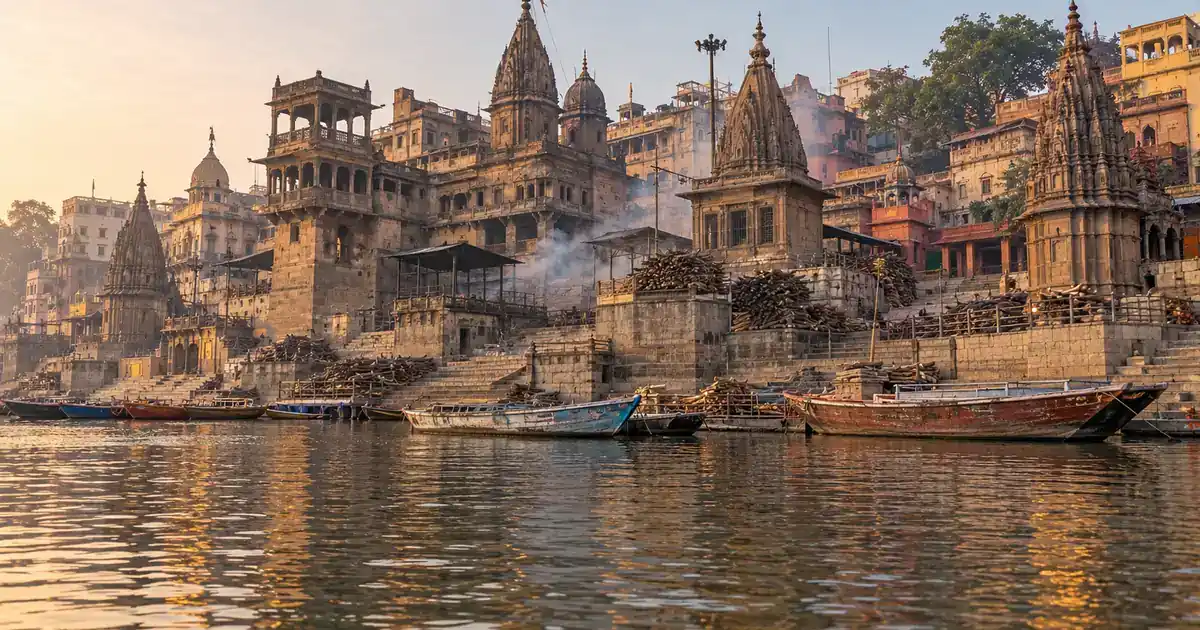
Manikarnika Ghat is the principal cremation ground of Kashi. According to legend, Lord Shiva’s earring slipped into a holy pool here while Lord Vishnu dug the sacred Manikarnika Kund. Hindu belief promises that Shiva whispers the taraka mantra into the ear of every departed soul here to grant moksha.
Dozens of funeral pyres burn along the tiered stone ramps round the clock. Piles of dried banyan, sal, and sandalwood line the upper alleys. Visitors are permitted to observe reverently from designated upper walkways, but camera usage is strictly prohibited.
4. Harishchandra Ghat
Harishchandra Ghat serves as the city’s second historic cremation riverfront. The landing takes its name from legendary King Harishchandra, who worked here as a cemetery assistant to test his steadfast devotion to truth. An electric crematorium operates alongside traditional open-air pyres to conserve timber and reduce river deposits.
5. Scindia Ghat
Constructed originally in 1830 by the Gwalior royal dynasty, Scindia Ghat is recognizable by its tilted Shiva temple. The weight of the massive stone masonry caused the shrine foundation to sink partially into the riverbed during construction. The submerged sanctum remains a striking visual landmark for passing boats.
6. Darbhanga Ghat and Brijrama Palace
Darbhanga Ghat displays imposing palace architecture built with Chunar sandstone by the royal house of Darbhanga in 1912. The fort-like structure features Greco-Roman balconies, carved bastions, and ornate pillared pavilions. The upper palace now operates as an upscale heritage hotel offering views across the river bend.
7. Chet Singh Ghat
Chet Singh Ghat resembles an impenetrable riverside fortress complete with high stone walls, round battlements, and arched water gates. In 1781, Maharaja Chet Singh staged a famous revolt against British governor-general Warren Hastings within these ramparts. The complex stands as a rare fortified monument on the sacred riverfront.
8. Panchganga Ghat
Panchganga Ghat marks the subterranean confluence of five sacred rivers: Ganga, Yamuna, Saraswati, Kirana, and Dhutapapa. Saint Ramananda initiated the medieval bhakti poet Kabir on these broad steps. Above the ghat rises the imposing 17th-century Alamgir Mosque built by Mughal emperor Aurangzeb over earlier foundations.
9. Kedar Ghat
Kedar Ghat draws numerous South Indian pilgrims who come to worship at the Kedareshwar Temple. Striped red-and-white stone steps lead upward to a shrine containing an ancient svayambhu (self-manifested) Shiva lingam. The adjacent Gauri Kund pool is revered for purifying skin ailments before morning prayers.
10. Namo Ghat (Khidkiya Ghat)
Namo Ghat represents the modern northern gateway of Varanasi’s riverfront, linking toward the Kashi Vishwanath Temple corridor across river transit. Developed under city modernizing initiatives, it features three monumental bronze folded-hand sculptures welcoming pilgrims. The site includes floating CNG fueling docks, accessible ramps, helicopter landing pads, and battery vehicle tracks.
Complete Sequential List of the 84 Ghats of Varanasi
Below is the verified south-to-north order of all 84 traditional ghats lining the Ganges in Varanasi, verified against records published by the District Administration Varanasi Ghat Overview.
| Number | Ghat Name | Historical Builder or Significance |
|---|---|---|
| 1 | Assi Ghat | Southern confluence landmark; Subah-e-Banaras |
| 2 | Ganga Mahal Ghat (I) | Palace built by Maharaja of Banaras in 1865 |
| 3 | Rewa Ghat | Built by Raja of Rewa; fortified residential palace |
| 4 | Tulsi Ghat | Associated with saint Tulsidas and Krishna Lila |
| 5 | Bhadaini Ghat | Waterworks facility; sun temple shrine |
| 6 | Janaki Ghat | Restored by Maharani of Sursand in Bihar |
| 7 | Anandamayi Ghat | Ashram founded by spiritual teacher Ma Anandamayi |
| 8 | Vacchraja Ghat | Sacred to Jain merchants; Jain shrine complex |
| 9 | Jain Ghat | Birthplace shrine honoring Tirthankara Suparshvanatha |
| 10 | Nishadraj Ghat | Dedicated to boatmen community and King Nishad |
| 11 | Panchkota Ghat | Built by King of Panchkot in West Bengal |
| 12 | Prabhu Ghat | Constructed by local Nirmal community elders |
| 13 | Chet Singh Ghat | 18th-century fort; site of battle against Warren Hastings |
| 14 | Niranjani Ghat | Historical monastery seat of the Niranjani Akhara |
| 15 | Mahanirvani Ghat | Headquarters of Naga sadhu Mahanirvani Akhara |
| 16 | Shivala Ghat | Massive palace landing renovated by King Kalyan Singh |
| 17 | Gularia Ghat | Named after ancient sacred wild fig tree |
| 18 | Dandi Ghat | Designated bathing landing for staff-bearing Dandi ascetics |
| 19 | Hanuman Ghat | Established by Goswami Tulsidas; Hanuman temple |
| 20 | Prachina Karnataka Ghat | Ancient residential landing constructed by Mysore kingdom |
| 21 | Karnataka State Ghat | Modern rest house managed by Karnataka government |
| 22 | Harishchandra Ghat | Historic cremation ground; legendary King Harishchandra |
| 23 | Lali Ghat | Built by Raja of Benares in early 18th century |
| 24 | Vijayanagaram Ghat | Restored by Maharaja of Vijayanagaram in Andhra Pradesh |
| 25 | Kedar Ghat | Red-white steps; Kedareshwar Temple |
| 26 | Chauki Ghat | Dedicated to Rukmini shrine; ancient pipal tree platform |
| 27 | Kshemeshwar Ghat | Associated with sage Kshemaka; purification steps |
| 28 | Mansarovar Ghat | Built by Raja Man Singh of Amber; holy water tank |
| 29 | Narad Ghat | Named after sage Narada; peaceful bathing ramp |
| 30 | Raja Ghat | Constructed by Maratha general Gajanan Pandit |
| 31 | Khori Ghat | Also known as Ganga Mahalakshmi Ghat |
| 32 | Babua Pandey Ghat | Named after wrestler and scholar Babua Pandey |
| 33 | Sarveshwar Ghat | Dedicated to Lord Sarveshwar Shiva |
| 34 | Digpatia Ghat | Palatial gateway built by King of Digpatia |
| 35 | Chausatthi Ghat | Dedicated to 64 Yogini temple complex |
| 36 | Rana Mahal Ghat | Palace built by Rana Jagat Singh of Udaipur in 1670 |
| 37 | Darbhanga Ghat | Grand sandstone palace built by royal house of Darbhanga |
| 38 | Munshi Ghat | Named after Sridhara Narayana Munshi of Nagpur |
| 39 | Ahilyabai Ghat | Rebuilt by Indore Queen Ahilyabai Holkar in 1778 |
| 40 | Sitala Ghat (I) | Small landing dedicated to smallpox goddess Sitala |
| 41 | Dashashwamedh Ghat | Central ceremonial hub; ten horse sacrifice site |
| 42 | Prayag Ghat | Replicating the sanctity of the Prayagraj confluence |
| 43 | Rajendra Prasad Ghat | Renamed in honor of India’s first President |
| 44 | Man Mandir Ghat | Palace and stone observatory built by Raja Man Singh |
| 45 | Tripura Bhairavi Ghat | Dedicated to Goddess Tripura Bhairavi |
| 46 | Mir Ghat | Named after Mir Rustam Ali, governor of Banaras |
| 47 | Phuta Ghat | Historical broken stone landing renovated by pilgrims |
| 48 | Nepali Ghat | Distinct Nepali wooden pagoda temple dedicated to Shiva |
| 49 | Lalita Ghat | Gateway to Kashi Vishwanath corridor; wooden carving |
| 50 | Bauli Ghat | Features natural freshwater spring well near the bank |
| 51 | Jalasen Ghat | Historic resting ramp for bodies awaiting cremation rites |
| 52 | Manikarnika Ghat | Prime cremation ground; Manikarnika Kund |
| 53 | Bajirao Ghat | Constructed by Maratha Peshwa Bajirao I in 1735 |
| 54 | Scindia Ghat | Submerged Shiva temple; Gwalior royal lineage |
| 55 | Sankatha Ghat | Dedicated to Sankatha Devi; labyrinthine alleys |
| 56 | Ganga Mahal Ghat (II) | Second palace riverfront built by Maratha courtiers |
| 57 | Bhonsale Ghat | Built by Bhonsale rulers of Nagpur in late 18th century |
| 58 | Naya Ghat | Restored modern landing for cargo boats |
| 59 | Genesh Ghat | Dedicated to Vinayaka elephant-headed guardian |
| 60 | Mehta Ghat | Built by Parsi philanthropists from Bombay |
| 61 | Rama Ghat | Associated with Rama temple and solar offerings |
| 62 | Jatara Ghat | Renovated by Madhavrao Peshwa of Pune |
| 63 | Raja Gwalior Ghat | Royal stone pavilion funded by Gwalior kingdom |
| 64 | Mangala Gauri Ghat | Shrine dedicated to Goddess Mangala Gauri |
| 65 | Venimadhava Ghat | Site of original Bindu Madhava Vishnu temple |
| 66 | Panchganga Ghat | Five-river subterranean confluence; Alamgir Mosque |
| 67 | Durga Ghat | Built by Peshwa Narayana Rao; dedicated to Durga |
| 68 | Brahma Ghat | Landing dedicated to Lord Brahma’s meditation seat |
| 69 | Bundi Parakota Ghat | Stone bastions built by Raja Rao Surjan of Bundi |
| 70 | Sitala Ghat (II) | Northern shrine dedicated to healing mother deity |
| 71 | Lal Ghat | Commissioned by Raja of Balwant Singh family |
| 72 | Hanumanagardhi Ghat | Historic fortress shrine honoring Lord Hanuman |
| 73 | Gaya Ghat | Dedicated to ancestral pinda pradaan rites |
| 74 | Badri Nayarana Ghat | Pilgrimage station replicating Badrinath shrine |
| 75 | Trilochan Ghat | Three-eyed Shiva temple; highly sacred bathing spot |
| 76 | Gola Ghat | Grain merchant riverfront; historic ferry landing |
| 77 | Nandeshwar Ghat | Built by Bhonsale noblemen; Nandi bull shrine |
| 78 | Sakka Ghat | Traditional water-bearer community landing |
| 79 | Telianala Ghat | Historic oil-presser community river steps |
| 80 | Naya Rajghat | Stone steps linking historic Rajghat plateau |
| 81 | Prahlad Ghat | Named after saintly child Prahlad; Narasimha temple |
| 82 | Raj Ghat | Ancient ferry point; excavation site of earliest Kashi |
| 83 | Sant Ravidas Ghat | Large southern park honoring saint Ravidas |
| 84 | Adi Keshava Ghat | Confluence of Ganga and Varuna; earliest Vishnu temple |
Daily Ritual Cycles: Subah-e-Banaras to Evening Ganga Aarti
Life along the ghats follows the natural rhythm of the sun. The first ritual activities begin around 4:30 AM during Brahma Muhurta. Monks, sadhus, and local swimmers gather to chant Sanskrit verses and perform morning surya namaskar as the eastern horizon softens.
Between 6:00 AM and 10:00 AM, family priests set up wooden low-legged platforms along Dashashwamedh, Kedar, and Assi ghats. Pilgrims sit before them to perform ancestral offerings, tonsure rites for newborns, and Vedic fire havans. The river air stays filled with the scent of burning dhoop and crushed marigold garlands.
| Time of Day | Ritual Activity | Location & Focus |
|---|---|---|
| 04:30 AM | Morning Brahma Muhurta prayers | River baths and silent meditation |
| 05:30 AM | Subah-e-Banaras program | Vedic chanting and classical music at Assi Ghat |
| 07:00 AM | Ancestral pinda daan | Family rites on raised wooden platforms |
| 12:00 PM | Midday rest and temple closure | Riverbank quiet and boat maintenance |
| 05:30 PM | Twilight assembly | Boats gather facing central platforms |
| 06:30 PM | Evening prayer worship | Multi-tiered brass lamp ritual at Dashashwamedh |
| 08:30 PM | Night quiet | Floating earthen oil lamps along river currents |
Twilight transforms the riverbank as hundreds of oil lamps flicker to life. The seven-priest Ganga Aarti ceremony at Dashashwamedh Ghat lasts approximately 45 minutes. Spectators watch incense burners billowing fragrant smoke while conch shells sound across the water.
Boat Ride Logistics: Routes, Rates, and Safety Protocols
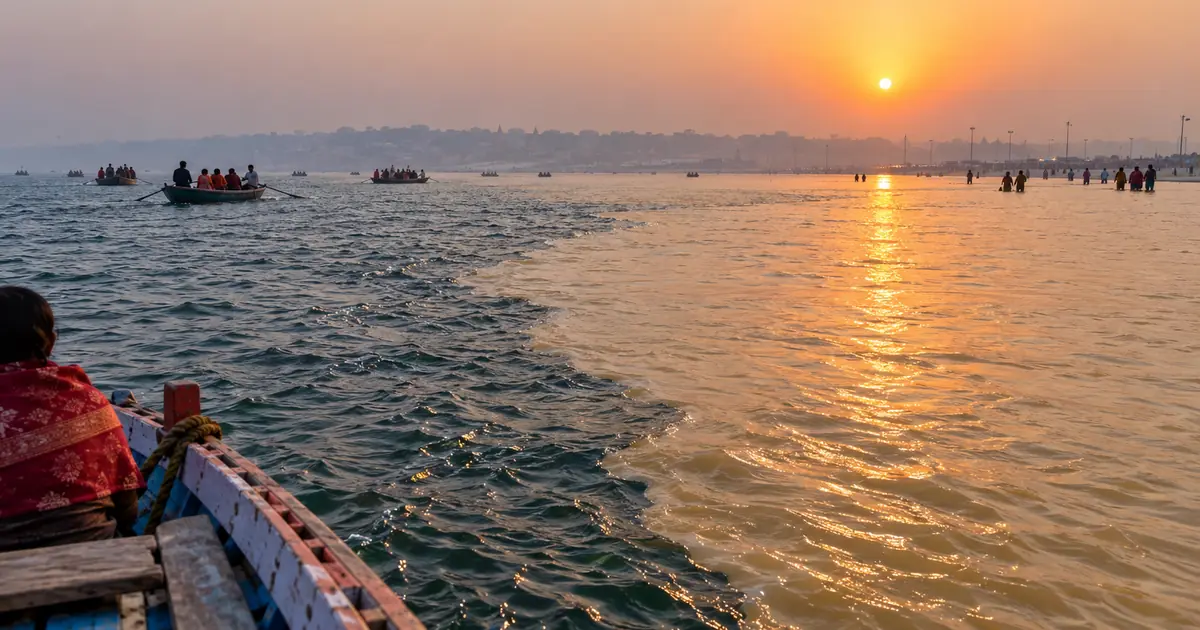
Taking a boat ride provides an uninterrupted view of the ghat architecture. Wooden rowboats and mechanized motor launches depart from Assi, Dashashwamedh, and Raj Ghat throughout the day. Sunrise and sunset excursions remain the most popular choices for experiencing Assi Ghat morning rituals from the water.
A typical two-hour circuit starts at Assi Ghat in the south and sails past Manikarnika to Panchganga before returning. Dawn cruises allow passengers to view morning bathers and temple spires illuminated by early light. Evening rides position boats opposite Dashashwamedh Ghat to view the aarti ceremony from the river.
| Boat Type | Capacity | Typical Duration | Approximate Cost | Ideal For |
|---|---|---|---|---|
| Manual Rowboat | 2 to 6 passengers | 1.5 to 2 hours | ₹500 to ₹1,000 | Quiet exploration, photography |
| Motorboat (Private) | 8 to 15 passengers | 1.5 to 2 hours | ₹1,500 to ₹3,000 | Families, faster river traversal |
| Shared Motor Launch | 30 to 50 passengers | 1 hour | ₹100 to ₹200 per seat | Budget travelers |
| Alaknanda Luxury Cruise | 60 passengers | 2 hours | ₹800 to ₹1,200 per seat | Air-conditioned comfort, onboard narration |
Always confirm the total fare and duration before boarding any private wooden boat. Life jackets are mandatory under Varanasi water police regulations, especially during monsoon currents. Avoid stepping onto small rowboats without verified flotation vests.
Visitor Etiquette and Cremation Ghat Protocols
The ghats of Varanasi are active places of devotion, bereavement, and community living. Observing modest behavior ensures an enriching experience while honoring local religious sentiments during Manikarnika Ghat cremation ceremonies.
Keep cameras pointed away from funeral pyres at Manikarnika and Harishchandra Ghats. Photographing mourning families is strictly prohibited and deeply offensive. If you wish to observe the burning rituals, stand quietly along upper stone terraces without interrupting the caretakers.
Dress modestly with shoulders and knees covered when walking along the steps. Remove footwear before stepping onto raised ceremonial wooden platforms or entering riverside shrines. Beware of touts claiming to collect timber donations for destitute families; genuine charity is managed directly by temple trusts.
Keep personal belongings secure in crowded alleys connecting Dashashwamedh and Vishwanath lanes. Foot traffic can become dense during evening aarti and festival days. Walk along the river steps slowly, as moss deposits near the water line can make stone flags slippery.
Best Time to Visit and Weather Considerations
The best months to explore the ghats run from October through March. Winter temperatures remain pleasant, ranging between 10°C and 25°C, making long walks along stone steps comfortable. Fog often blankets the river in December and January, creating atmospheric morning scenes.
The festive highlight occurs during Dev Deepawali in Varanasi on Kartik Purnima in November. Millions of earthen oil lamps line all 84 ghats from Assi to Adi Keshava, creating a continuous ribbon of golden light. River traffic during this night requires advance boat reservations months ahead.
Monsoon season from July to September brings swollen river levels. Water often submerges lower terraces and enters riverside temples, halting small rowboat operations. Summer months from April to June bring daytime heat exceeding 42°C, requiring visits to be restricted to early mornings and late evenings.
Frequently Asked Questions
How many ghats are there in Varanasi?
Varanasi has 84 traditional continuous stone ghats running along the western bank of the Ganges between the Assi and Varuna confluences. Recent waterfront developments have added modern landings such as Namo Ghat and Sant Ravidas Ghat.
Can tourists take photos at Manikarnika and Harishchandra Ghats?
Photography and video recording of funeral pyres and mourning families are strictly prohibited at both cremation ghats out of respect for bereavement rituals. Visitors may observe the ceremonies quietly from upper stone terraces without holding cameras or mobile phones.
How long does a typical sunrise boat ride take in Varanasi?
A standard sunrise boat ride covers the riverfront between Assi Ghat and Manikarnika Ghat in approximately 90 to 120 minutes. Starting at 5:30 AM allows passengers to view morning prayer rituals and sunrise over the eastern bank.
What time does the evening Ganga Aarti start at Dashashwamedh Ghat?
The evening Ganga Aarti begins around 6:30 PM during winter months and 7:00 PM during summer months immediately after sunset. Arriving by 5:30 PM is advisable to secure a front-row seat on stone steps or an anchored wooden boat.
Can you walk along all 84 ghats continuously?
You can walk continuously along the stone steps between Assi Ghat in the south and Raj Ghat in the north during winter and summer seasons. During peak monsoon months between July and September, high water levels submerge connecting stone ramps, requiring detours through parallel alleyways.
What major festivals transform the ghats besides Dev Deepawali?
The riverfront experiences massive spiritual gatherings during Chhath Puja in Bihar and UP, when thousands of fasting devotees stand waist-deep in the holy Ganges to offer sacred Arghya to the setting and rising sun, as well as during Maha Shivratri and Kartik Purnima.